

States Are Rushing to Respond As Congress’ SNAP Cost Shift Approaches. Are They Ready?
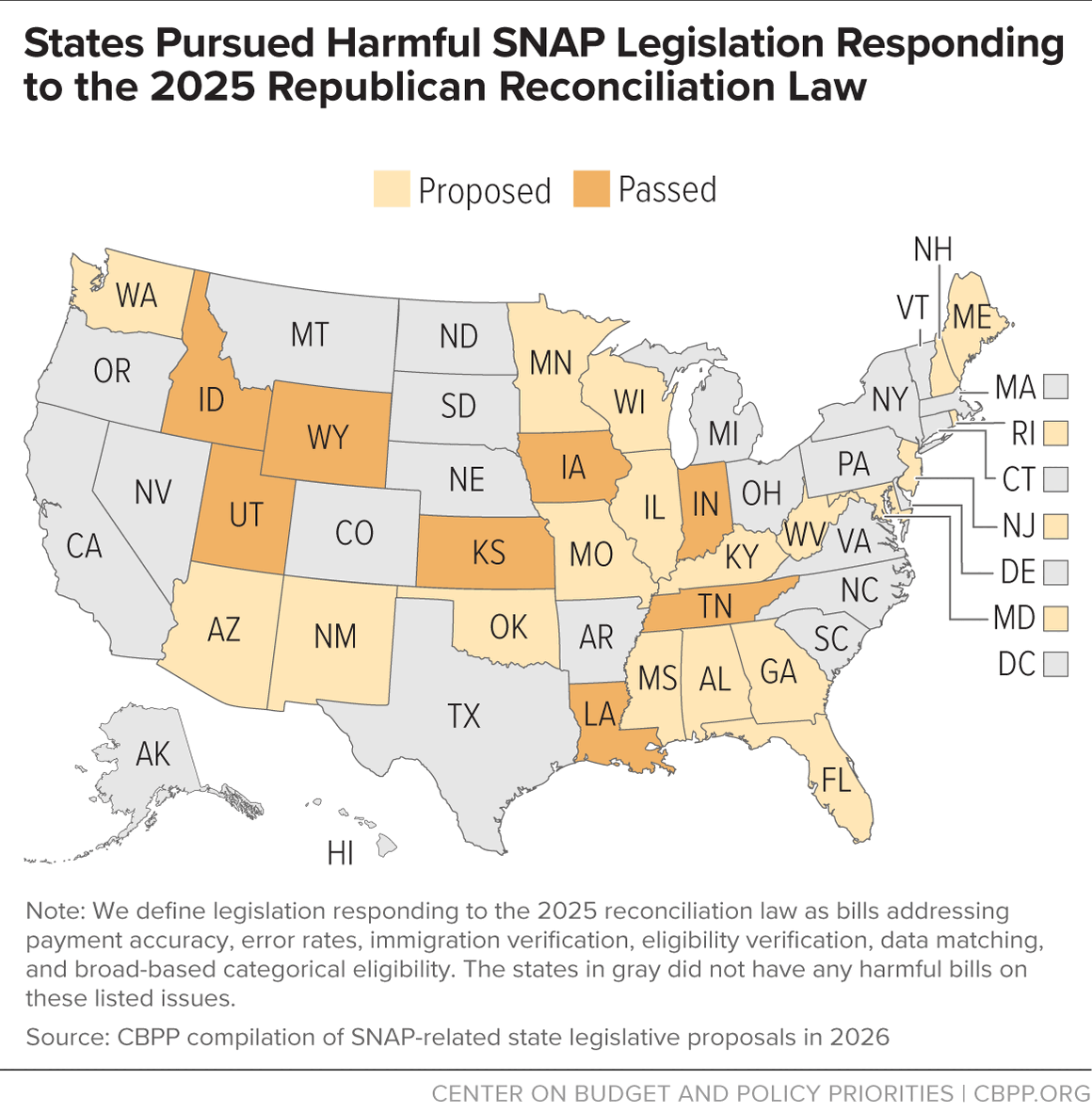
The harmful 2025 Republican reconciliation law will require most states starting in October 2027 to pay a portion of SNAP benefit costs for the first time in the program’s history. States’ payment obligations will be based on their “payment error rate,” a measure of states’ overpayments and underpayments of SNAP benefits from earlier years. Faced with the threat of hundreds of millions — or even billions[1] — of dollars in new annual costs, states are scrambling to reduce their error rates. In 2026, lawmakers introduced roughly 100 bills across 35 states to respond to the reconciliation law’s SNAP changes and cuts, including this massive “cost shift” (see Figure 1). If Congress fails to delay this cost shift to state budgets, states unable or unwilling to pay the costs will be forced to end SNAP entirely.
More than 5 million people nationwide have already had their SNAP benefits taken away, including likely about 2 million children, in the wake of the unprecedented SNAP cuts in last year’s Republican law.[2] Behind these numbers are families skipping meals and choosing between buying groceries and paying for other essentials like rent.
While the impact differs by state, these losses reflect, at least in part, states’ responses to the significant new fiscal pressures the reconciliation law has created. Many of the bills state policymakers pursued in legislative sessions earlier this year proposed policies that could make it harder for eligible low-income families to receive food assistance, often without evidence that these changes would reduce payment errors. In many cases, these legislative proposals require state agencies to implement a specific policy that the agency may have already implemented or had very good reasons not to implement. These approaches could both increase access barriers for families eligible for SNAP and in some cases increase the very errors states are trying to eliminate to avoid a crushing state budget crisis.
Burdensome Citizenship Verification Jeopardizes SNAP for U.S. Citizens
Lawmakers introduced and advanced bills in nine states that would subject all U.S. citizen SNAP applicants to new and burdensome red tape to document their citizenship status. These bills would require applicants to provide paper documentation of citizenship and/or have their citizenship status verified by the Department of Homeland Security’s Systematic Alien Verification for Entitlements (SAVE) system. While SNAP has longstanding harsh immigration-related eligibility restrictions, and those with a qualifying immigration status already must have their status verified through the SAVE system, these state bills often falsely claimed to be creating a new verification requirement for immigrants. Several of these bills passed, including in Tennessee, Wyoming, Idaho, Indiana, Louisiana, Utah, and Iowa.[3]
These laws risk eligible citizens losing benefits because electronic data matching has longstanding limitations that result in some people unable to have their citizenship substantiated, and many citizens do not have documents such as passports and certificates of citizenship. People who experience challenges in having their status documented electronically include people who have changed their names (including due to marriage), people born abroad but have U.S. citizen parents (like the people whose parents were in the military or the foreign service), and newborn babies that do not yet have Social Security numbers or birth certificates.
Forcing Families to Re-Prove SNAP Eligibility More Frequently Adds Administrative Burdens
In eight states, lawmakers proposed requiring SNAP households to recertify their eligibility more frequently. This increases the administrative workload for both families and agencies and risks eligible households losing benefits if they can’t complete the recertification process before their certification period expires or if an understaffed state agency falls behind on processing. Wyoming and Idaho were the only states to require truncated certification periods through state legislation.[4] Other states, including Illinois and Georgia, shortened certification periods for most households administratively.
Idaho’s law will force people who struggle to afford basic expenses, including adults subject to SNAP’s harsh time limit and families with circumstances the state considers “unstable” (without specifying further), to reapply at least every six months. It also gives the state agency broad discretion to require families to reapply every one or two months if it determines — based on no standard — that they will become ineligible “in the near future.” These additional reviews would create unnecessary administrative burdens and increase the risk that eligible families lose food assistance.
Wyoming’s law goes even further, requiring most households without an older adult or person with a disability to reapply every six months, as well as requiring adults subject to SNAP’s harsh time limit and families with circumstances the state considers “unstable” (again, leaving to the agency to define) to reapply every four months. On top of that, similar to Idaho’s law, families the state determines — again, based on no clear standard — will become ineligible “in the near future” could face reviews every one to two months. This means families may have to repeatedly complete forms, report income and household changes, gather pay stubs or other documents, complete an interview, and respond to follow-up requests — sometimes almost as soon as the previous review ends.
For someone juggling an unpredictable work schedule, unreliable or limited transportation, caregiving responsibilities, or limited internet access, each additional review creates another opportunity to miss a notice or deadline and another opportunity for overburdened caseworkers to mishandle the renewal or fail to complete it on time. This will only create more work for state agencies and increase the risk that eligible families lose food assistance because of paperwork barriers or processing backlogs, not because their circumstances have changed.
Restricting Self-Attestation Makes It Harder for Eligible Households to Apply for SNAP
A half dozen states proposed restricting or eliminating the use of self-attestation for certain eligibility factors, such as reporting earning no income, household composition, or being unhoused. While SNAP rules require verification of certain information such as an applicant’s identity, Social Security number, and income, these states have adopted policies that require additional documentation even in cases where federal SNAP rules allow self-attestation for information that is not questionable and where alternative documentation may be difficult or impractical to obtain. For example, a one-person household may have to get a neighbor to sign a document attesting that they live alone or find a document that proves that they don’t have a job.
This provision was enacted in Kansas and Indiana.[5] In Kansas, these additional paperwork requirements are already contributing to backlogs and delays in families receiving SNAP benefits. According to state officials, they did not receive the additional administrative funding needed to manage the increased workload.[6]
Some States Chose to Take SNAP Away From People With Modest Assets
For fiscal year 2027, SNAP restricts eligibility for households without an elderly or disabled individual to those with savings or assets below $3,000, and to $4,750 for households that include seniors or people with disabilities.
More than 40 states have opted to raise this limit so that families, seniors, and people with disabilities can have modest savings without losing needed SNAP benefits. In states that remove this “asset test,” fewer households are improperly denied or approved due to asset miscalculation. But Indiana and Idaho lowered their asset limit to the federal minimum in this year’s legislative session.
Duplicative Data Checks Further Complicate Eligibility Process
States already conduct extensive data matches to verify SNAP eligibility. Yet, in more than a dozen states, lawmakers proposed legislation that would require state agencies to make additional, and sometimes overlapping, data checks on the same information (such as monthly income).
More data matches do not necessarily provide more accurate information: databases may be outdated, cover different time periods, or provide incomplete information. If the data conflict, state workers must resolve these conflicts and spend additional time contacting families, requesting additional documents, and manually reconciling records — diverting limited staff resources from processing applications and increasing the risk of delays or payment errors. Adding more data checks can also increase procedural denials that occur when clients’ benefits are terminated for not responding to a notice, even though they continue to be eligible. Laws that passed in Wyoming, Idaho, Kansas, and Indiana mandate a laundry list of these repetitive or overlapping matches.[7]
These approaches will likely increase paperwork, administrative mistakes, and in some cases, payment error rates — raising the cost states will be responsible to pay under the reconciliation law’s cost shift.
Families will suffer as a result, especially working parents already navigating jobs and children, if they can’t overcome these additional barriers. That could cause them to lose critical help they need to buy groceries, despite being eligible for SNAP.
Instead of these burdensome approaches, some states, such as Hawaiʻi, have reduced administrative burdens without sacrificing accuracy by extending certification periods, particularly for seniors whose information changes less frequently.[8]
The flurry of state legislative action around SNAP payment errors shows that states are taking the new financial risks created by last year’s reconciliation law seriously. But their rushed response under intense time pressure means higher barriers to access that are contributing to millions of people already losing access to SNAP, even before the cost shift takes effect.[9] In next year's state legislative sessions, we anticipate continued misguided proposals to lower error rates that could result in additional barriers to access for families.
To help states address error rates without rushing to implement harmful policies, Congress should extend the delay to all states, not just the small handful of states with the highest error rates. That would give state agencies and legislatures more time to understand the factors impacting payment accuracy and assess how best to lower errors without unduly restricting access for families eligible for SNAP. States also need time to regroup and respond to the steep declines in SNAP participation and take affirmative steps to help eligible families re-enroll in SNAP.
End Notes
[1] Katie Bergh and Joseph Llobrera, “States’ First-Ever Bill for SNAP Benefits Could Cost Billions,” CBPP, June 24, 2026, https://www.cbpp.org/blog/states-first-ever-bill-for-snap-benefits-could-cost-billions.
[2] Dottie Rosenbaum et al., “SNAP Tracker: People Are Losing Food Assistance as the Harmful 2025 Republican Reconciliation Law Is Implemented,” CBPP, September 24, 2026, https://www.cbpp.org/research/food-assistance/snap-tracker-people-are-losing-food-assistance-as-the-republican-megabill.
[3] Tennessee SB 1915, May 2026, https://wapp.capitol.tn.gov/apps/BillInfo/Default?BillNumber=SB1915&ga=114; Wyoming SF 0106, Welfare Fraud Prevention Act Amendments, March 2026, https://www.wyoleg.gov/Legislation/2026/SF0106; Idaho HB 0730, 2026, https://legislature.idaho.gov/wp-content/uploads/sessioninfo/2026/legislation/H0730.pdf; Indiana SB 1, March 2026, https://iga.in.gov/legislative/2026/bills/senate/1/details; Louisiana HB 0335, 2026, https://www.legis.la.gov/legis/ViewDocument.aspx?d=1481232; Utah HB 0471, Social Services Amendments, March 2026, https://legiscan.com/UT/text/HB0471/id/3388142; Iowa SB 2422, June 2026, https://legiscan.com/IA/text/SF2422/2025.
[4] Wyoming SF 0106, Welfare Fraud Prevention Act Amendments, March 2026, https://www.wyoleg.gov/Legislation/2026/SF0106; Idaho HB 0730, 2026, https://legislature.idaho.gov/wp-content/uploads/sessioninfo/2026/legislation/H0730.pdf.
[5] Kansas HB 2731, https://www.kslegislature.gov/b2025_26/bills/download/?apn=b2025_26/year2/ready_for_publication/hb_2731/hb2731_enrolled.pdf; Indiana SB 1, https://iga.in.gov/legislative/2026/bills/senate/1/details.
[6] Sophia Gernander, “Wichitans face long waits, delays for SNAP benefits,” KWCH, September 2, 2026, https://www.kwch.com/2026/09/03/wichitans-face-long-waits-delays-snap-benefits/.
[7] Wyoming SF 0106, Welfare Fraud Prevention Act Amendments, March 2026, https://www.wyoleg.gov/Legislation/2026/SF0106; Idaho HB 0730, 2026, https://legislature.idaho.gov/wp-content/uploads/sessioninfo/2026/legislation/H0730.pdf; Kansas HB 2731, https://www.kslegislature.gov/b2025_26/bills/download/?apn=b2025_26/year2/ready_for_publication/hb_2731/hb2731_enrolled.pdf; Indiana SB 1, March 2026, https://iga.in.gov/legislative/2026/bills/senate/1/details.
[8] Hawai’i SB 3245, Relating to the Supplemental Nutrition Assistance Program, July 2026, https://www.capitol.hawaii.gov/session/measure_indiv.aspx?billtype=SB&billnumber=3245&year=2026.
[9] Rosenbaum et al., op. cit.