

New Data Underscore SNAP Cost Shift’s Harm to Low-Income Families and State Budgets
The harmful Republican reconciliation law enacted last July made unprecedented cuts to food assistance through SNAP, including a provision slashing federal funding for SNAP benefits and imposing these costs on state budgets. As states scramble to reduce their exposure to this cost shift and implement the law’s other cuts, SNAP participation has already fallen by more than 4.5 million people, with likely more than 1.5 million children losing access based on available data from 19 states.[1] In other words, SNAP-eligible people are losing out despite not being directly targeted by the new law. Compounding this dire outlook are new data from the U.S. Department of Agriculture (USDA), which indicate that as many as 35 states and one U.S. territory will be required to pay substantial new costs to continue participating in SNAP in fall 2027, with the remaining states at risk of facing this cost shift in future years. Congress should act now to grant all states the same two-year delay that some states received under the reconciliation law.
The stakes for state budgets and low-income families are incredibly high. If a state cannot fully cover these new costs by raising taxes or cutting elsewhere in its budget, it will be forced to further restrict access to SNAP or possibly even withdraw from the program altogether, eliminating this vital food assistance entirely for children, workers in low-paying jobs, seniors, people with disabilities, and others who need SNAP to meet their basic needs. The program’s long-standing status as a lifeline to people in all 50 states is at risk.
Starting October 1, 2027, most states will be required to pay a portion of benefit costs for the first time in the program’s history. The amount each state must pay in this first year of implementation will depend on the state’s “error rate” for fiscal year 2025 or 2026. The error rate is a measure of over- and underpayments in SNAP that largely reflect unintentional mistakes, often by program administrators. Payment accuracy is important, especially for ensuring families get all the assistance they need and are eligible for amid rising grocery prices. But the reconciliation law asks states to prioritize payment accuracy above all else, and if anything, incentivizes them to “improve” their error rates in a way that denies assistance to eligible people.
Even as states work intensively to reduce errors, the rushed implementation of the reconciliation law’s sweeping SNAP cuts, the delay in USDA providing critical details states needed to implement them, unprecedented disruption to SNAP during the 43-day government shutdown in fall 2025, and the imminent cut to federal funding for states’ administrative costs are all making administrative errors more likely. In anticipation of these massive new costs — and having been given so little time to reduce error rates on which penalties are based — some states have sought to reduce errors, in part, by making it more difficult for eligible low-income families to access SNAP. Notably, denials to eligible families don’t count toward the error rate.
States will face increasingly painful decisions about how — or even whether — they will cover these costs in the coming months, especially as USDA has not provided any information about how this cost-sharing requirement will work. As states begin preparations for their fiscal year 2028 budget cycles, they have received no details about how they should budget for these new costs or plan to implement a major structural change that could upend SNAP’s financial management. For example, states don’t yet know when or how the cost share will be paid, two of many questions with significant implications. Will states need to provide their share in real time as they issue benefits to participating households? Will they reimburse the federal government for the state share at some later date?
At minimum, lawmakers should delay this cost shift by two years for all states, not just the handful of states already granted this delay under the reconciliation law, and postpone the 50 percent cut to federal reimbursement for states’ administrative costs. This will give states the time and resources they need to improve payment accuracy while protecting access to vital food assistance for eligible low-income households struggling to afford groceries. Earlier this year, a bipartisan coalition of groups that represent states and localities called on Congress to do just that.[2]
But Congress must work to eventually repeal this untenable cost shift entirely. SNAP is our most important and effective anti-hunger program. It reduces food insecurity and poverty; stabilizes household budgets; improves health, education, and economic outcomes; and serves as a vital support for the broader economy during downturns. Payment accuracy is an important measure of SNAP’s performance, but a program isn’t successful if it’s technically “accurate” while failing to reach those who need it. That will be especially true if the cost shift drives some states to end the program altogether, abandoning our decades-long, nationwide commitment to addressing hunger by ensuring that eligible low-income children, adults, and seniors get the help they need regardless of where they live.
New Data Indicate Most States Will Face Substantial Cost Shift
The fiscal year 2025 SNAP error rates recently released by USDA confirm that most states will likely face substantial new costs to sustain SNAP, increasing the risk that even more low-income families will lose needed food assistance as states struggle to absorb these costs.
As noted, SNAP error rates are a measure of over- and underpayments. Based on new data from USDA, the SNAP overpayment rate, which represents the share of benefit dollars issued to ineligible households or to eligible households above what program rules direct, was 9.28 percent in fiscal year 2025. The underpayment rate, or the share of benefit dollars issued to eligible households below what program rules specify, was 1.33 percent. Combined, the overall SNAP payment error rate in fiscal year 2025 was 10.62 percent, a decrease of 0.31 percentage points compared to fiscal year 2024.[3] Despite the overall error rate decreasing only slightly, nearly one-quarter of states lowered their error rate by a percentage point or more from 2024 to 2025. (See Table 1 for each state’s 2025 error rate.)
In nine states and the U.S. Virgin Islands that have 2025 error rates below 6 percent, the federal government will continue to pay 100 percent of SNAP benefit costs — at least for now. But if a state’s error rate later rises above 6 percent, it will still be required to pay 5 to 15 percent of benefit costs in the applicable future fiscal year. (2028 is the first year in which states must pay, based on 2025 or 2026 error rates.) For some, this 6 percent threshold is perilously close. An increase of only one-tenth of a percentage point in Nebraska’s error rate would tip it over 6 percent, subjecting the state to millions of dollars in future costs. (See Table 2.)
Paradoxically, the District of Columbia and six states with the highest error rates will get a reprieve from this cost-sharing requirement, thanks to a last-minute carveout added to the reconciliation law on the Senate floor. States with fiscal year 2025 error rates at or above 13.33 percent will receive a one-year implementation delay and avoid a cost shift until at least fiscal year 2029, though they remain at risk of facing significant costs in the future. (See Table 3.) States with fiscal year 2026 error rates above this threshold will receive a two-year delay, postponing implementation until fiscal year 2030.
This carveout unfairly penalizes states with better accuracy. In fact, five states — Florida, Maryland, Massachusetts, New Jersey, and New York — had error rates above this arbitrary threshold in fiscal year 2024 but are now likely to face enormous penalties. In effect, they were too successful in reducing their error rate, dropping it below the threshold to qualify for this delay — but not enough to avoid the cost shift entirely. New Jersey decreased its error rate by the largest margin of any state, dropping it more than 7 percentage points from 14.33 percent in fiscal year 2024 to 6.86 percent in fiscal year 2025. As a result, New Jersey may now be required to pay 5 percent of benefit costs, effectively punishing the state for making significant improvements in payment accuracy. And it’s a costly punishment: we estimate that New Jersey would owe roughly $100 million, based on benefit issuance in the state over the first six months of fiscal year 2026.
For the 35 states and one U.S. Territory with error rates that are not low or high enough to avoid the cost shift in fiscal year 2028, the fiscal year 2025 error rate represents the maximum cost shift they will face when this requirement begins in October 2027. If a state manages to substantially lower its error rate during the current fiscal year, it will have the option to use that lower rate to determine its cost shift instead. If a state’s error rate increases during the current fiscal year, it may qualify for the two-year delay described above.
Figure 1 summarizes the cost shift states would face in fiscal year 2028 based on error rates for fiscal year 2025. Absent data for 2026, they indicate:
- Nine states and the U.S. Virgin Islands have error rates below 6 percent and will not face a cost shift in fiscal year 2028.
- Six states have error rates between 6 and 7.99 percent and would be required to pay 5 percent of SNAP benefit costs.
- 16 states have error rates between 8 and 9.99 percent and would be required to pay 10 percent of SNAP benefit costs.
- 13 states and Guam have error rates at or above 10 percent but below 13.33 percent and would be required to pay 15 percent of SNAP benefit costs.
- Six states and the District of Columbia have error rates at or above 13.33 percent and will not face a cost shift in fiscal year 2028.

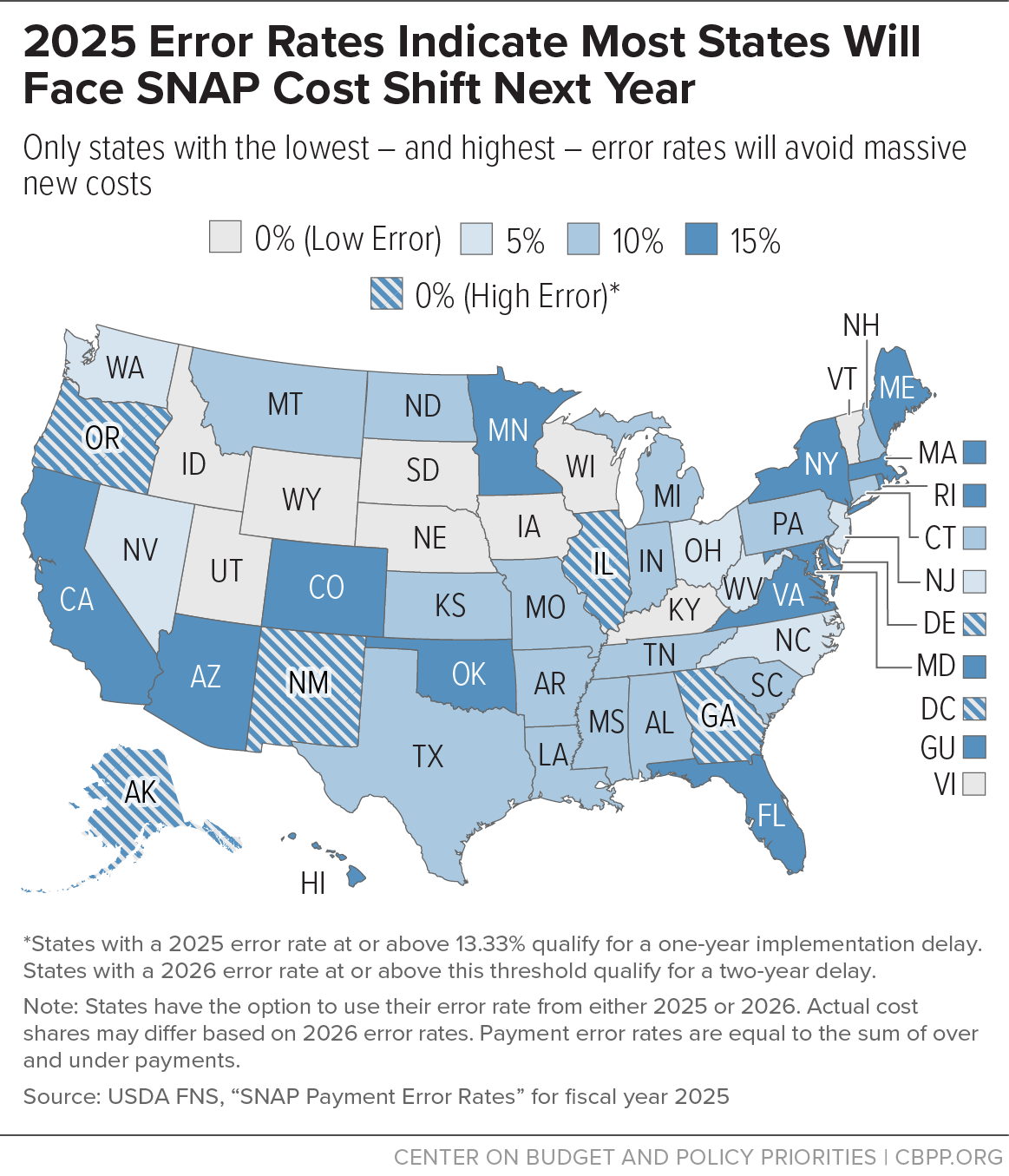
A 5 to 15 percent cost-sharing requirement for SNAP benefits represents significant new costs for states. Table 1 below provides an approximate amount each state may be required to pay in benefit costs based on its fiscal year 2025 error rate and estimated benefit costs. Based on these estimates, nearly half of states may be required to pay $100 million or more to sustain the program in fiscal year 2028. In total, this would shift roughly $9 billion in costs from the federal government to state budgets in fiscal year 2028 alone. If states choose to reduce their costs by restricting access to SNAP or withdrawing from the program entirely, the reduction in federal funding for SNAP benefits — and the harm to low-income families struggling to afford groceries — could be far greater.
These updated estimates are substantially lower than prior estimates for some states because the number of people participating in SNAP has declined more than anticipated as states implemented the reconciliation law’s SNAP cuts and raced to reduce errors and minimize their costs.
These estimates are also highly uncertain. While SNAP participation is expected to continue to decline over the next year as the law’s cuts continue to take effect, an economic downturn or higher-than-expected food price inflation could increase participation and benefit costs. As states begin to plan their budgets for next year, they will not only need to track progress on their error rates, but will also need to closely monitor SNAP participation trends, inflationary changes in the Thrifty Food Plan (the basis of SNAP benefit levels), and economic forecasts to ensure they provide enough funding to fully cover the required share of benefit costs.
| TABLE 1 | |||
|---|---|---|---|
Most States Would Face Significant SNAP Cost Shift Based on 2025 Error Rates | |||
| State | Fiscal Year 2025 SNAP Error Rate | Fiscal Year 2028 Cost Shift Percentage Based on 2025 SNAP Error Rate | Approximate Fiscal Year 2028 Cost Shift Amount Based on Fiscal Year 2025 Error Rate (Millions) |
| Alabama | 9.52% | 10% | $170 |
| Alaska | 23.15% | 0%* | $0 |
| Arizona | 10.80% | 15% | $200 |
| Arkansas | 8.81% | 10% | $50 |
| California | 10.93% | 15% | $1,900 |
| Colorado | 10.09% | 15% | $210 |
| Connecticut | 9.08% | 10% | $80 |
| Delaware | 16.00% | 0%* | $0 |
| District of Columbia | 18.66% | 0%* | $0 |
| Florida | 12.97% | 15% | $900 |
| Georgia | 15.21% | 0%* | $0 |
| Guam | 11.70% | 15% | $25 |
| Hawai‘i | 10.92% | 15% | $100 |
| Idaho | 3.85% | 0% | $0 |
| Illinois | 14.67% | 0%* | $0 |
| Indiana | 9.77% | 10% | $130 |
| Iowa | 5.34% | 0% | $0 |
| Kansas | 9.44% | 10% | $40 |
| Kentucky | 4.70% | 0% | $0 |
| Louisiana | 8.14% | 10% | $170 |
| Maine | 10.81% | 15% | $50 |
| Maryland | 13.08% | 15% | $220 |
| Massachusetts | 12.49% | 15% | $350 |
| Michigan | 9.89% | 10% | $300 |
| Minnesota | 12.58% | 15% | $130 |
| Mississippi | 9.51% | 10% | $75 |
| Missouri | 8.67% | 10% | $150 |
| Montana | 8.86% | 10% | $15 |
| Nebraska | 5.90% | 0% | $0 |
| Nevada | 6.22% | 5% | $50 |
| New Hampshire | 8.85% | 10% | $15 |
| New Jersey | 6.86% | 5% | $100 |
| New Mexico | 16.81% | 0%* | $0 |
| New York | 13.18% | 15% | $1,150 |
| North Carolina | 7.36% | 5% | $140 |
| North Dakota | 9.89% | 10% | $15 |
| Ohio | 6.76% | 5% | $150 |
| Oklahoma | 11.04% | 15% | $220 |
| Oregon | 14.14% | 0%* | $0 |
| Pennsylvania | 9.21% | 10% | $410 |
| Rhode Island | 12.42% | 15% | $50 |
| South Carolina | 8.80% | 10% | $120 |
| South Dakota | 2.47% | 0% | $0 |
| Tennessee | 9.44% | 10% | $160 |
| Texas | 9.34% | 10% | $725 |
| Utah | 5.54% | 0% | $0 |
| Vermont | 5.38% | 0% | $0 |
| Virgin Islands | 5.36% | 0% | $0 |
| Virginia | 12.32% | 15% | $250 |
| Washington | 6.98% | 5% | $100 |
| West Virginia | 6.69% | 5% | $30 |
| Wisconsin | 5.72% | 0% | $0 |
| Wyoming | 3.96% | 0% | $0 |
*2025 error rate exceeds threshold to qualify for a one-year delay in the cost shift. Note: Actual cost shift amounts will depend on each state’s fiscal year 2025 or 2026 error rate and anticipated benefit costs in fiscal year 2028. Projections are based on USDA data on SNAP participation and benefits for the first six months of fiscal year 2026 annualized and rounded to avoid unwarranted precision, given the high degree of uncertainty. If a state’s SNAP participation or benefit costs change substantially, then state cost shift amounts could be higher or lower than the approximation presented here. Puerto Rico, American Samoa, and the Commonwealth of the Northern Mariana Islands are not included in this table because they receive a nutrition assistance block grant in lieu of participation in SNAP. Source: U.S. Department of Agriculture SNAP Data for FY2026, https://www.fna.usda.gov/pd/supplemental-nutrition-assistance-program-snap. | |||
| TABLE 2 | |||
|---|---|---|---|
Nine States and the U.S. Virgin Islands Would Face SNAP Cost Shift in Fiscal Year 2029 if Their Error Rates Increase | |||
| State | Fiscal Year 2025 SNAP Error Rate | Percentage Point Increase in Error Rate to Trigger 5% Cost Share | Approximate Fiscal Year 2029 Cost Shift Amount if State’s Fiscal Year 2026 Error Rate is Above 6% (Millions) |
| Idaho | 3.85% | 2.15% | $15 |
| Iowa | 5.34% | 0.66% | $30 |
| Kentucky | 4.70% | 1.30% | $60 |
| Nebraska | 5.90% | 0.10% | $20 |
| South Dakota | 2.47% | 3.53% | $10 |
| Utah | 5.54% | 0.46% | $20 |
| Vermont | 5.38% | 0.62% | $10 |
| Virgin Islands | 5.36% | 0.64% | $5 |
| Wisconsin | 5.72% | 0.28% | $70 |
| Wyoming | 3.96% | 2.04% | $5 |
Note: Actual cost shift amounts will depend on each state’s fiscal year 2026 error rate and anticipated benefit costs in fiscal year 2029. Projections are based on USDA data on SNAP participation and benefits for the first six months of fiscal year 2026 annualized and rounded to avoid unwarranted precision, given the high degree of uncertainty. If a state’s SNAP participation or benefit costs change substantially, then state cost shift amounts could be higher or lower than the approximation presented here. Source: U.S. Department of Agriculture SNAP Data for FY2026, https://www.fna.usda.gov/pd/supplemental-nutrition-assistance-program-snap. | |||
| TABLE 3 | |||
|---|---|---|---|
Six States and D.C. Would Face Significant SNAP Cost Shift in Fiscal Year 2029 if Error Rates Fall Below Arbitrary Threshold | |||
| State | Fiscal Year 2025 SNAP Error Rate | Percentage Point Decrease in Error Rate to Trigger 15% Cost Share | Approximate Fiscal Year 2029 Cost Shift Amount if State’s Fiscal Year 2026 Error Rate Drops Below Threshold (Millions) |
| Alaska | 23.15% | -9.83% | $40 |
| Delaware | 16.00% | -2.68% | $40 |
| District of Columbia | 18.66% | -5.34% | $50 |
| Georgia | 15.21% | -1.89% | $500 |
| Illinois | 14.67% | -1.35% | $650 |
| New Mexico | 16.81% | -3.49% | $150 |
| Oregon | 14.14% | -0.82% | $250 |
Note: Actual cost shift amounts will depend on each state’s fiscal year 2026 error rate and anticipated benefit costs in fiscal year 2029. Projections are based on USDA data on SNAP participation and benefits for the first six months of fiscal year 2026 annualized and rounded to avoid unwarranted precision, given the high degree of uncertainty. If a state’s SNAP participation or benefit costs change substantially, then state cost shift amounts could be higher or lower than the approximation presented here. Source: U.S. Department of Agriculture SNAP Data for FY2026, https://www.fna.usda.gov/pd/supplemental-nutrition-assistance-program-snap. | |||
SNAP Cost Shift Is Now Unavoidable for Many States
The reconciliation law gave states very little time to reduce their exposure to these massive new costs by lowering their error rates, and this limited window is rapidly closing. As noted above, when the cost shift begins on October 1, 2027, the share of benefits states must initially pay will be based on their SNAP error rate from either fiscal year 2025 (the new data released last month), or fiscal year 2026 (the current fiscal year ending September 30).
While all states are working intensively to improve payment accuracy, it takes time to identify the root causes of errors and implement strategies to address them. For example, ensuring eligibility workers have manageable workloads can help reduce mistakes. But even if a state could rapidly hire additional staff, training new eligibility workers often takes a year or more before they are fully proficient in SNAP’s complex eligibility rules.[4] Similarly, a state may plan to reduce errors through technology upgrades, but such systems need to be procured, developed, piloted, and deployed. This often requires a budgetary investment upfront and several years to execute. Because the reconciliation law also cuts federal reimbursement for states’ administrative costs in half — from 50 percent to 25 percent, starting October 1, 2026 — states will soon have fewer federal resources to invest in these strategies.
Moreover, once a state implements an error reduction strategy, it takes time for those efforts to be reflected in a state’s error rate. Each month, any household receiving SNAP benefits can be selected for a quality control review, the process that determines the error rate. States typically approve SNAP households for certification periods of six or 12 months, which means that state eligibility workers may have made eligibility and benefits decisions for a household several months before that household is ultimately sampled for review.
The newly released fiscal year 2025 error rates largely reflect the accuracy of states’ eligibility and benefit decisions from before the reconciliation law was enacted on July 4, 2025, more than three-quarters of the way through fiscal year 2025. (See Table 4.) If a state faces a substantial cost shift based on its newly released fiscal year 2025 error rate, it is likely now too late to make meaningful progress to further reduce its error rate for the current fiscal year, 2026. With less than three months left in fiscal year 2026, states have completed most of the quality control reviews that will determine this year’s error rate and have already made eligibility and benefit determinations for many of the remaining cases that will be sampled for review this fiscal year.
While some states may have already made progress in improving payment accuracy in fiscal year 2026, states that face a cost shift based on their fiscal year 2025 error rate cannot wait to see if their fiscal year 2026 error rate is more favorable before planning their budgets. USDA will not finalize error rates for fiscal year 2026 until June 30, 2027, long after most states will have completed their budgets for the first year the cost shift is in effect and one day before the new fiscal year begins for 46 states.[5]
Cost Shift and Error Rate Timing
Implementation of the cost shift is delayed to fiscal year 2029 for states with an error rate at or above 13.33% in fiscal year 2025, and to fiscal year 2030 for states with an error rate at or above 13.33% in fiscal year 2026.
FY = fiscal year.
External Factors Are Increasing the Risk That States Face Higher Costs
As states work to improve payment accuracy, they are facing several factors outside of their control that have made it more difficult to substantially reduce errors throughout fiscal year 2026.
First, the reconciliation law made significant changes to SNAP’s eligibility and benefit calculation rules, the factors that determine whether states are issuing benefits to eligible households and in the correct amount. Many of the law’s eligibility and benefit cuts were effective upon the law’s enactment, including the provisions dramatically expanding SNAP’s harsh and ineffective work requirement, stripping eligibility from many people with a lawful immigration status based on humanitarian need, and eliminating a simplified calculation for many households’ utility expenses.
Regardless of USDA’s approach to implementation, program changes of this magnitude would have increased the risk of mistakes as states revise policies, update eligibility systems, train staff, and communicate changes to participants, which are all processes that can take many months. Many of these policy changes added complexity or eliminated flexibility states used to simplify program administration, further increasing the risk of errors by making SNAP more confusing for participants to navigate and more burdensome for states to administer.
But the Trump Administration dramatically increased the likelihood of errors by requiring states to implement many of these sweeping changes instantaneously — as soon as the bill was signed into law — while failing to provide states with critical implementation details for several months.
SNAP rules provide a grace period during which states are held harmless for errors stemming from a change in law or regulations, which begins when a state implements the new policy and ends 120 days after the required implementation date. USDA almost entirely negated this grace period by starting this 120-day clock as soon as the law was enacted while failing to give states the specifics they needed to implement the new policies — or even informing states that the clock was already running.
By the time states had received preliminary guidance on all provisions that were effective upon enactment, this 120-day grace period expired the next day.[6]USDA did not issue guidance clarifying the complex interactions between new eligibility rules for lawfully present immigrants and other long-standing provisions of law until December 9, and it then corrected that guidance on December 10.[7] In the interim, some states relied on the incomplete initial guidance and incorrectly terminated food assistance for people who remained eligible.[8] USDA did not provide states with further details on how they should be implementing the expanded work requirement until June 11, 2026, more than 11 months after this requirement went into effect.[9] These belated clarifications confirmed that some states had been incorrectly subjecting certain older adults to SNAP’s harsh work requirement even though they should have been exempt.[10]
As states were scrambling to implement the reconciliation law’s significant SNAP cuts, federal funding lapsed on October 1. During the ensuing 43-day government shutdown, SNAP experienced unprecedented disruption that delayed food assistance to millions of low-income families. For the first time, low-income households who were scheduled to receive their November SNAP benefits at the beginning of the month did not receive them.
States were forced to divert significant staff capacity and resources away from implementing the law to respond to constantly changing federal guidance during the shutdown. This included an initial instruction to not issue any benefits for the month of November, followed by an unprecedented directive to issue partial SNAP benefits, requiring states to re-calculate benefit amounts for every low-income household receiving SNAP. USDA then revised this directive the next day to correct an error in the partial benefit calculation, though not until after at least one state had already issued partial benefits based on the earlier, incorrect information.[11]
The funding lapse also meant that USDA staff were not available to provide states with the support and technical assistance they needed to successfully implement the reconciliation law, further slowing state implementation efforts and likely contributing to additional errors.
Cost Shift Is Already Harming Eligible Low-Income Families
With so many factors complicating their error rate efforts and no time before these cost-sharing penalties are locked in, some states are taking drastic steps that seek to reduce errors but make it more difficult for eligible families to access and maintain the SNAP benefits they need to afford groceries. For example, many SNAP-eligible people are losing assistance as they struggle to comply with states’ new, burdensome documentation requirements, and as understaffed state agencies fail to keep up with the additional workload to timely process applications and get benefits to eligible households.
This dynamic has been particularly damaging in Arizona, which substantially ramped up documentation requirements following the reconciliation law’s enactment, shortly after the state laid off hundreds of eligibility workers. Until a recent policy reversal, for example, applicants in Arizona were apparently denied benefits if they could not provide sufficient documentation to verify who lived in their household, even when there was no reason to question the information they provided.[12] Applicants reported being told they needed to obtain a signed statement from someone who could attest to the fact that no one else lived in their home.[13] With the severely understaffed state agency under increased strain, the number of Arizonans receiving SNAP fell by more than 50 percent in the first ten months after the law was enacted. Even people who could comply with the new paperwork requirements went without food assistance when they could not get through on overloaded phone lines to complete the required interview, or waited without benefits for months as the state worked through processing backlogs.[14]
Additionally, states such as Illinois and Georgia are now requiring most households to recertify their eligibility twice as often, putting families at risk of losing SNAP if they can’t navigate the additional red tape and increasing the chances that their benefits lapse if an overburdened state agency doesn’t process their paperwork in time.[15] Recertification is one of the top causes of “churn,” when a household is cut off SNAP but reenrolls within a few months — indicating they went without food assistance for paperwork reasons, despite being eligible. This lapse in benefits also increases the risk that households face food insecurity and financial strain.[16]
The cost shift creates harmful incentives for states to erect these and other bureaucratic obstacles. Under the reconciliation law, issuing SNAP benefits to an eligible family carries fiscal risks for states: if the state gives them too much or too little in benefits, its error rate — and the ensuing cost-sharing requirement — will go up. But under SNAP rules, delaying or denying benefits to eligible households doesn’t count as an “error.” In fact, limiting how many eligible people receive benefits will reduce a state’s direct costs; if the state ultimately must pay a share of benefits, it will be paying a percentage of a much smaller program that reaches far fewer people.
The decline in SNAP participation already exceeds the Congressional Budget Office’s projections. This likely reflects that many people who were not the ostensible target of the reconciliation law’s cuts — including children, seniors, and people with disabilities — are nonetheless losing SNAP because of states’ efforts to limit their costs.[17]
Cost Shift Will Force States to Make Painful Trade-offs, Likely Causing Much Greater Harm
States must balance their budgets, giving them few options to absorb these substantial new costs. If they cannot raise sufficient revenue to replace the lost federal funding for SNAP benefits, and if they want to continue operating SNAP, they will need to cut spending on other programs and services that people in the state rely on. The magnitude of these trade-offs will be significant for many states. Using error rates and SNAP expenditure data from fiscal year 2024, the National Association of State Budget Officers recently projected that increased state costs for SNAP administration and benefits under the reconciliation law are comparable to the total amount states spent on transportation in fiscal year 2025.[18]
As the cost shift for SNAP benefits hits state budgets, limited resources for program administration — necessary both to provide benefits to eligible people and to minimize errors — will increasingly be in direct competition with the far larger amount needed for the benefits themselves. As a result, states may increasingly face staffing shortages, backlogs, and people waiting months without benefits. Already, some states have failed to fully address the law’s 50 percent cut to federal funding for program administration. Ohio enacted legislation that will use state funds to fill only $12.5 million of the estimated $38 million hole this cut will create in county budgets next year, with an inequitable distribution formula that leaves counties with the largest populations — and the most households receiving SNAP — facing multimillion-dollar shortfalls.[19] In North Carolina, counties will face an estimated $52 million in added costs next year after the state failed to make up for the loss of federal administrative funds.[20]
The reconciliation law did not provide any hardship exemption or waiver process for states that cannot afford to pay the required benefit cost share for all eligible families seeking benefits, leaving few options for any state that cannot fully cover these costs. Federal SNAP rules, which set eligibility criteria and benefit levels, provide states with very limited flexibility to minimize their costs by directly restricting eligibility or reducing benefits.
Instead, a state that can afford to pay some — but not all — of its required cost share would have to largely rely on adding red tape to slash its SNAP caseload. Consider a state whose cost share in a year is projected to be $200 million. If the state decided it could only afford to contribute $100 million, it would have to terminate food assistance to about half of its participants. Indeed, Arizona appears to have preemptively taken this approach, erecting such significant paperwork barriers that the number of people receiving SNAP in the state has been cut in half. The bureaucratic obstacles states may erect to accomplish this, such as making more people travel in person to an office to access benefits and requiring additional unnecessary paperwork, often fall hardest on seniors, people with disabilities, and working families, who may struggle to wait on hold for hours when calls go unanswered or to travel to a social services office during business hours to get help.
And a state that cannot fulfill the cost-sharing requirement, even for a substantially smaller caseload, may be forced to withdraw from the program entirely, terminating food assistance for everyone in the state. SNAP has been available to eligible people in all states since 1974, though three U.S. Territories are excluded from the program and receive a capped block grant in lieu of SNAP.[21] Before SNAP, childhood hunger and malnutrition was devastatingly common in the United States.[22]
Deep reductions in the number of eligible people receiving SNAP or the complete elimination of the program would have dramatic and harmful ripple effects far beyond the increased risk of food insecurity, and the adverse health outcomes associated with it, for low-income people losing food assistance. These cuts will also have harmful impacts on schools, local businesses, and the broader economy.
For example, children who lose SNAP also lose automatic enrollment for free school meals via direct certification, increasing the risk that children go hungry during school hours. More than 50,000 schools participate in the Community Eligibility Provision (CEP), a federal policy that allows schools with higher need to serve free meals to all students without an application. The number of directly certified children determines schools’ eligibility for CEP and the federal reimbursement they receive under this policy. As more children lose access to SNAP, it may no longer be viable for some schools to continue participating in CEP, impacting all students.
SNAP also plays a critical role in supporting low-income families and the broader economy during economic downturns. Every $1 spent on SNAP in a weak economy returns $1.54 in economic activity as low-income families spend their benefits at local grocery stores, supporting jobs throughout the food supply chain.[23] For grocery stores that operate on thin margins, a substantial loss in revenue from a reduction or elimination of SNAP could force them to close their doors, leaving everyone in the community with fewer options to shop for groceries.
But the worst of these harms is not inevitable. The federal government should reverse course in the face of the clear evidence of harm. And if it doesn’t, states should prioritize protecting and raising revenues to prevent these devastating cuts and make vital investments in the well-being of people and communities in the state, including by ensuring that SNAP remains accessible to all eligible low-income people.[24]
States Lack Critical Information Needed to Plan for Cost Shift
In the next few months, states will begin to turn their attention to budgeting for fiscal year 2028, which for nearly all of them begins July 1, 2027. They will soon need to make critical decisions about how they will cover their new cost-sharing obligation. But in addition to the substantial uncertainty about their future error rates and other factors that will affect the amount of the cost shift, states lack critical details about how this fundamental structural change to SNAP’s financing will be implemented. To date, USDA has issued no guidance on this requirement, and the Administration’s recently released regulatory agenda indicates proposed regulations will not be released until December or later.[25] Key policy questions with significant implications for state budgets remain unanswered, including whether USDA considers the cost-sharing requirement to apply to Disaster SNAP (D-SNAP). A hurricane, wildfire, flood, or other disaster can dramatically increase the need for food assistance in impacted communities, and states need to know if they will be required to pay a percentage of those substantial unanticipated costs if disaster strikes.
States also need to know how USDA will operationalize these unprecedented changes to SNAP’s financial management, especially if they will be required to undertake costly and time-intensive system changes or negotiate contract modifications with their EBT (electronic benefits transfer) processor. Currently, state agencies determine individual households’ eligibility and monthly benefit amounts and provide those amounts to their EBT processor to load onto each household’s EBT card. Every month, the federal government authorizes an amount for aggregate SNAP benefits in a letter of credit for each state with the Federal Reserve Bank, acting on behalf of the U.S. Treasury. When a household pays for groceries using their SNAP benefits at a SNAP-authorized retailer, the state’s EBT processor reimburses the retailer and deducts that amount from the state’s letter of credit.[26] Critically, federal funding for SNAP benefits does not flow through the state at any point in this process, nor is there an existing mechanism to add grocery benefits funded by state dollars to EBT cards in most states.
Congress Must Intervene to Prevent Further Harm to Low-Income Families
With the number of children receiving SNAP already down by at least 1.5 million, Congress must act quickly to give states the time and resources they need to improve payment accuracy while protecting access to food assistance for eligible low-income households struggling to afford groceries. At minimum, Congress should delay the cost-sharing requirement for food benefits for all states — not just the states with the highest error rates — and postpone cuts to federal reimbursement for states’ administrative costs.
While this would mitigate the immediate risk that low-income families lose food assistance due to the cost shift, this policy is fundamentally untenable and must be repealed. For more than 50 years, SNAP has ensured that children, adults, and seniors in low-income households in every state receive a food benefit that allows them to afford an adequate diet. By creating the risk that some states may opt out of SNAP altogether, the cost shift abandons this decades-long nationwide commitment to addressing hunger.
End Notes
[1] Dottie Rosenbaum, Joseph Llobrera, Catlin Nchako, and Luis Nuñez, “SNAP Tracker: People Are Losing Food Assistance as the Republican Megabill Is Implemented,” CBPP, updated July 21, 2026, https://www.cbpp.org/research/food-assistance/snap-tracker-people-are-losing-food-assistance-as-the-republican-megabill.
[2] National Governors Association, “NGA Joins Coalition Letter Outlining SNAP Recommendations,” January 8, 2026, https://www.nga.org/advocacy-communications/letters-nga/nga-joins-coalition-letter-outlining-snap-recommendations/.
[3] U.S. Department of Agriculture, “SNAP Quality Control,” https://www.fna.usda.gov/snap/qc.
[4] Testimony of Joy Bivens, Deputy County Administrator, Franklin County, Ohio, “Exploring State Options in SNAP,” Before the House Agriculture Committee, Subcommittee on Nutrition and Foreign Agriculture, September 9, 2025, https://agriculture.house.gov/uploadedfiles/testimony_bivens_09.09.2025.pdf.
[5] While the federal fiscal year begins October 1, 46 states begin their fiscal years on July 1. New York begins its fiscal year on April 1; Texas on September 1; and Alabama, the District of Columbia, Guam, Michigan, and the U.S. Virgin Islands on October 1. See “Proposed and Enacted Budgets,” National Association of State Budget Officers, https://www.nasbo.org/resources/proposed-enacted-budgets.
[6] See “Policy Memo” at USDA, “Supplemental Nutrition Assistance Program (SNAP) Implementation of the One Big Beautiful Bill Act of 2025 – Alien SNAP Eligibility,” October 31, 2025, https://www.fna.usda.gov/snap/obbb-alien-eligibility.
[7] The clarification released on December 9 incorrectly stated that victims of severe trafficking were subject to a five-year waiting period after obtaining a green card before they would be eligible for SNAP. This was corrected on December 10, though this revision is not noted in the document. USDA, “SNAP Provisions of the One Big Beautiful Bill – Alien SNAP Eligibility – Question and Answer #1,” updated December 10, 2025, https://www.fna.usda.gov/snap/obbb-alien-eligibility-qas1.
[8] Reply of Plaintiff States to Motion for Preliminary Injunction 4, State of New York v. Rollins, 6:25-cv-02186, (D. Or.), December 12, 2025, https://storage.courtlistener.com/recap/gov.uscourts.ord.190652/gov.uscourts.ord.190652.60.0.pdf.
[9] USDA, “SNAP Provisions of the One Big Beautiful Bill Act of 2025: Time Limit Changes - QAs #1,” June 11, 2026, https://www.fna.usda.gov/obbb/snap/time-limit-changes-qas1.
[10] Tara Britton, “At risk after 60: Ohio’s proposed SNAP rules put food assistance for caregiving older adults at risk,” Center for Community Solutions, March 23, 2026, https://www.communitysolutions.com/resources/at-risk-after-60-ohios-proposed-snap-rules-put-food-assistance-for-caregiving-older-adults-at-risk.
[11] Luis Nuñez and Katie Bergh, “Administration Won’t Spend All SNAP Funds It Says Are Available, Leading to Deep Benefit Cuts for Low-Income Households,” CBPP, November 5, 2025, https://www.cbpp.org/blog/administration-wont-spend-all-snap-funds-it-says-are-available-leading-to-deep-benefit-cuts; Kristle Muessle, “Partial SNAP benefits issued to eligible Nevadans,” Nevada Department of Human Services, November 5, 2025, https://www.dhs.nv.gov/reports/press-releases/press-releases/partial-snap-benefits-issued-to-eligible-nevadans/.
[12] Arizona Department of Economic Security, “Determining Budgetary Units,” archived April 27, 2026, https://dbmefaapolicy.azdes.gov/Archived_Policy/baggage/FAA2.A06_DeterminingBudgetaryUnits_%20Revision54.pdf. The revised policy requires verification of living arrangements only when questionable, in alignment with federal requirements at 7 CFR 273.2(f)(1)(x).
[13] Nicole Ludden, “The truth behind Arizona’s SNAP free fall,” Arizona Agenda, April 17, 2026, https://www.arizonaagenda.com/p/the-truth-behind-arizona-s-snap-free-fall.
[14] Joseph Llobrera and Catlin Nchako, “Arizona’s SNAP Participation is Plummeting – Far More Than Anticipated – as It Implements Megabill,” CBPP, April 8, 2026, https://www.cbpp.org/blog/arizonas-snap-participation-is-plummeting-far-more-than-anticipated-as-it-implements-megabill.
[15] See Illinois Department of Human Services, “Reinstatement of Six-Month Redetermination Process and EZ REDE for SNAP,” October 23, 2025, https://www.dhs.state.il.us/page.aspx?item=175074 and Georgia Department of Human Services, Division of Family and Children Services, “Periodic Reporting,” https://dfcs.georgia.gov/services/snap/periodic-reporting.
[16] Gregory Mills et al., “Understanding the Rates, Causes, and Costs of Churning in the Supplemental Nutrition Assistance Program (SNAP): Final Report,” USDA, November 2014, https://fns-prod.azureedge.us/sites/default/files/ops/SNAPChurning.pdf.
[17] Dottie Rosenbaum and Joseph Llobrera, “Congress Should Staunch SNAP Participation Losses, Which Exceed CBO’s Estimates,” CBPP, June 30, 2026, https://www.cbpp.org/blog/congress-should-staunch-snap-participation-losses-which-exceed-cbos-estimates.
[18] Kim Chipman, Lydia Johnson, Grace Miller, and Noah Wicks, “Daybreak June 12: States outline costs of SNAP compliance,” June 12, 2026, https://www.agri-pulse.com/articles/24828-daybreak-june-12-states-outline-costs-of-snap-compliance.
[19] Jeremy Pelzer, “DeWine signs bill to help offset federal food-stamp cuts, but large counties left short,” Cleveland.com, April 1, 2026, https://www.cleveland.com/news/2026/04/dewine-signs-bill-to-help-offset-federal-food-stamp-cuts-but-large-counties-left-short.html.
[20] Ashley Fredde, “’We have to juggle other things’: NC counties will have to absorb new SNAP costs without state funding,” North Carolina Health News, July 10, 2026, https://www.northcarolinahealthnews.org/2026/07/10/nc-counties-carry-cost-of-federal-snap-changes/.
[21] Puerto Rico, American Samoa, and the Commonwealth of the Northern Mariana Islands receive a nutrition assistance block grant in lieu of participating in SNAP. Puerto Rico participated in SNAP until Congress replaced it with a block grant in 1982. See USDA, “A Short History of SNAP,” https://www.fna.usda.gov/snap/history.
[22] Nick Kotz, “Hunger in America: The Federal Response,” Field Foundation, 1979; Brynne Keith-Jennings, Joseph Llobrera, and Stacy Dean, “Links of the Supplemental Nutrition Assistance Program With Food Insecurity, Poverty, and Health: Evidence and Potential,” American Journal of Public Health, 109, 1636-1640, https://ajph.aphapublications.org/doi/abs/10.2105/AJPH.2019.305325; and Dorothy Rosenbaum and Zoë Neuberger, “Food and Nutrition Programs: Reducing Hunger, Bolstering Nutrition, CBPP, revised August 17, 2005, https://www.cbpp.org/research/food-and-nutrition-programs-reducing-hunger-bolstering-nutrition.
[23] Patrick Canning and Brian Stacy, “The Supplemental Nutrition Assistance Program (SNAP) and the Economy: New Estimates of the SNAP Multiplier,” U.S. Department of Agriculture, July 2019, https://www.ers.usda.gov/publications/pub-details?pubid=93528.
[24] Wesley Tharpe, Clara Wilson, and Joanna LeFebvre, “Sound State Revenue Choices Essential to Counteract Harmful Policies and Build Forward,” CBPP, February 26, 2026, https://www.cbpp.org/research/state-budget-and-tax/sound-state-revenue-choices-essential-to-counteract-harmful-policies.
[25] Office of Management and Budget, Office of Information and Regulatory Affairs, “Supplemental Nutrition Assistance Program: Benefit Matching Requirements for State Governments,” https://www.reginfo.gov/public/do/eAgendaViewRule?pubId=202510&RIN=0584-AF21.
[26] U.S. Department of Agriculture Inspector General, “FNS SNAP: Disbursement of SNAP Benefits Using the EBT System,” April 2025, https://usdaoig.oversight.gov/sites/default/files/reports/2025-04/27801-0002-23_FR_508_FOIA_redacted_public.pdf.