

SNAP Provides Needed Food Assistance to Millions of People With Disabilities
There are over 70 million people in the United States with one or more disabilities. Many people with disabilities have greater expenses than people without disabilities, making it harder for people with disabilities and their caregivers to work, put food on the table, and afford adequate health care. While programs like Supplemental Security Income (SSI), Social Security Disability Insurance (SSDI), Medicaid, and Medicare provide critical support to many people with disabilities, the importance of the Supplemental Nutrition Assistance Program’s (SNAP) benefits for the economic well-being and food security of low-income people with disabilities is less recognized.
Our new report, co-authored with researchers at the Johns Hopkins University Disability Health Research Center, highlights SNAP’s essential role in helping low-income people of all backgrounds, including many with disabilities, put food on the table. Our report shows that:
- People with disabilities are more likely to experience food insecurity than people without disabilities. Households with people with disabilities are two to three times more likely to be food insecure, meaning they experience limited or uncertain access to adequate food due to economic constraints, than households without people with disabilities, in part due to additional daily living costs and lack of access to appropriate or adequate food.
- SNAP is the largest federally funded food assistance program in the United States, providing assistance to 42 million people in 2025, including an estimated 19.5 million people with disabilities. An extensive body of evidence demonstrates that SNAP lifts millions of people out of poverty, improves food security, and can improve long-term health and economic outcomes.
- Historically deep cuts to SNAP and work requirement expansions must be reversed to protect disabled people’s equitable and consistent access to food. Research shows SNAP improves food security among disabled people; however, an estimated 4.2 million households with low incomes that include someone with a disability are food insecure. The Fiscal Responsibility Act of 2023 raised the age limit for the work requirement from 49 to 54. The harmful 2025 Republican reconciliation law expanded the work requirement to older adults ages 55 to 64 and to parents and caregivers whose youngest child is at least 14 years old. The law also cuts federal funding for states’ SNAP programs, creating the possibility that states will cut or end their programs altogether. These recent changes risk taking away food assistance from millions of individuals, including older adults and people with disabilities, and the people they live with.
Policy Implications
Although SNAP has been proven to improve food security, there are several barriers that limit SNAP’s potential to reduce food insecurity among people with disabilities. Importantly, people with disabilities still report experiencing food insecurity while receiving SNAP, suggesting changes to current SNAP policies are needed to better support disabled people.
The Republican reconciliation law, enacted in July 2025, made historic cuts to SNAP and takes food assistance away from an estimated 4 million people, including people with disabilities. It includes provisions that will add administrative hurdles that make it harder for people to enroll and receive the assistance they need to put food on the table. There are several ways policymakers can improve SNAP’s support for people with disabilities:
- Repeal, or at a minimum, delay the SNAP cost shift. Starting October 1, 2027, most states will be required to pay a share of SNAP food benefit costs — for many states, potentially hundreds of millions of dollars a year — for the first time in the program’s history. In the face of these massive new costs, states have a strong incentive to erect additional barriers to the program, taking away food assistance from people with disabilities and other people with low incomes, or even to end their SNAP programs entirely. At minimum, Congress should delay the cost-share requirement for food benefits for all states. While this would mitigate the immediate risk of low-income families losing food assistance due to the cost shift, this policy is fundamentally untenable and must be repealed.
- Roll back or eliminate work requirements that take food assistance away from people. There is growing evidence that SNAP work requirements create more barriers and decrease SNAP participation, including among adults with disabilities, without improving employment outcomes. Households with disabled members still face a higher risk of food insecurity even if disabled members can work. The expansion of work requirements to millions more people will likely have disproportionate negative impacts on the disability community, particularly among disabled individuals who face barriers to work but who do not qualify for an exception because they do not receive disability benefits. States should develop robust processes for identifying individuals who qualify for an exemption from the work requirement, such as having work-limiting health conditions. Ultimately, permanently eliminating work requirements is critical to protecting food security among disabled people.
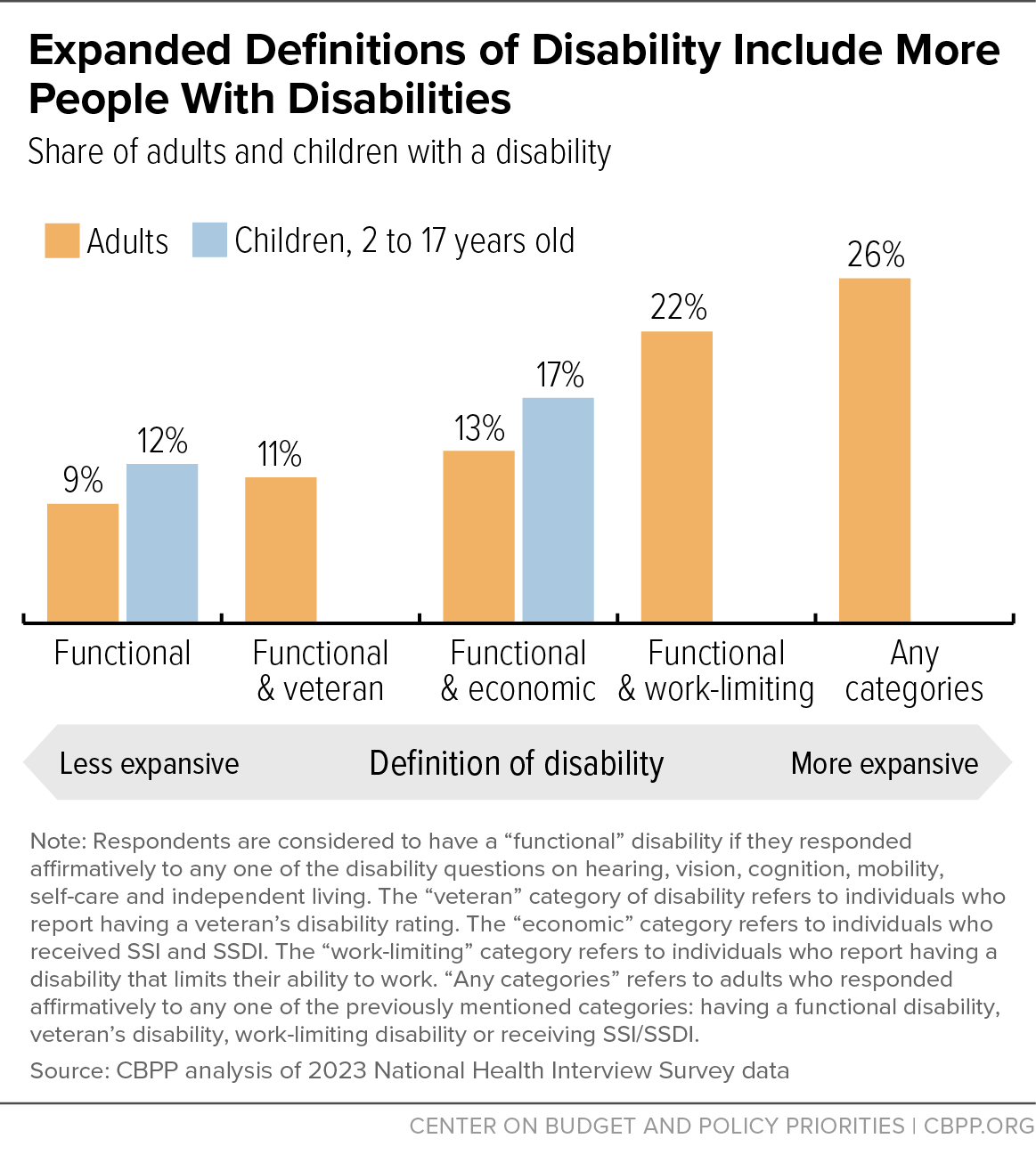
- Update the existing definition of disability used to determine SNAP eligibility and benefits to be more inclusive. The existing definition excludes many people with severe and long-lasting disabilities. Those excluded range from veterans with service-related injuries that are rated at just under 100 percent to individuals who have not yet received an SSI/SSDI determination to children who are severely disabled but do not qualify for SSI due to their parents’ income or assets. These individuals would benefit significantly from the medical expense deduction and other provisions, as some have trouble affording food and may also have increased expenses due to their impairments. Unfortunately, if an individual is not considered disabled as defined in SNAP regulations, the state agency cannot provide them with those accommodations.

- Protect and improve accessibility of SNAP enrollment and recertification processes. State agencies are responsible for ensuring that all individuals with disabilities receive assistance in applying for the program and for providing reasonable accommodations to ensure administrative procedures are accessible. The harmful 2025 Republican reconciliation law, which cuts federal funding for SNAP and shifts costs to states, puts pressure on states to add administrative hurdles and create barriers to SNAP in order to keep their costs down and reduce their error rates. But states can implement options and procedures that simplify the application process and help keep their costs down without creating additional complexities and barriers for people participating in the program. This includes making sure that websites, portals, and forms are accessible to people with disabilities.
- Use SNAP’s existing rules to their full potential to maximize benefits for eligible people. While the medical expense deduction can help households with high medical costs obtain adequate benefits, it appears to be underutilized. Eligible households may not claim the deduction due to confusion or lack of awareness or state procedures and policies that can make the process unnecessarily cumbersome. Some state SNAP applications do not appear to seek sufficient information from applicants to ensure that eligible households receive the full deduction. To simplify the process of documenting expenses, states can implement standard medical deduction demonstration projects, under which they deduct a standard amount (representing the average medical expenses for senior or disabled SNAP households) from all eligible households that demonstrate medical expenses of over $35 a month.
Improve cross-program coordination and look for opportunities to shift from opt-in to opt-out enrollment practices to increase SNAP participation. People participating in SNAP and disabled people often report experiencing stigma, which reduces their willingness to claim public benefits. Pairing SNAP with other public benefits may help to reduce stigma and improve efficiency. Many households that include someone with disabilities are already known to have low incomes because household members receive Medicaid or other income-based benefits. Improving the efficiency in the application processes of other programs can enable more eligible disabled people to apply for and receive SNAP benefits. For example, the Combined Application Project, implemented by 17 states, waives certain enrollment and documentation requirements for SSI recipients who have already provided documentation to the Social Security Administration. The Combined Application Project represents an important SNAP enrollment pathway for disabled people. Improved coordination across government departments and agencies could reduce the SNAP enrollment burden for people with disabilities.
It is important to note, however, that the strict medical criteria to qualify for SSI and SSDI exclude many people with disabilities, including those with temporary or episodic disabilities. Not everyone who qualifies for benefits like SSI or SSDI receives them, and there are opportunities to improve supports for disabled people across all government programs. SNAP’s reliance on the receipt of other disability payments eliminates the need for applicants to again prove they have a disability, but there is still room for improvement to enable many more households with disabled members to afford food and meet their basic needs.
- Protect SNAP eligibility and benefits for caregivers of people with disabilities. SNAP does not include eligibility accommodations for people who have caregiving responsibilities for people with disabilities. For example, family members may have to reduce their hours or quit their jobs to provide needed assistance and care for those with disabilities. Caregivers of children with medical complexity report facing financial challenges which are exacerbated by the cost of care for their children’s medical conditions. Ultimately, supporting caregivers of disabled people improves the health outcomes of disabled people under their care. However, the 2025 Republican reconciliation law expanded SNAP work requirements to older adults ages 55 to 64 and, for the first time, parents and caregivers of older children ages 14 to 17. This will take food assistance away from caregivers of people with disabilities unless they can document that they are working 80 hours a month. It is also important to note that one-third of caregivers have disabilities themselves. Future research must focus on disabled caregivers and parents to understand their specific experiences and issues related to food and nutritional security.
- Allow SNAP benefits to be used to purchase hot and/or prepared foods. Disabled people, who experience challenges with food access and may have limitations with daily activities, may benefit from being allowed to purchase prepared foods. For example, people with disabilities may have difficulties with preparing their own foods or may want to stretch prepared foods across multiple meals. However, the arbitrary restriction on allowable foods prevents disabled people from accessing options that would help them feed themselves.
- Expand the SNAP Online Purchasing Pilot. The SNAP Online Purchasing Pilot (OPP) program, which has been implemented in all 50 U.S. states and the District of Columbia, demonstrates the potential to improve food access for SNAP households, including those with disabled members. There is evidence that online purchasing reduced food insufficiency, however, to maximize its impact on people with disabilities, the program should be expanded to cover the cost of delivery and other transaction fees. These changes will allow disabled people who experience transportation barriers to obtain food from stores in their communities. Support for the SNAP OPP must continue, and efforts should be made to strengthen the program to meet the needs of disabled people.
- Work closely with the disability community, including a diversity of disabled people’s perspectives. A key principle of disability justice is that those most impacted should lead the development and revision of federal nutrition guidelines, programs, and policies to better serve their needs. Given the disability community has been historically marginalized and excluded from equitable engagement and access to federal supports, ongoing efforts to improve SNAP must center disabled voices to ensure that changes to SNAP are effective and reflective of the disability community’s needs.