

The Federal Estate Tax
The federal estate tax is a tax on very large inheritances received by a small group of wealthy heirs. Because it only affects the heirs of the wealthiest people in the United States — fewer than 1 in 1,000 estates — the estate tax is the most progressive part of the tax code.

A long-standing part of the federal tax system, the estate tax is a tax on property (cash, real estate, stock, or other assets) transferred from deceased persons to their heirs.
The estate tax is levied only on the portion of an estate’s value that exceeds the exemption level, minus deductions, such as for charitable giving. Largely because of the generous exemption level, fewer than 0.1 percent of estates pay any estate tax, and typically at fairly moderate rates.
The estate tax can also serve as a backstop to the capital gains tax by ensuring that the increase in the value of unsold assets that had appreciated over time is subject to at least some tax.
Estate Tax Has Weakened Considerably Since 2001
Legislation enacted in 2001 gradually phased out the estate tax by raising the exemption level and reducing the rate, leading to the tax’s temporary repeal in 2010. (The 2001 legislation also eliminated the federal estate tax credit that offset state estate or inheritance taxes paid, leading to the elimination of the state estate tax in a number of states.) The tax was scheduled to return in 2011 under pre-2001 rules (an individual exemption of $1 million and a top rate of 55 percent), but policymakers instead permanently extended it in much weaker form.
The 2017 tax law weakened the tax further, doubling the exemption level from $5.5 million per individual ($11 million per couple) to $11.2 million per individual ($22.4 million per couple) and indexing it for inflation going forward. Because of the increase in the exemption level, the share of estates facing the tax fell from 2 in 1,000 to under 1 in 1,000.
The 2025 Republican megabill weakened the estate tax yet again (see first chart), raising the exemption level (which was slated to revert to $5 million per individual in 2026) to $15 million ($30 million per couple). The exemption amount will continue to be indexed annually for inflation, and the top statutory rate remains unchanged at 40 percent.
Estate Tax Rate Is Modest

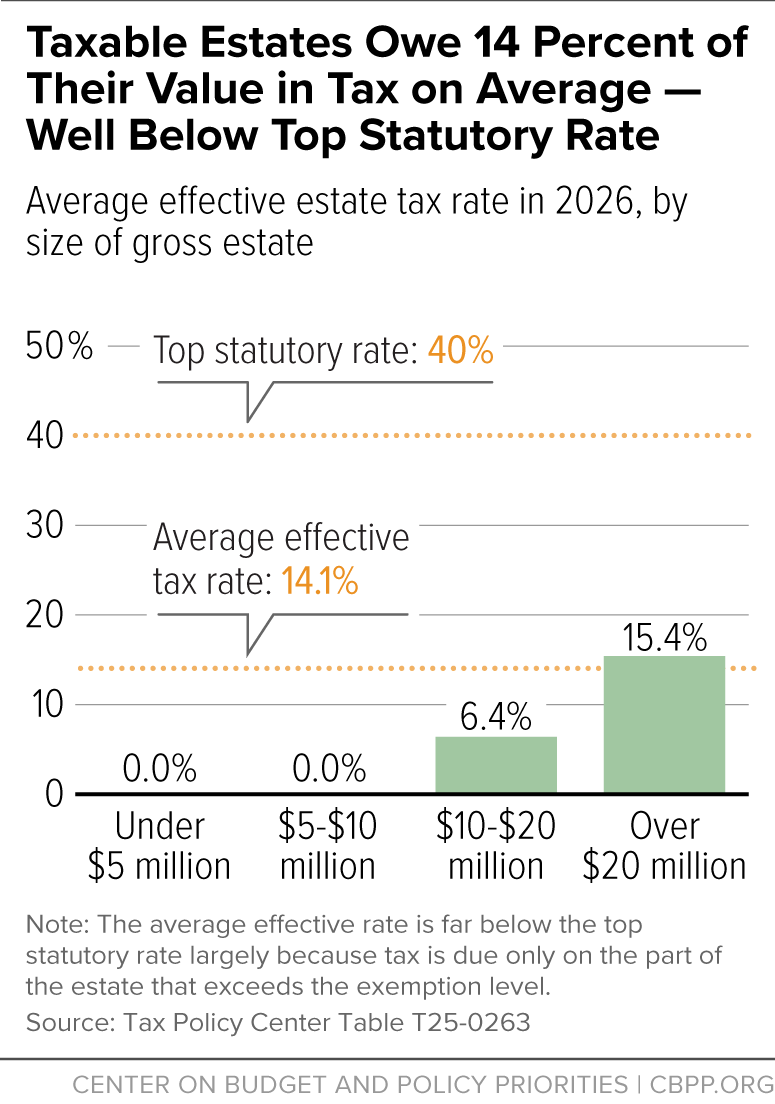
Taxable estates will owe 14.1 percent of their value in tax in 2026, on average (see second chart). This “effective rate” is well below the top marginal rate of 40 percent for three reasons:
- The tax applies only to the value of the estate that exceeds the exemption level. For example, at the 2026 exemption level of $15 million per individual, an estate worth $16 million would owe taxes on $1 million at most, for a maximum effective tax rate of less than 3 percent.
- The tax contains a number of provisions that reduce estates’ tax liability. For example, the “minority ownership discount” allows an estate that owns a minority share of a business to value — and therefore pay estate taxes on — the estate’s share of the business below its fair-market value. And farm owners can use the “special-use valuation” tax break to value their assets based on their current use (farming) rather than their most profitable potential use.
- Many wealthy estates use complex estate planning methods to exploit loopholes that reduce their tax liability and allow them to pass on significant portions of their estates without owing any estate tax, such as by using certain kinds of trusts to pass along considerable assets tax-free.
More Robust Estate Tax Could Reduce Wealth Inequality


Without a robust estate tax, a large part of the value of the nation’s largest estates would never be taxed. That’s because the federal income tax is essentially voluntary for many very wealthy people. Much of their income comes in the form of gains in the value of their stocks and other assets, and they can avoid taxes on those gains simply by holding on to their assets rather than selling them. (Usually, capital gains are taxed only when the asset is sold or disposed of and the gain is “realized.”)
Often, wealthy people never sell these assets. Instead, they choose to pass the assets — including the unrealized gains — to their heirs, who will never pay income tax on the unrealized gains.
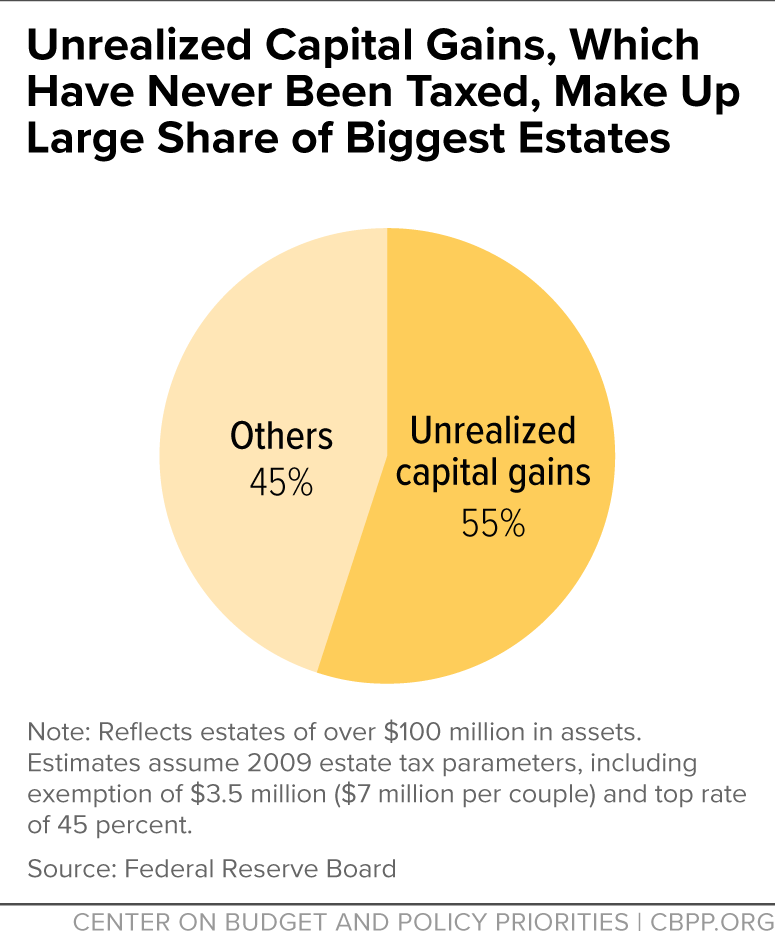
Unrealized capital gains account for a significant proportion of the assets held by large estates — about 55 percent for estates worth more than $100 million (see third chart).
Tax rules that enable some of the nation’s wealthiest people to go through life without paying income taxes on much or all of their income worsen inequality in income and wealth — both overall and across racial and ethnic groups. Because of racial barriers to economic opportunity, households of color are overrepresented at the lower end of the income and wealth distributions, while white households are overrepresented at the top. For example, the wealthiest 10 percent of white households — a group that makes up just 7 percent of households — holds 61 percent of the nation’s wealth. By contrast, people of color account for 33 percent of all households but just 14 percent of the nation’s wealth.
A robust estate tax could push back against this inequality by imposing some tax on the windfall an heir receives, but the weakening of the estate tax in recent decades has severely limited its ability to do so.
Estate Tax Is Economically Sound
While critics claim that the estate tax hurts the economy, evidence shows it likely has little or no impact on overall private saving, and it has a positive impact on overall national (private plus public) saving because of the revenues it raises. The tax will generate an estimated $367 billion over 2025-2034 under current law, according to the Joint Committee on Taxation and Congressional Budget Office. Research also finds that the estate tax encourages heirs to work.
In sum, the estate tax is an economically efficient way to raise revenue that supports public services and lowers deficits without imposing burdens on low- and moderate-income people in the United States. Its role in our revenue system is particularly important given our long-term budget challenges.