MÁS ALLÁ DE LOS NÚMEROS
House Republican Tax Bill Extends — and Expands — Costly Tax Breaks for the Wealthy
Wealthy heirs, owners of multimillion-dollar partnerships, and private equity investors would be among the big winners from the expanded tax breaks for wealthy households in the House Republican tax bill. Those tax cuts would come on top of the bill’s extension of the expiring 2017 tax cuts, which would also deliver the biggest benefits to the wealthiest households.
It’s a very different story for the millions of working families struggling to meet their basic needs. The bill wouldn’t extend enhanced premium tax credits that are critical to making marketplace health coverage more affordable, and it wouldn’t give the full proposed $2,500 Child Tax Credit to as many as 20 million children in working families because their family incomes are too low.
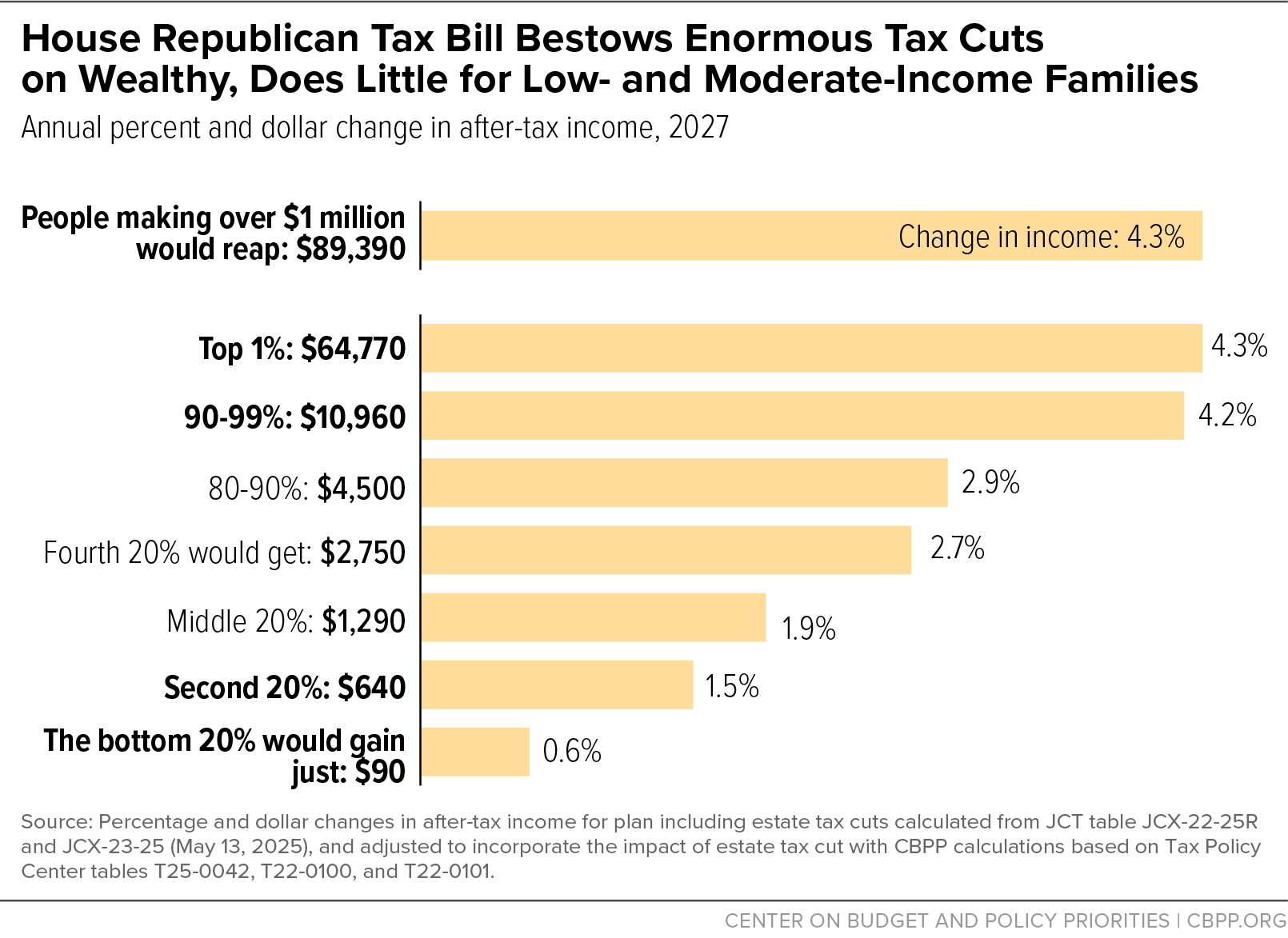
As a result, the 1 percent of people with the highest incomes would receive tax cuts three times the size of those for people in the bottom 60 percent, measured as a share of after-tax income. (See chart.) Other core components of the Republican agenda would harm households with low or moderate incomes, including massive cuts to health care and food assistance, making those households worse off, according to the Congressional Budget Office.

The bill’s expanded tax breaks primarily benefiting high-income households include:
- Bigger estate tax cuts for wealthy heirs. The bill increases the amount a wealthy couple can pass on tax-free to their heirs to $30 million ($15 million for a single person), $1.7 million more than under a simple extension of the 2017 law. Just extending the 2017 law’s exemption level would provide a tax cut of almost $5.7 million per couple for the 1 in 1,000 estates that are wealthy enough to owe any estate tax; the bill’s even larger exemption would boost this amount to $6.3 million. The provision would cost $211 billion through 2034, $10 billion more than just extending the 2017 law’s exemption.
Bigger tax break for pass-through business owners. The bill would permanently extend the 2017 law’s pass-through deduction, which exempts 20 percent of eligible owners’ business income, and expand it to 23 percent. This would effectively cut the top tax rate on business owners’ pass-through income to 28.5 percent, well below the 37 percent top rate for their employees.
Proponents argue the deduction is needed to achieve “parity” with corporations, which pay a 21 percent tax rate. But pass-through businesses typically face lower effective tax rates than corporations even without the deduction, so increasing the deduction to 23 percent would just give business owners an added windfall. For example, a business owner with $5 million in qualifying pass-through income, who receives a $370,000 tax benefit from the current deduction, would get another $55,000 annually from the expansion.
Expanding the deduction adds $115 billion to the $700 billion cost of simply extending it through 2034. Over half of the added tax breaks would flow to 200,000 millionaire owners of very profitable businesses.
- Bigger SALT deduction for high earners. The bill allows high-income people to deduct more of their state and local taxes (SALT), which the 2017 law capped at $10,000. The bill raised the cap to $40,400 for filers making up to $505,000, with a phaseout above that amount. This change would lose around $350 billion of revenue compared to extending the 2017 law’s $10,000 cap. While other changes in the bill modestly reduce the benefit of the higher cap, high-income taxpayers would still receive substantial new tax cuts.
Wealthy people are also big winners from House Republicans’ decision not to include two proposals from President Trump in their bill. One was to raise the top marginal rate. Allowing the top rate to revert to its pre-2018 level would lower the cost of the tax bill by $360 billion through 2034, but House Republicans rejected even this modest change. The other was to close the “carried interest” loophole, which lets private equity executives treat their compensation as capital gains in order to benefit from lower rates. Instead, the bill expands tax breaks for private equity funds by enabling them to qualify for the pass-through deduction if they receive income from certain “business development companies” and by rolling back a limit on business interest deductions.
Wealthy households also continue to benefit from the 2017 tax law’s permanent corporate tax cuts. In fact, 83 percent of the permanent tax cuts from the law go to the wealthiest 1 percent of people. Instead of revisiting those tax cuts, the House bill would reverse scheduled business tax increases Republicans added in 2017 to partially offset their high cost — amounting to more than $270 billion in business tax cuts.
The expanded tax breaks discussed above — wholly apart from the bill’s extension of the expiring 2017 individual and estate tax provisions — would cost roughly $750 billion through 2034. This is significant revenue that could instead be used to extend the enhanced premium tax credits for marketplace coverage and expand the Child Tax Credit for families left out of the full credit — two much-needed wins for working families.