

House Republican Tax Bill Would Create Costly Red Tape for Millions of Families
The recently passed House Republican tax and budget-cutting bill is full of new administrative burdens: unnecessary forms and cumbersome processes that would make it harder for working families, seniors, veterans, people with disabilities, and others to see a doctor when they are sick, put food on the table, and file their taxes — all to help pay for tax cuts for rich people.
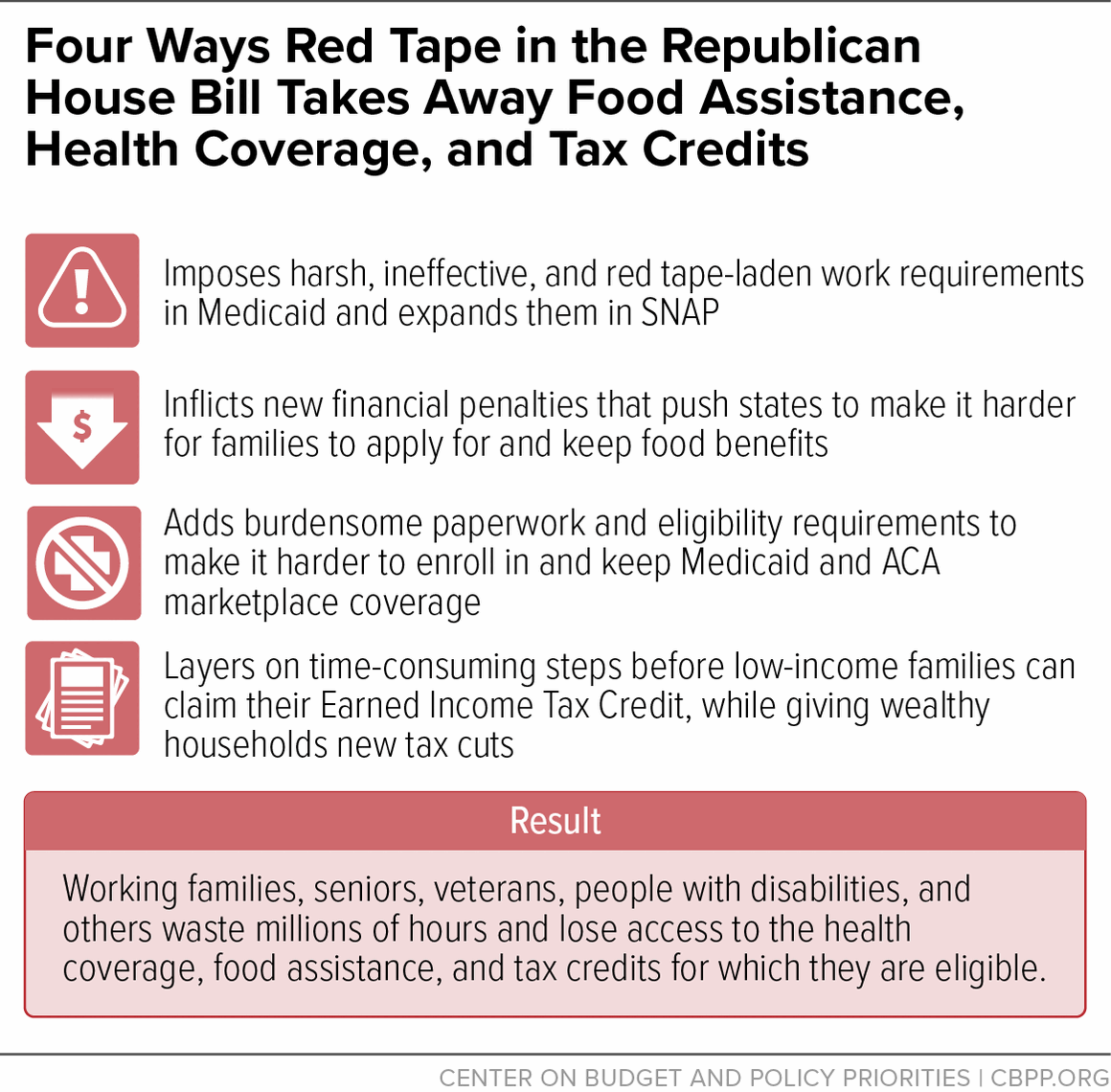
This Republican red tape would cost people millions of additional hours, imposing a “time tax” [1] on families to access needed benefits and services for which they are eligible — wasting time that could otherwise be spent caring for elderly family members, helping children with homework, working, or addressing family health care needs. And more than that, these administrative burdens are designed to take away health coverage, food assistance, and tax benefits that people are eligible for and need. (See Figure 1.)
Most of the people who would lose benefits would do so because of issues created by the complicated new reporting processes, even though they remain eligible for the benefits themselves. This seems to be House Republicans’ goal — not to improve program efficiency (since the additional red tape would make these programs more expensive to operate and less efficient for families), but to pay for tax cuts for the very wealthy by denying people their benefits through frustrating, pointless paperwork.

New Paperwork Requirements Would Take Health Coverage Away From Eligible People
The House Republican bill makes extensive, damaging cuts to Medicaid. The largest cut would result from imposing red tape-laden work requirements on the Medicaid expansion population, taking health coverage away from millions. Those affected would need to complete lengthy and detailed paperwork to document their work status during the application process and then, if they are able to enroll, continue to show that they are working or exempt while they receive Medicaid.
Evidence shows that work requirements do not improve employment: the Congressional Budget Office concluded in 2023 that Medicaid work requirements have no impact on employment rates for those subject to them.[2] The budgetary savings result from terminating coverage for people, not allowing people to enroll, or discouraging people from even trying to apply. Most of those who lose coverage are already working or exempt from the requirements but lose coverage because of the paperwork burdens that set people up to fail.
When Arkansas implemented Medicaid work requirements in 2018 and 2019, they resulted in no increase in employment. However, nearly 25 percent of those subject to the requirements lost health coverage in the months the requirement was in place, and the coverage losses would have grown even larger over time. Survey estimates indicated that more than 95 percent of adults in the targeted group met or were exempt from the requirements, suggesting the real issue was imposing hugely burdensome reporting requirements on people already juggling work and family responsibilities (many of whom also had poor health).[3]
Applying these types of requirements nationwide would put Medicaid coverage at risk for 9.7 million to 14.4 million adults.[4] If states experience coverage loss at the rates observed in Arkansas, 7 million people would lose coverage, CBPP estimates. But coverage losses under the House Republican bill could be higher because some of its requirements are far more stringent than Arkansas’s policy was.
In addition to work requirements, the bill would make a slew of changes to enrollment processes for Medicaid, the Children’s Health Insurance Program (CHIP), and the Affordable Care Act (ACA) marketplaces that would reduce health coverage by making that coverage harder for people to get and keep. These changes include undoing a Biden Administration rule that would have stopped states from establishing lifetime limits for children who get their care through CHIP and from requiring unnecessary in-person meetings for seniors and those with disabilities when applying for or renewing Medicaid. The bill also requires that adults in the Medicaid expansion population prove their eligibility every six months instead of annually and ends automatic re-enrollment in an ACA marketplace health plan when coverage expires each year.
None of these types of requirements exist for people who get their health insurance through their employer, where barriers are minimized to encourage enrollment. The purpose of these new burdensome requirements is to reduce federal costs by making health care enrollment so difficult that people eligible for coverage cannot successfully obtain and maintain it.
More Red Tape Would Make It Harder to Enroll in Food Assistance, Increasing Poverty and Hunger
The GOP bill would also take away food assistance by making the Supplemental Nutrition Assistance Program’s (SNAP) existing harsh work requirement broader and more punitive. Nearly 11 million people live in households at risk of losing some amount of their food assistance under the expanded work requirement, including more than 4 million children living with parents (or other relatives) who, for the first time, would be subject to the requirement.[5]
As in Medicaid, research consistently shows that SNAP’s work requirement does not increase employment or earnings.[6] Instead, the primary impact is to take food assistance away from people who are already struggling to meet their basic needs, increasing poverty and hunger. One study found that this policy cut off more than half — 53 percent — of the people subject to it without improving employment.[7] And, as in Medicaid, many of the people who lose their benefits are working or qualify for an exemption, but the complicated system stymies their ability to prove that they remain eligible.
In addition, the House Republican bill would radically alter SNAP’s structure by cutting billions in federal funding and shifting those costs to states. The federal government now pays 100 percent of benefit costs to ensure that people in all states have access to the food assistance they need. But for the first time in the modern 50-year history of the program, the bill would require states to pay between 5 and 25 percent of food assistance benefit costs.
How large a share of food benefit costs states would have to pay would depend on their “error rate,” imposing an extremely punitive monetary penalty based on a measure of the state’s under- and over-payments.[8] (These payment errors almost entirely reflect unintentional mistakes by state workers and households; in most cases the household is eligible for SNAP benefits, but receives either somewhat too much or too little in food benefits.) A small difference in error rates would have huge cost implications for states — a state whose error rate rises from 5.8 percent to 6.1 percent would see its share of benefit costs rise from 5 to 15 percent, tripling the state’s cost.
States that are unable to pay these large new costs would have two choices: cut their programs to reduce costs or opt out of SNAP entirely. States trying to maintain their programs may try to cut their costs by requiring more paperwork to enroll and re-enroll and more frequent re-enrollment to reduce their measured error rate. But these types of requirements cause more eligible people to lose benefits for failing to provide the needed paperwork or complete the re-enrollment process.
Under SNAP’s error rate measure, an eligible household not receiving a benefit because of burdensome state processes does not count as an error. Of course, from the perspective of the program meeting its overall purpose, an eligible household not receiving a benefit is an error. But, if the state can reduce its measured error rate, then its federal funding share would be higher under the House bill. And if such policies cut the number of eligible people receiving SNAP, that lowers the program’s overall cost, also reducing state expenditures.
In short, the bill creates financial incentives that all point in one direction: create more complex administrative red tape for families to navigate to lower the measured error rate and reduce overall program costs and the required state match, even as those administrative requirements result in eligible families not receiving their benefits.
Bill Would Make Filing for the EITC Harder for Eligible Families
Even while seeking to cut taxes for the wealthiest households, House Republicans found a way to increase burdens for working families filing their taxes. The tax bill would impose new, onerous requirements on filers claiming the Earned Income Tax Credit (EITC). The EITC benefits low- and moderate-income workers, and many households receive the EITC as a refund when they file their taxes. Because it is administered through tax returns that individuals already file, the burdens associated with claiming the credit are currently low.
The House Republican bill would complicate the process by creating new pre-certification requirements for taxpayers before they can claim the EITC. Taxpayers who can’t comply would lose the portion of the EITC they receive as a refund. While the details of these new requirements are vague, a more targeted pre-certification system was considered during the George W. Bush Administration and rejected because it was less cost-effective than other tax enforcement measures and would have resulted in eligible taxpayers not receiving the credit.[9] The Bush-era proposal was found lacking even though it focused on only the EITC filers with the highest risk of potential errors, whereas the House bill would apply the requirements to all EITC filers regardless of risk.
Data from 2022 suggest that more than 17 million families with qualifying children would have to learn about and comply with the new precertification requirement.[10] And the impact would be significant: the IRS estimated that the Bush-era pre-certification effort added an average of 2.6 hours to the filing time of each family affected and resulted in many families being unable to receive the credit.[11] Given that the House Republican bill proposes a blanket approach — without providing more resources to an IRS that is already experiencing sharp funding and staffing reductions — it would put greater time and paperwork burdens on taxpayers and would likely result in eligible taxpayers losing the credit. Meanwhile, the Trump Administration has drastically reduced the number of auditors who investigate tax non-compliance among wealthy filers,[12] even though auditing the highest income filers yields $6 in revenue for each dollar spent.[13]
Taking all these provisions as a whole, House Republicans’ message is clear: the value of hardworking families’ time and the critical benefits they rely on to meet their basic needs are worth little compared to House Republicans’ desire to further cut taxes for the wealthy.
End Notes
[1] Office of Management and Budget, “Tackling the Time Tax: How the Federal Government Is Reducing Burdens to Accessing Critical Benefits and Services,” July 2023, https://bidenwhitehouse.archives.gov/wp-content/uploads/2023/07/OIRA-2023-Burden-Reduction-Report.pdf.
[2] Congressional Budget Office, “CBO’s Estimate of the Budgetary Effects of Medicaid Work Requirements Under H.R. 2811, the Limit, Save, Grow Act of 2023,” April 26, 2023, https://www.cbo.gov/system/files/2023-04/59109-Pallone.pdf.
[3] Elizabeth Hinton and Robin Rudowitz, “5 Key Facts About Medicaid Work Requirements,” KFF, February 18, 2025, https://www.kff.org/medicaid/issue-brief/5-key-facts-about-medicaid-work-requirements/; Benjamin D. Sommers, et al., “Medicaid Work Requirements — Results from the First Year in Arkansas,” New England Journal of Medicine, June 19, 2019, https://www.nejm.org/doi/10.1056/NEJMsr1901772.
[4] Elizabeth Zhang and Gideon Lukens, “Harsh Work Requirements in House Republican Bill Would Take Away Medicaid Coverage From Millions: State and Congressional District Estimates,” CBPP, May 13, 2025, https://www.cbpp.org/research/health/harsh-work-requirements-in-house-republican-bill-would-take-away-medicaid-coverage.
[5] Katie Bergh, Catlin Nchako and Luis Nuñez, “Expanded Work Requirements in House Republican Bill Would Take Away Food Assistance From Millions: State and Congressional District Estimates,” CBPP, May 13, 2025, https://www.cbpp.org/research/food-assistance/expanded-work-requirements-in-house-republican-bill-would-take-away-food.
[6] Lauren Bauer and Chloe N. East, “A primer on SNAP work requirements,” The Hamilton Project, April 7, 2025, https://www.hamiltonproject.org/publication/paper/a-primer-on-snap-work-requirements/.
[7] Colin Gray et al., “Employed in a SNAP? The Impact of Work Requirements on Program Participation and Labor Supply,” American Economic Journal: Economic Policy 15 (1): 306–41, February 2023, https://www.aeaweb.org/articles?id=10.1257/pol.20200561.
[8] Katie Bergh and Dottie Rosenbaum, “House Agriculture Committee Proposal Would Worsen Hunger, Hit State Budgets Hard,” CBPP, May 13, 2025, https://www.cbpp.org/research/food-assistance/house-agriculture-committee-proposal-would-worsen-hunger-hit-state-budgets#states-would-be-hit-hard-cbpp-anchor.
[9] Greg Leiserson, “The GOP plan to cut the EITC via administrative burdens,” Can We Still Govern? May 19, 2025, https://donmoynihan.substack.com/p/the-gop-plan-to-cut-the-eitc-via.
[10] Internal Revenue Service Statistics of Income Table 2.5, “Returns with Earned Income Credit, by Size of Adjusted Gross Income and Number of Qualifying Children, Tax Year 2022 (Filing Year 2023)”, https://view.officeapps.live.com/op/embed.aspx?src=https://www.irs.gov/pub/irs-soi/22in25ic.xls.
[11] Internal Revenue Service, “IRS Earned Income Tax Credit (EITC) Initiative Final Report to Congress, October 2005,” October 2005, archived at: https://web.archive.org/web/20080920030911/https:/www.irs.gov/pub/irs-utl/irs_earned_income_tax_credit_initiative_final_report_to_congress_october_2005.pdf.
[12] Kate Dore, “IRS loses nearly 1 in 3 tax auditors in DOGE cuts, watchdog report finds,” CNBC, May 7, 2025, https://www.cnbc.com/2025/05/07/irs-budget-cuts-doge.html?msockid=09de6075598c626b26ee75b4589e63dc.
[13] William C. Boning et al., “A Welfare Analysis of Tax Audits Across the Income Distribution,” NBER Working Paper 31376, June 2023, https://www.nber.org/system/files/working_papers/w31376/w31376.pdf.