MÁS ALLÁ DE LOS NÚMEROS
The Economy Posed Challenges for Black Households and Black-Owned Businesses in 2025
Although the U.S. economy is not experiencing a downturn, several economic indicators weakened in 2025 relative to 2024. This weakness is particularly harmful for Black households and Black-owned small businesses. The implementation of the Republican budget law enacted last year will further exacerbate the harm and could weaken economic conditions for Black households.
Labor market. The labor market was weaker in 2025 than in 2024, with only half as many jobs being added per month. The labor market added a total of 584,000 jobs for the entire year — the lowest amount outside of a recession since 2003. The unemployment rate is starting to slowly rise, reaching levels last seen in 2021.
Historically, the Black unemployment rate is higher than the overall unemployment rate even when the economy is strong, due to structural racism and ongoing discrimination in education and employment. When the economy weakens, Black households are usually the first to feel the effects, with Black workers tending to be the first fired and last hired during the business cycle.

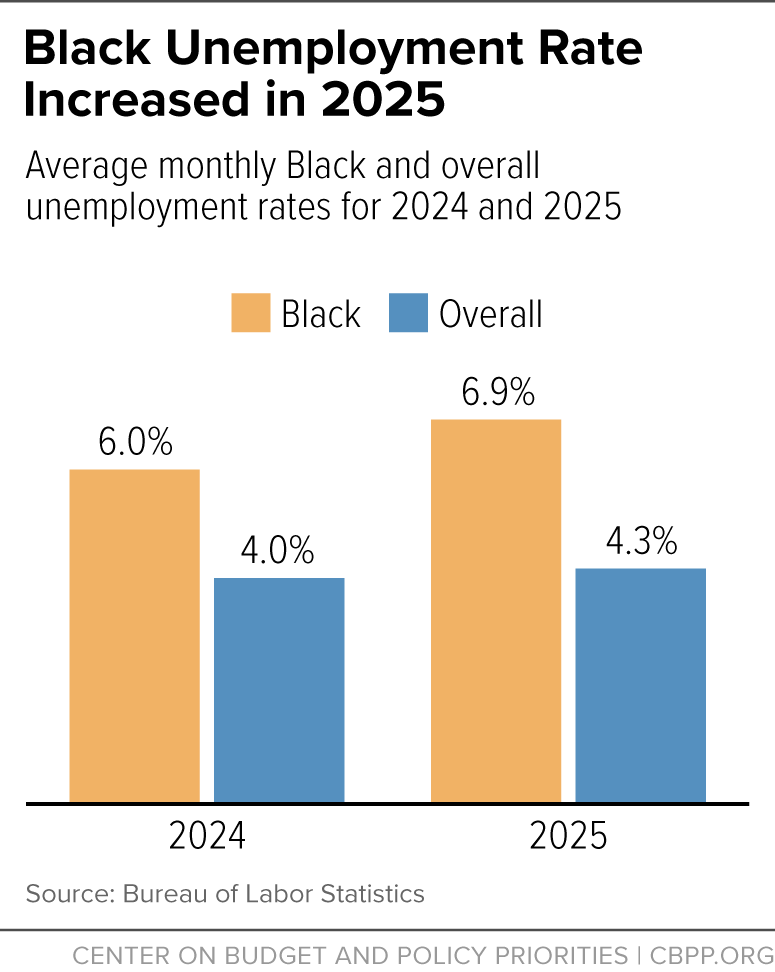
Amid the weakening labor market, unemployment among Black households jumped in 2025. In December, the Black unemployment rate was 7.5 percent, the highest since October 2021. Average monthly unemployment for Black workers was 0.9 percentage points higher in 2025 than in 2024, compared to a rise of only 0.3 percentage point in the overall unemployment rate over the same time (see chart). Over the course of 2025, the unemployment rate rose for both Black men and women and across the age span.
Focusing on industries, Black workers tend to be concentrated in sectors like the federal government, manufacturing, and private education and health services. In particular, federal government employment has provided a pathway to the middle class for Black households for decades. Since January 2025, the federal workforce lost 277,000 jobs, according to Bureau of Labor Statistics data, as a result of the Trump Administration’s direct targeting of this workforce with both layoffs and buyouts. Manufacturing employment has fallen by 72,000 since April 2025, when President Trump announced his massive tariff scheme on over 70 countries.
Conversely, employment in private education and health services rose in 2025 by 647,000 jobs. While the rise in employment in this sector is good news, wages for these workers haven’t grown enough to address affordability concerns. The average weekly earnings in this sector grew 1.9 percent in 2025, while average weekly earnings in all private employment grew 3.6 percent.
Impact of rising costs. While inflation was lower in 2025 than in 2024, the downward trend through the first half of 2025 stalled and reversed. The Consumer Price Index was 2.7 percent in December on a year-over-year basis after falling to a four-year low of 2.3 percent in April.
One reason for higher prices is the Administration’s tariff policy. The Trump Administration has hurt the broader economy by chaotically imposing — and changing — tariffs. This is harming the economy both by raising prices for consumers and increasing costs for businesses. The Administration effectively acknowledges this harm when it removes tariffs on specific goods. The uncertainty from the frequently changing tariff policies makes it harder for businesses to know when to invest and can cause consumers to hold off on their spending, none of which is good for growth.
Small businesses have struggled to adapt to this chaotic tariff scheme because they don’t have clarity on tariff rates or cannot avoid some of the high rates on inputs. Large corporations and politically connected companies, however, are often better able to get exemptions from tariffs because they can afford armies of lawyers, consultants, and lobbyists.
This problem is particularly acute for Black small businesses, which have been disproportionately affected by higher input costs, as they tend to operate on thinner profit margins and have less access to capital than similar white-owned businesses. Whether it is beauty stores that rely on international supply chains or transportation firms that source globally for parts and equipment, these Black-owned businesses are facing higher costs that require them to make decisions about either raising prices, cutting staff, or a combination of both. A majority of Black-owned businesses have fewer than 20 employees, and businesses of that size have cut 62,000 jobs since January 2025. The ongoing chaotic and haphazard tariff scheme will continue to present challenges for Black small businesses.
The standard of living for Black households and small businesses faltered in 2025 due to a variety of targeted policies from the Trump Administration, including tariffs and layoffs in the federal workforce. These data may be a canary in the coal mine, with the impact of economic weakening on Black households indicating how these struggles may spread throughout the economy absent steps to address them.
We would like to thank the Black Economic Alliance Foundation for their insights and support of this work.