MÁS ALLÁ DE LOS NÚMEROS
Missouri Tax Amendment Likely to Seriously Harm Services, Shift Taxes Onto Working Families
In early August, Missouri voters will decide one of the most consequential state tax policy questions in recent memory: whether to eliminate their state’s personal income tax. Such a step would jeopardize billions of dollars in yearly support for vital public services and shift taxes more heavily onto people with low and middle incomes. If adopted, the plan could seriously harm people not just in Missouri but elsewhere by sending into overdrive an already prevalent tax-slashing spree causing widespread harm.
Approving this amendment would make Missouri the first state to fully eliminate its personal income tax since oil-rich Alaska did in 1980, and the first ever to do so via ballot initiative. It would go a step beyond five other conservative-controlled states – Kentucky, Mississippi, Oklahoma, South Carolina, and West Virginia – that have taken serious steps toward axing their personal income tax in recent years, yet stopped short of near-immediate elimination. While policies in those states could eliminate personal income taxes over time if various benchmarks and triggers are hit – a harmful enough outcome in itself – Missouri’s proposed amendment would achieve that ultimate goal in a very short period.
Specifically, the Missouri measure would require future legislators to cut personal income tax rates as state revenue increases, down until the rates reach zero, and in turn allow them to expand state and local sales taxes far beyond their current limits. State lawmakers would have five years to change what is covered by sales taxes or to increase the rate to generate the required revenue. The result would be a tax system both far less fair and far less capable of raising the funding needed to support Missouri people and communities.
For one, Missouri’s income tax would be hard to realistically replace, paving the way for massive cuts to vital public services, including education. Missouri gets about 62 percent of its state revenue from the income tax, and another 24 percent from the sales tax. To replace the lost income tax revenue, lawmakers would have to either sizably expand the pool of goods and services subject to the sales tax – to things like home repairs, car insurance, and many business transactions – or significantly increase its rate. If future lawmakers chose not to expand the sales tax base at all, raising the revenue needed to offset the loss could require a combined state and local sales tax rate up to nearly 20 percent.
Given the political headwinds that sales tax hikes on that scale would face, the result would be near-certain cuts to core state and local services. Missouri is already collecting about $3 billion less each year due to prior state tax cuts – more than state policymakers send to local K-12 public schools through the state’s education funding formula each year. The state also faces significant new fiscal pressures from last summer’s harmful federal reconciliation law, which included massive federal cuts to health coverage, food assistance, and clean energy investments and shifted significant new responsibilities to states. Harm to public services may further compound due to some additional components of the ballot measure that could impact local budgets.
Even Missouri’s state auditor recently raised the alarm, noting in a formal report that “the state is on track to completely run out of money in the (general revenue fund) and be forced to implement emergency budget reductions — limiting options and maximizing pain for every Missourian and entity who relies on state funded services.”
And regardless of whether the sales tax rises, that tax would now bear the brunt of supplying the state’s revenue. This would shift the responsibility for funding state services further onto workers, families, and seniors and away from wealthier taxpayers. Like most states’, Missouri’s tax structure is already upside-down: Missourians who earn the least contribute a higher share of their incomes than Missourians who earn the most.
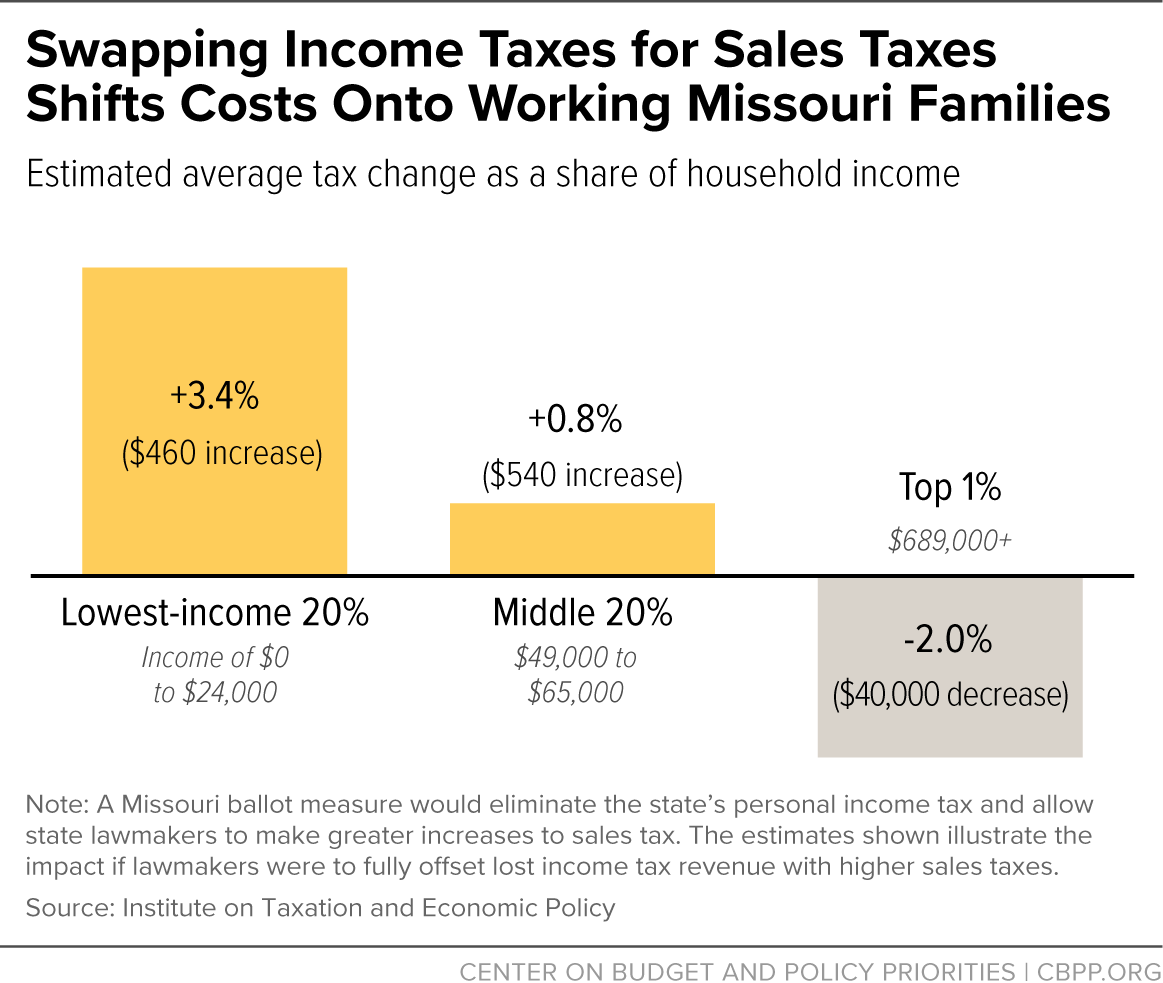
Tax changes that Missouri lawmakers adopted in recent years exacerbated this inequity; for example, a costly capital gains exemption passed just last year sent an estimated 80 percent of the benefit to the state’s richest 5 percent of residents. If lawmakers follow through on significant sales tax increases under this new amendment, it would double down on the unfairness; as many as 4 in 5 households could see an overall tax hike, with low-income taxpayers feeling the sharpest increase as a share of income (see chart).

As in many other states, proponents of this extreme tax shift have been pointing to stale claims around the relationship between state tax cuts and economic growth or interstate migration. But such claims wither under scrutiny. As just one example: of the five states that cut personal income taxes most deeply following the Great Recession of 2007-2009, all five saw weaker overall GDP growth than the nation as a whole in the years immediately after. And in one of those states, Kansas, a bipartisan supermajority of legislators had to eventually reverse tax cuts after the policy wreaked widespread damage.
The truth is that slashing state revenues is likelier to undermine state prosperity and attractiveness than to bolster it, given the crucial role public services play in people’s ability to access opportunity and businesses’ ability to compete. A better approach, for Missouri and other states, would be to prioritize equitable revenues and invest those funds in ways that make people’s lives better, as the recent experience of at least a dozen states has shown.