MÁS ALLÁ DE LOS NÚMEROS
In Case You Missed It...
This week at CBPP, much of our analysis focused on poverty, income, and health coverage data the Census Bureau released for 2025. But first, here’s a recap of our other work on food assistance, state budgets and taxes, and the federal budget and taxes.
- On food assistance, Jay Tomkus and Ed Bolen explained the 2025 Republican reconciliation law’s harsh SNAP work requirement doesn’t apply to Tribal citizens and provided guidance to state SNAP administrators on how to implement this exception from the work requirement to adequately protect Tribal citizens.
- On the federal budget and taxes, Kris Cox, Shelby Gonzales, Samantha Jacoby, and Claire Zippel warned that the Trump Administration’s proposed rule taking access to the Child Tax Credit and the Earned Income Tax Credit away from many people with lawful immigration statuses would affect roughly 1 million people and hundreds of thousands of U.S. citizen children. Kathleen Romig and Josephine Cureton updated our Executive Action Watch resource with the Trump Administration’s latest effort to use flawed and incomplete citizenship data to restrict voting access.
- On state budgets and taxes, Sam Waxman and Cassidy Sheppard explained how states can build on the success of federal tax credits by enacting and expanding state-level Child Tax Credits and Earned Income Tax Credits to help people afford the basics while investing in communities. Rachel Jacobson argued states should increase energy assistance for low-income households to address high energy costs, not cut climate programs for negligible energy bill reductions.
And here are our analyses of the Census data:
- In a statement, CBPP President Sharon Parrott explained that Census data for 2025 underscore the importance of food assistance and health insurance programs in helping families afford their basic needs and why cuts to these programs in the 2025 Republican reconciliation law are misguided. We also excerpted this statement.
- Our live resource, updated throughout the week, focused on topics including health. Gideon Lukens noted the uninsurance rate held steady from 2024 to 2025, but warned that over 2026-2028, Trump Administration regulations and Medicaid cuts in the Republican reconciliation law will take away health coverage and leave people without insurance. Lukens previewed that more Census data on health coverage trends will be released later this year.
- On data, Victoria Hunter Gibney explained that despite recent threats to the Census Bureau’s independence, this week’s data release appeared to follow standard procedures.
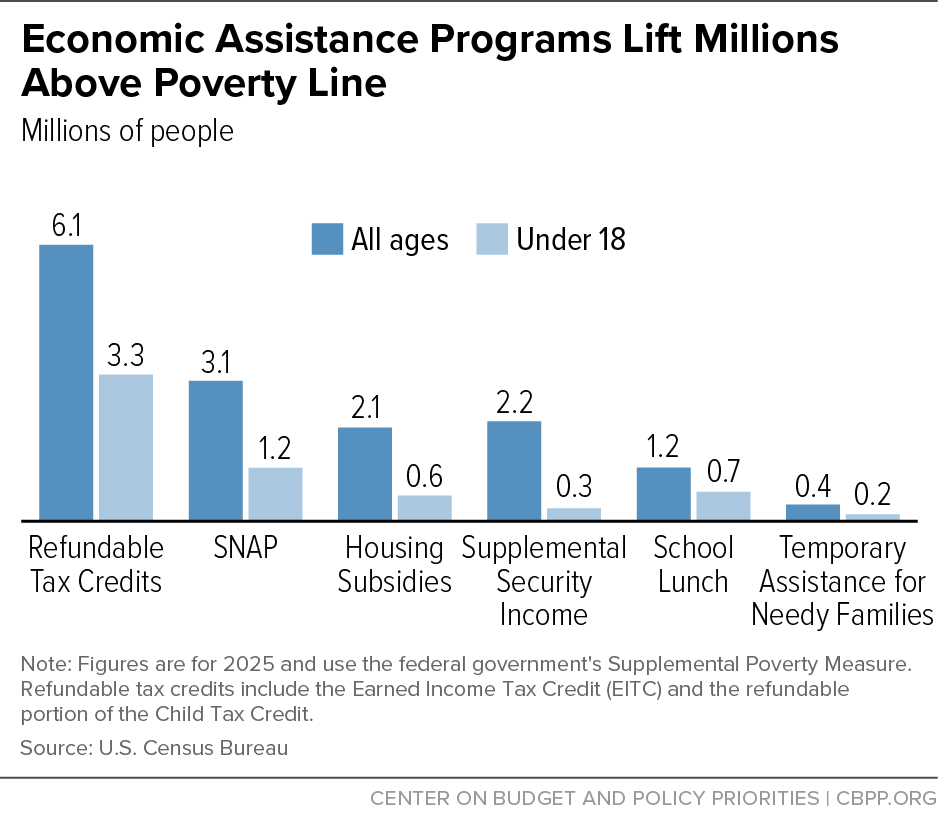
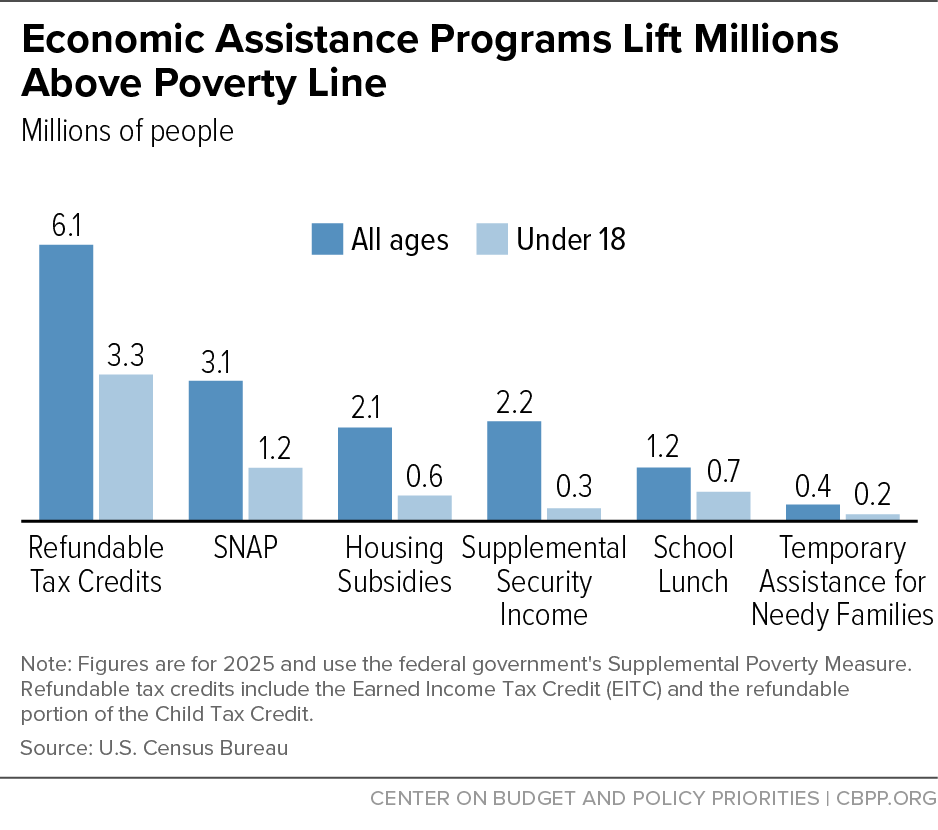
- On poverty and inequality, Claire Zippel underscored that the harmful Republican reconciliation law makes deep cuts to food assistance and health coverage programs that lifted millions of people out of poverty in 2025. Stephanie Hingtgen highlighted after-tax income inequality is at its widest point in at least 17 years. Danilo Trisi explained why the Supplemental Poverty Measure (SPM) is better for evaluating long-term trends in poverty and the effectiveness of government policies in reducing poverty. He also highlighted that we have the policy tools to reduce wide racial and ethnic disparities in child poverty, something our nation achieved in 2021 through pandemic relief policies that brought child poverty to a historic low. Arloc Sherman and Danilo Trisi explained different ways the Census measures poverty and noted that the data suggest living conditions improved modestly for people with low incomes in 2025. We also excerpted this blog.
Chart of the Week – Economic Assistance Programs Lift Millions Above Poverty Line
The Center was active on social media this week. Here are some highlights:
- Sharon Parrott posted a thread to X and Bluesky underscoring the important role Medicaid, ACA marketplace coverage, and SNAP play in helping families afford the basics, as indicated by the latest Census data.
- Katie Bergh posted a thread to X and Bluesky on this week’s Senate farm bill markup, highlighting the growing impact of SNAP cuts and the need for Congress to strengthen the proposal.
- Shelby Gonzales posted a thread to X and Bluesky on lawsuits challenging the Administration’s harsh new public charge policy, which would give immigration officers sweeping discretion, increasing the risk of bias and discrimination, and leading families to forgo help they are eligible for.
A variety of news outlets featured CBPP’s work and experts this past week. Here are some of the highlights:
Family income rose and poverty fell in 2025 — but safety net cuts could erase gains
NPR
September 15, 2026
Poverty Rate Was Stable Before Trump’s Safety Net Cuts Gained Force
New York Times
September 15, 2026
Census data shows US poverty rate drops to lowest on record, but experts are cautious
Stateline
September 15, 2026
U.S. poverty rate drops slightly, but experts fear worse ahead
The Washington Post
September 15, 2026
More than 1.2 million children have lost SNAP benefits since last July. Experts explain why
PBS
September 14, 2026
Rural Americans feel the sting of sweeping federal food aid restrictions
Harvest Public Media
September 14, 2026
Don’t miss any of our posts, papers, or charts — follow us on Bluesky, Twitter, Facebook, Threads, and Instagram.
Authors