

MÁS ALLÁ DE LOS NÚMEROS
Hiking Sales Taxes to Cut Property Taxes Is Unfair for Low-Income Residents
Our tax code works best when it adequately funds the public services that make our society better without putting financial strain on people already struggling to get by. Yet many state legislators across the country are pursuing inequitable property tax cuts that would undermine local governments and benefit wealthy residents over renters, who are more likely to struggle with housing affordability.
Lawmakers in some states including Ohio, South Dakota, and Wyoming, are considering “tax swaps,” cutting property taxes and replacing the forgone revenue with higher sales taxes, either by increasing the sales tax rate or by expanding the goods and services it applies to.
State politicians claim shifting local funding away from property taxes and toward sales taxes is an effort to maintain funding for local services using what they see as a “fairer” tax, or at least a tax that would be easier for households to manage. This swap is ultimately a poor deal for most families, though, as sales taxes are more volatile and take up a greater share of income for people with low earnings.
The kinds of services that property taxes fund, like public education and public safety, require a funding source that is stable regardless of economic conditions. Property taxes are uniquely suited to this task as they remain the most stable of the three major taxes (income, sales, and property) even in the face of economic downturns. Tying local services to property taxes means that the schools we send our children to, the roads we drive on, and the programs that keep our communities safe and healthy will be less vulnerable when recessions strike.
Property taxes also take less of a toll than sales taxes on people who are already struggling to get by. While there is still more to be done to make property taxes fairer, they remain less regressive than sales taxes, which require a greater share of income from people with less financial means and a lower share from people who are well off. Sales taxes also coexist alongside other regressive revenue sources like fines and fees, making local services even more expensive for those with the least ability to pay. Swapping property taxes out for sales taxes would make state and local taxes even more rigged in favor of the wealthy.
Proposals to substitute sales tax revenue for property tax revenue also ignore an important fact: most people already pay more in sales tax than they do in property tax. Nationally, the middle 20 percent of income earners pay 4.8 percent of their income in sales and excise taxes on average, compared to only 3.1 percent of their income in property taxes. This difference is even starker for people with low income, with the bottom 20 percent by income paying 7 percent of their income in sales and excise taxes, compared to 4.4 percent in property taxes.
People are often unaware of this because sales taxes are typically paid in dollars or even cents at a time, with no total invoice for the year. Property taxes, by contrast, are either paid monthly (for people with mortgages) or in lump sums, which are much more visible and less predictable. When you add up the total amount most people pay in a year, though, sales taxes clearly come out ahead.

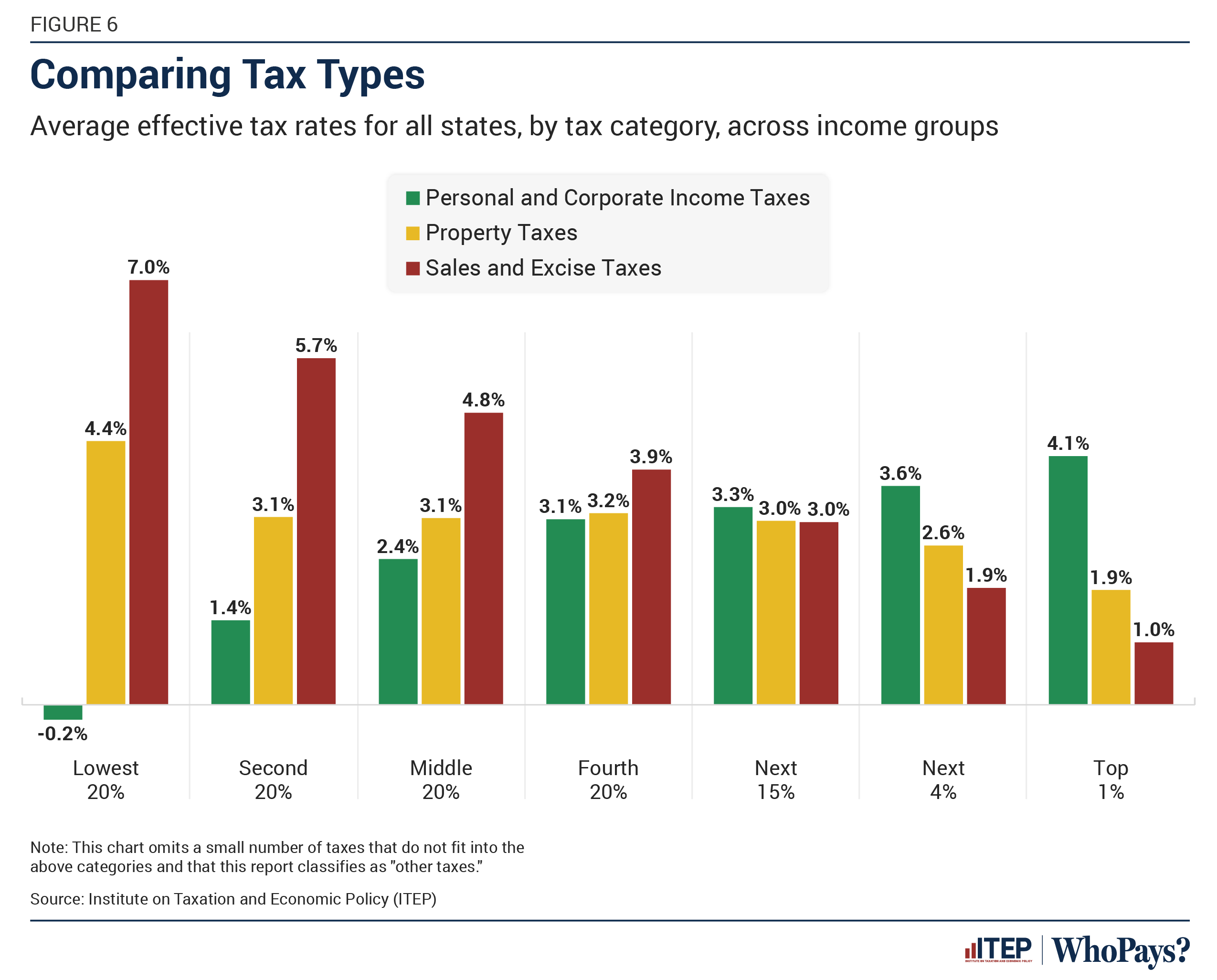

The disparity between what most people pay in sales taxes compared to property taxes isn’t particularly small, either. In 39 of the 45 states (plus Washington, D.C.) that have statewide sales taxes, the bottom 60 percent of households pay more in sales taxes than property taxes. In at least five states, the bottom 80 percent of households pay at least triple in sales tax what they pay in property tax.
States relying more on regressive sales taxes rather than more equitable options like property or income taxes is no accident. In fact, white lawmakers in Jim Crow Mississippi created the first modern retail sales tax in an explicit attempt to shift taxes away from wealthy white property owners and onto Black families, who owned less property and had few other assets to tax. In Alabama, the 140-year-old limit on local property taxes was created by white legislators post-Reconstruction to shield wealthy white property owners from any increases in property taxes should Black residents regain political power. Modern efforts to limit property taxes and shift the funding of public goods onto people with low incomes are less explicitly racist, but they still carry on an ugly history of tax policy intended to advance white supremacy.
There are better ways lawmakers can make property taxes fairer, particularly for those living on low or fixed incomes. By creating or expanding circuit breaker programs, legislators can better tie property taxes to people’s ability to pay. States can also allow or promote property tax deferrals for people on fixed incomes, allowing them to pay the property taxes on their homes only when those homes are sold, which is when taxpayers will be most able to afford them. Through these and other administrative fixes, state legislators can make property taxes fairer for their constituents without deepening their states’ reliance on regressive sales taxes.