MÁS ALLÁ DE LOS NÚMEROS
Five Reasons Lawmakers Should Reject Expansions of Health Savings Accounts
Expanding health savings accounts (HSAs) is a key element of Republicans’ health care policy agenda. Ostensibly, HSAs allow people enrolled in certain health insurance policies to set aside money for medical expenses. In reality, HSAs offer a triple tax advantage for the wealthy – a tax shelter masquerading as health policy.
Over a dozen bills expanding HSAs were introduced in the first four months of 2025, ranging from broad proposals that would greatly expand HSA eligibility and contribution limits to niche bills (including some bipartisan bills) that would expand HSAs in particular domains.
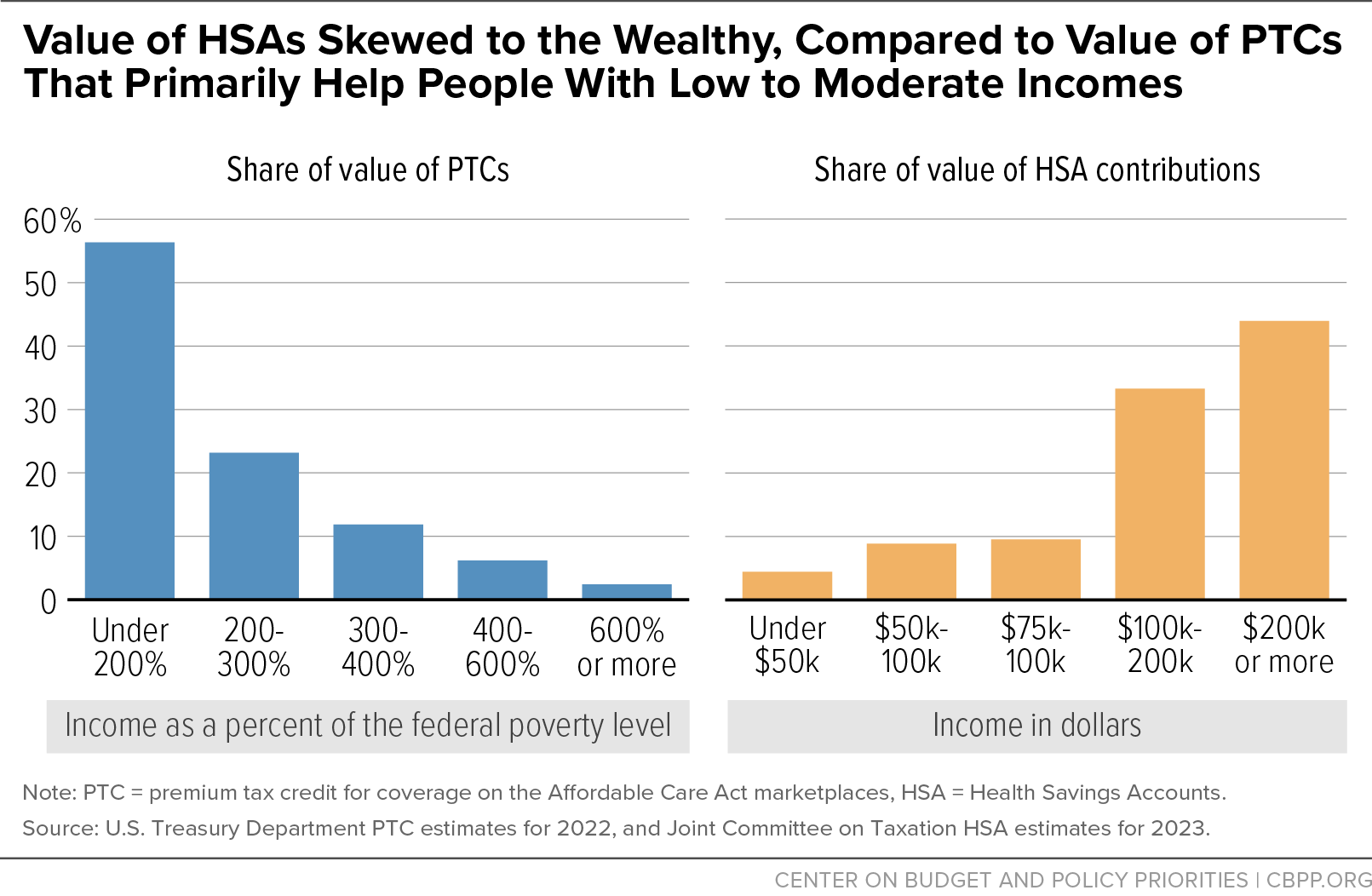
Consistent with other elements of the Republicans’ tax agenda, expanding HSAs would overwhelmingly benefit people with high incomes and substantial wealth. Moreover, expanding HSAs could crowd out policies that help people with low and moderate incomes afford health coverage and medical needs, such as the enhanced premium tax credits that cut health insurance costs for more than 20 million people enrolled in the Affordable Care Act (ACA) marketplaces. The enhanced premium tax credits are set to expire this year unless Congress extends them.
In addition, House Republican leadership is considering hundreds of billions of dollars in cuts to Medicaid, which provides health coverage for low-income people. Instead, policymakers should limit HSAs, generating federal savings in a way that increases equity without taking away people’s health coverage.
Here are five reasons why policymakers should reject expansions of HSAs:
1. HSAs mostly benefit people with high incomes.
Under current law, people enrolled in high-deductible health plans that meet certain standards can establish and set aside money in an HSA. These accounts offer a triple tax advantage: (1) contributions are not taxed; (2) contributions can be invested in stocks and bonds and rolled over indefinitely, with tax-free earnings; and (3) withdrawals are not taxable if they are used for qualified medical expenses that occurred after establishment of the HSA.
These tax advantages ensure that HSAs — and any proposal that expands them — largely benefit people with higher incomes. That’s because people with higher incomes have more money to contribute and save, and because they’re in higher tax brackets, they get a bigger benefit for each dollar saved. For example, a married couple making $800,000 saves 37 cents for each dollar contribution to an HSA, more than three times the 12 cents per dollar saved by a married couple making $30,000.
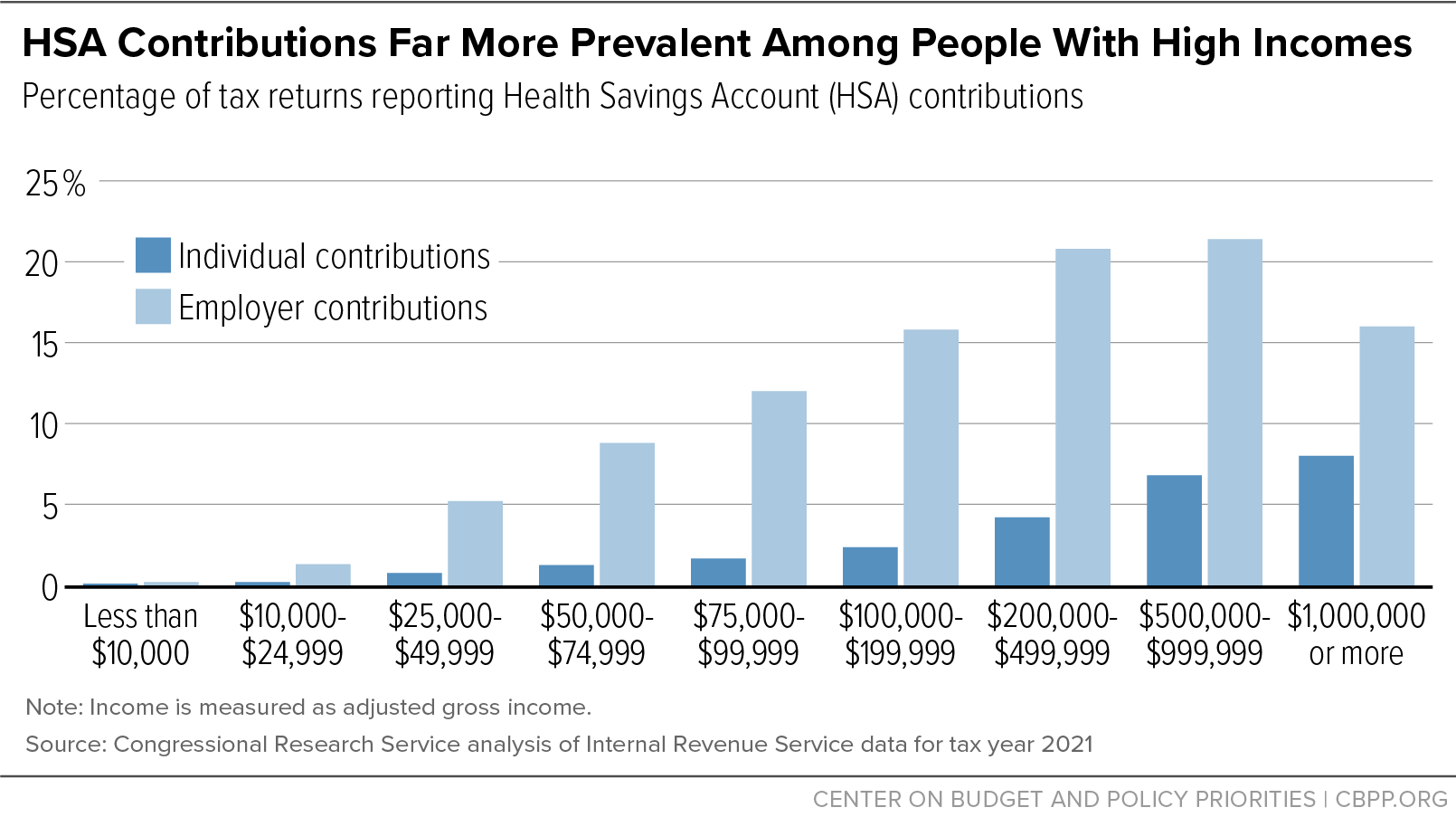
An analysis of 2021 IRS data found that tax returns with incomes of $1 million or more were the most likely to report individual HSA contributions, and returns between $500,000 and $1 million were the most likely to report employer contributions (see chart).

2. HSAs provide little help to people with lower incomes or who have difficulty affording health care.

Conversely, HSAs provide little help to people who have lower incomes or who struggle to afford health care. After paying premiums and paying upfront for needed medical care prior to meeting the deductible, many people won’t have money left to put into an HSA. HSAs are widespread, in part because many employers have few insurance options, but a large fraction of HSAs provide no benefit because they aren’t used. Over half of the accounts have a balance of less than $500, including more than 1 in 5 accounts with a balance of $0.
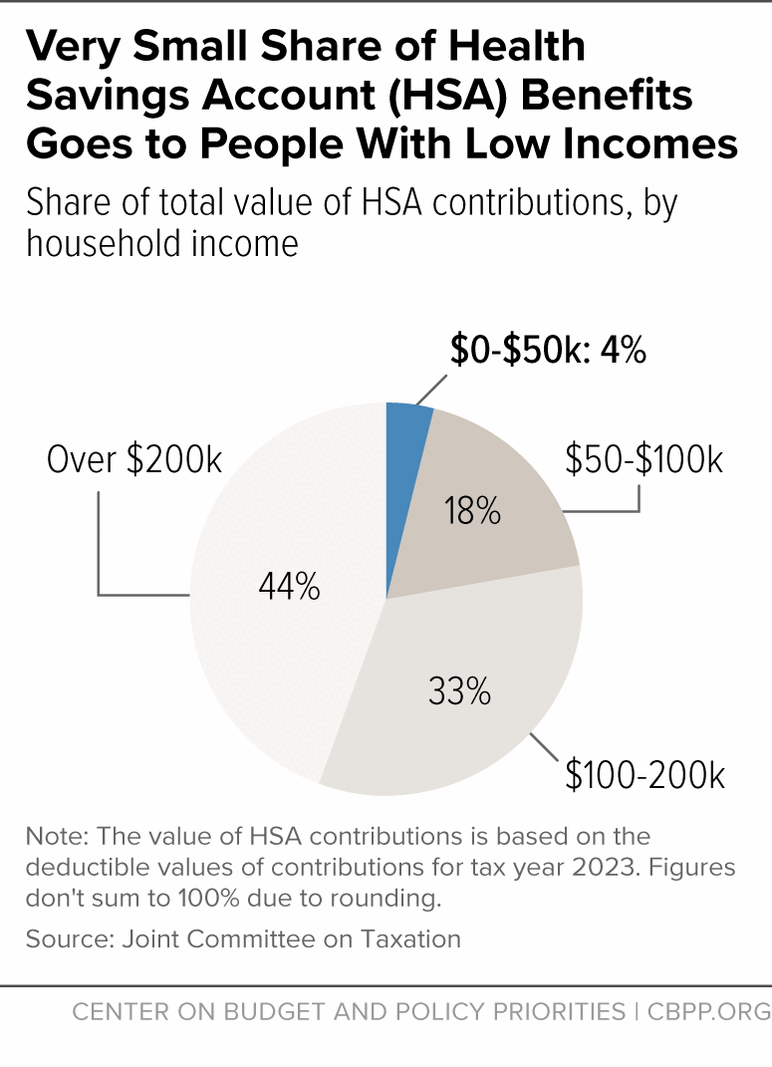
Even if they can contribute, the tax benefit for people with low incomes is minimal because they are in low tax brackets. According to Joint Committee on Taxation estimates for tax year 2023, 77 percent of the total deductible value of HSA contributions goes to households with incomes over $100,000 (see chart.) Only 4 percent of the value goes to households with incomes $50,000 or below, and 44 percent goes to those with incomes over $200,000.
And according to a report from the Consumer Financial Protection Bureau, HSAs are rife with junk fees and typically provide an interest rate of well under 1 percent. Monthly and other fees are less problematic for people in high tax brackets who use HSAs to invest in stocks and bonds, but less than 9 percent of HSAs have any portion of balances in investments. For the overwhelming majority of HSAs that have no investments, junk fees may significantly erode any tax savings.
3. HSAs exacerbate racial disparities in wealth.
Among people with private health coverage, Latino and Black people are about half as likely to have HSAs than are white and Asian people. Moreover, HSA holders in disproportionately Black or Latino zip codes contribute smaller amounts and have lower balances, on average, than HSA holders in disproportionately white or Asian zip codes. Against a backdrop of long-standing racial disparities in wealth that can be traced to discrimination in housing, banking, taxation and other areas — a typical white family in 2022 had six times the wealth of a typical Black family and five times the wealth of a typical Latino family — HSAs provide preferential tax treatment that is disproportionately out of reach for Black and Latino people.
4. HSAs don’t improve health care affordability and access, and they don’t make spending more efficient.
HSAs do nothing to address the urgent problems people face in accessing affordable health care. For example, 4 in 10 people have debt due to medical or dental bills. Given that they can’t cover their existing medical expenses, it’s unlikely that they have spare cash to set aside in an HSA. And HSAs are a bad deal for people with chronic conditions or illnesses, who often face significant health costs.
HSAs also do not promote efficient use of health care services. Research found no evidence that people switching into high-deductible health plans, which are required for HSA contributions, learn to shop for lower prices. And multiple studies found that HSAs do not reduce health care spending at all, instead just shielding more of that spending from taxes.
5. HSAs crowd out policies that would better help people afford coverage and care.
HSAs are projected to cost $180 billion in lost revenues over 2025-2034. That’s a significant amount of federal resources that could be put to better use. The cost of HSAs over the next ten years would cover the cost of extending the enhanced premium tax credits for marketplace enrollees for roughly six years, or closing the Medicaid coverage gap for about nine years — policies that would provide coverage and lower costs for millions of people with low and moderate incomes, who are most likely to lack health coverage or have trouble affording care.

Proposals to expand HSAs would only add to their costs. Instead of throwing more money into these high-income tax breaks disguised as health policy, policymakers should target federal resources toward expanding coverage, increasing affordability, and improving equity.