MÁS ALLÁ DE LOS NÚMEROS
Continued Freeze of Greenhouse Gas Reduction Fund Threatens Climate Investments in Vulnerable Communities Across the Country
One of the largest solar developments in Arkansas, energy efficiency renovations of housing for low-income seniors, and other clean energy projects prioritizing low-income communities across the country are at-risk as the Trump Administration tries to terminate a key source of federal funding for these projects, the Greenhouse Gas Reduction Fund (GGRF).
Created through one of the most significant climate laws in U.S. history, known as the Inflation Reduction Act, GGRF is intended to benefit low-income communities by helping to finance and develop clean energy projects that lower energy costs and improve health for those most at risk of harm from air and climate pollution from fossil fuels.
While the Trump Administration’s actions are being challenged in the courts, the vast majority of GGRF awards, or $20 billion of the $27 billion total, are currently unavailable because the Environmental Protection Agency (EPA) blocked grantees’ ability to draw down the grant funds. The Administration should immediately end the freeze and allow the program to proceed as intended.
Clean energy projects, particularly in low-income communities, often struggle to obtain financing in traditional credit markets because they may, for example, have small project sizes, rely on newer technologies, or require longer payoff periods relative to traditional energy projects.
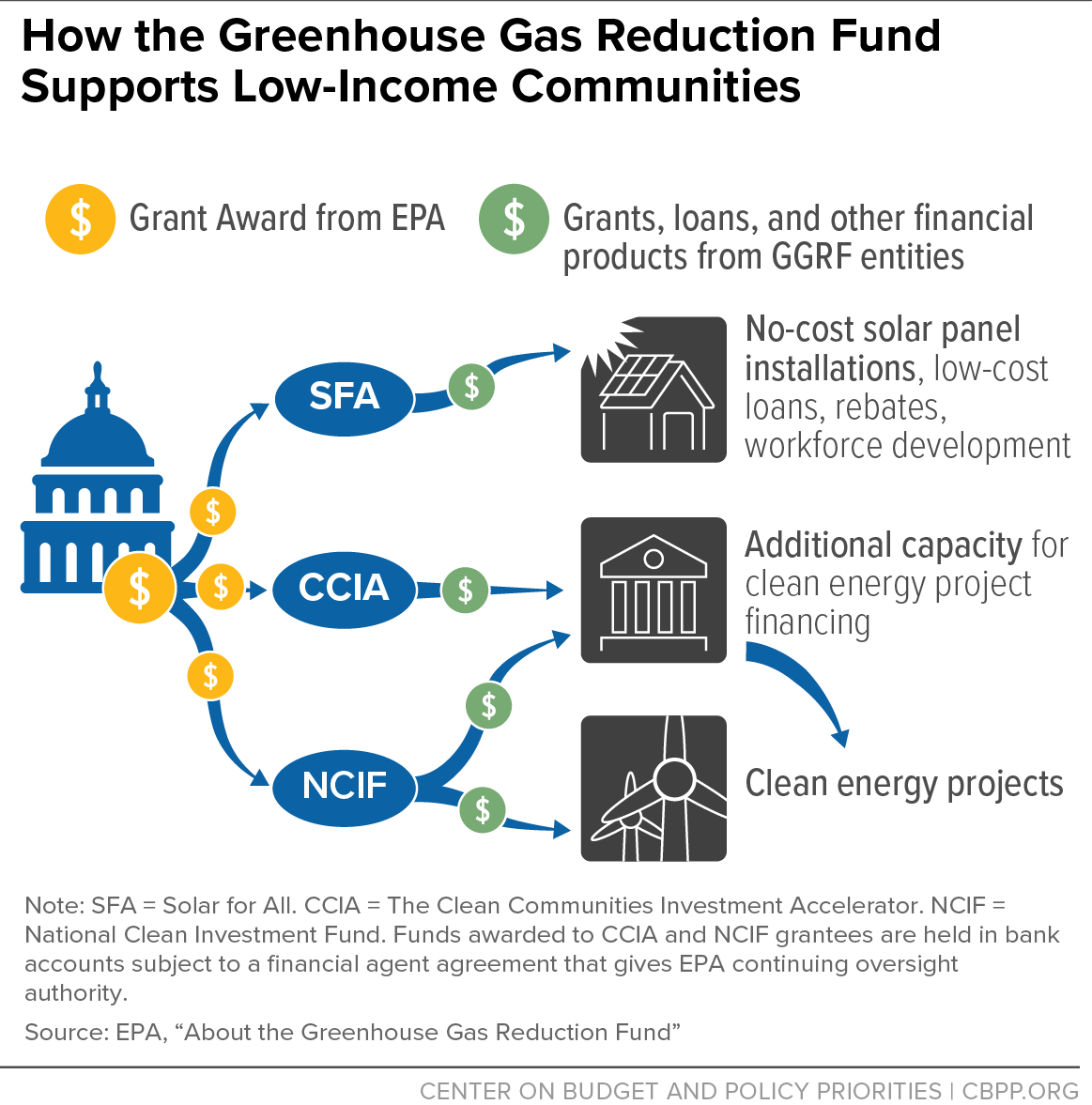
GGRF consists of three distinct but related competitive grant programs, each tackling a different set of finance barriers to clean energy development in low-income communities. The EPA selected the GGRF grantees under each program, and these grantees use their awards to finance or fund clean energy and other climate-related projects — either by making loans to project developers or funding them directly, or by making awards to intermediary entities that will provide such funding or financing. (See graphic.)
- The National Clean Investment Fund (NCIF). NCIF awarded a total of $14 billion to three national nonprofits — Climate United Fund, Coalition for Green Capital, and Power Forward Communities — to serve as national green banks and provide new and expanded financing products, such as loans and loan guarantees, to directly finance new clean energy projects across the country, and to make loans to other financing institutions that will also finance projects. The three NCIF grantees must commit 50 to 75 percent of their funding to low-income and disadvantaged communities.
- The Clean Communities Investment Accelerator (CCIA). CCIA awarded a total of $6 billion to five coalitions of nonprofit community lenders. These grantees —Opportunity Finance Network, Inclusiv, Justice Climate Fund, Appalachian Community Capital, and Native CDFI Network — provide sub-grants to community lenders, such as community development financial institutions (CDFIs), credit unions, and nonprofits. All CCIA funding is dedicated to low-income and disadvantaged communities, with 10 percent for technical assistance to community lenders to build their expertise and capacity to provide clean energy financing.
- Solar for All. Solar for All provides $7 billion to 60 state, tribal, and local governments and nonprofits to create or expand residential and community solar programs in low-income and disadvantaged communities. Solar for All grantees are establishing grants, low-interest loans, and other financial incentives for community solar projects, which are critical for enabling low-income households to participate in the benefits of solar energy projects, such as lowered energy costs, healthier air, and improved energy resilience.

The NCIF and CCIA grantees are currently unable to access their grant awards or use the awards to finance clean energy projects because the EPA ordered a freeze of their grant accounts and is seeking to terminate the grants altogether. A federal court blocked EPA’s termination of the grants, but the funds remain frozen while court proceedings continue. (Solar for All faces its own set of threats, as it was subject to the Trump Administration’s initial set of unlawful funding freezes, but those funds continue to flow.)
As a result of the funding freeze on NCIF and CCIA grantees, project developers waiting for GGRF financing to come through may be unable to develop projects on schedule, while others could face higher costs to obtain alternative financing sources. In other cases, projects may be cancelled altogether.
Some of these at-risk projects include:
- NCIF grantee Climate United Fund awarded pre-construction funding for a solar project for the University of Arkansas that is expected to save $120 million in energy costs for the state’s public university system. According to Climate United Fund’s legal filings, this project will not move forward if the freeze is not lifted.
- Another NCIF grantee, Power Forward Communities, alleged in legal filings that several of its projects, including renovation of an affordable senior-living facility and other affordable housing projects across the country would likely fall through without restored access to GGRF funding.
- CCIA grantee Inclusiv, a CDFI that leads a network of credit unions, has awarded a substantial part of its $1.87 billion CCIA grant to 64 credit unions across 26 states for operating and capitalization funds for green lending programs. Many of these programs could be abandoned without Inclusiv’s seed funding through GGRF.