

With Federal Climate Funding at Risk, Policymakers Should Protect Benefits for Those Most Impacted and With Fewest Resources
Recent years’ transformative climate legislation is benefiting communities nationwide, including frontline communities: those most impacted by climate change and least resourced to respond.[1] Rural communities are among those benefiting, and so far, Republican-held districts have received a majority of these investments.[2] But threatened cuts risk upending this progress: House Republicans are reportedly considering large cuts to clean energy tax credits and climate funding, and the Trump Administration has issued multiple directives affecting grant and loan disbursements.[3] Policymakers should protect against any such cuts or unlawful impoundment of funds,[4] most strongly defending investments in frontline communities — of whom Black and Latine people, Native Americans, and people with low incomes or wealth make up an outsized share.
This outsized impact is due to many forms of discrimination, such as underinvestment and redlining, and requires targeted climate funding to meet long-unaddressed, critical needs in these communities. Targeted funds in the Inflation Reduction Act (IRA) and Infrastructure Investment and Jobs Act (IIJA) are reducing harmful air pollution from diesel buses, decreasing energy costs for people struggling to pay monthly expenses, and supporting water supplies in the face of unprecedented droughts, to name just a few key benefits.[5]
Protecting Federal Climate Funding From Cuts
A menu of tax and budget options being circulated by House Republicans confirms that they are considering cuts to some or all of the clean energy and clean vehicle tax credits created or expanded by the IRA. The list also identifies IRA grant and loan funding for climate investments as potential targets, signaling that Republicans may try to repeal these programs by rescinding any unspent funds. Congressional Republicans may attempt these cuts to tax credits, grants, and loans during budget reconciliation, posing a serious threat given that reconciliation bills require only 51 votes to pass the Senate.[6]
Congressional Threats to Tax Credits
Tax credit cuts could range from eliminating entire credits to reducing credit availability, such as by forcing the credits to sunset earlier or capping the credit amount that a household or manufacturer may claim. The following provisions provide the greatest direct benefit to the people and communities who are most impacted by climate change and have the fewest resources to respond. Preserving them should be a priority.
Direct pay. This innovative system makes several IRA clean energy tax credits available for the first time to tax-exempt and public entities such as nonprofits, state and local governments, and economic development agencies; previously only for-profit entities could claim them.[7] Direct pay-eligible entities are well positioned to partner with frontline communities to ensure they can access the credits’ benefits — and are not left out of this source of investment, which is often the case under the traditional tax credit system.[8] Direct pay-eligible projects can improve health for vulnerable populations; decrease energy costs for state and local governments and other tax-exempt entities pursuing clean energy projects; improve energy reliability; and expand economic opportunities in areas facing underinvestment.[9]
Before the IRA provided access to tax credits through direct pay, tax-exempt entities relied on alternative, often more costly, sources of funding to finance projects, such as taking on a larger loan or contracting with a third-party investor to own the project and receive the tax credits. These alternatives often made projects less financially feasible, limited the amount of energy savings, or deterred projects altogether.
- Clean electricity investment tax credit (ITC) and production tax credit (PTC). These credits are two of the most commonly claimed by entities that are using direct pay, and have helped spur tremendous growth in renewable energy generation. Communities nationwide have benefited, with projects ranging from solar panels on churches in rural Pennsylvania and on a Boston nonprofit hospital, to geothermal heat pumps in Kentucky schools.[10]
- Low-income communities bonus credit. This provides a 10 to 20 percent bonus to the ITC for certain clean energy projects in designated economically distressed communities or on tribal lands. Treasury may allocate credits for projects totaling 1.8 gigawatts of power output per year, including some reserved for certain project categories, such as those on Indian land or that benefit residents of federally subsidized housing.[11] Other projects given allocation priority under Treasury rules include those owned by direct pay-eligible entities or ones located in climate-disadvantaged areas, that is, those meeting criteria for persistently high poverty, high energy or pollution burdens, and least investment.[12]
- Commercial clean vehicle credit. School districts, local governments, and state agencies are using this credit through direct pay to offset up to 30 percent of the cost of each vehicle (up to $7,500 per small vehicle and $40,000 per large vehicle) as they electrify their fleets. Loudoun County Public Schools in Virginia, for example, has completed electric vehicle and solar projects throughout the district, and expects a $2 million dollar reimbursement through direct pay.[13] This builds energy resilience for the school system, whose students also stand to benefit from the health and attendance improvements projected to result from less diesel usage.[14]
- Credit for charging infrastructure. Projects in areas that have faced significant underinvestment in clean vehicle infrastructure — non-urban areas and designated low-income census tracts — are using this credit, including through direct pay, to claim up to 30 percent of the cost of charging infrastructure for electric vehicles, up to $100,000.
Even the threat of repeal creates market uncertainty and erodes consumer confidence, which could limit lenders’ willingness to provide upfront capital for clean energy projects — which is necessary for projects to begin. In addition to maintaining these credits, policymakers should bolster clean energy finance markets by continuing to provide grant and loan funding, which can make projects in low-income communities more viable, including by attracting more private investment.
Congressional Threats to Grant and Loan Funding
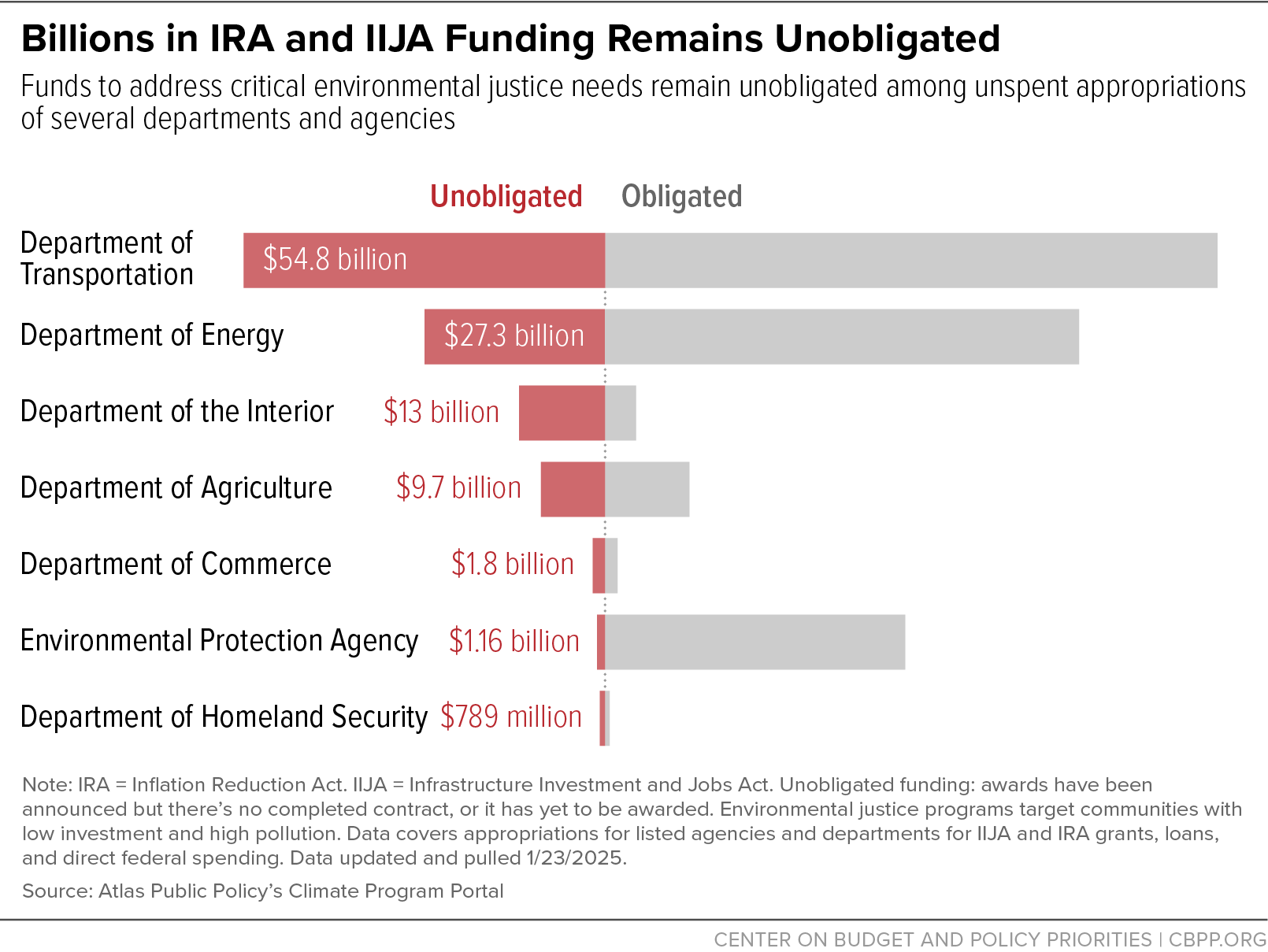
The House Republican budget options list includes cuts to IRA and IIJA grant and loan programs that would reduce funding or effectively repeal entire programs. These cuts would affect unobligated funds — that is, funding for which awards have been announced but the contracting process has not been completed, and funding that agencies have yet to allocate or award. (See box.)
Funding for programs addressing critical environmental justice needs remains unobligated across a wide range of programs in several agencies, as many programs targeted long-term investment, with implementation deadlines between 2027-2031. Examples of such programs include the Environmental Protection Agency’s (EPA) Thriving Communities program, which provides grants and technical assistance to community-based organizations for projects such as ensuring reliable electricity during extreme weather events and decreasing health impacts of air pollution; climate resilience grants for tribal nations administered by the Department of the Interior; and the Department of Homeland Security’s Building Resilient Infrastructure and Communities program, which provides grants to local governments to build resilience to climate hazards through actions such as regular maintenance of trees and shrubs to reduce wildfire risks.
See Figure 1 for an overview of unobligated funding by department, and Figure 2 for details on remaining unobligated funds for EPA environmental justice programs, which are critical for ensuring underserved communities get the funding they typically wouldn’t to meet the challenges of a changing climate. [15]



Administrative Threats to Federal Climate Funding
Recent administrative actions have directed agencies to pause disbursement and contracting of IRA and IIJA climate funds. On January 20, President Trump issued an executive order titled “Unleashing American Energy,” directing all agencies to immediately pause disbursement of certain IRA and IIJA grants and loans.[16] On January 27, the Office of Management and Budget (OMB) issued a memo to all agencies directing them to freeze most federal grant and loan programs.[17]
The funding freeze is being challenged through the legal system: two federal courts ruled to temporarily block the freeze, and OMB has since withdrawn its memo.[18] Still, the January 20 executive order has not been rescinded, and there is much confusion around what the executive order means for recipients of federal climate funding through the IRA and IIJA.[19] For example, grantees of the Solar for All program — which provides grants for solar energy systems in low-income communities — have reportedly been unable to draw down obligated funds.[20]
These recent executive actions pose short- and long-term risks to climate grants and loans across multiple stages of implementation. Funding delays — even if only temporary while litigation is being resolved — can pose real harm to projects, calling their long-term viability into question.[21]
Even if the funding freeze is eventually lifted and disbursements resume, obligated funding could also be threatened if agencies attempt to end individual grant awards by terminating contracts with awardees. Such actions may or may not be legally authorized, depending on the requirements to terminate awards laid out in each contract.[22]
IRA programs that have not advanced to the award stage — especially those not yet taking applications — could also face threats from reprogramming: the IRA allows the Administration to legally move up to 10 percent of these funds to a different activity within the same budget account.[23]
Any slowdown of the grantmaking process, including pauses, cuts, or even just ambiguity, moves these resources further out of reach for small and low-capacity communities who can’t afford to absorb the increased upfront cost that comes with a longer time frame and higher level of uncertainty.
End Notes
[1] CBPP, “Policy Basics: Advancing Racial, Economic, and Health Justice Through Climate Action,” December 12, 2024, https://www.cbpp.org/research/climate-change/advancing-racial-economic-and-health-justice-through-climate-action.
[2] Liam Denning et al., “Biden Is Giving Red Districts an Inconvenient Gift: Green Jobs,” Bloomberg, June 20, 2024, https://www.bloomberg.com/graphics/2024-opinion-biden-ira-sends-green-energy-investment-republican-districts/.
[3] Benjamin Guggenheim, “GOP budget menu outlines sweeping spending cuts,” Politico, January 17, 2025, https://subscriber.politicopro.com/article/2025/01/reconciliation-menu-reveals-wide-ranging-gop-policy-priorities-00198940 ; Jeff St. John, “Trump freezes Inflation Reduction Act and infrastructure-law funding,” Canary Media, January 21, 2025, https://www.canarymedia.com/articles/policy-regulation/trump-orders-freeze-on-inflation-reduction-act-infrastructure-law-funding; Michael D. Shear, “Judge Stays Trump’s Federal Funding Freeze, but Disruption to Medicaid Sows Fear,” New York Times, January 28, 2025, https://www.nytimes.com/2025/01/28/us/politics/trump-freeze-funding.html.
[4] Richard Kogan, “FAQs on Impoundment: Presidential Actions Are Constrained by Long-Standing Constitutional Restrictions,” CBPP, November 21, 2024, https://www.cbpp.org/research/federal-budget/faqs-on-impoundment-presidential-actions-are-constrained-by-long-standing.
[5] U.S. Environmental Protection Agency, “Clean Heavy-Duty Vehicles Grant Program Tentative Selections,” December 11, 2024, https://www.epa.gov/clean-heavy-duty-vehicles-program/clean-heavy-duty-vehicles-grant-program-tentative-selections; RMI, “16 Rural Electric Cooperatives Will Leverage $7.3 Billion in Federal Funding to Deliver More Affordable, Reliable Electricity to Their Members,” September 5, 2024, https://rmi.org/press-release/16-rural-electric-cooperatives-will-leverage-7-3-billion-in-federal-funding-to-deliver-more-affordable-reliable-electricity-to-their-members/; U.S. Department of the Interior, “Biden-Harris Administration Announces Nearly $64 Million for New Water Conservation Agreements to Protect the Colorado River System,” November 3, 2023, https://www.doi.gov/pressreleases/biden-harris-administration-announces-nearly-64-million-new-water-conservation.
[6] Richard Kogan and David Reich, “Introduction to ‘Budget Reconciliation,’” CBPP, updated May 6, 2022, https://www.cbpp.org/research/introduction-to-budget-reconciliation.
[7] Mikaela Tajo and Rachel Jacobson, “Direct Pay Outcomes Highlight Clean Energy Benefits, But Threatened Cuts Pose Risks,” CBPP, January 22, 2025, https://www.cbpp.org/blog/direct-pay-outcomes-highlight-clean-energy-benefits-but-threatened-cuts-pose-risks; Jacobson and Samantha Jacoby, “States Should Spur Use of ‘Direct Pay’ Tax Credits to Advance Clean Energy in Low-Income Communities,” CBPP, September 26, 2024, https://www.cbpp.org/research/climate-change/states-should-spur-use-of-direct-pay-tax-credits-to-advance-clean-energy-in.
[8] Ricardo Kumelys, “Energy Inequality and the Just Transition: How Can We Make the Benefits of Clean Energy Accessible to Everyone?” Berkeley Energy & Resources Collaborative, November 7, 2024, https://berc.berkeley.edu/news/energy-inequality-and-just-transition-how-can-we-make-benefits-clean-energy-accessible-everyone.
[9] Jacobson and Jacoby, op. cit.
[10] Amrith Ramkumar, “Churches Look Skyward for Energy Savings,” Wall Street Journal, October 26, 2024, https://www.wsj.com/business/energy-oil/churches-look-skyward-for-energy-savings-f00f677a?msockid=34b93e47740366d712d62abb75ae67ad; Martha Bebinger, “Why these doctors started writing medical 'prescriptions' for solar power,” NPR, December 9, 2024, https://www.npr.org/sections/shots-health-news/2024/12/09/nx-s1-5193035/boston-low-income-patients-utility-cutoff-doctors-prescriptions-solar-power-hospital-rooftop; CMTA, “Hart County Schools Receives $793K for Geothermal,” January 21, 2025, https://www.cmta.com/news/hart-county-schools-geothermal.
[11] To learn more about the eligibility categories for the low-income communities bonus credit program, see: https://drive.google.com/file/d/1oC1KG06cEKiYN3oHIga7gZu-XdA4lecJ/view.
[12] For methodology on these criteria, see the Climate and Economic Justice Screening Tool at https://www.cakex.org/tools/climate-and-economic-justice-screening-tool-cejst.
[13] UndauntedK12, “California School Districts Leading Energy Tax Credits and Elective Pay,” updated October 2024, https://drive.google.com/file/d/1F6YBb7GlZI-Ps6Pyf64dwbyrGhBwddRq/view.
[14] Jacobson and Jacoby, op. cit.
[15] Complete data on implementation by program and awardee are not available to the public; it is necessary to communicate directly with each administering agency and/or awardee to verify a particular program or project’s funding implementation stage.
[16] The White House, Executive Order on Unleashing American Energy, January 20, 2025, https://www.whitehouse.gov/presidential-actions/2025/01/unleashing-american-energy/. Following the release of the executive order, the Office of Management and Budget (OMB) clarified that not all IRA and IIJA funding programs are affected, but that it does cover funding across a broad set of categories, including oil and gas permitting; mining; shutting down — and possibly replacing — fossil fuel infrastructure; electric vehicles; and energy-efficient appliances. OMB, “Guidance Regarding Section 7 of the Executive Order ‘Unleashing American Energy,’” January 21, 2025, https://www.whitehouse.gov/briefings-statements/2025/01/omb-memo-m-25-11/. See also Andrew Olson, “‘Green New Deal’ Funding at Risk,” Federal Funds Information for States, https://mcusercontent.com/16c4868c51f1ec364e11316a2/files/966753d9-2a04-dbf1-d4d8-5c4996edf5fd/IB25_04.01.pdf.
[17] OMB, “Temporary Pause of Agency Grant, Loan, and Other Financial Assistance Programs,” January 27, 2025, https://ffis.org/wp-content/uploads/2025/01/2025-01-27-OPM-Memo.pdf.
[18] Charlie Savage, “Judge Further Blocks White House Spending Freeze,” New York Times, February 3, 2025, https://www.nytimes.com/2025/02/03/us/politics/white-house-spending-freeze-omb-judge.html.
[19] Though the text of the executive order is not clear, outside legal experts have concluded that it should not affect the issuance of IRA tax credits. See Mike Kaercher and David Kamin, “The disbursement pause in the Executive Order (EO) titled ‘Unleashing American Energy” should have no impact on tax credits,” Tax Law Center at NYU, January 24, 2025, https://medium.com/@taxlawcenter/the-disbursement-pause-in-the-executive-order-eo-titled-unleashing-american-energy-should-have-cf62169a0cd8. Also see Olson, op. cit.
[20] Jean Chemnick, “EPA cuts off IRA solar money already under contract,” E&E News, January 30, 2025, https://www.eenews.net/articles/epa-cuts-off-ira-solar-money-already-under-contract/.
[21] Sabrina Shankman and Erin Douglas, “Trump’s attempted funding freeze was blocked. So why are billions in grants for solar still locked up?” Boston Globe, February 4, 2025, https://www.bostonglobe.com/2025/02/04/science/trump-pause-solar-funding-massachusetts-new-england/.
[22] Romany M. Webb, Martin Lockman & Emma Shumway, “Implementing the Inflation Reduction Act: Progress to Date and Risks from a Changing Administration,” Sabin Center for Climate Change Law, September 10, 2024, https://scholarship.law.columbia.edu/sabin_climate_change/232/ .
[23] Ibid.