
Policy Basics: The Earned Income Tax Credit
The Earned Income Tax Credit (EITC) is a federal tax credit for working people with low and moderate incomes. It boosts the incomes of workers paid low wages while offsetting federal payroll and income taxes. Thirty states, plus the District of Columbia and Puerto Rico, have established their own EITCs to supplement the federal credit.
Who Is Eligible, and for How Much?
In the 2020 tax year, 25 million working families and individuals in every state received the EITC.
When filing taxes for 2023 (due in April 2024), working families with children that have annual incomes below about $46,600 to $63,400 (depending on marital status and number of dependent children) may be eligible for the federal EITC. During the 2020 tax year (the latest year for which these IRS data are available), the average EITC was $3,099 for a family with children.
Working adults who aren’t raising children at home and had incomes below $17,640 if they are unmarried ($24,210 for a married couple) in 2023 can receive a very small EITC. During tax year 2020, for example, the average EITC for a filer without children was just $295. The American Rescue Plan expanded the EITC for this group for 2021 only. (See below section, “Fixing the Meager EITC for Workers Not Raising Children.”)
The amount of the EITC depends on a recipient’s income, marital status, and number of children. As the figure below shows, workers receive the credit beginning with their first dollar of earned income; the amount of the credit rises with earned income until it reaches a maximum level and then phases out at higher income levels (see tables 1 and 2). The EITC is “refundable,” meaning that if the value of the credit exceeds the amount of federal income tax a low-paid worker owes, the worker receives the difference in the form of a refund.
Research shows that families mostly use the EITC to pay for necessities such as food and housing, and in some cases, for education or training to boost their job prospects and earning potential.
Reducing Poverty
Census data show that in 2018 the EITC lifted about 5.6 million people above the poverty line, including nearly 3 million children, based on the Supplemental Poverty Measure (SPM). (Poverty estimates in this section are based on the latest pre-pandemic year with reliable data because temporary relief available during the pandemic influences these figures substantially.) The number of children living below the poverty line would have been more than one-quarter higher without the EITC. The credit reduced the severity of poverty for another 16.5 million people, including about 6 million children, based on the SPM.
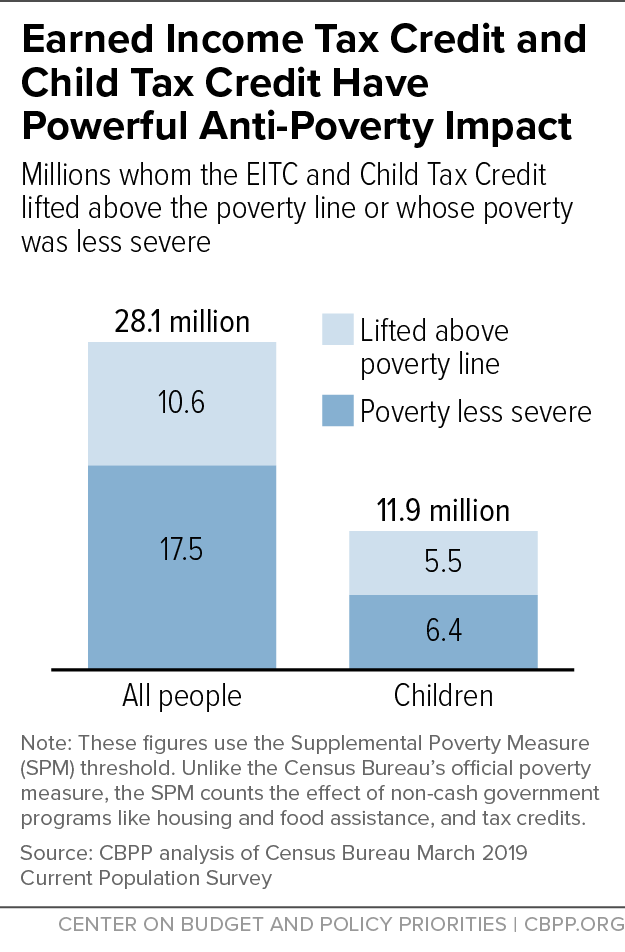
The EITC and Child Tax Credit together lifted 10.6 million people above the SPM poverty line and made poverty less severe for 17.5 million others in 2018. The EITC reduces poverty by supplementing the earnings of workers paid low wages.
Considerable research has found that increasing low-income families’ income when a child is young tends to improve a child’s immediate well-being, as well as positive long-term effects such as better health and higher earnings in adulthood. Studies link improvements in the EITC and similar income support to improved school performance and higher college attendance rates.
Fixing the Meager EITC for Workers Not Raising Children
For tax year 2021, the American Rescue Plan Act temporarily expanded the EITC for workers without children by raising the maximum from roughly $540 to roughly $1,500, and raising the income cap for these adults to qualify from about $16,000 to at least $21,000 ($27,000 for married couples). The Rescue Plan also expanded the age range of eligible working adults without children to include younger adults aged 19-24 (excluding students under 24 who are attending school at least part time), and people aged 65 and older. These changes provided income support to over 17 million people who do important work for low pay. Under the Rescue Plan, the expansion of the EITC for workers not raising children was only in effect for tax year 2021.
After the expansion expired, the EITC for workers not raising children returned to an extremely small credit amount — too small even to fully offset federal income and payroll taxes for workers at the federal poverty line. Under current law for tax year 2023, a single adult without children or noncustodial parent working full time, year-round at the federal minimum wage will be eligible for a meager EITC — approximately $200. (Such an individual would receive a much larger EITC — near the maximum — if they had children.) Low-paid workers not raising children are the sole group the federal tax system taxes into or deeper into poverty, mainly because their EITC is so low. We estimate that roughly 6 million adults aged 19 and older without children (excluding full-time students under age 24) are taxed into, or deeper into, poverty under current law. For 2021, the Rescue Plan’s expanded EITC for this population was estimated to reduce the number of adults without children taxed into or deeper into poverty to roughly 200,000.
Credit Grows With Earnings, Then Phases Out at Higher Income Levels
Working households qualify for an EITC based on their earnings. Beginning with the first dollar of earnings, a low-income household’s EITC increases (or “phases in”) as their earnings increase, until the credit reaches its maximum amount. The rate at which the EITC phases in depends on marital status and number of children; for example, the phase-in rate for a married couple with two children is 40 percent, meaning their EITC rises by 40 cents for each dollar they earn up to a certain level. Similarly, the EITC for households at higher income levels phases out at a set rate until reaching zero.
| TABLE 1 | ||||||
|---|---|---|---|---|---|---|
| 2023 Earned Income Tax Credit Parameters (Filing status singlea) | ||||||
| Phase-in rate | Phase-in ends | Maximum credit amount | Phase-out begins | Phase-out rate | Phase-out ends | |
| No childrenb | 7.65% | $7,840 | $600 | $9,800 | 7.65% | $17,640 |
| 1 child | 34% | $11,750 | $3,995 | $21,560 | 15.98% | $46,560 |
| 2 children | 40% | $16,510 | $6,604 | $21,560 | 21.06% | $52,918 |
| >2 children | 45% | $16,510 | $7,430 | $21,560 | 21.06% | $56,838 |
| TABLE 2 | ||||||
|---|---|---|---|---|---|---|
| 2023 Earned Income Tax Credit Parameters (Filing status married filing jointly) | ||||||
| Phase-in rate | Phase-in ends | Maximum credit amount | Phase-out begins | Phase-out rate | Phase-out ends | |
| No children | 7.65% | $7,840 | $600 | $16,370 | 7.65% | $24,210 |
| 1 child | 34% | $11,750 | $3,995 | $28,120 | 15.98% | $53,120 |
| 2 children | 40% | $16,510 | $6,604 | $28,120 | 21.06% | $59,478 |
| >2 children | 45% | $16,510 | $7,430 | $28,120 | 21.06% | $63,398 |