

States Should Close “Drop-Kick” Loopholes That Allow the Wealthy to Dodge Real Estate Transfer Taxes
Tax laws work best when they are transparent, apply fairly to everyone, and can raise the revenue required to meet the needs of our communities. Tax loopholes that allow well-resourced people or corporations to avoid paying their fair share violate these principles, undermining our collective faith in government and shortchanging needed public investments. One of these loopholes is the “drop-kick,” a work around designed to avoid paying real estate transfer taxes that are owed when buying or selling a home or other property.
Thirty-three states and Washington, D.C., as well as some localities, impose a one-time transaction tax on the transfer of real estate when it’s sold.[1]Most of these taxes apply only on direct transfers of real estate from seller to buyer. The ultrawealthy and large corporations can easily avoid such taxes by making their property sales indirect: a seller can “drop” the property into a shell company and then “kick” (sell) that company to the buyer. By skirting this tax, drop-kicks reduce state tax revenue to the tune of tens of millions of dollars, according to some estimates.[2] Fortunately, states can easily close this drop-kick loophole through “controlling interest taxes,” which tax the sale of the shell company that’s used to avoid real estate transfer taxes.
Continued legislative acceptance of the drop-kick loophole sends a message: the rules that apply to hardworking families do not apply to those who are well-resourced enough to mask their real estate transactions under the guise of selling a company. Closing the drop-kick loophole will rewrite that message — to one where everyone, no matter their financial standing, pays their fair share supporting the public goods and services upon which we all rely.
How the Drop-Kick Avoids Real Estate Transfer Taxes
Drop-kicks are used to avoid real estate transfer taxes because they aren’t, technically speaking, transferring real estate. They’re transferring ownership of a company that owns the real estate.

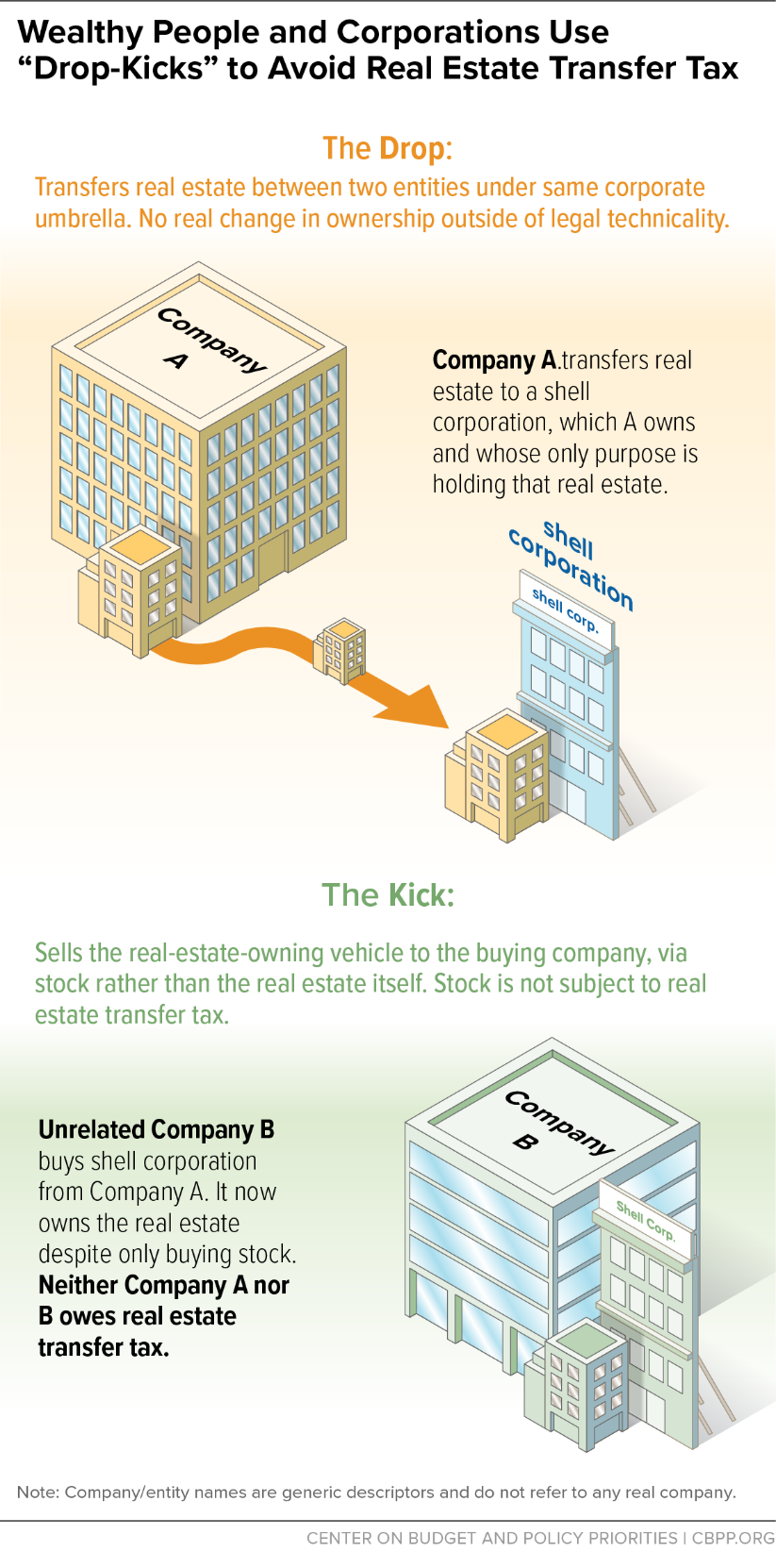
For instance, if a Seller wants to transfer a piece of real estate to a Buyer without incurring tax on that transfer, it can first transfer that real estate to a shell company that it owns. This is the “drop.”
Second, the Seller will sell stock of that company (which now owns the real estate) to the Buyer. This is the “kick,” the actual transfer of property from seller to buyer. But the property directly sold is no longer real estate; it is a company. This does not trigger a real estate transfer tax, despite effectively transferring ownership of real estate.
“Controlling Interest” Transfer Taxes Shut Down Drop-Kicks by Taxing the Kick
Controlling interest transfer taxes apply when entities that own real estate transfer majority ownership — that is, a 50 percent or greater stake, or “controlling interest.” This ensures that real estate transactions are properly taxed regardless of their form.
A true controlling interest transfer tax applies to the transfer of a controlling interest in an entity that possesses[3] an economic interest in real estate. Such a tax can be designed broadly to capture virtually all transfers of real estate, no matter how any particular transaction is structured.
Specifically, controlling interest transfer taxes accomplish this by taxing the “kick” of the drop-kick formula. Attempting to tax the “drop” opens the tax up to legal challenges from companies looking to avoid the tax, reducing its efficacy.
For instance, the Nevada legislature attempted to close the drop-kick loophole following a high-profile property sale that avoided paying the state’s real estate transfer tax.[4] But legislators enacted a fact-specific, narrowly targeted anti-abuse amendment to its real estate transfer tax. It made the real estate transfer tax apply to the drop — but only in cases where the government can prove that the entity receiving the real estate drop was “formed for the purpose of evading” real estate transfer taxes.[5] Litigation to prove intent is notoriously difficult for government agencies to win in tax avoidance cases.
Other states, such as Connecticut, Maine, New Jersey, and New York, have taken a broader, more effective approach by taxing the “kick,” or a transfer of controlling interest in an entity that owns real estate.[6] Currently, only six states and the District of Columbia shut down the major loopholes associated with the drop-kick avoidance scheme. While no jurisdiction's statute is perfect, these seven manage to tax the kick rather than the drop and contain provisions to prevent tax avoidance strategies that spread the transaction out across a period of time or a number of buyers and sellers acting in unison.[7]
Other states looking to follow their example should make sure their controlling interest transfer tax statute is broad enough to account for various avoidance schemes, by including the following considerations:
- The trigger to apply a controlling interest transfer tax should be any transfer of a controlling interest in any legal entity that owns an interest in real property. (This assumes the real estate transfer tax, to which the controlling interest transfer tax is added, is triggered by any direct transfer of an interest in real property.) The threshold for a controlling interest should be set at “greater than 50 percent,” not higher. If an entity owns 51 percent of a company, then it effectively has total control over the organization. If a state sets the bar at, for instance, 60 percent or greater, it would just allow tax evaders to effectively transfer control of a piece of real estate without triggering the tax.
- Broad application to all transfers of interests in real property should be the rule, regardless of the transaction’s form, with limited exceptions for transfers to family members and such cases.[8]
- Anti-abuse provisions should include rules to neutralize tax-dodge schemes that — aiming to misrepresent a transfer as less than a controlling interest — sell a series of smaller portions over time or coordinate multiple smaller sales among related persons. These are often known as “serial transactions” and “acting in concert” rules.
- The tax base, that is, the amount or value subject to tax, can vary whether the entity owns one or more properties (real or personal).[9] For owners of one property, even if the controlling interest being transferred is less than 100 percent, the tax base should be the greater of the sales price, fair market value (if the property has been sold within the past five years), or full assessed value (for property tax purposes) of the real property being transferred that is located within the state. A tax on any one of these values by itself is manipulable, open to litigation, or potentially limited by other elements of state law. Including a “greater of” provision ensures that the actual value of the property will be subject to tax. When dealing with a transfer of an entity that owns multiple assets aside from the real estate, the base should be the percentage of ownership being transferred multiplied by the greater of the full assessed value for property tax purposes or the fair market value of the real estate. This will help to further safeguard against price manipulation for the purposes of tax avoidance.
- Limited exemptions may be included for interests below a certain value (if the state’s real estate transfer tax has a similar provision) and transfers between spouses. There should be no exemption for transfers between separately owned companies and no exclusion of an entire class of property.
- Definitions for controlling interest transfer tax should be consistent with real estate transfer tax definitions; “legal entity” should include trusts even if they are mere legal relationships.[10]
Every state and locality with a real estate transfer tax — and even those that adopted a controlling interest transfer tax or some form of drop-kick loophole closer — should reevaluate their current law against these design criteria. In doing so, these jurisdictions can shut down the drop-kick loophole, put real estate transfer tax revenue collection back in sync with legislative intent, make their tax code more equitable, and take a step toward restoring public confidence in our civic institutions and the taxes that fund them.
End Notes
[1] Samantha Waxman, Carl Davis, and Erika Frankel, “States Should Enact, Expand Mansion Taxes to Advance Fairness and Shared Prosperity,” CBPP, June 26, 2024, https://www.cbpp.org/research/state-budget-and-tax/states-should-enact-expand-mansion-taxes-to-advance-fairness-and.
[2] Eli Segall, “How Las Vegas' biggest real estate deals result in no transfer taxes,” Las Vegas Review-Journal, May 12, 2022, https://www.reviewjournal.com/business/how-las-vegas-biggest-real-estate-deals-result-in-no-transfer-taxes-2517174/.
[3] This ownership can be direct or indirect. Direct ownership is when a person or entity owns the property outright. Indirect ownership, by contrast, is when a person or entity owns an entity that owns the property. For instance, a person who owns their home would be an example of direct ownership. A person who owns a company that owns a subsidiary company that owns a building would be indirect ownership.
[4] Eli Segall, “Nevada lawmakers want to seal a tax loophole. Here’s why it may not close all the way.” Las Vegas Review-Journal, May 18, 2023, https://www.reviewjournal.com/investigations/nevada-lawmakers-want-to-seal-a-tax-loophole-heres-why-it-may-not-close-all-the-way-2779248/.
[5] Assembly Bill No. 448 (2023), “An Act relating to taxation; revising the exemption from the real property transfer tax applicable to certain transfers of real property between business entities; and providing other matters properly relating thereto.”
[6] Connecticut State Department of Revenue Services, “Controlling Interest Transfer Tax Information,” updated December 16, 2024, https://portal.ct.gov/drs/taxes/controlling-interest/tax-information; Maine Legislature, Maine Revised Statutes Title 36: Taxation, Part 7: Special Taxes, Chapter 711-A: Real Estate Transfers, https://www.mainelegislature.org/legis/statutes/36/title36sec4641.html; 2024 New Jersey Revised Statutes Title 54 – Taxation, Section 54:15C-1-Tax on transfer over $1,000,000 of controlling interest in certain commercial property, https://law.justia.com/codes/new-jersey/title-54/section-54-15c-1/; New York State Department of Taxation and Finance Tax Bulletin RE-885 (TB-RE-885): Transfer or Acquisition of a Controlling Interest—Additional Guidance, https://www.tax.ny.gov/pubs_and_bulls/tg_bulletins/rett/controlling_interest.htm.
[7] For example, a parent company attempting to transfer controlling interest in a property-owning subsidiary company (like the shell corporation from the example in Figure 1) may spread the transactions out over time, transferring a 20 percent stake in the shell corporation. in one month, another 20 percent stake the next month, and a final 15 percent stake the month after. Similarly, instead of spacing the transaction out across time, a company could spread the transaction out across people or groups. For instance, Company A could transfer 20 percent of stake in the property-owning the shell corporation to Person 1, another 20 percent to Person 2, and a final 15 percent to Person 3, and then have each of those people transfer their stake to the company purchasing the property. The end result is the same — control of the property has still been transferred — but because the controlling interest wasn’t transferred at the same time or by the same person, the transaction could avoid the controlling interest transfer tax unless the tax accounts for this avoidance scheme.
8 For instance, if an attempt at closing the loophole only applies to transactions where the transfer of corporate stock is to avoid paying the real estate transfer tax, then it would be relatively easy for most would-be tax avoiders to argue in court that their transfers of stock are for any purpose other than tax avoidance. In general, intent is extremely difficult to prove in a court of law, and relying on it as a standard of evidence will weaken the effectiveness of the controlling interest transfer tax.
[9] Real property refers to land and/or buildings, such as houses, apartment buildings, or offices. Personal property includes tangible items that aren’t buildings, such as machinery, business equipment like computers or printers, or furniture.
[10] Applying the controlling interest transfer tax to transfers of any kind of legal entity that owns real estate ensures that tax avoiders cannot dodge their obligations simply by shifting the transfer to a different form of ownership, such as through trusts, LLCs, or partnerships. If an entity, regardless of its form, owns real estate and would be liable for the real estate transfer tax if selling the real estate directly, the transfer of that entity should be subject to the controlling interest transfer tax.