

Trump Administration, DOGE Activities Risk SSA Operations and Security of Personal Data
Executive Summary
Tens of millions of people count on the Social Security Administration (SSA) to reliably deliver benefits they need to pay rent or afford basic household expenses.[2] In recent weeks, however, the Trump Administration — including Elon Musk and the Department of Government Efficiency (or DOGE) — has taken actions that risk creating unprecedented delays, degraded customer service, and unnecessary barriers for millions of beneficiaries to access the benefits they earned. For these primarily older and disabled people, President Trump’s repeated insistence that he would not cut Social Security benefits may be a distinction without a difference if his Administration’s actions delay benefits or make it harder to get them in the first place, regardless of whether the President ever proposes legislative changes to Social Security.
The Administration, Musk, and DOGE have engaged in four types of activities that each present a clear danger to Social Security but together create the potential for significant damage to the program:
- Launching rhetorical attacks on Social Security programs, including false claims of massive fraud — providing a pretext for actions that could undermine eligible beneficiaries’ access to benefits.
- Engaging in deep cuts to staffing, new restrictions on phone-based services for the public, and “agency-wide . . . restructuring” and “massive reorganizations” of SSA that are neither well thought-out nor wise — all of which threaten SSA’s ability to serve seniors and people with disabilities effectively while providing a potential excuse for privatizing key services.[3]
- Jeopardizing the reliability of SSA’s systems, including through the sharp reduction of staff with technical expertise of systems that serve some 73 million people, or 1 in 5 people in the United States, each month.
- Threatening the security of people’s personal information by giving untrained DOGE political appointees unprecedented access to sensitive SSA data.
These four dangers (see Figure 1) compound one another — rather than making improvements that would help Social Security beneficiaries now or in the future. Social Security is highly accurate and efficient — with a payment accuracy rate of 99.7 percent and administrative costs of only 0.5 percent — and has successfully paid benefits for over 85 years. After years of underfunding, SSA needs more staff — not fewer — to give the nation’s retirees and people with disabilities the service they deserve.

By contrast, false claims by the President and Musk that Social Security is rife with hundreds of billions of dollars in fraud or that it is a “Ponzi scheme” appear designed to justify aggressive actions that would — intentionally or not — block many eligible beneficiaries from receiving payments.[4] Then, when such errors occur, cuts to staffing and field offices would make it harder for beneficiaries whose payments are blocked or delayed to get the help they need to fix the problem and to secure the benefits they are owed.
Similarly, system outages may become increasingly frequent, long-lasting, and/or severe due to the exodus of technical staff needed to maintain SSA’s complex and fragile layers of interconnected systems, making it harder for SSA to quickly identify and fix problems that arise in the normal course of business and threatening the timeliness of benefits or access to assistance. The potential for SSA system outages may grow further as SSA adopts new policies requiring changes to complicated systems without the appropriate care or necessary expertise among the employees who are still there.
Exacerbating these risks is the unprecedented and rushed granting of access to SSA’s highly sensitive databases — containing some of the most deeply personal information held anywhere by the federal government — to inexperienced political appointees. This effort appears to be part of DOGE’s attempt to find any evidence supporting Musk’s claims about fraud plaguing Social Security and the illicit use of Social Security numbers (SSN), which he has described as “on the order of ten percent of federal expenditures, which is half a trillion dollars” a year.[5] On March 20, a federal judge found that DOGE was “essentially engaged in a fishing expedition at SSA, in search of a fraud epidemic, based on little more than suspicion,” resulting in the potential inappropriate disclosure of the personal and private data of millions of Americans.[6]
If DOGE cared about government efficiency, it would be laser-focused on helping SSA to better serve those who rely on Social Security — planning, resourcing, and carrying out needed improvements in SSA systems and offerings with the goal of strengthening the delivery of critical services — instead of undertaking policy and personnel actions that risk degrading customer service, threaten reliability, and make it harder for beneficiaries to access their benefits.
Career staff at SSA have raised the alarm. Based on what she witnessed at SSA before her sudden retirement in February 2025, Tiffany Flick — then the acting chief of staff to the acting commissioner — submitted a declaration in court that the DOGE and Trump Administration team’s “disregard for critical processes . . . and lack of interest in understanding [SSA’s] systems and programs . . . combined with the significant loss of expertise as more and more agency personnel leave, have me seriously concerned that SSA programs will continue to function and operate without disruption.”[7]

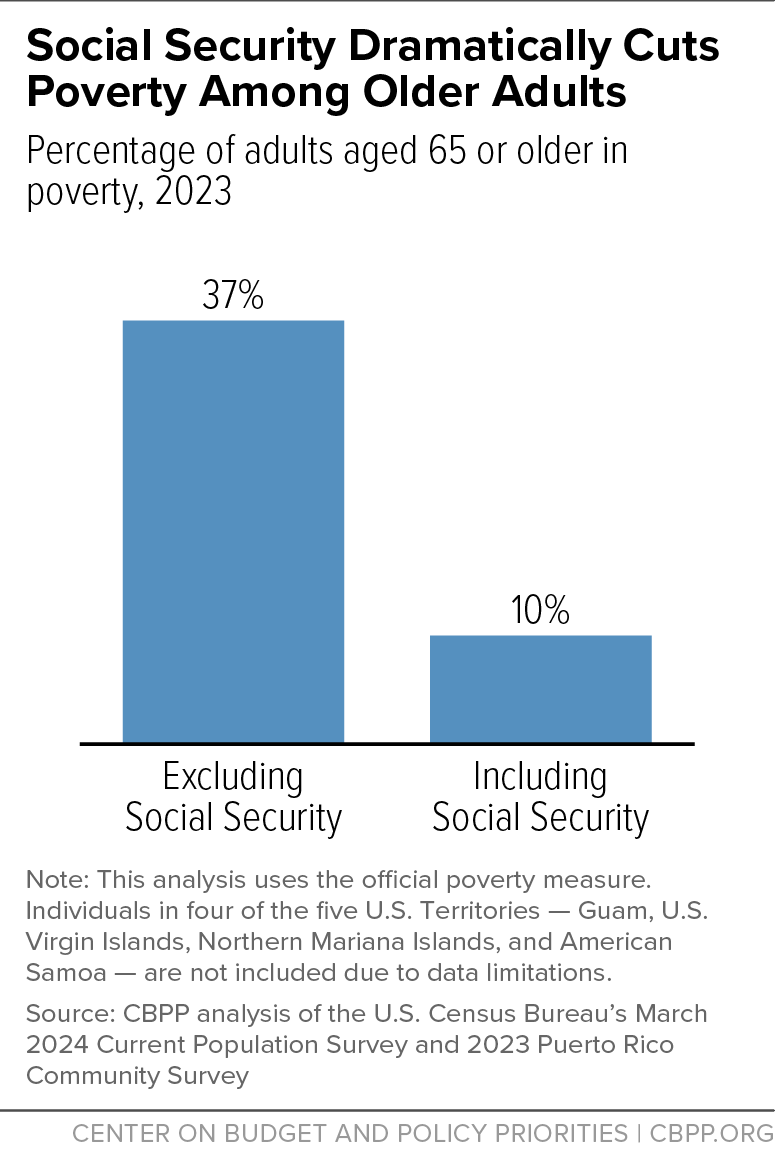
Despite Commerce Secretary Howard Lutnick’s cavalier suggestion that if Social Security benefits were delayed there would be few problems for honest beneficiaries and only people “stealing” from the program would complain, Social Security benefits are central to beneficiaries’ ability to make ends meet.[8] In fact, Social Security is the largest source of income for most beneficiaries, virtually the only source of income for millions, and dramatically cuts poverty among older adults.[9] (See Figure 2.)
Following years of underinvestment in SSA’s infrastructure and staff, agency officials already had publicly expressed concerns about the risk of a “customer service crisis” if significant recent investments in the agency were not sustained.[10] Instead, Republicans in Congress have provided flat funding for the agency while DOGE and the Trump Administration have pursued policies and rhetoric that jeopardize SSA’s ability to carry out its mission — an unacceptable risk for seniors and people with disabilities for whom Social Security is a crucial lifeline. Even the Trump Administration’s hand-picked acting SSA commissioner, Leland Dudek, reportedly admitted in a private meeting that it “would be catastrophic for the people in our country” if DOGE were to make changes at SSA as sweeping as they had at other agencies, while worrying, “Are we going to break something? I don’t know.”[11]
This paper describes how the actions that DOGE and the Administration are taking — rationalized by their false claims — risk “break[ing] something” within SSA’s systems, with the potential to delay payments for millions of Americans and make it more difficult for some to apply for benefits altogether.
False Attacks on Social Security to Justify Damaging Actions
In recent weeks, President Trump and Elon Musk have both falsely described Social Security as rife with fraud. To justify the idea that there are hundreds of billions of dollars in fraud that must be cut by the Administration, they have repeated inaccurate claims about the program even after these claims were refuted by the Administration’s own choice for acting commissioner, and despite being contradicted by SSA’s inspector general and outside experts.[12]
A timeline of one false claim — that Social Security is making payments to millions of dead people — illustrates the Administration’s approach:
- On February 16, Musk tweeted a chart from “the Social Security database” showing more than 15 million people over age 110, including nearly 9 million over 130, whose death field was set to “false,” meaning it was not marked with a confirmed date of death. “Maybe Twilight is real and there are a lot of vampires collecting Social Security,” Musk joked.[13]
- Almost immediately, external fact checkers pointed out that while SSA’s Numident database typically does not have recorded death dates for people born before 1920, the table Musk tweeted out provides no evidence that these individuals (or those impersonating them) are getting benefits. They cited a 2023 Office of the Inspector General report explaining that “almost none” of the people born before 1920 in the dataset are receiving benefits.[14] Acting Commissioner Dudek himself released a statement making clear that Musk’s claims were unwarranted, noting: “The reported data are people in our records with a Social Security number who do not have a date of death associated with their record. These individuals are not necessarily receiving benefits.”[15]
- Despite that debunking, the President — speaking to his largest audience since the inauguration in his address to a joint session of Congress — repeated this false claim more than two weeks later, on March 4, listing the number of people in age brackets over 110 and saying “money is being paid to many of them.”[16]
- On March 5, SSA released another statement acknowledging that “it is important for the agency to maintain accurate and complete records” but again making clear that “these people may not be receiving benefits.”[17]
- Despite this, Musk claimed in a March 10 interview that “there [are] 20 million people who are definitely dead marked as alive in the Social Security database.”[18] And a recent headline — “DOGE Has 10 Staffers at Social Security in Hunt for Dead People” — reflects the Trump Administration’s continuing focus on finding “evidence to support its claim that there could be millions of dead people receiving public benefits,” while Elon Musk boasted on March 20 that DOGE actions were “cleaning up the fraud file” without providing any evidence of fraud.[19]
As discussed more below, data on Social Security beneficiaries and Social Security’s systems for ensuring that benefits cease after someone dies make clear that there is no widespread problem of benefits being paid to people no longer alive.
But this sequence of events demonstrates how Musk and Trump remain committed to a false premise — and continue broadcasting it and orienting the Administration’s focus around it — even after it has been categorically debunked by external experts and SSA’s own data. More broadly, Musk has also used rhetoric — like calling it “the biggest Ponzi scheme of all time” — long used by those who have argued for fundamentally overhauling the Social Security system, including through privatization.[20] Musk has also offered unsubstantiated estimates on the amount of fraud in programs including Social Security, establishing a target of $600 to $700 billion a year that can be cut from “entitlements” in one recent interview.[21]
Social Security’s Payment Accuracy Rate Is 99.7 Percent
These claims do not reflect the reality about the program. Social Security’s Old Age, Survivors, and Disability Insurance program has a payment accuracy rate of 99.7 percent, and the 0.3 percent in improper payments is typically paid out to eligible beneficiaries but in incorrect amounts due to mistakes or delays.[22] (See Figure 3.) Only 0.1 percent of Social Security benefits are paid to people over 100 years old, a figure consistent with other data about the number of people in the U.S. of that age.[23] And while Musk has made false claims about dead people receiving benefits, SSA has dedicated processes in place to prevent exactly this problem — utilizing data collection from state agencies, funeral home directors, and financial institutions alongside checks of whether beneficiaries are, for example, using Medicare benefits.
Repeated false statements by President Trump and Musk present two dangers to Social Security. First, they appear designed to set the predicate that Social Security is so fraud-ridden that aggressive actions are necessary, even (or perhaps especially) if they create serious barriers to access for some eligible enrollees and applicants. By claiming, as Elon Musk has, that the existence of millions of SSN records with early 20th century (or earlier) birth dates and no confirmed death dates “might be the biggest fraud in the history of humanity,” the Administration has tried to create a justification for disruptive measures regardless of their consequences.[24] Former SSA acting Chief of Staff Tiffany Flick noted that the senior-most DOGE staffer embedded at SSA “seemed completely focused on questions from DOGE officials based on the general myth of supposed widespread Social Security fraud, rather than facts.”[25]

Second, by making unsubstantiated claims about the available savings from his efforts to fight fraud (e.g., the up to $700 billion a year that can be cut from entitlements toward the goal of “a trillion dollars of savings”), Musk appears to be working backwards from a savings target, no matter how unaligned to facts it is, that is dictating his efforts. The risk is that achieving this target becomes the overarching objective for the administration of Social Security programs, regardless of the consequences for eligible beneficiaries and applicants. Because that target is based on vastly inflated claims of fraud, meeting it will necessarily require reducing payments to legitimate, eligible individuals.
New Access Barriers Can Be a Benefit Cut by Another Name
Importantly, Administration actions to cut Social Security spending need not take the form of proposed eligibility or benefit cuts to achieve the same damaging results. Instead, the Administration can create access barriers for Social Security that make it harder for eligible households to receive payments or discourage them from applying altogether, or it can launch ostensible fraud-prevention efforts that delay or restrict benefits, even if inadvertently.
SSA’s March 18 announcement that it plans to limit access to services over the phone — supposedly to address identity theft — is one example.[26] Telephone services are critical for seniors and people with disabilities, who may struggle to effectively access online portals and may face barriers to traveling to field offices (if one even exists in their area). This is especially true in rural areas. For example, in the state of Alaska — which only has three SSA field offices — an estimated 60,000 people lack access to broadband, some residents live hundreds of miles from their nearest field office, and some communities are not connected to the SSA field offices by roads.[27] In addition, some applicants — including children and those applying for survivors’ benefits — are not allowed to apply for benefits online, so the loss of telephone options will force them to visit an office in person in order to claim benefits.
On March 26, SSA announced minor adjustments to its plan following public outcry. These minimal changes – including a brief delay in implementation – do not change the reality that SSA plans to implement a hugely disruptive and entirely unnecessary new policy in a confusing and rushed manner. The new policy will drive up fraud and force millions more people to seek in-person help.
First, SSA announced that beneficiaries will no longer be able to change their banking information over the phone — despite the ongoing implementation of tools designed to limit fraudsters’ ability to impersonate recipients over the phone.[28] SSA then announced more sweeping changes eliminating identity verification over the phone.[29] Instead, millions of people trying to access SSA services (to claim benefits, make changes, request a replacement Social Security card, and so on) who cannot successfully use online tools to authenticate their identities will need to schedule, wait for, and travel to an appointment in person at a field office — despite well-documented problems with those online tools.[30]
Internal SSA analysis estimated that these service changes could increase the number of people traveling to field offices by over 4 million annually, resulting in “delayed processing” and “disproportionate impact on vulnerable populations.”[31] Rather than sorting out authentication problems in a single phone call, elderly and disabled people who cannot use the online tools will now have to wait over a month for an appointment to visit an SSA field office in person, and may struggle to travel to a field office. The change in phone service policy has been opposed by AARP, concerned that it would harm older Americans and “result in more headaches and longer wait times to resolve routine customer service needs.”[32]
The reductions in fraud due to these policy changes will likely be marginal at best and almost certainly could be achieved through other means. And the changes will create barriers to benefit access for the most vulnerable people and an overall increase in demand for limited in-person assistance at a time when DOGE and SSA are dramatically reducing customer service staffing, as discussed below.
This approach is the opposite of improving government efficiency. SSA should be making it easier for people to access hard-earned benefits, not harder. Prior to this Administration, SSA was doing just that, investing in efforts to save beneficiaries time and improve the customer service experience, including updates and improvements in each of the pathways through which people access benefits and assistance from SSA: online, over the phone, and in person in field offices. New investments in staffing for the national 800 number had allowed SSA to cut call wait times in half.[33]
In 2022, SSA launched a redesigned, user-friendly website with improved interactive tools. And by the end of 2024, SSA had worked to enable beneficiaries to submit digital signatures on 90 percent of the most commonly used forms in SSA field offices (totalling roughly 14 million annual submissions), while eliminating signature requirements from some forms where they were not needed.[34] Also in 2024, SSA released an online tool that enabled digital submission of dozens of forms and types of evidence, making it easier to apply for benefits or services by eliminating the need to mail, fax, or deliver certain information to a local Social Security office. Critically, these improvements in digital access gave SSA customers additional options without eliminating existing pathways that some retirees or individuals with disabilities rely on.
SSA had also been working to improve processes for applying for and maintaining benefits to reduce the time people spend on government paperwork. For example, SSA improved the process for obtaining disability benefits by allowing for the submission of forms online, pre-filling those forms with data the government already had, and removing unnecessary and confusing requirements to maintain eligibility.[35] These types of changes improve program integrity without harming beneficiaries, saving people time and reducing costs for SSA.
Deep Cuts to Front-line Staff and Field Offices
Social Security beneficiaries’ access to their benefits depends in part on receiving adequate service from the front-line SSA staff who take appointments, answer calls, and process applications. This is true for people who are applying for benefits for the first time, experiencing a change in their circumstances that might need to be reflected in SSA’s system, or facing a problem in their ongoing receipt of benefits. It’s also true for people who don’t yet receive benefits — for example, job seekers, victims of identity theft, recently married people who have changed their names, and others who need replacement Social Security cards.

Despite the recent improvements in SSA services noted above, the public continues to face considerable challenges accessing SSA services due to years of constrained funding. From 2010 to 2024, SSA’s administrative budget fell 19 percent (adjusted for inflation), leading to a 15 percent cut in staff, even as the number of beneficiaries rose 27 percent. As a result, a 2024 OIG report found that the average wait for an appointment was 32 days, with many field office calendars “booked out the full 40 business days that the system allows.”[36] And the steady progress in reducing the national 800 number call wait-times to reach a representative that was seen through fiscal year 2024 has begun to erode.[37]
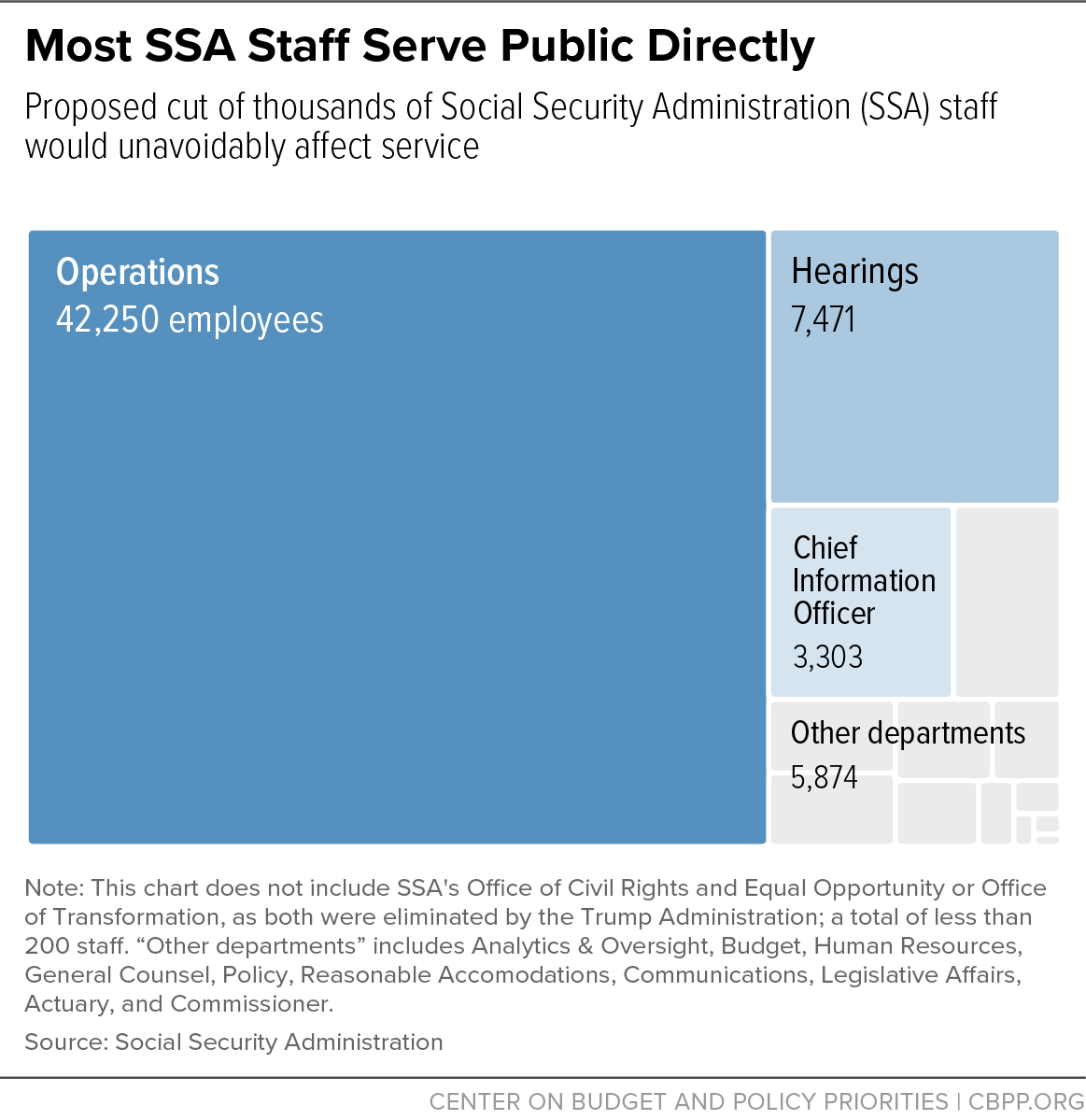
Yet the Trump Administration has taken steps that will exacerbate SSA’s challenges in adequately serving beneficiaries. The agency has announced a “massive reorganization,” “drastically reduced overtime,” and plans to cut 7,000 staff across the country by the end of September.[38] Already, SSA announced that 3,000 staff are leaving the agency.[39] After these cuts, SSA will have lost 26 percent of its staff, compared to 2010, even as the number of beneficiaries staff serve has grown by 28 percent. (See Figure 4.) Given that the majority of SSA employees serve the public directly, large cuts in SSA staff will unavoidably have a significant impact on the public. (See Figure 5.)
Staff Cuts Being Made With Little Regard for Their Impact
The Administration’s moves to slash SSA staff have little regard for the impact on customer service. The latest push to cut staff started with a “voluntary” opportunity for a buyout or “early out,” paired with a threat of major “reductions in force” (RIFs) and involuntary reassignments to follow, as well as an abrupt reversal of contractual telework agreements.[40] SSA offered cash incentives of up to $25,000 for staff to leave the agency, including field office staff, teleservice center agents, cybersecurity experts, system architects, and other essential employees — with no exceptions and no plans to address disproportionate losses of staff in key areas of the agency. SSA will use Social Security and Medicare trust fund dollars to pay its staff to quit or retire, meaning that taxpayers are paying SSA staff not to work even as the agency’s service to the public declines.[41]




While SSA leadership have stated that these efforts will simply “reduc[e] non-mission critical work,” the manner in which these staff reductions have occurred and the pre-existing challenges from understaffing mean these cuts will inevitably impair SSA’s ability to provide core services.[42] To understand the potential impact, consider how staffing shortfalls and field office closures might affect a beneficiary who faces a challenge in getting a payment she is due. With fewer front-line staff available, she would have more trouble getting someone on the phone to explain what was happening with a delayed payment. Depending on the nature of the problem, she may no longer be able to resolve it over the phone once she connects with someone to talk to. To the extent the problem is especially complex, the departure of the most experienced staff — and the regional headquarters staff who often resolve the most difficult cases — might make it particularly difficult to get help. Given the combination of staff cuts and new SSA policies requiring millions more people to go to field offices, in-person appointment wait times are likely to increase considerably.
Additionally, the staff losses resulting from SSA’s personnel measures likely won’t be evenly distributed across SSA operations at headquarters or in the field. And they are even less likely to reflect strategic considerations of where reductions might do the least harm. In New York State, for example, reportedly, no field office employees in Troy or Albany accepted SSA’s buy-out offer but more than a quarter of the staff in the Schenectady field office did.[43] And the loss of trained field office staff could not be quickly reversed in the future. Given the complicated and varied nature of all the services SSA provides, fully training a new field office staffer can take over two years.
The loss of field office staff could also create pressure on SSA to adopt shortsighted policies that further degrade SSA’s ability to carry out its mission. Acting Commissioner Dudek emailed staff on March 1 saying that SSA would seek to “revitalize SSA operations” in part by “outsourc[ing] non-essential functions to industry experts,” seemingly opening the door to increased privatization of some SSA activities.[44]
Actions Placing Social Security’s Operational Reliability at Risk
Each month, over 73 million Americans rely on SSA’s systems to accurately determine and deliver over $130 billion in retirement, survivor, and disability benefit payments without interruption.[45] However, there are worrisome signs that DOGE and Trump Administration actions are placing the operational reliability of SSA systems at risk.
Complex SSA Systems Require Careful Attention
SSA has been making monthly benefit payments continuously for over 85 years and has been collecting earnings and tax information for longer. Because an individual’s Social Security benefit is based on a lifetime of work, SSA must rely on information (like quarterly wages earned) that may have been collected many decades ago — possibly in the form of a paper report that was later converted to microfilm or keyed into a recording system on magnetic tape.
SSA has had to carefully manage the complicated task of updating systems over generations while maintaining complicated chains of interoperability and accommodating new technologies, rule changes, and functionalities that have been added over time — often with far fewer resources than the task demanded. For much of its history, SSA worked with a complexity or volume of data collection that exceeded what commercially available solutions could accomplish, requiring it to develop custom tools. Despite the complex layers of new and historical data — and the far-from-perfect legacy systems — SSA has ensured in every era that its technology remained fully operable and that benefit payments were processed and paid without disruption.
To be sure, more work is needed to modernize SSA, but to do this responsibly requires a thorough understanding of the current infrastructure, sufficient staff and funding to see the project through, and a healthy respect for the importance of ensuring the systems for determining eligibility and providing benefits remain functional as upgrades are made, so people get the benefits they need and are owed. When a social media app like X stops working, users are inconvenienced and some even lose income. If Social Security benefits do not arrive, seniors, people with disabilities, and survivors trying to make do without the income from a parent or spouse can lose access to their medications or be evicted.
As a result, appropriate care must be taken. These many historical layers make even day-to-day maintenance of SSA’s data systems difficult, and require careful planning when changes are made, including efforts to modernize existing infrastructure. As SSA explains, the agency’s systems are a “hugely complex interrelationship of applications and data . . . with many dependencies not well understood” involving tens of millions of lines of “unstructured or less-structured COBOL code” and hundreds of “legacy applications developed over decades supporting a range” of functions (including some that are “business critical”).[46] While much progress has been made over time, by some estimates a major overhaul of SSA systems would likely take five to seven years to complete and require a multi-billion-dollar investment.[47]
Previous modernization efforts have stalled over lack of funding and turnover in leadership, while constant technological advances and program changes have required additional layers of iteration. Biden Administration-era improvements will have lasting effects but did not come close to finishing the mammoth task of creating a stable ecosystem based on newer and more efficient technologies that meet all of SSA’s business needs while mitigating the risk of disruption to SSA services.[48]
As a result, an aggressive plan to further accelerate improvement — modernizing back-end systems, improving front-end user experiences, and addressing the ad hoc shortcuts, patches, and fixes accumulated over time — would be welcome if it were undertaken in a way that ensured there would be no interruption of benefits and services and had the backing of Congress to provide the resources needed to accomplish the task.
DOGE, however, has been described as subscribing to “management practices that embrace upheaval” and the Silicon Valley mantra of “move fast and break things.” This creates a severe risk that its efforts, even if intended to upgrade the agency’s technology, could cause severe collateral damage in the near term — damage that Social Security beneficiaries and applicants cannot afford.[49] Moreover, it’s unclear DOGE wants to invest the time and funds necessary to undertake upgrades, having shown little interest so far in helping leverage technology improvements to enhance delivery of critical services, or even to create opportunities for more efficient service. Instead, it is focusing on short-term cost savings and preventing what most experts believe to be relatively rare occurrences of fraud — layering additional, potentially catastrophic stresses on the existing fragile technology and customer service infrastructure.
The risk from the Trump Administration and DOGE’s choices is compounded by an apparent exodus of technical experts within SSA. Given the fragility of existing systems, a responsible modernization effort would rely on SSA’s existing technology experts and their experience with those systems as well as experts in newer technologies to prevent benefit delivery interruptions during a transition. During the first Trump Administration, SSA’s chief information officer noted that “systems engineers with legacy system expertise are retiring from SSA at an increasing rate. Replacing them with similarly skilled staff is also increasingly difficult.”[50] Yet in its short-sighted effort to indiscriminately reduce head count, DOGE is offering these critical experts — roughly 30 percent of whom have been estimated to be at or approaching retirement age — buy-outs and pushing them to leave, often with little time for knowledge transfer and no clear plan in place to replace their skill sets.[51]
These personnel moves have come alongside reported cancellations or reductions of SSA IT contracts, which may already be contributing to increasing system challenges and instability.[52] The loss of critical staff could very likely make future SSA systems outages more serious and prolonged, since the people best positioned to figure out what is broken and how to fix it may no longer be at SSA.
There are also indications that DOGE may have originally sought access to “source code” underlying SSA systems, although the Administration has testified that DOGE employees have only had “read-only” access to date, meaning they could not directly modify or change systems code or SSA data.[53] However, even if inexperienced DOGE staffers are appropriately prevented from directly interacting with SSA systems, there remains a heightened risk that their misunderstanding of SSA programs or data — or the impacts of system outages on people and families — will lead to increased risks if they direct unnecessary or unwise changes in SSA policies that require systems changes or inappropriately flag as potentially ineligible (or deceased) beneficiaries who are eligible for benefits.
DOGE Personnel and Management Actions Combine With Policy Changes to Increase Risks to SSA Systems
SSA has rapidly pursued several policy changes that could affect how SSA systems determine eligibility and the pathways through which beneficiaries are allowed to access services, at a time when it is losing experienced technical staff to update systems to reflect those changes. The accurate monthly production of SSA benefit payments relies on ten different utilities — each performing a specific eligibility-determining task — to consistently redetermine eligibility and benefit amounts based on the many data inputs that SSA receives and complicated program rules. Those utilities, and the dozens of applications and tools SSA uses to collect and process data, are often built on legacy systems with surprising and sometimes poorly documented interdependencies built up over years of evolving needs. In such an environment, even seemingly minor changes in business processes or program rules can have unexpected systems effects, requiring careful testing and adjustment.
Again, a careful but aggressive effort to modernize these technologies backed by adequate resources is needed. But rather than making the planning and execution of that kind of effort its priority, the Trump Administration has hastily announced that it is implementing or exploring the following changes that could add complications or pressures to the performance of the existing systems:
- Eliminating the option for people to change their direct deposit information over the phone, requiring more in-person visits to under-resourced field offices.[54]
- Eliminating the option for people to verify their identity over the phone, which also will require more in-person visits to under-resourced field offices.[55]
- Increasing the share of an individual’s monthly benefit that can be taken to repay overpayments, without notable investments to reduce the reporting lags (around changes in life circumstances or income) that most commonly lead to overpayments.[56]
- “Implement[ing] AI . . . to streamline and improve call resolution” and “leverag[ing] AI for online forms and electronic signature.”[57]
- Developing “self-service scheduling” for some appointments.[58]
- Blocking benefit payments to “representative payees” that have not provided an SSN.[59]
- Freezing the “Enumeration-Beyond-Entry” agreement with the U.S. Citizenship and Immigration Services, in which SSA automatically provides eligible non-citizens with Social Security cards once they are authorized to work in this country. This change could require an additional 60,000 to 75,000 in-person visits to under-resourced field offices each week.[60]
Making these changes puts strain on the existing system, which risks outages to ongoing operations or introducing errors if appropriate testing is not undertaken or the necessary expertise is no longer available if something goes wrong.
Taken together, the personnel and management actions that are driving experienced and knowledgeable staff to flee SSA and the flurry of ill-planned policy and procedural changes give little indication that the Trump Administration or DOGE appreciate the risks they are creating. In a fragile, interconnected system, the danger is that actions taken without appropriate care — and without the institutional knowledge needed to fix inadvertent problems as they arise in hours rather than days or weeks — could create acute harm for some individuals, like inaccurately blocking them from payment, or broad harm, like systems outages that delay payments for millions. And the consequences will be borne not by the wealthy, but by people for whom Social Security is necessary for their financial well-being.
Actions Placing Security of People’s Personal Data at Risk
Nearly all people living in the United States — including workers, dependents, and spouses — could potentially be eligible for Social Security benefits in the future. So, to accurately process benefit payments, construct and maintain earnings records, facilitate Social Security tax collections, and help administer other critical federal programs like Medicare, SSA needs to collect sensitive personal information on nearly everyone.
SSA’s data collection begins at birth for those born in the U.S., when their parents apply for an SSN and Social Security card on their behalf. As a result, SSA hosts some of the most sensitive and comprehensive data systems in the federal government — many of which include not just highly personal information like name, address, SSN, date of birth, and bank account numbers, but also tax information and earnings and employment history.[61]
For the tens of millions of people who have ever applied for disability benefits administered by SSA, the agency holds medical records and other deeply personal information about people’s health conditions and services received. This information may not be on file anywhere else in the federal government. For example, in applications for Supplemental Security Income (SSI) benefits for a child with a severe disability, SSA requires detailed information about the child’s medical condition and how it affects their ability to perform daily activities, including school records, medical records, and testimonials from doctors, teachers, therapists, and other professionals.[62] Adults applying for disability benefits may have had to share detailed psychotherapy notes or extensive accounts of medical procedures or prescription drug history covering sensitive topics like reproductive health, depending on the timeframe. In some limited situations, SSA systems also include classified data that support national security activities.
DOGE Team’s Training, Activities Still Unclear
There are serious questions about whether the appropriate safeguards and limitations have been put in place around the DOGE team’s access to sensitive SSA data. Acting Commissioner Dudek reportedly described the DOGE team as “outsiders who are unfamiliar with nuances of SSA programs,” noting that they “are learning and they will make mistakes.” He has made clear that he is “receiving decisions that are made without my input. I have to effectuate those decisions.”[63] In court filings, the Trump Administration has acknowledged that Dudek has given members of the DOGE team access to sensitive data and systems.[64]
While the Administration claims that the DOGE team members have all received the “same level of training that we provide our other SSA employees,” a former official attested in a court filing that at least some DOGE team members gained greater access to a set of complex systems and sensitive data — for which they have no previous experience — more quickly and with less training than would be typical for any other new SSA staff.[65]
The Trump Administration has also provided very little transparency about the scope of the DOGE team’s activities beyond the purported goal of “detect[ing] waste, fraud, and abuse in SSA programs” or why it received approval to access unmasked personal data directly, rather than beginning with anonymized data analysis as is typical. By contrast, the U.S. Digital Service team detailed to SSA to assist with modernization efforts prior to DOGE’s arrival had no access to sensitive agency data or personally identifiable information.[66]
There are indications that DOGE team members may be unnecessarily jeopardizing SSA data security, including accessing SSA data from non-secure locations off-site from where SSA data is usually housed, which increases the risk that it could be further duplicated, transferred, or inadvertently exposed to bad actors.[67] A reported member of the SSA DOGE team recently resigned from a DOGE role at Treasury, where court filings show he violated agency IT security policies, including by emailing personally identifiable information taken from a sensitive Treasury database to DOGE associates outside of the agency without approval, encryption, or necessary safeguards.[68]
By ignoring existing security protocols and granting high levels of access to DOGE team members without long experience or training in SSA systems, the Trump Administration — even if unintentionally — is creating greater risks of accidental data disclosure and opportunities for fraud, theft, or espionage.[69] Former SSA Commissioner Michael Astrue, appointed by President George W. Bush, has warned that “we should be petrified about privacy and theft of data,” and that descriptions of what is happening at SSA suggest that “literally illegal and inappropriate conduct is happening.”[70]
On March 20, in response to a lawsuit brought against the agency, a federal judge issued a temporary restraining order that requires SSA to pull back on the DOGE team’s “unlimited access” to SSA’s record systems and non-anonymized data. The judge found that SSA had likely violated both the Privacy Act and Administrative Procedure Act, exposing “personal, confidential, sensitive, and private information that millions of Americans entrusted to their government” without ever identifying or articulating “a single reason for” needing to have granted such access.[71] However, the restraining order is temporary, and the risk remains that DOGE will continue to pursue expanded access or misinterpret and misuse the SSA data it does have access to.
Avoiding Catastrophe
The public alarms and worst-case scenarios being raised by former SSA leaders and career staff who have served under Presidents of both parties reflect the dangers presented by early DOGE and Trump Administration actions. Even while investments in the agency have not been sufficient, there has generally been widespread public support for SSA’s mission to deliver benefits on time without interruption.[72] Unless the Trump Administration takes steps to address the concerns described above — including correcting misleading and inaccurate statements about the programs, preventing degradation of customer service and benefits access, reversing harmful across-the-board personnel actions and the loss of systems expertise, and safeguarding personal data — the many millions of retirees, survivors, and individuals with disabilities who rely on SSA-administered programs will have good reason to worry that they may no longer receive the same reliable access to benefits they have experienced until now.
End Notes
[1] Jacob Leibenluft most recently served as Executive Associate Director of the Office of Management and Budget during the Biden Administration. Prior to that, he served in senior roles at the Department of the Treasury under Secretary Janet Yellen and at the National Economic Council in the Obama White House.
[2] Kathleen Romig, “Social Security Lifts More People Above the Poverty Line Than Any Other Program,” CBPP, January 21, 2025, https://www.cbpp.org/research/social-security/social-security-lifts-more-people-above-the-poverty-line-than-any-other.
[3] Social Security Administration (SSA), “Social Security Announces Options to its Workforce,” February 27, 2025, https://www.ssa.gov/news/press/releases/2025/#2025-02-27.
[4] Chris Megerien, “Musk eyes Social Security and benefit programs for cuts while claiming widespread fraud,” Associated Press, March 10, 2025, https://apnews.com/article/elon-musk-donald-trump-doge-b21b74f56f30012a6450a629e7232a1a.
[5] Fox Business, “Elon Musk exposes the ‘biggest’ source of fraud in the world,” March 10, 2025, https://www.foxbusiness.com/video/6369857929112.
[6] CourtListener, “Memorandum Opinion,” Civil Action No. ELH-25-0596, https://storage.courtlistener.com/recap/gov.uscourts.mdd.577321/gov.uscourts.mdd.577321.49.0.pdf.
[7] CourtListener, “Exhibit J: Declaration of Tiffany Flick,” Civil Action No. 1:25-cv-00596, https://storage.courtlistener.com/recap/gov.uscourts.mdd.577321/gov.uscourts.mdd.577321.22.10.pdf.
[8] Katherine Li, “Commerce Secretary Howard Lutnick says his mother-in-law wouldn’t complain if her Social Security check didn’t arrive this month,” Business Insider, March 21, 2025, https://www.yahoo.com/news/commerce-secretary-howard-lutnick-says-235508751.html.
[9] SSA, “Fact Sheet: Social Security,” https://www.ssa.gov/news/press/factsheets/basicfact-alt.pdf; Romig.
[10] SSA, “FY 2025 President’s Budget Overview,” https://www.ssa.gov/budget/assets/materials/2025/2025BO.pdf.
[11] Eli Hager, “‘The President Wanted It and I Did It’: Recording Reveals Head of Social Security’s Thoughts on DOGE and Trump,” ProPublica, March 12, 2025, https://www.propublica.org/article/recording-reveals-leland-dudek-thoughts-trump-doge-social-security.
[12] Fatima Hussein, “Tens of millions of dead people aren’t getting Social Security checks, despite Trump and Musk claims,” Associated Press, February 19, 2025, https://apnews.com/article/social-security-payments-deceased-false-claims-doge-ed2885f5769f368853ac3615b4852cf7.
[13] Elon Musk, February 16, 2025, 11:55 p.m., https://x.com/elonmusk/status/1891350795452654076.
[14] SSA, Office of the Inspector General, “Numberholders Age 100 or Older Who Did Not Have Death Information on the Numident,” July 2023, https://oig.ssa.gov/assets/uploads/a-06-21-51022.pdf. SSA’s OIG reported that only 44,000 individuals over age 100 were currently receiving payments in 2021.
[15] SSA, “Statement from Lee Dudek, Acting Commissioner, about Commitment to Agency Transparency and Protecting Benefits and Information,” February 19, 2025, https://www.ssa.gov/news/press/releases/2025/#2025-02-19.
[16] “Remarks by President Trump in Joint Address to Congress,” March 5, 2025, https://www.whitehouse.gov/remarks/2025/03/remarks-by-president-trump-in-joint-address-to-congress/.
[17] SSA, “Social Security Addressing Aged Records,” March 5, 2025, https://blog.ssa.gov/social-security-addressing-aged-records/.
[18] Rev.com, “Elon Musk Fox Interview,” March 12, 2025, https://www.rev.com/transcripts/elon-musk-fox-interview.
[19] Gregory Korte, “DOGE Has 10 Staffers at Social Security in Hunt for Dead People,” Bloomberg, March 13, 2025, https://www.bloomberg.com/news/articles/2025-03-13/doge-has-10-staffers-at-social-security-in-hunt-for-dead-people; Elon Musk, March 20, 2025, 1:38 p.m., https://x.com/elonmusk/status/1902776846309117988?s=12.
[20] Megerien.
[21] Rev.com.
[22] Payment Accuracy, “Annual Improper Payments Datasets,” FY 2024 dataset, accessed on March 18, 2025, https://www.paymentaccuracy.gov/payment-accuracy-the-numbers/.
[23] Kathleen Romig, “Setting the Record Straight on Social Security,” CBPP, February 20, 2025, https://www.cbpp.org/blog/setting-the-record-straight-on-social-security.
[24] Elon Musk, February 17, 2025, 12:28 a.m., https://x.com/elonmusk/status/1891359120558551375?s=12.
[25] CourtListener, “Exhibit J.”
[26] SSA, “Social Security Strengthens Identity Proofing Requirements and Expedites Direct Deposit Changes to One Day,” March 18, 2025, https://blog.ssa.gov/social-security-strengthens-identity-proofing-requirements-and-expedites-direct-deposit-changes-to-one-day/; Emily Peck, “Leaked memo: DOGE plots to cut Social Security phone support,” Axios, March 17, 2025, https://www.axios.com/2025/03/17/social-security-trump-doge.
[27] Mark Sabbatini, “Update: Social Security to cut phone support, forces Alaskans online or to Juneau, Anchorage or Fairbanks,” Juneau Empire, March 19, 2025, https://www.juneauempire.com/news/social-security-may-cut-phone-support-force-alaskans-online-or-to-juneau-anchorage-and-fairbanks/.
[28] Hannah Natanson et al., “Social Security scraps far-reaching cuts to phone services after Post report,” Washington Post, March 12, 2025, https://www.washingtonpost.com/politics/2025/03/12/social-security-phone-doge-elderly-disabled.
[29] SSA, “Social Security Strengthens.”
[30] Natalie Alms, “DOGE allies want more online identity verification despite its mixed efficacy,” Nextgov/FWC, March 20, 2025, https://www.nextgov.com/digital-government/2025/03/doge-allies-want-more-online-identity-verification-despite-its-mixed-efficacy/403917/?oref=ng-homepage-river.
[31] Judd Legum, “EXCLUSIVE: Memo details Trump plan to sabotage the Social Security Administration,” Popular Information, March 17, 2025, https://popular.info/p/exclusive-memo-details-trump-plan.
[32] Andy Markowitz, “Social Security to End Applying for Benefits by Phone,” AARP, March 19, 2025, https://www.aarp.org/social-security/phone-id-verification-to-end/.
[33] The White House, “The Biden-Harris Administration Has Transformed How Government Services are Delivered for the American People,” January 13, 2025, https://bidenwhitehouse.archives.gov/omb/briefing-room/2025/01/13/the-biden-harris-administration-has-transformed-how-government-services-are-delivered-for-the-american-people/.
[34] Jeffrey Buckner, “Social Security Launches Redesigned Website at SSA.gov,” SSA, December 6, 2022, https://blog.ssa.gov/social-security-launches-redesigned-website-at-ssa-gov/; Dawn Bystry, “We’re Making It Easier To Do Business With Us Electronically,” SSA, September 5, 2024, https://blog.ssa.gov/were-making-it-easier-to-do-business-with-us-electronically/.
[35] Betsy Beaumon, “Simplified Online SSI Application Now Available as First Step in Larger Effort,” SSA, December 16, 2024, https://blog.ssa.gov/simplified-online-ssi-application-now-available-as-first-step-in-larger-effort/.
[36] SSA, Office of the Inspector General, “Customer Wait Times in the Social Security Administration’s Field Offices and Card Centers,” May 2024, https://oig.ssa.gov/assets/uploads/152307.pdf.
[37] SSA, “800 number performance,” accessed on March 20, 2025, https://www.ssa.gov/ssa-performance/800-number-performance.
[38] SSA, “Social Security Announces Options to its Workforce,” February 27, 2025, https://www.ssa.gov/news/press/releases/2025/#2025-02-27; SSA, “Social Security Announces Workforce and Organization Plans,” February 28, 2025, https://blog.ssa.gov/social-security-announces-workforce-and-organization-plans/; SSA, “Social Security Identifies Hundreds of Millions of Dollars in Savings,” March 3, 2025, https://www.ssa.gov/news/press/releases/2025/#2025-03-03.
[39] Social Security News, “A Month of Solid Progress,” March 18, 2025, https://socsecnews.blogspot.com/2025/03/a-month-of-solid-progress.html.
[40] SSA, “Social Security Announces Options to its Workforce”; Aaron Wiener and Hannah Natanson, “Federal workers told to report to faraway offices — with days’ notice,” Washington Post, March 14, 2025, https://www.washingtonpost.com/dc-md-va/2025/03/14/federal-return-to-office-remote-workers/.
[41] SSA’s operations are funded by the Old Age & Survivors Insurance (OASI), Disability Insurance (DI), and Medicare trust funds for their shares of administrative expenses, by the general fund of the Treasury for the Supplemental Security Income (SSI) program’s share of administrative expenses, and through applicable user fees. For details, see SSA, “Justification of Estimates for Appropriations Committees, Fiscal Year 2025,” https://www.ssa.gov/budget/assets/materials/2025/FY25-JEAC.pdf.
[42] SSA, “Social Security Announces Workforce and Organization Plans.”
[43] Paul Nelson, “Social Security office in Schenectady shrinks as workers take DOGE buyouts,” Times Union, March 13, 2025, https://www.timesunion.com/news/article/schenectady-social-security-office-losing-staff-20217524.php.
[44] Joe Perticone, “Elon Is Coming for Your Social Security,” The Bulwark, March 4, 2025, https://www.thebulwark.com/p/elon-is-coming-for-your-social-security.
[45] SSA, “Monthly Statistical Snapshot, January 2025,” Table 1. Number of people receiving Social Security, Supplemental Security Income (SSI), or both, January 2025, https://www.ssa.gov/policy/docs/quickfacts/stat_snapshot/2025-01.pdf.
[46] SSA, “IT Modernization Plan: A Business and IT Journey,” October 2017, https://www.ssa.gov/open/materials/IT-Modernization-Plan.pdf.
[47] Tara Siegel Bernard, “Social Security Employees Warn of Damage From DOGE,” New York Times, March 17, 2025, https://www.nytimes.com/2025/03/17/business/social-security-doge-ssa.html.
[48] SSA, “Digital Modernization Strategy — Narrative 2024,” February 2025, https://www.ssa.gov/open/materials/DMS-narrative-2024.pdf.
[49] Hannah Natanson et al., “Move fast, break things, rebuild: Elon Musk’s strategy for U.S. government,” Washington Post, February 24, 2025, https://www.washingtonpost.com/technology/2025/02/24/doge-fast-cuts-federal-workers-programs-elon-musk/.
[50] SSA, “IT Modernization Plan.”
[51] Bernard.
[52] Hager.
[53] “Exhibit J”; CourtListener, “Declaration of Michael L. Russo,” Civil Action No. 1:25-cv-00596, https://storage.courtlistener.com/recap/gov.uscourts.mdd.577321/gov.uscourts.mdd.577321.36.1.pdf.
[54] SSA, “Correcting the Record About Social Security Direct Deposit and Telephone Services,” March 12, 2025, https://blog.ssa.gov/correcting-the-record-about-social-security-direct-deposit-and-telephone-services/.
[55] SSA, “Social Security Strengthens Identity Proofing Requirements.”
[56] SSA, “Social Security to Reinstate Overpayment Recovery Rate,” March 7, 2025, https://blog.ssa.gov/social-security-to-reinstate-overpayment-recovery-rate/.
[57] Social Security News.
[58] Ibid.
[59] Natalie Alms and Erich Wagner, “SSA weighs axing payments to 170,000 beneficiaries,” Government Executive, March 13, 2025, https://www.govexec.com/management/2025/03/ssa-weighs-axing-payments-170000-beneficiaries/403740/.
[60] Judd Legum, “EXCLUSIVE: Secret policy shift could overwhelm Social Security offices with millions of people,” Popular Information, March 20, 2025, https://popular.info/p/exclusive-secret-policy-shift-could.
[61] Each year, employers are required to submit W-2 forms to SSA on behalf of every employee who has had income, Social Security, or Medicare taxes withheld.
[62] SSA, “Benefits for Children with Disabilities, 2025,” https://www.ssa.gov/pubs/EN-05-10026.pdf.
[63] Lisa Rein, Jeff Stein, and Hannah Natanson, “DOGE is driving Social Security cuts and will make mistakes, acting head says privately,” Washington Post, March 6, 2025, https://www.washingtonpost.com/politics/2025/03/06/doge-is-driving-social-security-cuts-will-make-mistakes-acting-head-says-privately/.
[64] CourtListener, “Defendants’ Opposition to Plaintiffs’ Motion for a Temporary Restraining Order, Preliminary Injunction, and/or 6 U.S.C. § 705 Stay,” Case No. 1:25-cv-00596-ELH, https://storage.courtlistener.com/recap/gov.uscourts.mdd.577321/gov.uscourts.mdd.577321.36.0.pdf.
[65] CourtListener, “Exhibit K: Supplemental Declaration of Tiffany Flick,” Civil Action No. 1:25-cv-00596, https://storage.courtlistener.com/recap/gov.uscourts.mdd.577321/gov.uscourts.mdd.577321.39.1.pdf.
[66] CourtListener, “Declaration of Michael L. Russo.”
[67] CourtListener, “Exhibit J.”
[68] Makena Kelly and David Gilbert, “These Are the 10 DOGE Operatives Inside the Social Security Administration,” Wired, March 13, 2025, https://www.wired.com/story/doge-operatives-access-social-security-administration/; CourtListener, “Declaration by David Ambrose,” Case No. 1:25-cv-1144-JA; https://storage.courtlistener.com/recap/gov.uscourts.nysd.636609/gov.uscourts.nysd.636609.116.1.pdf.
[69] James Goldgeier and Elizabeth Saunders, “Does DOGE Pose a National Security Risk?” Foreign Affairs, February 7, 2025, https://www.foreignaffairs.com/united-states/elon-musk-does-doge-pose-national-security-risk.
[70] Melanie Waddel, “‘It’s Going to Get Worse’: Former Social Security Chief Calls for Acting Head to Resign,” Think Advisor, March 13, 2025, https://www.thinkadvisor.com/2025/03/13/its-going-to-get-worse-former-social-security-chief-calls-for-acting-head-to-resign/.
[71] CourtListener, “Memorandum Opinion.”
[72] Kathleen Romig, “Social Security Administration Needs Additional Funding to Avoid Exacerbating Customer Service Crisis,” CBPP, September 22, 2023, https://www.cbpp.org/blog/social-security-administration-needs-additional-funding-to-avoid-exacerbating-customer-service.