

Rental Assistance to Families with Children at Lowest Point in Decade
The number of families with children receiving federal rent subsidies has fallen by over 250,000 (13 percent) since 2004 and is at its lowest point in more than a decade, despite rising need. To enable low-income children to have a better chance to thrive, policymakers should substantially expand the availability of rental assistance.
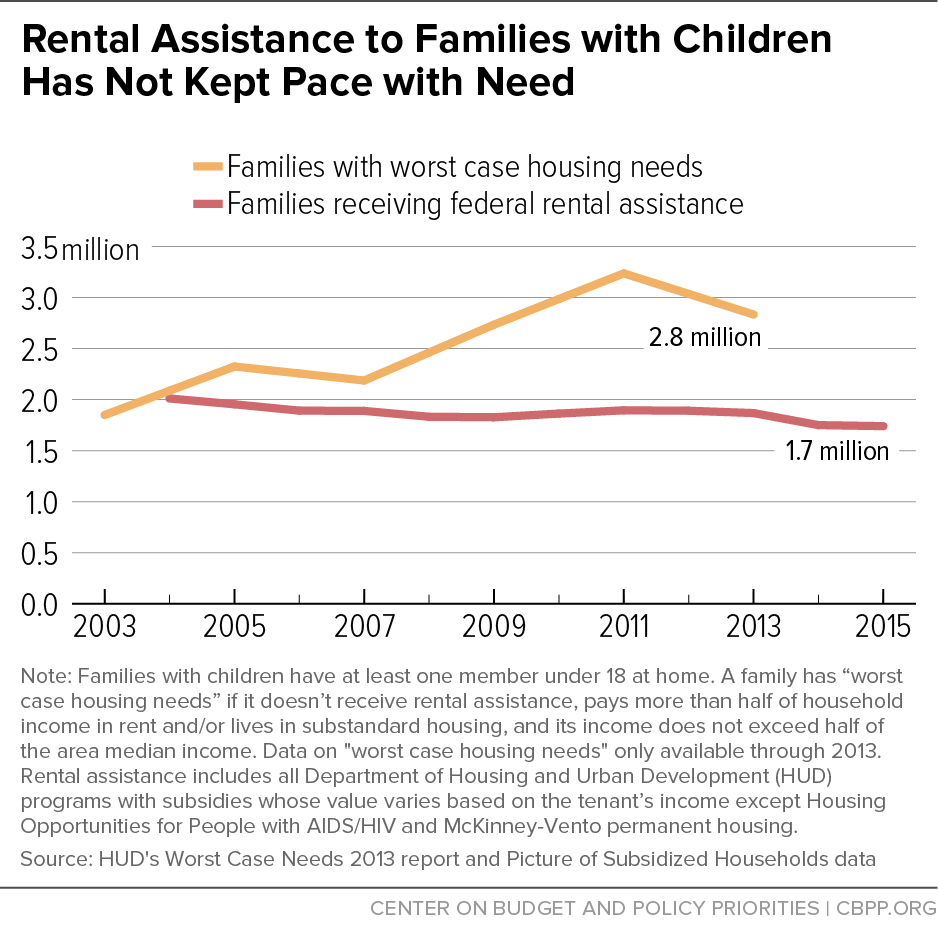
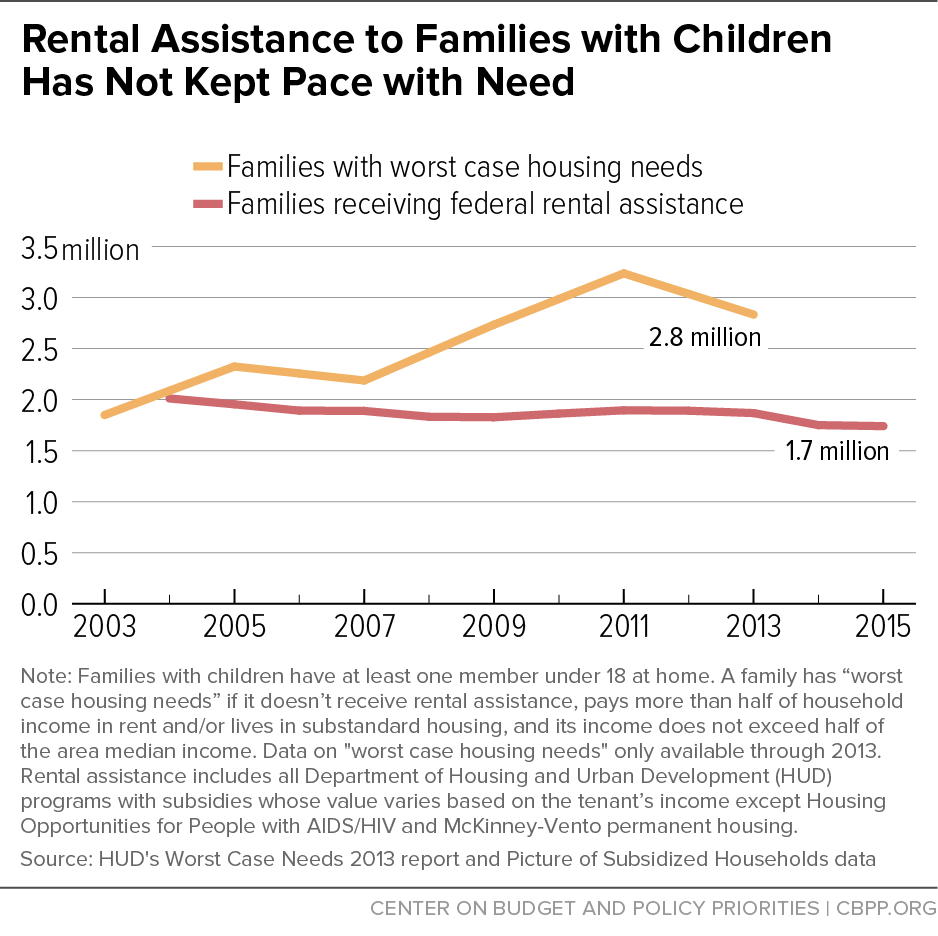
Demand for rental housing has risen sharply in the last decade due to economic and demographic factors,[2] and many families with children are being squeezed financially as rents rise faster than incomes.[3] The number of families that paid more than half their income for rent or lived in severely substandard housing rose by 53 percent between 2003 and 2013, to nearly 3 million.
Alarmingly, homelessness among school-aged children is at a record high.Alarmingly, homelessness among school-aged children is at a record high.[4] The persistence of family homelessness despite an improving economy is worrisome because housing instability is especially harmful for children’s health and school performance. Children who experience homelessness or frequent, involuntary family moves are more likely to develop cognitive, behavioral, and mental health problems, as well as physical health problems such as asthma, and they are less likely to do well in school.[5]
The total number of households receiving rental assistance from the Department of Housing and Urban Development (HUD) rose slightly between 2004 and 2015, even as the number of assisted families with children fell. This apparently reflects two trends: first, some households continue receiving rental assistance after their children have grown up or left home; in about half of these cases, the household heads were disabled or elderly by 2015. Second, federal policymakers (as well as state and local housing agencies in some cases) have targeted newly available vouchers primarily on homeless veterans and people with disabilities. With 2015 federal spending for housing assistance $2.9 billion (6 percent) below 2004 levels, after adjusting for inflation, fewer resources were available for families with children.
Unfortunately, the housing problems facing low-income renters with children are unlikely to improve without more public investment in rental assistance. Public policy changes that boost family incomes are vital, but even with such measures, millions more families will need help to meet their rental costs and provide stable homes for their children.
Rental Assistance to Families with Children Falling as Need Rises
The number of families with children using HUD rental assistance has fallen by over 250,000 (13 percent) since 2004, hitting an 11-year low of 1,740,000 households in 2015.[6] As fewer families with children receive rental assistance, more struggle to pay the rent and keep a roof over their heads.
Nearly 3 million very low-income families with children had “worst case housing needs” in 2013 — meaning they paid more than half their income for rent or lived in severely substandard housing — 53 percent more than in 2003.[7] (See Figure 1.) Families with worst case needs typically have two children and are headed by a single woman or married couple with low-wage jobs that don’t pay enough to enable them to pay the rent and meet other basic needs. These families typically pay $930 per month for rent and utilities.[8]
When housing costs half or more of monthly income, families often must make painful choices between paying the rent and buying basic necessities like adequate food or medication. This precarious financial situation also puts them at an increased risk of eviction or homelessness. Families with children who are behind on rent are more likely to be evicted than other types of households.[9]
During the 2013-2014 school year, 1.4 million school-age children were in families that lacked a home of their own — for instance, they were in a homeless shelter or doubled up with other families.[10] Moreover, these figures omit preschool children, the age group for which the risk of homelessness is highest.[11]
The persistence of family homelessness — despite an improving economy — is particularly worrisome because housing instability is especially harmful for children.[12] Children experiencing homelessness perform worse in school, are more likely to experience physical and mental health problems, and are at greater risk of accidental injury and becoming a victim of physical assault.[13] Even doubling up with family or friends can be risky: studies show children living in crowded homes have lower reading scores and complete less schooling than their peers.[14]
Families With Children Receiving Smaller Share of Assistance
Even as the number of families with children with rental assistance has fallen, the total number of households receiving rental assistance has grown modestly. This shift primarily reflects changes in the types of households receiving Housing Choice Vouchers (HCV), the largest rental assistance program. The changes have been less dramatic in public housing and other multifamily properties, where families with children have never been the majority of recipients.
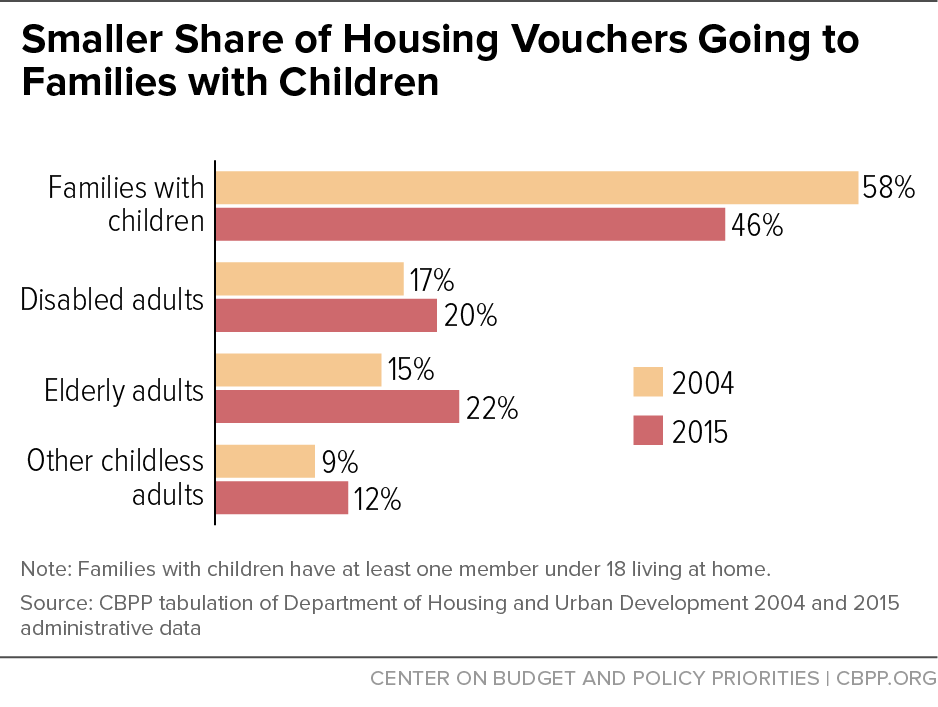
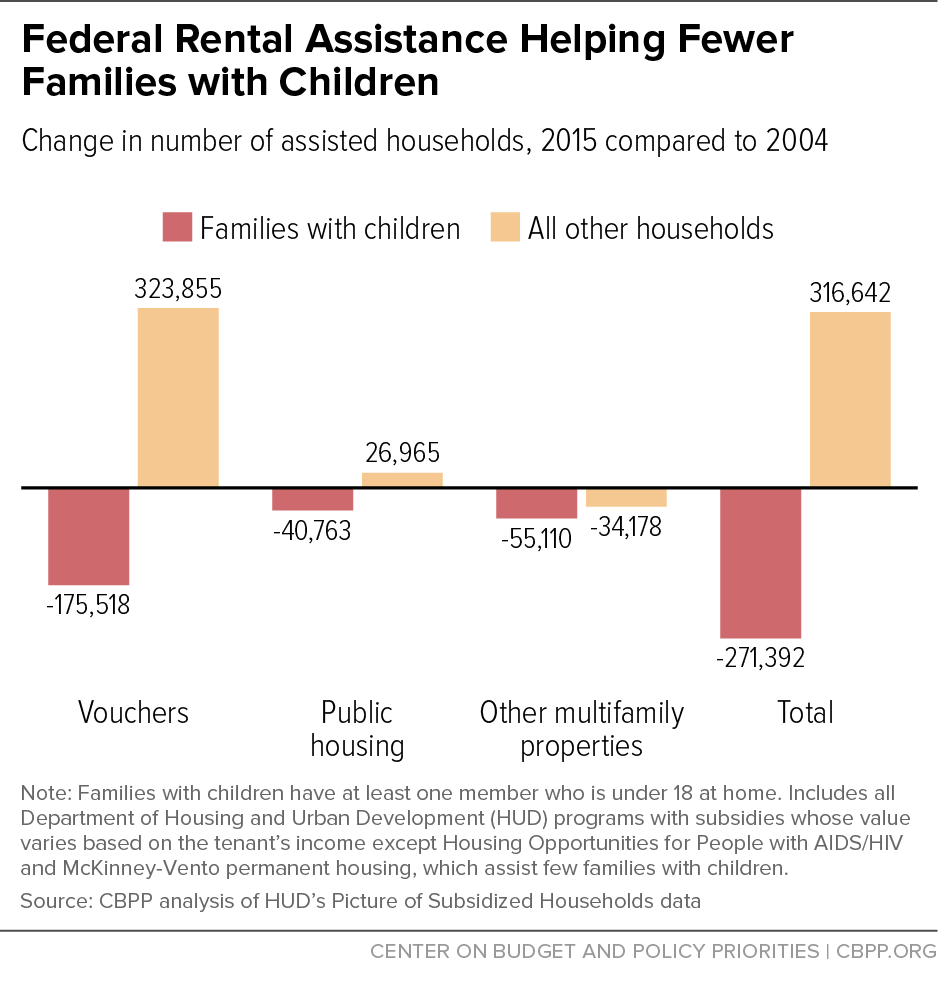
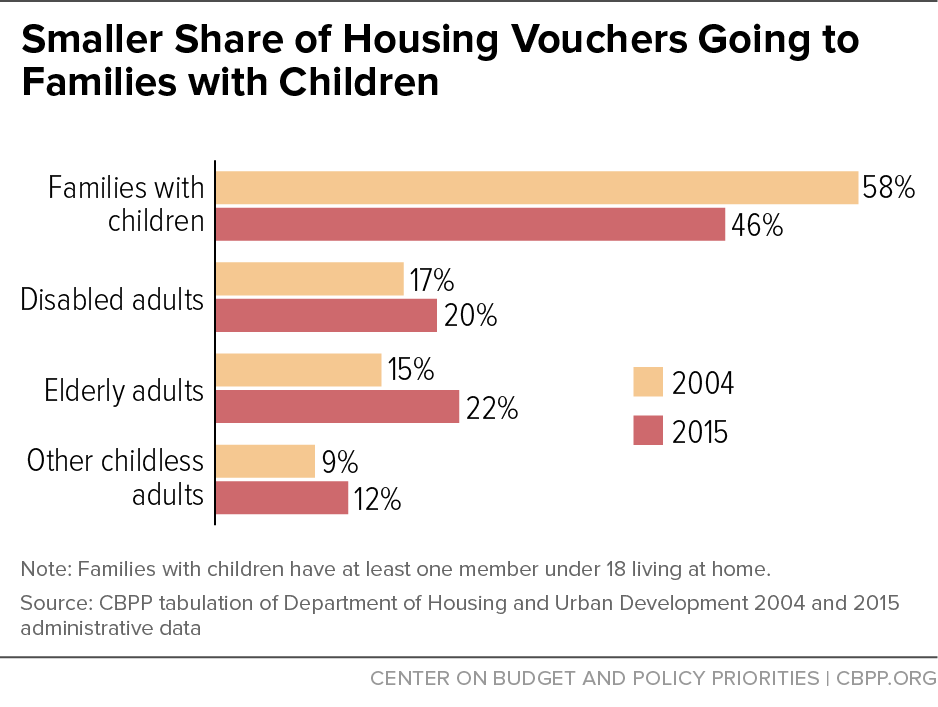
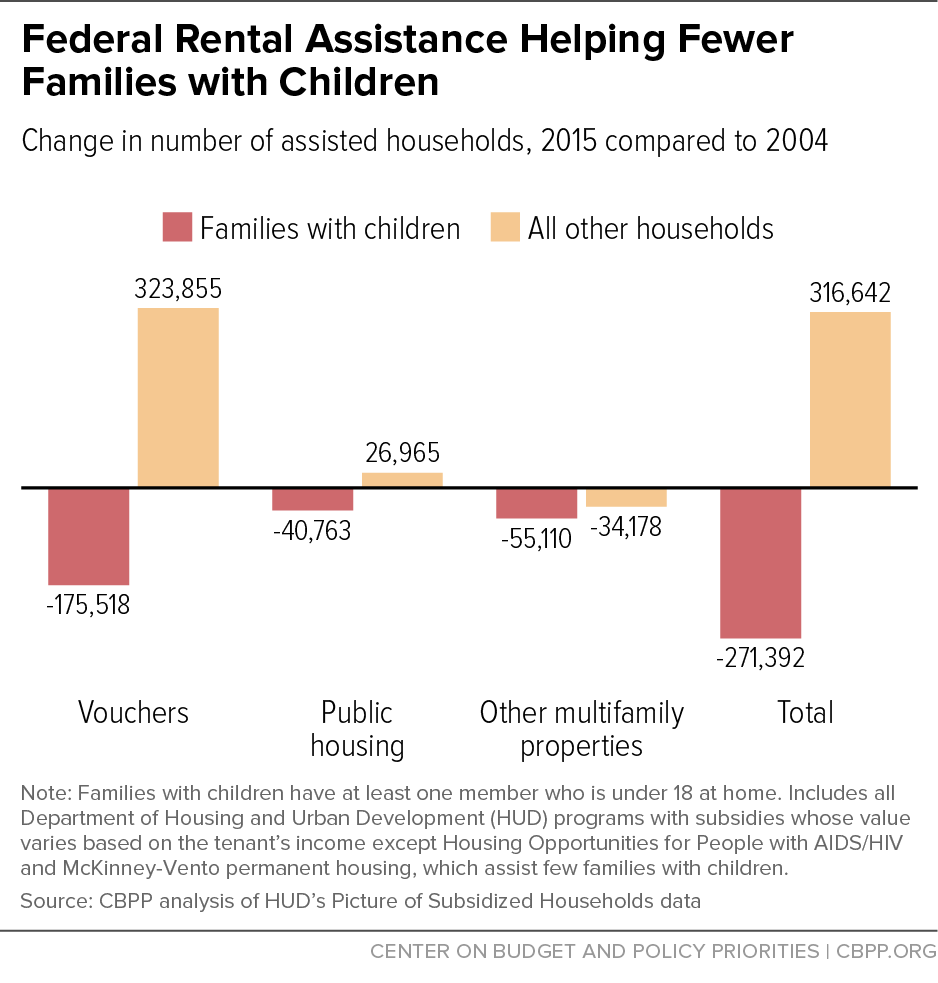
While the number of families with children using vouchers fell by 175,000 from 2004 to 2015, the number of other households using vouchers rose by more than 320,000; families with children fell from 58 percent of all voucher households to 46 percent (see Figure 2). This national pattern is reflected in nearly every state (see Appendix Table 2).
Also over this period, the number of families with children in public housing fell by 40,000 but the number of other households grew by nearly 27,000. In the other federal rental assistance programs that serve the general population, the total number of households assisted has fallen but the number of assisted families with children has fallen more than other groups. (See Figure 3.)
The decline in the number of families with children assisted apparently reflects two factors: 1) some households remaining on rental assistance after their children have grown up or left home; and 2) federal decisions to target newly available vouchers primarily on homeless veterans and people with disabilities, combined in some cases with similar decisions by state and local housing agencies.
While the large majority of families with children that received HUD rental assistance in 2004 were no longer assisted by 2015, some parents continued to use their voucher or live in an assisted unit after their children had turned 18 or moved away; in about half of these cases, the household heads were disabled or elderly by 2015.[15] Elderly and disabled households are more likely to remain on assistance, as they are less likely to be able to work and more likely to age in place.[16] In the absence of a significant expansion of rental assistance in the last decade, these demographic changes have had an outsize impact on the composition of households using HUD assistance.
Federal policies have also played a role by targeting new housing resources almost entirely to people without minor children. From 2004 to 2015, policymakers funded some 109,000 new vouchers (in addition to providing new “tenant protection” vouchers to assist households that lost other forms of housing assistance), but few of these additional vouchers went to families with children. The new vouchers were designated for homeless veterans, non-elderly people with disabilities, and families engaged with child welfare agencies. Relatively few families with children fall into the first two categories, and only 7,000 of the new “special purpose” vouchers were targeted to families in the third category.[17]
In some communities, well-intentioned local decisions have magnified the impact of these federal decisions. When faced with long waiting lists for apartments or vouchers, housing agencies and private owners that manage properties with project-based subsidies may prioritize particular types of households through their use of admissions preferences. Some agencies choose to house those with the greatest need — often homeless people or people with disabilities — first, which is a commendable practice.[18] Homeless people in many communities are more likely to be single individuals.
Expanded Rental Assistance Needed
The federal government spent $2.9 billion less for housing assistance in 2015 than in 2004, after adjusting for inflation. Had federal spending remained at 2004 levels, that $2.9 billion could have funded an estimated 350,000 additional vouchers — potentially preventing the decline in families with children receiving rental assistance.
The housing problems facing low-income renters with children are unlikely to improve without more public investment in rental assistance. Growing demand for rental housing is driving rent increases in many parts of the country, and the increase in households that cannot afford more than modestly priced rentals far exceeds the increase in the supply of such units.
For the 20 percent of renters with annual incomes below $15,000, rents must be under $400/month to be affordable. Yet between 2003 and 2013, the number of such low-cost units rose by just 10 percent, while the number of such households rose by 40 percent. In addition, the net gain in moderately priced units, with rents of $400-$799/month, was less than half the growth in renter households that could afford these units.[19] This indicates that while building more housing would take some pressure off rents in most markets, private market units generally will remain too costly for families with low incomes.[20]
Strategies that boost family incomes would help. But it would take a steady full-time income of roughly $19 per hour for very low-income families with children to reduce their severe rent burdens to an affordable level, and still more income to meet the higher rents in high-cost markets or in many neighborhoods with good schools.[21] Millions of single-parent families, and many households with two adults in the home, are unlikely to achieve incomes at this level even with robust policy changes to increase skill levels, create more jobs, raise minimum wages, subsidize quality child care and pre-school programs, and overcome other barriers to employment.
The Children’s Defense Fund (CDF) has proposed providing housing vouchers to the 2.6 million renter families with children with incomes below 150 percent of the poverty line that pay more than half their income for rent. This proposal, once fully phased in, would cost about $23.5 billion per year and would be perhaps the single most powerful step policymakers could take to reduce child poverty.[22] It also would effectively eliminate family homelessness. The Bipartisan Policy Center’s Housing Commission recommended making housing assistance effectively an entitlement for all types of households with incomes at or below 30 percent of the area median. This is a somewhat lower income ceiling than CDF proposed, but because the proposal is not limited to families with children it would provide additional vouchers to more households — about 3 million — and cost somewhat more once fully phased in: about $31 billion per year.[23]
The President’s fiscal year 2017 budget proposes a more targeted rental assistance strategy to end family homelessness by 2020. It builds on strong evidence that vouchers are highly effective at enabling homeless families with children to secure stable homes.[24] At a cost of $11 billion over ten years, the plan would provide roughly 160,000 new vouchers to homeless families with children, as well as expand “rapid re-housing” assistance to help homeless families that can reestablish stable housing with short-term financial assistance.[25] This proposal would be a major step, though it would not fully restore the number of families with children using housing vouchers to the 2004 level. A substantial number of families would remain at risk of housing instability and homelessness due to unaffordable rents.
In addition to funding a substantial increase in the number of housing vouchers available, federal policymakers could make rents affordable to more families by creating a renters’ tax credit, as CBPP has proposed.[26]
Of course, such policy changes — and similar actions at the state level — would require a significant change in priorities. Growing attention to the severity of the housing affordability crunch and the long-term consequences of failing to address it, however, provide some grounds for hope that we could see an increased focus on the need to start reversing the several-decade decline in the extent to which public policy helps address the housing needs of low-income families.[27]
Appendix
| TABLE 1 | ||||||||||||
|---|---|---|---|---|---|---|---|---|---|---|---|---|
HUD Rental Assistance to Families with Children 2004-2015 |
||||||||||||
| Total | Vouchers | Public Housing | Other multifamily | |||||||||
| Year | All recipients | Families w/kids | Share w/kids | All recipients | Families w/kids | Share w/kids | All recipients | Families w/kids | Share w/kids | All recipients | Families w/kids | Share w/kids |
| 2004 | 4,533,332 | 2,010,960 | 44% | 2,027,718 | 1,173,314 | 58% | 1,062,804 | 446,781 | 42% | 1,442,810 | 390,866 | 27% |
| 2005 | 4,522,538 | 1,954,488 | 43% | 1,995,942 | 1,121,319 | 56% | 1,072,417 | 441,510 | 41% | 1,454,179 | 391,659 | 27% |
| 2006 | 4,482,517 | 1,891,608 | 42% | 1,958,646 | 1,063,162 | 54% | 1,086,216 | 446,126 | 41% | 1,437,655 | 382,320 | 27% |
| 2007 | 4,544,810 | 1,889,184 | 42% | 1,991,897 | 1,044,507 | 52% | 1,091,219 | 446,140 | 41% | 1,461,694 | 398,537 | 27% |
| 2008 | 4,516,991 | 1,831,913 | 41% | 2,062,448 | 1,045,141 | 51% | 1,074,224 | 436,111 | 41% | 1,380,318 | 350,660 | 25% |
| 2009 | 4,384,533 | 1,826,652 | 42% | 1,981,497 | 1,038,083 | 52% | 1,052,083 | 426,633 | 41% | 1,350,953 | 361,936 | 27% |
| 2010 | 4,534,133 | 1,863,045 | 41% | 2,090,406 | 1,071,697 | 51% | 1,061,159 | 425,184 | 40% | 1,382,568 | 366,163 | 26% |
| 2011 | 4,643,933 | 1,895,146 | 41% | 2,171,461 | 1,092,774 | 50% | 1,077,040 | 431,756 | 40% | 1,395,432 | 370,616 | 27% |
| 2012 | 4,713,576 | 1,890,633 | 40% | 2,201,378 | 1,078,610 | 49% | 1,085,769 | 432,181 | 40% | 1,426,429 | 379,842 | 27% |
| 2013 | 4,731,771 | 1,867,849 | 39% | 2,200,622 | 1,050,213 | 48% | 1,083,570 | 430,893 | 40% | 1,447,579 | 386,743 | 27% |
| 2014 | 4,532,158 | 1,750,193 | 39% | 2,112,963 | 984,945 | 47% | 1,069,775 | 417,623 | 39% | 1,349,420 | 347,626 | 26% |
| 2015 | 4,578,583 | 1,739,569 | 38% | 2,176,055 | 997,796 | 46% | 1,049,006 | 406,017 | 39% | 1,353,522 | 335,756 | 25% |
Notes: Families with children have at least one member under age 18 living in the home. Table includes all HUD programs with subsidies whose value varies based on the tenant’s income except Housing Opportunities for People with AIDS/HIV and McKinney-Vento permanent housing. Source: CBPP analysis of Department of Housing and Urban Development, Picture of Subsidized Households. Missing values were interpolated using data from other years. | ||||||||||||
| TABLE 2 | |||||
|---|---|---|---|---|---|
Share of HUD Rental Assistance Going to Families with Children by State in 2004 and 2015 |
|||||
| State | Year | All programs Share going to families w/kids |
Vouchers Share going to families w/kids |
Public Housing Share going to families w/kids |
Other multifamily Share going to families w/kids |
| AK | 2004 | 48% | 50% | 61% | 37% |
| 2015 | 42% | 38% | 56% | 42% | |
| AL | 2004 | 52% | 71% | 48% | 31% |
| 2015 | 50% | 61% | 48% | 36% | |
| AR | 2004 | 47% | 63% | 41% | 25% |
| 2015 | 41% | 49% | 36% | 33% | |
| AZ | 2004 | 51% | 61% | 61% | 22% |
| 2015 | 44% | 49% | 56% | 24% | |
| CA | 2004 | 45% | 51% | 54% | 23% |
| 2015 | 34% | 36% | 50% | 21% | |
| CO | 2004 | 44% | 54% | 48% | 26% |
| 2015 | 38% | 43% | 44% | 27% | |
| CT | 2004 | 43% | 62% | 37% | 23% |
| 2015 | 37% | 47% | 33% | 23% | |
| DC | 2004 | 47% | 56% | 40% | 45% |
| 2015 | 38% | 40% | 34% | 38% | |
| DE | 2004 | 42% | 48% | 47% | 35% |
| 2015 | 43% | 49% | 50% | 34% | |
| FL | 2004 | 50% | 63% | 48% | 30% |
| 2015 | 44% | 49% | 44% | 32% | |
| GA | 2004 | 57% | 74% | 50% | 39% |
| 2015 | 49% | 56% | 45% | 42% | |
| HI | 2004 | 49% | 63% | 49% | 16% |
| 2015 | 43% | 51% | 44% | 18% | |
| IA | 2004 | 33% | 46% | 24% | 16% |
| 2015 | 32% | 40% | 21% | 20% | |
| ID | 2004 | 46% | 60% | 24% | 28% |
| 2015 | 39% | 44% | 25% | 32% | |
| IL | 2004 | 41% | 63% | 26% | 25% |
| 2015 | 38% | 50% | 30% | 27% | |
| IN | 2004 | 44% | 60% | 43% | 29% |
| 2015 | 41% | 50% | 38% | 32% | |
| KS | 2004 | 32% | 49% | 26% | 20% |
| 2015 | 30% | 41% | 28% | 21% | |
| KY | 2004 | 46% | 60% | 42% | 30% |
| 2015 | 41% | 49% | 39% | 32% | |
| LA | 2004 | 57% | 72% | 55% | 35% |
| 2015 | 48% | 53% | 47% | 36% | |
| MA | 2004 | 37% | 53% | 31% | 24% |
| 2015 | 32% | 41% | 28% | 21% | |
| MD | 2004 | 42% | 59% | 36% | 27% |
| 2015 | 40% | 47% | 40% | 28% | |
| ME | 2004 | 33% | 43% | 39% | 17% |
| 2015 | 30% | 36% | 38% | 17% | |
| MI | 2004 | 37% | 54% | 31% | 28% |
| 2015 | 36% | 46% | 31% | 27% | |
| MN | 2004 | 34% | 53% | 22% | 23% |
| 2015 | 33% | 50% | 22% | 24% | |
| MO | 2004 | 45% | 64% | 37% | 25% |
| 2015 | 42% | 53% | 35% | 27% | |
| MS | 2004 | 58% | 75% | 52% | 45% |
| 2015 | 55% | 63% | 49% | 48% | |
| MT | 2004 | 41% | 50% | 53% | 24% |
| 2015 | 36% | 38% | 50% | 26% | |
| NC | 2004 | 51% | 60% | 54% | 30% |
| 2015 | 48% | 51% | 51% | 38% | |
| ND | 2004 | 31% | 40% | 23% | 17% |
| 2015 | 30% | 33% | 24% | 25% | |
| NE | 2004 | 36% | 51% | 27% | 22% |
| 2015 | 37% | 51% | 26% | 24% | |
| NH | 2004 | 29% | 44% | 22% | 12% |
| 2015 | 27% | 35% | 22% | 15% | |
| NJ | 2004 | 36% | 54% | 30% | 20% |
| 2015 | 31% | 42% | 25% | 20% | |
| NM | 2004 | 51% | 60% | 50% | 34% |
| 2015 | 43% | 44% | 46% | 38% | |
| NV | 2004 | 51% | 57% | 53% | 37% |
| 2015 | 45% | 47% | 43% | 36% | |
| NY | 2004 | 40% | 54% | 40% | 23% |
| 2015 | 34% | 40% | 33% | 21% | |
| OH | 2004 | 45% | 58% | 45% | 29% |
| 2015 | 42% | 48% | 43% | 32% | |
| OK | 2004 | 48% | 62% | 37% | 33% |
| 2015 | 43% | 49% | 37% | 37% | |
| OR | 2004 | 39% | 47% | 44% | 16% |
| 2015 | 36% | 39% | 41% | 21% | |
| PA | 2004 | 36% | 48% | 39% | 19% |
| 2015 | 35% | 45% | 35% | 22% | |
| RI | 2004 | 29% | 60% | 26% | 12% |
| 2015 | 27% | 50% | 22% | 15% | |
| SC | 2004 | 56% | 64% | 55% | 47% |
| 2015 | 52% | 54% | 52% | 50% | |
| SD | 2004 | 32% | 45% | 19% | 21% |
| 2015 | 33% | 42% | 18% | 27% | |
| TN | 2004 | 47% | 67% | 44% | 29% |
| 2015 | 44% | 55% | 42% | 32% | |
| TX | 2004 | 58% | 68% | 51% | 42% |
| 2015 | 50% | 53% | 46% | 44% | |
| UT | 2004 | 46% | 55% | 50% | 26% |
| 2015 | 38% | 42% | 36% | 29% | |
| VA | 2004 | 50% | 60% | 56% | 35% |
| 2015 | 46% | 49% | 52% | 39% | |
| VT | 2004 | 32% | 42% | 23% | 20% |
| 2015 | 28% | 36% | 18% | 17% | |
| WA | 2004 | 43% | 56% | 39% | 16% |
| 2015 | 34% | 40% | 28% | 18% | |
| WI | 2004 | 34% | 56% | 26% | 17% |
| 2015 | 30% | 44% | 25% | 20% | |
| WV | 2004 | 40% | 57% | 34% | 22% |
| 2015 | 36% | 46% | 33% | 24% | |
| WY | 2004 | 35% | 45% | 42% | 25% |
| 2015 | 31% | 29% | 42% | 31% | |
Notes: Families with children have at least one member under age 18 living in the home. Table includes all HUD programs with subsidies whose value varies based on the tenant’s income except Housing Opportunities for People with AIDS/HIV and McKinney-Vento permanent housing. Source: CBPP analysis of Department of Housing and Urban Development, Picture of Subsidized Households. Missing values were interpolated using data from other years. | |||||
Data Sources and Adjustments
This analysis is based on HUD programs that provide rental subsidies whose value varies based on the tenant’s income: Housing Choice Vouchers, Public Housing, Section 8 Project-Based Rental Assistance, Moderate Rehabilitation, Supportive Housing for the Elderly and People with Disabilities (Sections 202 and 811), and multifamily assisted projects receiving other HUD subsidies. Due to limited data, our figures exclude households in HUD’s Housing Opportunities for People with AIDS/HIV (HOPWA) and McKinney-Vento permanent housing programs for the homeless. Those programs predominantly serve people without children.
In addition to HUD rental assistance, the Department of Agriculture (USDA) provides rent subsidies for approximately 270,000 units as part of its Rural Rental Assistance program. Those units primarily serve elderly and disabled households. We exclude USDA households from our analysis due to lack of historical and demographic data.
Data on the number of families with children receiving rental assistance are from the HUD’s Picture of Subsidized Households dataset (https://www.huduser.gov/portal/datasets/picture/yearlydata.html). These data are available annually from 2004 through 2015, though HUD published data intermittently from 1995 to 2004.
Picture of Subsidized Households contains two variables that indicate whether a household has children: the percent of households with two spouses and one or more children under 18, and the percent of households with one parent and one or more children under 18. We sum these variables to determine the total share of families with minor children.
Our figures and tables use occupied units for public housing and multifamily properties and vouchers in use for the Housing Choice Voucher program. (An analysis of total units and authorized vouchers, as opposed to occupied units and vouchers in use, yields very similar trends across programs.) To calculate occupied units/vouchers in use, we multiply the total number of units/vouchers by the annual occupancy rate. To calculate the total number of families with children, we multiply the occupied units/vouchers in use by the share of families with children.
For Housing Choice Vouchers, Public Housing, and Moderate Rehabilitation, we use Picture of Subsidized Households’ data on individual public housing agencies to calculate the national number of families with children in these programs. We calculate national totals by summing up individual data for all public housing agencies in the United States and territories. We use national totals published in Picture of Subsidized Households for all other HUD programs in our analysis.
There were 275 public housing agencies representing 107,000 units (about 2 percent of all units) with missing data on the share of families with children in 2004. We used linear interpolation based on Picture of Subsidized Households data from 2000 and 2004-2015 to estimate the missing values for these agencies (HUD has not published data for 2001-2003). We were able to interpolate values for 161 agencies representing 96,000 units. An additional 20 agencies representing 7,000 units were absorbed by other agencies after 2004 and no longer existed in 2015. The remaining 94 agencies representing 3,900 units were dropped from the analysis.
Due to rounding and differences in the time period and method of data collection, figures on the number of vouchers from Picture of Subsidized Households do not necessarily match data published in HUD’s Voucher Management System (VMS) and on CBPP’s website.[28]
We relied on HUD administrative data to analyze and present demographic information on households using rental assistance in 2004 and 2015. The data are not public and are shared with CBPP through a special research agreement. The number of assisted households in this non-public dataset differs somewhat from Picture of Subsidized Households, likely due to differences in the period of data collection and adjustments HUD performs to account for missing data.
To understand the demographic changes among households with rental assistance in 2004 and 2015, we use household identifiers to match families receiving any kind of HUD rental assistance in 2004 to their household records in any HUD program in 2015. We assumed these households remained on rental assistance continuously between 2004 and 2015, but some households may have left and later returned during this period. Forty percent of households with children in 2004 that received HUD assistance in 2015 no longer reported minor children at home by 2015, meaning their children had grown up or left home during the period of our analysis. Conversely, just 4 percent of households without children in 2004 had children living at home by 2015.
End Notes
[1] Interns Jae Sik Jeon and Henry Watson assisted with the data analysis.
[2] Recent growth in the number of renters is primarily due to two sets of factors: the Great Recession and related foreclosure crisis pushing more people into the rental market, and household formation among millennials entering their 20s, a prime period of renting. Harvard Joint Center for Housing Studies, “America’s Rental Housing: Expanding Options for Diverse and Growing Demand,” December 2015, http://www.jchs.harvard.edu/americas-rental-housing.
[3] Center on Budget and Policy Priorities, “Chart Book: Cuts in Federal Assistance Have Exacerbated Families’ Struggles to Afford Housing,” April 12, 2016, https://www.cbpp.org/research/housing/chart-book-cuts-in-federal-assistance-have-exacerbated-families-struggles-to-afford#section03.
[4] Ehren Dohler, “The Alarming Rise in Homeless Students,” Center on Budget and Policy Priorities, September 15, 2015, https://www.cbpp.org/blog/the-alarming-rise-in-homeless-students.
[5] Will Fischer, “Research Shows Housing Vouchers Reduce Hardship and Provide Platform for Long-Term Gains Among Children,” Center on Budget and Policy Priorities, October 7, 2015, https://www.cbpp.org/research/housing/research-shows-housing-vouchers-reduce-hardship-and-provide-platform-for-long-term.
[6] For more information on HUD’s rental assistance programs, see Center on Budget and Policy Priorities, “Policy Basics: Federal Rental Assistance,” December 21, 2015, https://www.cbpp.org/research/housing/policy-basics-federal-rental-assistance. See the Appendix for the sources and methods used to estimate the change in households served by HUD’s rental assistance programs.
[7] Department of Housing and Urban Development, “Worst Case Housing Needs: 2015 Report to Congress,” April 2015, https://www.huduser.gov/portal/publications/affhsg/wc_HsgNeeds15.html. These are the latest data available. HUD considers families very low-income if their income does not exceed 50 percent of local median income, adjusted for household size.
[8] Id.
[9] Matthew Desmond et al., “Evicting Children”, Social Forces, 92:303-27, 2013, http://www.fhco.org/pdfs/news/NEWS_EvictingChildrenSocialForces2013.pdf. This study of the Milwaukee rental market found that families with children were nearly three times as likely to be subject to a court-ordered eviction, regardless of their income or how much they owed the landlord, than others who were behind on rent, and that Milwaukee neighborhoods with higher percentages of children experienced more evictions than neighborhoods with fewer children.
[10] Department of Education, “Total Number of Homeless Students Enrolled in LEAs with or without McKinney-Vento Subgrants,” http://eddataexpress.ed.gov/data-element-explorer.cfm/tab/trend/deid/5353/state/US/.
[11] Marybeth Shinn, “What Does Research Tell Us About Homelessness Among Families?,” presentation at 2014 National Conference on Ending Homelessness, July 30, 2014, http://www.endhomelessness.org/page/-/files/What%20Does%20Research%20Tell%20Us%20About%20Homelessness%20Among%20Families_2.pdf.
[12] Roughly as many families with children were in homeless shelters in 2014 as in 2008, during the Great Recession. Department of Housing and Urban Development, The 2014 Annual Homeless Assessment Report (AHAR) to Congress, Part 2: Estimates of Homelessness in the United States, November 2015, https://www.hudexchange.info/resource/4828/2014-ahar-part-2-estimates-of-homelessness/. Moreover, the number of homeless school-aged children identified by the Department of Education — a figure that includes children in families that are doubled up with other families or in other precarious situations, as well as in homeless shelters — is at an all-time high. National Center for Homeless Education, “Federal Data Summary School Years 2011-12 to 2013-14: Education for Homeless Children and Youth,” Department of Education, November 2015, http://center.serve.org/nche/pr/data_comp.php.
[13] Jelena Obradovic et al., “Academic Achievement of Homeless and Highly Mobile Children in an Urban School District,” Development and Psychopathology, 2009; Marybeth Shinn et al., “Long-Term Associations of Homelessness with Children’s Well-Being,” American Behavioral Scientist, Vol. 51, No. 6, February 2008; Linda C. Berti et al., “Comparison of Health Status of Children Using a School-Based Health Center for Comprehensive Care,” Journal of Pediatric Health Care, Vol. 15; September/October 2001; Stanley K. Frencher et al., “A Comparative Analysis of Serious Injury among Homeless and Housed Low Income Residents of New York City,” Trauma, Vol. 69, No. 4, October 2010.
[14] Lorraine E. Maxwell, “Home and School Density Effects on Elementary School Children: The Role of Spatial Density,” Environment and Behavior, Vol. 35, No. 4, 2003; Frank Braconi, “Housing and Schooling,” The Urban Prospect, Citizens Housing and Planning Council, 2001; Dalton Conley, “A Room with a View or a Room of One’s Own? Housing and Social Stratification,” Sociological Forum, Vol. 16, No. 2, 2001. Children also are at additional risk of mistreatment. See, e.g., Kathryn J. Edin and H. Luke Shaefer, $2.00 a Day: Living on Almost Nothing in America (New York: Houghton Mifflin Harcourt, 2015).
[15] CBPP analysis of HUD administrative data for 2004 and 2015. See Appendix.
[16] Barbara Sard, “Most Rental Assistance Recipients Work, Are Elderly, or Have Disabilities,” Center on Budget and Policy Priorities, July 17, 2013, https://www.cbpp.org/research/most-rental-assistance-recipients-work-are-elderly-or-have-disabilities.
[17] Some of the recipients of these Family Unification Program vouchers were youth age 18 or older who aged out of foster care and who therefore are not minor children. In addition to new housing vouchers, Congress provided funding to add roughly 55,000 new supportive housing units for seniors and people with disabilities from 2004 to 2015, and approximately 75,000 new permanent supportive housing units for homeless households. The large majority of the new households occupying these new units did not include children.
[18] Roughly one-quarter of agencies prioritize people experiencing homelessness over others on their waiting lists, a 2012 survey found. The impact of such admissions preferences on the demographic characteristics of households receiving rental assistance remains unclear. Abt Associates, “Study of PHAs’ Efforts to Serve People Experiencing Homelessness,” February 2014, https://www.huduser.gov/portal/publications/homeless/pha_homelessness.html.
[19] Harvard Joint Center for Housing Studies, “America’s Rental Housing: Expanding Options for Diverse and Growing Demand,” December 2015, http://www.jchs.harvard.edu/americas-rental-housing.
[20] In 2015, only 10 percent of new apartments had rents below $850/month. Id. A family would need an income of $34,000 per year to afford such apartments, using the common federal standard that rent and utility costs should not exceed 30 percent of income. Apartments constructed using Low Income Housing Tax Credits to cover a portion of the construction costs may rent for more than $850 in areas with incomes at or above the national average. The large majority of families with children with severe rent burdens could not afford rents at this level without vouchers or other rental assistance.
[21] This estimate is based on the national median gross rent of $1,010 per month that severely cost-burdened, very low-income families with children paid in 2014 (CBPP analysis of the Census Bureau’s American Community Survey 2014 one-year public use microdata sample).
[22] Children’s Defense Fund, “Ending Child Poverty Now,” 2015, http://www.childrensdefense.org/newsroom/mediaresources/ending-child-poverty-now.pdf.
[23] Bipartisan Policy Center, “Housing America’s Future: New Directions for National Policy,” February 2013, http://cdn.bipartisanpolicy.org/wp-content/uploads/sites/default/files/BPC_Housing%20Report_web_0.pdf; Bipartisan Policy Center, “Background Memorandum: Measuring Likely Participation in an Open-Enrollment Housing Voucher Program for Extremely Low-Income Households,” January 2015, http://bipartisanpolicy.org/wp-content/uploads/2015/01/Housing-Voucher-Recommendation-Memo-January-2015.pdf. Matthew Desmond echoed this recommendation in his recent book, Evicted: Poverty and Profit in the American City (New York: Crown Publishers, 2016).
[24] Daniel Gubits et al., “Family Options Study,” Office of Policy Research and Development, Department of Housing and Urban Development, July 2015, https://www.huduser.gov/portal/sites/default/files/pdf/FamilyOptionsStudy_final.pdf.
[25] The plan also assumes that an additional 120,000 vouchers would be made available via turnover from the pool of existing vouchers that are currently in use.
[26] “Renters’ Credit,” Center on Budget and Policy Priorities, https://www.cbpp.org/topics/renters-credit.
[27] “Chart Book: Cuts in Federal Assistance Have Exacerbated Families’ Struggles to Afford Housing,” Center on Budget and Policy Priorities, April 12, 2016, https://www.cbpp.org/research/housing/chart-book-cuts-in-federal-assistance-have-exacerbated-families-struggles-to-afford#section03. See, e.g., Jennifer Senior, “Review: In ‘Evicted,’ Home Is an Elusive Goal for America’s Poor,” The New York Times, February 21, 2016, http://www.nytimes.com/2016/02/22/books/evicted-book-review-matthew-desmond.html?_r=0.
[28] See https://www.cbpp.org/research/housing/national-and-state-housing-data-fact-sheets.