

2025 Budget Stakes: Proposals Would Harm Women
Proposals that Congress could enact this year, including through fast-track “reconciliation” legislation, would harm women, who make up the majority of adults in families with incomes below the poverty line, the majority of adult participants in Medicaid and SNAP — two programs likely facing massive cuts — and a large majority of the adult participants in the Temporary Assistance for Needy Families (TANF) program, where cuts are also under consideration. Proposed cuts could leave millions of women with less health care access and higher health care costs, less ability to afford food for their families, less ability to afford rent, and less access to child care.
Cutting Women’s Health Care Through Medicaid

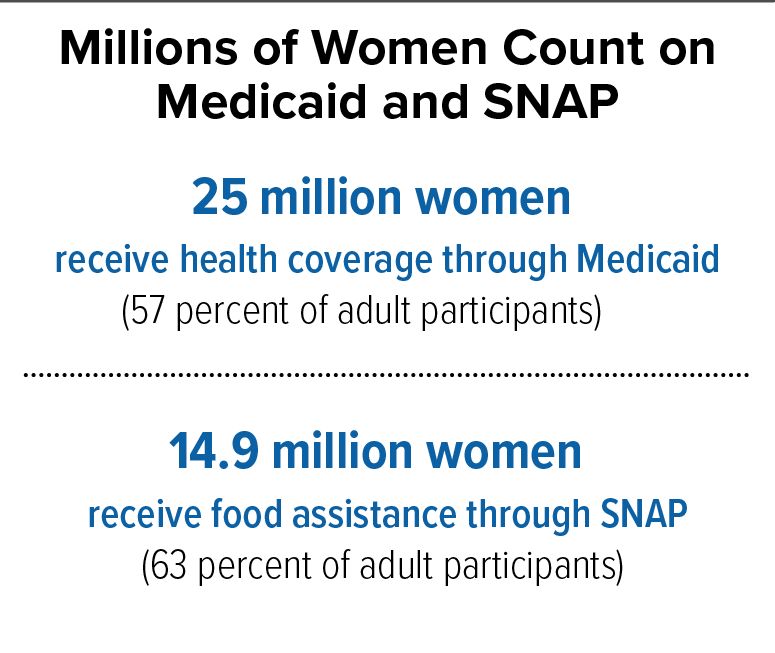
Cutting Medicaid by hundreds of billions of dollars would have especially devastating consequences for the 25 million women aged 18 and over who receive health care through the program. Women make up a majority (57 percent) of adult Medicaid or adult Children’s Health Insurance Program beneficiaries. Medicaid financed 41 percent of all births in 2023 and is the largest source of public funding for family planning services. Medicaid also financed 61 percent of all long-term services and supports, which women are more likely to need as they age.
Undermining Medicaid expansion. Millions of women became eligible for Medicaid through the Affordable Care Act’s expansion of Medicaid to cover more low-income adults. The expansion has improved women’s access to a wide range of essential health care services. For example, studies link Medicaid expansion with increased health coverage before and after pregnancy, increased utilization of prenatal and postpartum care, increased use of the most effective contraceptive methods, and improved HIV care and prevention. Cutting federal funding for expansion coverage could lead some states to drop the expansion entirely, make changes to eligibility and benefits, or cut provider payments, reducing access to care and undoing many of these gains in women’s health.
Taking Medicaid away from people who don’t meet rigid work requirements. Burdensome work requirements would harm many women, including those caring for children or other family members, those out of work, and those with disabilities or illnesses who either don’t qualify for an exemption or struggle with the bureaucratic hurdles to secure an exemption. Work requirements would also harm working women: many women enrolled in Medicaid work in low-paid jobs where inconsistent schedules could prevent them from getting the required number of hours each month and where an illness or family emergency can lead to job loss. Working women who meet the hours requirements can also lose coverage due to difficulties with red tape that make documenting their work hours difficult or even impossible.
Cutting long-term care. Long-term services and supports, including both institutional and home- and community-based care, account for roughly one-third of Medicaid spending and thus would likely face cuts as states seek to offset a large decline in federal Medicaid funding. Those cuts would disproportionately affect women, since they live longer than men and are much likelier to need long-term care services. Women make up 6 in 10 Medicaid enrollees who are nursing home residents and the majority of Medicaid enrollees receiving home- and community-based care.
Cutting Families’ Food Assistance Through SNAP
SNAP helps protect families from hardship and hunger and lifts millions of people above the poverty line. Access to SNAP in childhood has been found to improve birth outcomes and boost women’s later earnings and economic well-being. Women are especially likely to receive SNAP benefits due to their higher poverty rates and their roles as mothers and caregivers for other family members. In 2022, some 14.9 million women received SNAP, or 63 percent of the program’s adult recipients.
Shifting a share of SNAP benefit costs, which have been fully federally funded for 50 years, to states would strain state budgets, likely forcing states to cut benefits or restrict eligibility; women would no longer be guaranteed to receive the food assistance they need regardless of where they live. Similarly, expanding SNAP’s harsh, ineffective work requirements to more groups of people, such as parents of school-age children and older adults, would take away food assistance from many women and their families.
Cutting Income Support and Child Care
Proposals to cut other forms of core assistance for people with low incomes would harm women and their families as well.
Cutting cash assistance through TANF. The vast majority of adult TANF recipients (84 percent) are women. Cutting TANF funding, which has already lost half of its value since the program’s creation in 1996 due to inflation, would further erode the ability for women who are experiencing poverty to meet the needs for themselves and their children, such as rent, utilities, personal hygiene products, and school supplies. TANF benefit levels are low — at or below 60 percent of the poverty line in every state — and for every five families in poverty, only about one receives TANF cash assistance.
Worsening the large unmet need for child care assistance. Child care provides significant benefits to working parents and their children, research shows, but many families struggle to meet its high cost, and just 1 in 6 children eligible for child care assistance receive it due to inadequate funding. Proposals to shrink TANF — an important source of child care funding — by 10 percent and to do away with another funding source, the Social Services Block Grant, would eliminate access to child care for 40,000 children. Also, proposals to eliminate Head Start would affect 700,000 children.
Alternative Path Would Help Women Thrive
Congress should make it easier, not harder, for women to get needed health care and other assistance for themselves and their families. For example, Congress should advance maternal health equity by closing the Medicaid “coverage gap,” in which many adults with incomes below the poverty line have no pathway to affordable coverage because their state hasn’t expanded Medicaid. Of the 1.5 million adults in the coverage gap in 2023, more than one-third were women of reproductive age and 64 percent were people of color.