

House Bill Would Leave Over 400,000 More People Without Stable, Affordable Housing
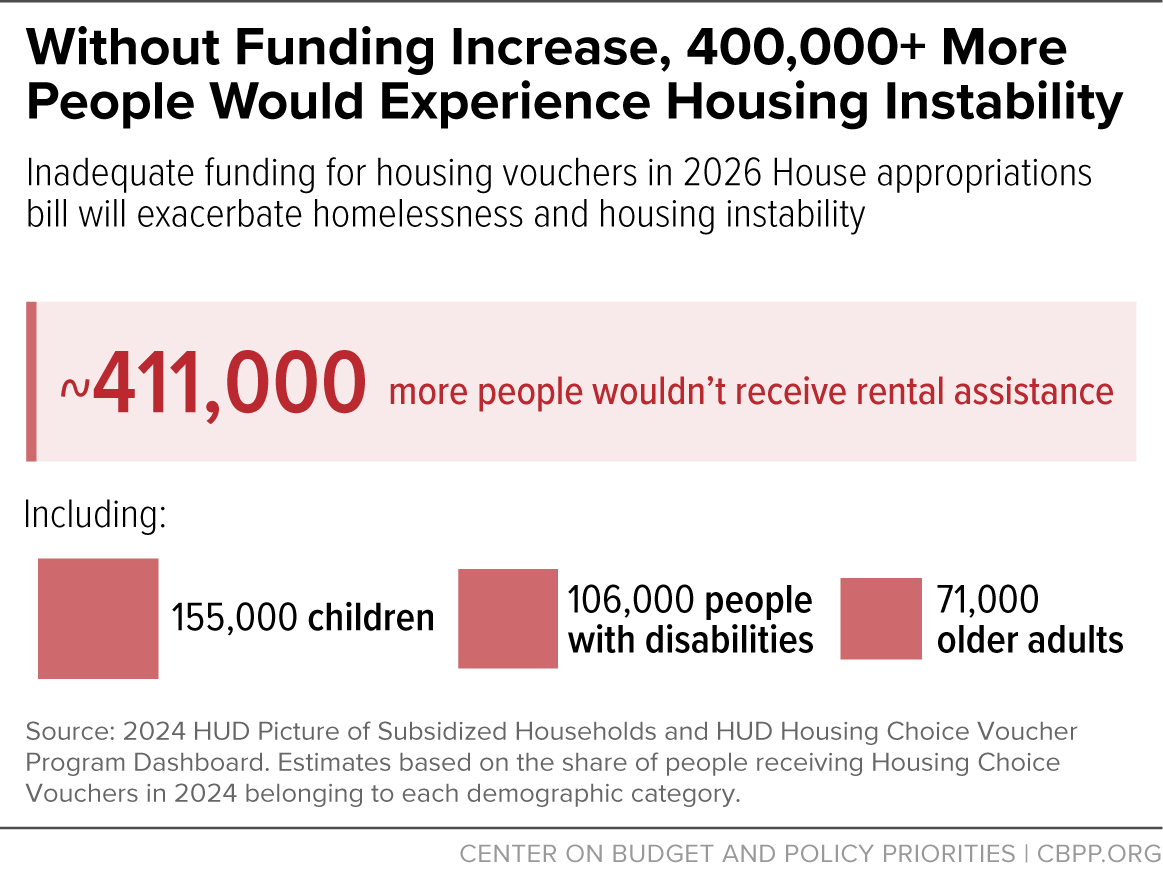
Affordable housing is a basic human need and rental assistance is proven to make housing more affordable. But a House committee recently passed a bill that could result in about 411,000 fewer people receiving housing vouchers to help them afford stable housing. (See Figure 1.) The Senate version of the same spending bill provides more funding than the House, but it would still fall short of maintaining current housing vouchers, serving an estimated 243,300 fewer people. People in every state and territory would be impacted by insufficient funding for housing vouchers. (See Table 1.)
Housing vouchers and other rental assistance help prevent homelessness, overcrowding, evictions, and other forms of housing instability, research shows.[1] However, because the federal government already underfunds rental assistance, only about a quarter of the millions of families who need assistance receive it.[2] Moving forward, Congress should expand and improve rental assistance to reach all people with low incomes who need it.
Along with the insufficient funding for the main housing voucher program, neither the House nor Senate bills provide resources to prevent another 58,000 households from losing their assistance as a result of an approaching funding cliff for the Emergency Housing Voucher program. The House bill also cuts funding needed to effectively administer vouchers and includes a concerning provision granting the Department of Housing and Urban Development (HUD) sweeping authority to allow state and local housing agencies to raise rents on people with low incomes.
In addition to these threats, the Administration’s and congressional Republicans’ actions regarding federal funding pose added challenges to ensuring people have stable housing. The recent enactment of a partisan rescission package has undermined the fiscal year 2025 bipartisan funding agreement reached just months ago.[3] The Administration is also withholding critical funding to investigate housing discrimination and is refusing to honor a previously established two-year grant cycle for homelessness response providers. There’s little reason for the minority party in Congress to agree to a funding deal for fiscal year 2026 when the Administration and the majority party can strip away funding they don’t like in a purely partisan way, or if the Administration may attempt to unilaterally and illegally withhold funds with no pushback from the majority party.
Such actions make it far more difficult to reach the bipartisan agreements necessary to fund the government on time and with the resources required to serve people’s needs. To address these challenges, it’s essential that congressional Republicans and the President agree — through enforceable legislative provisions — that funding allocated through bipartisan agreements will reach, in full, the people for whom Congress has appropriated it.

Robust Funding for Rental Assistance Can Ensure Everyone Has Stable Housing
Housing Choice Vouchers (HCVs) are the largest and most effective tool to address homelessness and housing instability. [4] Housing vouchers and other rental assistance help bridge the gap between rents and incomes. Rents are simply too high for many people — including most low-paid workers — to afford. Even working full time at 40 hours a week, nearly half of all workers in the U.S. are not paid wages high enough to rent a modest one-bedroom home. Rental assistance helps people afford a stable home, which makes finding and keeping a job easier, improves health and educational outcomes, reduces the use of emergency services, and helps keep children in their homes and families together.
An affordable home is a basic need for all of us, but not everyone has equal access to housing. Because of income and wealth inequities stemming from generations of discrimination in housing, education, and employment, people of color, particularly Black and Latine households, face structural barriers to housing and economic security. Similarly, women[5] and people with disabilities[6] experience discrimination that creates barriers to their equal access to economic security and stable housing. Children in low-income families[7] and older adults[8] face unique vulnerabilities that put them at risk of experiencing housing instability. Robust funding for rental assistance can help address these racial and other inequities so that everyone, regardless of race, gender, disability, income, or age, has the dignity of a safe, stable, and affordable home. (See Table 2 for demographic information about those who would be impacted by insufficient housing voucher funding.)
Proposed 2026 Funding Bills Would Exacerbate Existing Housing Vouchers Funding Shortfall
The House’s fiscal year 2026 appropriations bill provides flat funding compared to 2025 levels to renew existing housing vouchers, even though additional funding is needed to accommodate inflation-related increases in program costs. Housing Choice Vouchers are tied to rental costs, so flat funding is effectively a cut, leaving fewer households with assistance and putting them at greater risk of eviction, homelessness, and housing instability.
In contrast, the Senate’s 2026 appropriations bill does provide an increase for HCVs, but we estimate based on HUD data that this level will not be sufficient for agencies to serve the same number of families. The bill does include a helpful provision allowing HUD to use excess reserve funding to help offset costs, including from agencies that have previously been exempt, but any additional funding would still not fully cover program costs. While the impact would be less than in the House bill, housing agencies administering vouchers would likely need to take cost cutting measures that would result in fewer people receiving help.
Current funding for housing voucher subsidies in 2025 is already below the level some agencies need to continue to assist the same number of families, and there are reports that some agencies have stopped reissuing vouchers after a household leaves the program as a way to cut costs.[9] In fact, HUD sent a letter to housing agencies expressing its concern “that a sizeable number [of housing agencies] may experience HCV funding shortfalls this year” while noting that HUD has limited resources to help agencies experiencing a shortfall.[10] The funding levels in these bills, especially the House bill, would exacerbate the existing shortfall and lead to more extreme cost cutting measures.
Indeed, instead of providing the needed funding for rental assistance programs, the House bill includes a provision that would let state and local agencies raise rents for people who receive vouchers or live in public housing, with no limits. Essentially, the House is proposing people with low incomes cover the insufficient funding. The current rent payment structure, which generally caps a household’s rent at 30 percent of their income, allows people to afford other basic needs, like food, medicine, or child care, without putting their housing at risk. Allowing agencies to raise rents creates two bad options for agencies to deal with insufficient funding: charge higher rents, shifting the burden to families with low incomes, or reduce the number of families they assist. Either approach would result in more hardship, evictions, and homelessness since most households who receive rental assistance have incomes below $20,000 and cannot afford higher rents. In combination with the cruel cuts to Medicaid and SNAP in the recently passed harmful Republican megabill,[11] higher rents and fewer vouchers would make life even more precarious for low-income people, the opposite of President Trump’s promise to make people’s basic needs more affordable.
Moreover, the House bill includes a nearly 30 percent cut to administrative funding for state and local voucher agencies, making it harder for them to issue vouchers promptly and provide search assistance and other support. These resources can help agencies make their programs more effective. For example, the Emergency Housing Voucher (EHV) program — created in 2021 — provided housing agencies and their community partners with additional resources to help agencies provide security deposit assistance, incentives to landlords participating in the program, and hiring additional staff to assist families through the housing search and leasing process.[12] Through these efforts, housing agencies demonstrated they are a key partner for solving homelessness if given the resources. The robust administrative investment allowed the EHV program to successfully help 70,000 households at risk of, or experiencing, homelessness secure stable housing, even in very tight rental markets. Properly funding housing agencies’ administrative needs is essential to implementing these and other best practices proven to strengthen the voucher program and improve people’s ability to secure and stabilize in housing upon receiving assistance.
Though incredibly successful in housing survivors of gender-based violence and people experiencing homelessness, neither the House nor the Senate bills provide resources to continue Emergency Housing Vouchers or mitigate the harm of the program approaching a funding cliff. The one-time pot of funding the Emergency Housing Voucher program received when it was created is expected to run out next year, leaving close to 58,000 households without assistance.[13] The House bill includes important language that would allow HUD to direct resources to help impacted families, but the overall lack of funding for vouchers means the provision would only broaden the pool for an inadequate amount of funding. The Senate bill allows HUD to waive some administrative processes to help agencies provide HCVs to families losing their Emergency Housing Vouchers, but, again, limited resources would still be a huge barrier for agencies to actually do this.
Looking ahead, a rental assistance guarantee that helps all people with low incomes would prevent these funding shortfalls, eliminate long waiting lists, and provide immediate assistance to people struggling to afford a home. But at a minimum for fiscal year 2026, a final funding measure should sufficiently fund all housing vouchers as well as other critical rental assistance and homelessness services programs. Congress must also reject the Administration’s continued efforts to undo any bipartisan funding agreements so states and local communities can use these resources to implement proven solutions to provide affordable housing and end homelessness.
| TABLE 1 | ||||
|---|---|---|---|---|
Estimated Reduction of Housing Vouchers Under House and Senate Appropriations Bills, by State | ||||
| Under the House Bill | Under the Senate Bill | |||
| State | Reduction in Households Served | People Impacted by Lost Vouchers | Reduction in Households Served | People Impacted by Lost Vouchers |
| Alabama | 2,600 | 6,700 | 1,600 | 4,000 |
| Alaska | 400 | 700 | 200 | 400 |
| Arizona | 1,800 | 4,500 | 1,100 | 2,700 |
| Arkansas | 1,700 | 3,600 | 1,000 | 2,200 |
| California | 24,300 | 53,400 | 14,400 | 31,600 |
| Colorado | 2,600 | 5,700 | 1,500 | 3,400 |
| Connecticut | 3,100 | 7,000 | 1,800 | 4,200 |
| Delaware | 300 | 800 | 200 | 500 |
| District of Columbia | 900 | 1,900 | 500 | 1,100 |
| Florida | 8,500 | 21,300 | 5,000 | 12,600 |
| Georgia | 4,400 | 10,900 | 2,600 | 6,500 |
| Hawai‘i | 900 | 2,400 | 500 | 1,400 |
| Idaho | 500 | 1,100 | 300 | 600 |
| Illinois | 7,700 | 17,200 | 4,600 | 10,200 |
| Indiana | 3,000 | 5,700 | 1,800 | 3,400 |
| Iowa | 1,600 | 2,900 | 900 | 1,700 |
| Kansas | 900 | 1,700 | 500 | 1,000 |
| Kentucky | 2,600 | 5,800 | 1,600 | 3,500 |
| Louisiana | 4,200 | 9,300 | 2,500 | 5,500 |
| Maine | 900 | 1,800 | 600 | 1,100 |
| Maryland | 4,000 | 9,700 | 2,400 | 5,700 |
| Massachusetts | 7,200 | 15,400 | 4,200 | 9,100 |
| Michigan | 4,400 | 9,800 | 2,600 | 5,800 |
| Minnesota | 2,600 | 7,000 | 1,500 | 4,200 |
| Mississippi | 1,900 | 4,800 | 1,100 | 2,900 |
| Missouri | 2,900 | 6,500 | 1,700 | 3,800 |
| Montana | 400 | 800 | 300 | 500 |
| Nebraska | 900 | 1,900 | 500 | 1,100 |
| Nevada | 1,200 | 3,000 | 700 | 1,800 |
| New Hampshire | 800 | 1,500 | 500 | 900 |
| New Jersey | 6,300 | 13,500 | 3,800 | 8,000 |
| New Mexico | 900 | 1,800 | 500 | 1,100 |
| New York | 19,000 | 41,100 | 11,300 | 24,300 |
| North Carolina | 4,300 | 9,600 | 2,600 | 5,700 |
| North Dakota | 600 | 1,000 | 300 | 600 |
| Ohio | 6,900 | 15,700 | 4,100 | 9,300 |
| Oklahoma | 1,900 | 4,100 | 1,100 | 2,500 |
| Oregon | 2,900 | 5,700 | 1,700 | 3,400 |
| Pennsylvania | 6,100 | 13,300 | 3,600 | 7,900 |
| Rhode Island | 700 | 1,600 | 400 | 1,000 |
| South Carolina | 2,000 | 4,600 | 1,200 | 2,700 |
| South Dakota | 400 | 800 | 300 | 500 |
| Tennessee | 2,700 | 6,700 | 1,600 | 4,000 |
| Texas | 11,800 | 30,800 | 7,000 | 18,200 |
| Utah | 1,000 | 1,900 | 600 | 1,100 |
| Vermont | 600 | 1,200 | 300 | 700 |
| Virginia | 3,900 | 8,900 | 2,300 | 5,300 |
| Washington | 4,500 | 10,100 | 2,700 | 6,000 |
| West Virginia | 1,100 | 2,000 | 700 | 1,200 |
| Wisconsin | 2,100 | 4,500 | 1,300 | 2,700 |
| Wyoming | 200 | 300 | 100 | 200 |
| Guam | 200 | 800 | 100 | 500 |
| Northern Mariana Islands | 30 | 200 | 17 | 100 |
| Puerto Rico | 2,200 | 4,800 | 1,300 | 2,800 |
| U.S. Virgin Islands | 100 | 200 | 67 | 100 |
| Total U.S. | 181,900 | 410,500 | 107,800 | 243,300 |
Note: Figures are rounded to the nearest hundred (unless under 100) and may not sum to totals due to rounding. Source: 2024 HUD Picture of Subsidized Households, HUD Housing Choice Vouchers Dashboard | ||||
| TABLE 2 | ||
|---|---|---|
Demographics of People Harmed by Housing Voucher Shortfall in House and Senate Appropriations Bills | ||
| People Impacted Under the House Bill | People Impacted Under the Senate Bill | |
| Race and Ethnicity | ||
| American Indian/Alaska Native | 2,700 | 700 |
| Asian/Pacific Islander | 12,400 | 3,300 |
| Black | 209,300 | 56,300 |
| Latine | 80,100 | 21,600 |
| White | 94,800 | 25,500 |
| Other Populations | ||
| Children | 154,600 | 41,600 |
| Older Adults | 70,700 | 19,000 |
| People With Disabilities | 105,800 | 28,500 |
| Women and Girls | 254,900 | 68,600 |
Note: Figures are rounded to the nearest hundred. Latine category may contain individuals of any race who identify as Latine or Hispanic; other categories exclude individuals who identify as Latine or Hispanic. Estimates for children, older adults, people with disabilities, and women and girls are not mutually exclusive. Older adult category includes individuals aged 62 or older. People with disabilities includes people of all ages. Source: CBPP analysis of 2024 HUD administrative data | ||
End Notes
[1] Will Fischer, Sonya Acosta, and Erik Gartland, “More Housing Vouchers: Most Important Step to Help More People Afford Stable Homes,” CBPP, updated May 13, 2021, https://www.cbpp.org/research/housing/more-housing-vouchers-most-important-step-to-help-more-people-afford-stable-homes#vouchers-reduce-homelessness-and-housing-cbpp-anchor.
[2] Erik Gartland, “Chart Book: Funding Limitations Create Widespread Unmet Need for Rental Assistance,” CBPP, February 15, 2022, https://www.cbpp.org/research/housing/funding-limitations-create-widespread-unmet-need-for-rental-assistance#section-1-funding-limitations-prevent-cbpp-anchor.
[3] Devin O’Connor, Sam Berger, and Jacob Leibenluft, “Trump Recission Proposal Builds on Illegal Impoundments, Would Undermine Future Funding Deals,” July 10, 2025, https://www.cbpp.org/research/federal-budget/trump-rescission-proposal-builds-on-illegal-impoundments-would-undermine.
[4] Will Fischer, Douglas Rice, and Alicia Mazzara, “Research Shows Rental Assistance Reduces Hardship and Provides Platform to Expand Opportunity for Low-Income Families,” CBPP, December 5, 2019, https://www.cbpp.org/research/housing/research-shows-rental-assistance-reduces-hardship-and-provides-platform-to-expand.
[5] National Women’s Law Center, National Low Income Housing Coalition, “Gender and Racial Justice in Housing,” May 2021, https://nwlc.org/wp-content/uploads/2021/05/GenderRacialJusticeFSNLIHC_8pages-2.pdf.
[6] Susan J. Popkin et al., “People with Disabilities Living in the US Face Urgent Barriers to Housing,” Urban Institute, October 21, 2022, https://www.urban.org/research/publication/people-disabilities-living-us-face-urgent-barriers-housing.
[7] Sonya Acosta, “Investing in Housing Vouchers Critical to Protecting Children From Hardship, Building More Equitable Future,” CBPP, November 16, 2021, https://www.cbpp.org/research/housing/investing-in-housing-vouchers-critical-to-protecting-children-from-hardship.
[8] Dennis Culhane, et al., “The Emerging Crisis of Aged Homelessness,” University of Pennsylvania, 2019, https://aisp.upenn.edu/wp-content/uploads/2019/01/Emerging-Crisis-of-Aged-Homelessness-1.pdf.
[9] See Lizzie Kane, “Cook County housing authority facing potential multimillion-dollar budget shortfall as agencies brace for funding cuts,” Chicago Tribune, May 8, 2025, https://www.chicagotribune.com/2025/05/08/cook-county-housing-authority-budget-shortfall/; Carly Berlin, “Vermont’s largest provider of Section 8 housing subsidies will stop issuing new vouchers,” vtdigger, May 22, 2025, https://vtdigger.org/2025/05/22/vermonts-largest-provider-of-section-8-housing-subsidies-will-stop-issuing-new-vouchers/; Housing Authority of the City of Los Angeles (HACLA), “Updated Statement on Section 8 Federal Funding,” May 22, 2025, https://www.hacla.org/en/news/updated-statement-section-8-federal-funding.
[10] HUD, Letter from PIH PDAS to PHA Executive Directors, May 20, 2025, https://www.nahro.org/wp-content/uploads/2025/05/PDAS-Letter-on-PHA-Budget-Management-May-2025.pdf.
[11] Sharon Parrot, “Statement: House Should Reject Senate Republican Bill That is Even Worse Than Already harmful House Version in Important Ways,” CBPP, July 1, 2025, https://www.cbpp.org/press/statements/house-should-reject-senate-republican-bill-that-is-even-worse-than-already-harmful.
[12] “How Have Communities Used Emergency Housing Vouchers to Prevent and End Homelessness,” Urban Institute, 2025, https://www.urban.org/projects/how-have-communities-used-emergency-housing-vouchers-prevent-and-end-homelessness.
[13] Sonya Acosta, “Unless Congress Acts, 59,000 Additional Households at Risk of Homelessness,” CBPP, June 23, 2025, https://www.cbpp.org/blog/unless-congress-acts-59000-additional-households-at-risk-of-homelessness.