

Five Key Changes to ACA Marketplaces Amid Uncertainty Over Premium Tax Credit Enhancements
More than 22 million people rely on the Affordable Care Act (ACA) marketplaces for their health insurance. Recent policy changes, most notably enhancements to premium tax credits to reduce enrollees’ health insurance premiums, have driven record-breaking enrollment gains and delivered reduced costs, simplified enrollment processes, and stable marketplace plan options. But unless Congress acts, the premium tax credit improvements will expire at the end of this year, causing 2026 premiums to spike for all marketplace enrollees, whether or not they receive premium tax credits.
If the credits’ enhancements expire, about 4 million people will lose their marketplace coverage and become uninsured, according to the Congressional Budget Office (CBO).[1] The reconciliation megabill enacted in July and a separate marketplace regulation the Trump Administration finalized in June will create additional, new barriers to marketplace enrollment that are expected to cause about 3 million more people to lose marketplace coverage and become uninsured.
Because of the congressional inaction on premium tax credits enhancements, the adverse effects of the megabill on health care, the new marketplace rule, and Trump’s tariffs, on top of rising health care and prescription drug costs, insurers are expected to increase premiums by almost 20 percent, on average. Everyone with marketplace insurance is going to experience a premium spike, and the improved premium tax credits are the best tool to absorb that shock and keep people insured.
It’s not too late for Congress and President Trump to extend the premium tax credit enhancements in time to make a meaningful difference for marketplace enrollees. If the premium tax credit enhancements are extended by early October, people shopping for coverage during “window shopping” that starts in mid-October and during the early weeks of open enrollment in November will see accurate premium estimates when they first visit the marketplace, allowing them to make decisions about their coverage for 2026. If, instead, people see unaffordable premiums during this period, many will decide coverage is priced out of financial reach. Getting them to return to the marketplace at a later date will be difficult, if not impossible.
As policies currently stand, here are five key changes that will affect people who rely on ACA marketplaces for health coverage in 2026.
1. Nearly All Enrollees Will Face Higher Premium Costs
Nearly all marketplace enrollees (93 percent) receive premium tax credits (PTCs) that help reduce their costs. Policy changes in recent years, including most notably PTC enhancements that reduced the average enrollee’s premium by 44 percent, have driven record-breaking enrollment gains by making coverage more affordable and simplifying the enrollment process. Growth has been concentrated among Black and Latino people, people with low incomes, and people living in states that haven’t expanded Medicaid, where enhanced premium tax credits to purchase insurance through the marketplace may be their only viable pathway to affordable coverage.[2] The marketplace is also an important source of coverage for people who are self-employed or own small businesses.[3] Premium credits are available to people with income greater than four times the federal poverty level if they face very high premiums. About 90 percent of enrollees have income below this level, and nearly half of enrollees have income below twice the poverty level. (See Figure 1.)

But unless Congress acts, the PTC improvements will expire at the end of this year, causing 2026 premiums to spike for both subsidized and unsubsidized enrollees. For example, a family of four making $70,000 (217 percent of the federal poverty level (FPL)) who is enrolled in benchmark coverage could face an increase in annual premium costs of $3,182 if the tax credit enhancements expire, including a $131 increase in premiums due to formula changes included in the final marketplace rule. Households with income greater than 400 percent FPL would lose the credit entirely. For example, based on preliminary data, a family of four with a household income of $130,000 (404 percent FPL) who is enrolled in benchmark coverage could see their premiums go up by 104 percent (an increase in annual premiums of $11,450).[4] See Appendix for state-specific data based on 2025 premiums.

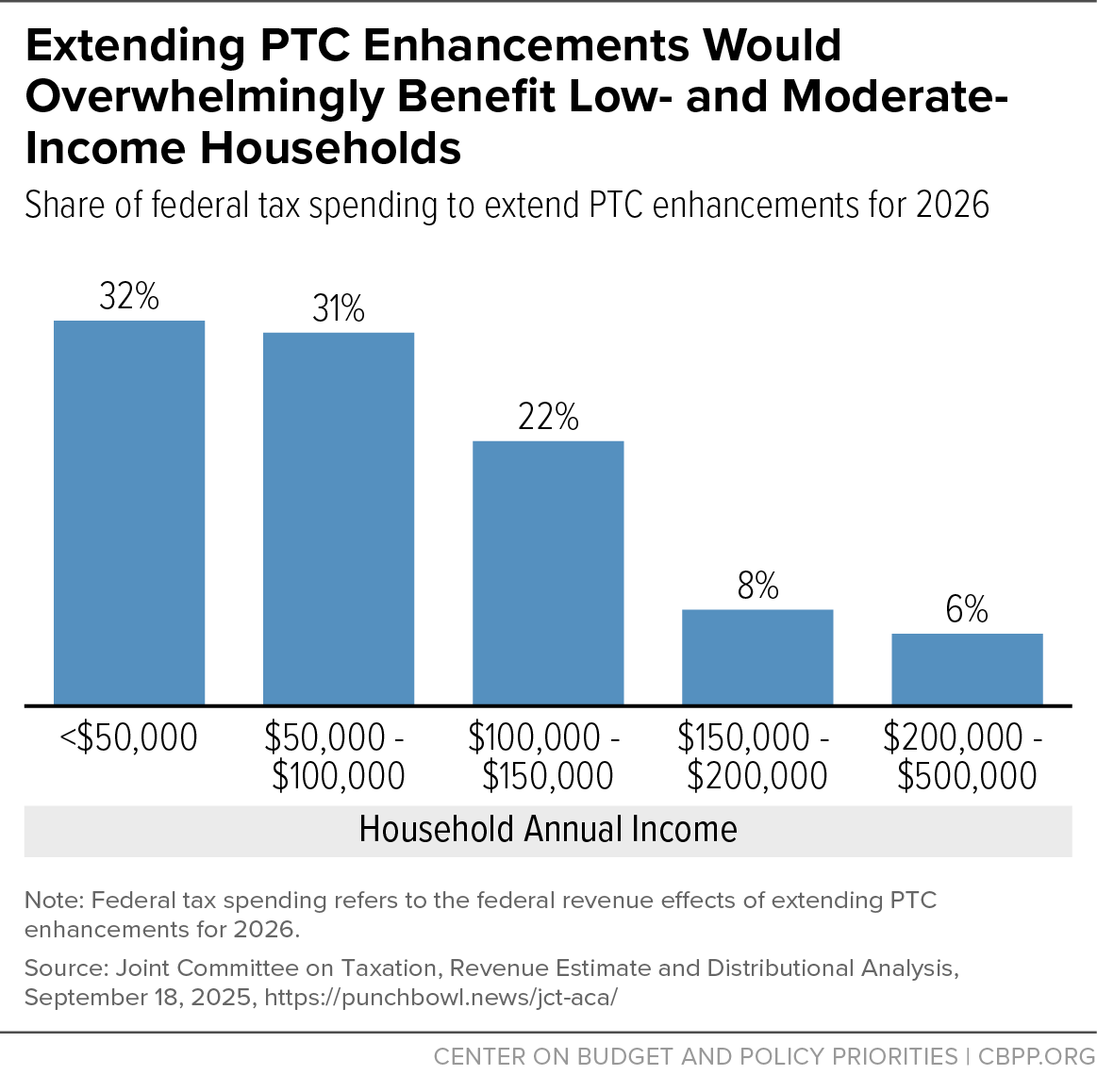
Some enrollees who are aware of this issue now say they may have to sacrifice essentials to maintain coverage.[5] Others say they will be forced to drop their coverage, even though they fear for their health. Congress and President Trump could protect enrollees from the worst of the potential premium increases, and prevent roughly 4 million enrollees from becoming uninsured, by extending the PTC enhancements. Extending the PTC enhancements would overwhelmingly benefit low- and moderate-income families, with nearly two-thirds of the federal tax spending supporting health coverage for households who earn less than $100,000 per year. (See Figure 2.) The sooner they act, the more people will be protected from price increases or becoming uninsured.
2. Trump Administration Policies and the Republican Megabill Are Driving Up Underlying Premiums
Federal policy changes, including looming expiration of the premium tax credit enhancements, enactment of the megabill, the Trump Administration’s marketplace rule changes, and the impact of tariffs are contributing to increases in the underlying marketplace premiums (before premium tax credits are taken into account). Along with rising health care and prescription drug costs, these changes led insurers to propose average gross premium increases of 18 percent, the largest premium hikes since 2017.[6]
Underlying premiums reflect the insurer’s expectations for the cost of covered services and prescriptions as well as expectations about how much of those benefits enrollees will use in the coming year. Federal actions that raise the costs people pay or make it more challenging for people to enroll in a plan will reduce enrollment. People with fewer medical needs, whose care costs less to cover, are more likely to drop their insurance, while enrollees with greater medical needs, whose care costs more to cover, are more likely to remain enrolled.
Most marketplace enrollees (the 93 percent who receive PTC) do not pay the underlying premium; they pay the difference between that amount and their premium tax credit. If Congress extends the PTC enhancements, this will insulate these enrollees from the brunt of the gross premium increases. (See Figure 3 and example described in text box.) But if Congress allows the PTC enhancements to expire, marketplace enrollees in every state will see massive premium spikes.

3. Increased Complexity Will Create Confusion Among People Who Rely on ACA Marketplace Coverage
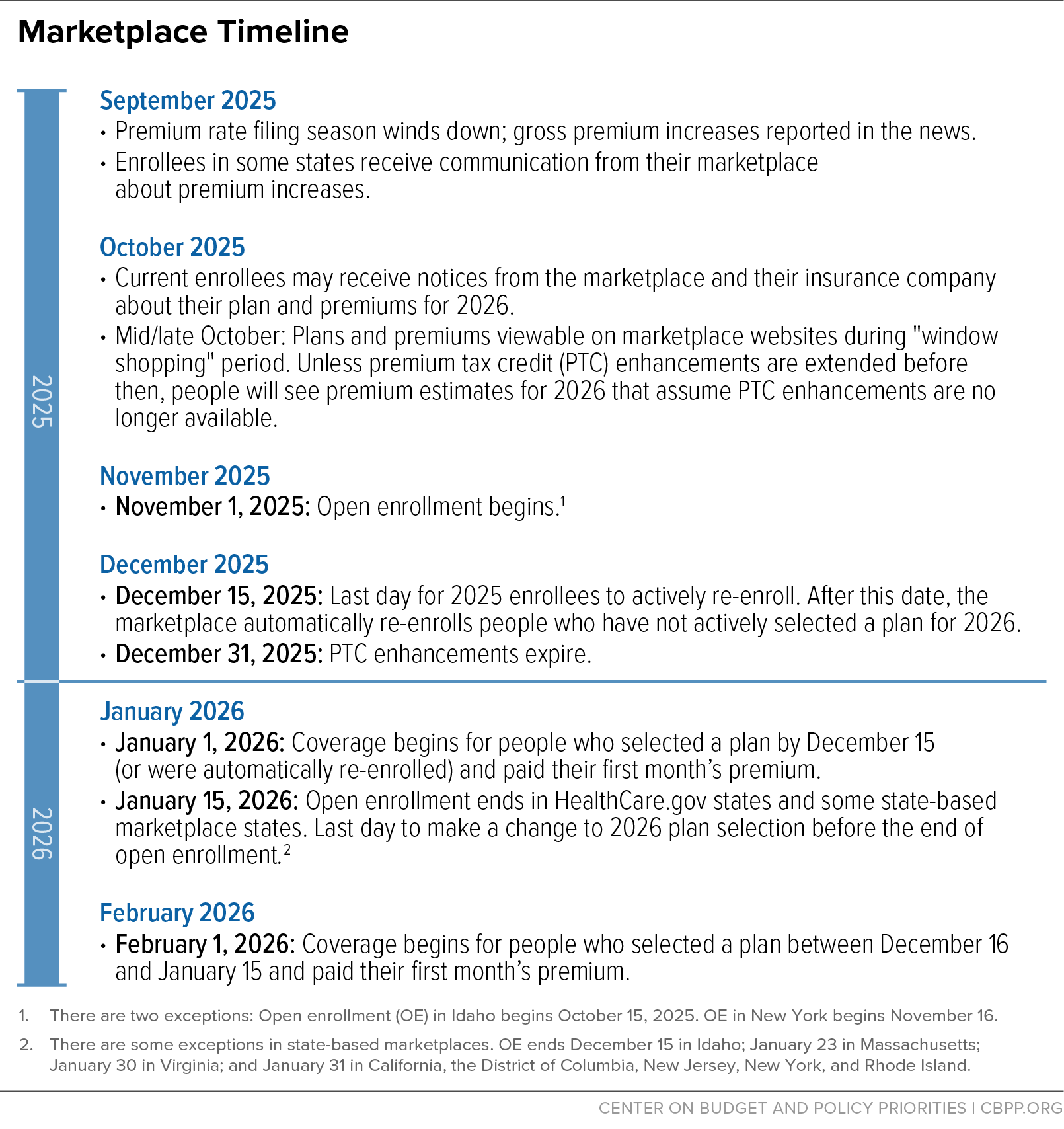
Open enrollment for 2026 begins on November 1, and people typically begin to see their premiums and estimated premium tax credit amounts in September and October. (See Figure 4.) This year, because of the uncertainty about whether the PTC enhancements will continue, notices from marketplaces and from insurers might not include information about the household’s monthly premiums for 2026.[7] As a result, people may not learn what their 2026 premiums will be until they return to the marketplace during open enrollment. However, more than half of enrollees were automatically re-enrolled last year; people who rely on automatic enrollment this year may not learn about their 2026 premiums until they receive their first bill for January coverage, at which point they will have just a few weeks to make changes before open enrollment ends January 15.[8]
People who have questions or concerns about their coverage for 2026 will also have fewer ways to get help, because the Trump Administration slashed funding for Navigators by 90 percent in the 28 states that use the federally operated marketplace.[9] Outreach and enrollment assistance is particularly important for people who face heightened barriers to enrollment including recent immigrants and people with limited English proficiency, people with limited internet access, people in rural areas, and people with complex circumstances.[10]



4. Many People Who Have Lawful Immigration Status Will Be Blocked From Affordable Marketplace Coverage
The new marketplace regulation prohibits people with Deferred Action for Childhood Arrivals (DACA) from enrolling in marketplace coverage. As of March 31, 2025, there were more than 525,000 people with DACA living in the U.S.[11] An estimated 100,000 people could have gained coverage as a result of a 2024 marketplace regulation that allowed people with DACA to enroll in marketplace coverage and to obtain PTC (if otherwise eligible) beginning in 2025.[12] However, a lawsuit paused implementation in 19 states. Despite high rates of employment, people with DACA are nearly 2.5 times as likely as the general U.S. population to be uninsured; thwarting their access to affordable coverage through the marketplace will leave most of these individuals without an affordable coverage option.[13]
The megabill eliminates PTC eligibility and creates additional barriers to coverage for many other immigrants who are living lawfully in the U.S. Beginning January 1, 2026, the new law eliminates PTC eligibility for lawfully present immigrants with income below the federal poverty level ($15,650 a year for an individual in 2025) who are ineligible for Medicaid coverage due to their immigration status (many lawfully present immigrants are barred from Medicaid entirely and some are subject to a five-year waiting period before they can qualify for Medicaid). Since 2014, the ACA has filled this gap, providing access to affordable ACA marketplace coverage for people with lawful immigration statuses with very low incomes. Ending PTC eligibility for this group will result in approximately 300,000 people becoming uninsured in 2034, according to CBO.
The uninsured rate among people who are immigrants declined 36 percent from 2010 to 2023. The new law will further reduce health insurance coverage for immigrants in 2027.[14] Beginning January 1, 2027, the megabill limits PTC eligibility to U.S. citizens and a narrow group of immigrants, including lawful permanent residents (green card holders), Cuban and Haitian entrants, and people from Compact of Free Association nations living in the U.S.[15] This will result in 900,000 people becoming uninsured in 2034, according to CBO. These marketplace changes along with other megabill federal funding restrictions in Medicaid and CHIP will result in many immigrants becoming uninsured. Broader Trump Administration anti-immigrant policies will shut the door to health coverage benefits to many people who are living lawfully in the U.S. Still more, U.S. citizens, green card holders, and others who remain eligible may avoid enrolling out of fear that doing so may put themselves and their families at risk.[16]
5. Higher Costs and New Layers of Red Tape Bring New Challenges for People Who Need Coverage
The marketplace regulation the Trump Administration finalized on June 20 contains provisions that will make ACA marketplace coverage less affordable for enrollees, more difficult for people to enroll and stay enrolled, and increase the number of people who are uninsured. While additional provisions will make coverage less accessible over the next several years, some provisions in the marketplace regulation have already taken effect or apply to the 2026 open enrollment period.
Previously, people with income at or below 150 percent of FPL ($39,975 for a household of three in 2025) qualified for a Special Enrollment Period (SEP) to enroll in an ACA marketplace plan or switch plans at any time during the year, with no prior coverage requirement. This policy was implemented in 2021 to make affordable coverage available to more people and was an important enrollment pathway for millions of marketplace enrollees. In less than one year between October 2022 and August 2023, about 1.3 million people in states with marketplaces on the federal platform enrolled through the low-income SEP.[17] The megabill bars people from receiving PTC starting January 1, 2026 if they enroll via an SEP that is based solely on income.
Additional changes for Plan Year (PY) 2026 or earlier include:
- When a person faces a data matching issue, marketplaces no longer grant an automatic 60-day extension to the 90-day period to resolve income inconsistencies (effective August 25, 2025).
- If people project their income to be lower than it turns out to be when they file their taxes the following year, they must pay back any excess premium credit amounts they received. Currently, repayment limits protect people from large, unexpected repayment burdens, especially if they have low incomes. The megabill eliminates those limits. When people file their taxes in 2027, those who received excess advance premium tax credit (APTC) in 2026 will be required to pay back the full amount, no matter how high[18] (effective for PY 2026).
- A new methodology for calculating the premium adjustment percentage will result in a 2.7 percent increase in marketplace net premiums after APTC and increased maximum out-of-pocket limits (from $10,150 to $10,600) for both qualified health plans and employer sponsored coverage.[19]
On August 22, 2025, a judge issued an injunction temporarily stopping implementation of several provisions of the marketplace rule that were scheduled to take effect during or before the 2026 open enrollment period.[20] These provisions are temporarily paused pending additional legal action:
- Requiring people to submit documentation to verify their income if tax data are unavailable or if sources suggest they have income below 100 percent FPL and they attest to income at or above 100 percent FPL.
- Requiring people enrolling through an SEP to upload documentation within 30 days of picking a plan and delaying their coverage start date until the verification process is complete.
- Charging enrollees in states that use HealthCare.gov and whose APTC covers the full cost of their premium $5 per month if they do not actively re-enroll in coverage. Enrollees must return to the marketplace to verify their household and income information to end the monthly charge. While a seemingly nominal amount, this $5 fee will result in people losing coverage.
- Instead of revoking coverage if someone fails to reconcile their APTCs for two years, revoking coverage for people who fail to reconcile just once.[21]
- Unless disallowed by a state, allowing insurers to require people to pay past-due premiums, with no limit on the lookback period, before they can effectuate new coverage with that insurer.
- Enabling insurers to offer plans with higher deductibles and cost sharing within a given metal tier than is currently permitted (which will raise out-of-pocket costs for enrollees).
Appendix
| APPENDIX TABLE 1 | ||||
|---|---|---|---|---|
National Average Premium Increases if Enhancements Expire, by Income Level | ||||
| Annual marketplace premiums | ||||
| With enhancements (current) | Without enhancements | Premium increase without enhancements | Percentage premium increase | |
| 45-year-old individual | ||||
| $22,000 (146% FPL) | $0 | $754 | $754 | N/A |
| $32,000 (212% FPL) | $794 | $1,956 | $1,162 | 146% |
| $46,000 (305% FPL) | $2,818 | $3,979 | $1,161 | 41% |
| $62,000 (411% FPL) | $5,270 | $6,739 | $1,469 | 28% |
| 60-year-old couple | ||||
| $30,000 (147% FPL) | $0 | $1,028 | $1,028 | N/A |
| $42,000 (205% FPL) | $924 | $2,474 | $1,550 | 168% |
| $62,000 (303% FPL) | $3,767 | $5,363 | $1,596 | 42% |
| $82,000 (401% FPL) | $6,970 | $25,331 | $18,361 | 363% |
| Family of four | ||||
| $45,000 (144% FPL) | $0 | $1,493 | $1,493 | N/A |
| $65,000 (208% FPL) | $1,508 | $3,891 | $2,383 | 158% |
| $95,000 (304% FPL) | $5,795 | $8,218 | $2,423 | 42% |
| $126,000 (404% FPL) | $10,710 | $19,068 | $8,358 | 78% |
Note: FPL = federal poverty level. The FPL for these calculations is based on 2024 poverty guidelines, which are used to determine premium tax credits for 2025 marketplace coverage. Examples are illustrative and based on 2025 national average benchmark (second-lowest-cost silver plan) premiums with age adjustments. The example family includes two 40-year-old parents, a 10-year-old, and a 5-year-old. Estimates are applicable in all states except for those with different poverty level standards than the national standard and/or those that subsidize marketplace premiums beyond the federal subsidy. See Appendix Table 2 for state-specific estimates. Source: CBPP calculations and Congressional Budget Office estimates of applicable percentages without enhancements in 2025. | ||||
| APPENDIX TABLE 2 | |||||||||
|---|---|---|---|---|---|---|---|---|---|
State-by-State Premium Increases if Enhancements Expire | |||||||||
| 45-year-old individual; $62,000 (411% FPL) | 60-year-old couple; $82,000 (401% FPL) | Family of four; $126,000 (403% FPL) | |||||||
| State | With enhance-ments (current) | Without enhancements | Premium increase without enhancements | With enhancements (current) | Without enhancements | Premium increase without enhancements | With enhance-ments (current) | Without enhancements | Premium increase without enhancements |
| U.S. average | $5,270 | $6,739 | $1,469 | $6,970 | $25,331 | $18,361 | $10,710 | $19,068 | $8,358 |
| Alabama | 5,270 | 7,254 | 1,984 | 6,970 | 27,267 | 20,297 | 10,710 | 19,220 | 8,510 |
| Alaska | 6,587 | 14,169 | 7,582 | 8,705 | 53,261 | 44,556 | 13,393 | 40,093 | 26,700 |
| Arizona | 5,270 | 5,559 | 289 | 6,970 | 20,897 | 13,927 | 10,710 | 15,730 | 5,020 |
| Arkansas | 5,270 | 6,210 | 940 | 6,970 | 23,343 | 16,373 | 10,710 | 17,572 | 6,862 |
| California | 5,270 | 6,942 | 1,672 | 6,970 | 26,095 | 19,125 | 10,710 | 19,643 | 8,933 |
| Colorado | 5,270 | 6,278 | 1,008 | 6,970 | 23,598 | 16,628 | 10,710 | 17,764 | 7,054 |
| Connecticut | 5,270 | 9,396 | 4,126 | 6,970 | 35,320 | 28,350 | 10,710 | 26,588 | 15,878 |
| Delaware | 5,270 | 7,240 | 1,970 | 6,970 | 27,216 | 20,246 | 10,710 | 20,488 | 9,778 |
| District of Columbia | 5,270 | 8,401 | 3,131 | 6,970 | 29,864 | 22,894 | 10,710 | 23,177 | 12,467 |
| Florida | 5,270 | 6,983 | 1,713 | 6,970 | 26,248 | 19,278 | 10,710 | 19,759 | 9,049 |
| Georgia | 5,270 | 6,684 | 1,414 | 6,970 | 25,127 | 18,157 | 10,710 | 18,915 | 8,205 |
| Hawai'i | 6,062 | 6,684 | 622 | 8,010 | 25,127 | 17,117 | 12,321 | 18,915 | 6,594 |
| Idaho | 5,270 | 5,912 | 642 | 6,970 | 22,222 | 15,252 | 10,710 | 16,728 | 6,018 |
| Illinois | 5,270 | 6,427 | 1,157 | 6,970 | 24,158 | 17,188 | 10,710 | 18,186 | 7,476 |
| Indiana | 5,179 | 5,179 | 0 | 6,970 | 19,469 | 12,499 | 10,710 | 14,656 | 3,946 |
| Iowa | 5,270 | 5,817 | 547 | 6,970 | 21,865 | 14,895 | 10,710 | 16,459 | 5,749 |
| Kansas | 5,270 | 6,956 | 1,686 | 6,970 | 26,146 | 19,176 | 10,710 | 19,682 | 8,972 |
| Kentucky | 5,270 | 5,993 | 723 | 6,970 | 22,527 | 15,557 | 10,710 | 16,958 | 6,248 |
| Louisiana | 5,270 | 7,105 | 1,835 | 6,970 | 26,707 | 19,737 | 10,710 | 20,104 | 9,394 |
| Maine | 5,270 | 7,403 | 2,133 | 6,970 | 27,828 | 20,858 | 10,710 | 20,948 | 10,238 |
| Maryland | 4,949 | 4,949 | 0 | 6,970 | 18,603 | 11,633 | 10,710 | 14,004 | 3,294 |
| Massachusetts | 5,270 | 5,818 | 548 | 6,970 | 18,214 | 11,244 | 10,710 | 16,512 | 5,802 |
| Michigan | 5,270 | 5,478 | 208 | 6,970 | 20,591 | 13,621 | 10,710 | 15,500 | 4,790 |
| Minnesota | 4,922 | 4,922 | 0 | 6,970 | 18,501 | 11,531 | 10,710 | 14,779 | 4,069 |
| Mississippi | 5,270 | 6,576 | 1,306 | 6,970 | 24,719 | 17,749 | 10,710 | 17,424 | 6,714 |
| Missouri | 5,270 | 6,630 | 1,360 | 6,970 | 24,923 | 17,953 | 10,710 | 18,761 | 8,051 |
| Montana | 5,270 | 7,512 | 2,242 | 6,970 | 28,236 | 21,266 | 10,710 | 21,255 | 10,545 |
| Nebraska | 5,270 | 8,135 | 2,865 | 6,970 | 30,580 | 23,610 | 10,710 | 23,020 | 12,310 |
| Nevada | 5,270 | 5,613 | 343 | 6,970 | 21,100 | 14,130 | 10,710 | 15,884 | 5,174 |
| New Hampshire | 4,407 | 4,407 | 0 | 6,970 | 16,564 | 9,594 | 10,710 | 12,469 | 1,759 |
| New Jersey | 5,270 | 6,671 | 1,401 | 6,970 | 25,076 | 18,106 | 10,710 | 18,876 | 8,166 |
| New Mexico | 5,270 | 6,983 | 1,713 | 6,970 | 26,248 | 19,278 | 10,710 | 19,759 | 9,049 |
| New York | 5,270 | 9,480 | 4,210 | 6,970 | 18,960 | 11,990 | 10,710 | 27,018 | 16,308 |
| North Carolina | 5,270 | 6,874 | 1,604 | 6,970 | 25,840 | 18,870 | 10,710 | 19,452 | 8,742 |
| North Dakota | 5,270 | 7,281 | 2,011 | 6,970 | 27,369 | 20,399 | 10,710 | 20,603 | 9,893 |
| Ohio | 5,270 | 5,979 | 709 | 6,970 | 22,477 | 15,507 | 10,710 | 16,919 | 6,209 |
| Oklahoma | 5,270 | 6,793 | 1,523 | 6,970 | 25,535 | 18,565 | 10,710 | 19,221 | 8,511 |
| Oregon | 5,270 | 6,915 | 1,645 | 6,970 | 25,993 | 19,023 | 10,710 | 18,322 | 7,612 |
| Pennsylvania | 5,270 | 6,251 | 981 | 6,970 | 23,496 | 16,526 | 10,710 | 17,687 | 6,977 |
| Rhode Island | 5,270 | 5,762 | 492 | 6,970 | 21,661 | 14,691 | 10,710 | 16,306 | 5,596 |
| South Carolina | 5,270 | 6,386 | 1,116 | 6,970 | 24,006 | 17,036 | 10,710 | 18,070 | 7,360 |
| South Dakota | 5,270 | 8,393 | 3,123 | 6,970 | 31,549 | 24,579 | 10,710 | 23,749 | 13,039 |
| Tennessee | 5,270 | 6,996 | 1,726 | 6,970 | 26,299 | 19,329 | 10,710 | 19,797 | 9,087 |
| Texas | 5,270 | 6,630 | 1,360 | 6,970 | 24,923 | 17,953 | 10,710 | 18,761 | 8,051 |
| Utah | 5,270 | 7,758 | 2,488 | 6,970 | 26,629 | 19,659 | 10,710 | 20,167 | 9,457 |
| Vermont | 5,270 | 15,324 | 10,054 | 6,970 | 30,648 | 23,678 | 10,710 | 43,060 | 32,350 |
| Virginia | 5,044 | 5,044 | 0 | 6,970 | 18,960 | 11,990 | 10,710 | 14,272 | 3,562 |
| Washington | 5,270 | 5,884 | 614 | 6,970 | 22,120 | 15,150 | 10,710 | 16,651 | 5,941 |
| West Virginia | 5,270 | 12,460 | 7,190 | 6,970 | 46,839 | 39,869 | 10,710 | 35,259 | 24,549 |
| Wisconsin | 5,270 | 6,712 | 1,442 | 6,970 | 25,229 | 18,259 | 10,710 | 18,991 | 8,281 |
| Wyoming | 5,270 | 11,810 | 6,540 | 6,970 | 44,392 | 37,422 | 10,710 | 33,417 | 22,707 |
Note: FPL = federal poverty level. The FPL for these calculations is based on 2024 poverty guidelines, which are used to determine premium tax credits for 2025 marketplace coverage. Examples are illustrative and based on 2025 state average benchmark (second-lowest-cost silver plan) premiums with age adjustments. The example family includes two 40-year-old parents, a 10-year-old, and a 5-year-old. Alaska and Hawai’i have state poverty levels that differ from the federal poverty level; estimates for Alaska and Hawai'i assume that the state poverty levels match the federal poverty levels depicted, which means that income levels in the examples differ from those depicted. Depending on the scenario, for a few states, premium payments under the enhancements do not exceed the income cap of 8.5 percent. In those cases, premium payments are equal with or without enhancements. Estimates do not account for any state subsidized marketplace premiums beyond the federal subsidy because such state policies may be dependent on the federal tax credit enhancements. Source: CBPP calculations and Congressional Budget Office estimates of applicable percentages without enhancements in 2025. | |||||||||
End Notes
[1] Congressional Budget Office, “Re: The Estimated Effects of Enacting Selected Health Coverage Policies on the Federal Budget and on the Number of People With Health Insurance,” September 18, 2025, https://www.cbo.gov/system/files/2025-09/61734-Health.pdf.
[2] Anupama Warrier et al., “HealthCare.gov Plan Selections by Race and Ethnicity, 2015-2024,” Assistant Secretary for Planning and Evaluation, U.S. Department of Health & Human Services, October 1, 2024, https://aspe.hhs.gov/reports/healthcaregov-plan-selections-race-ethnicity-2015-2024; Centers for Medicare and Medicaid Services, “Health Insurance Exchanges 2025 Open Enrollment Report,” January 2025, https://www.cms.gov/data-research/statistics-trends-reports/marketplace-products/2025-marketplace-open-enrollment-period-public-use-files.
[3] Gideon Lukens, “Research Note: 5 Million Small Business Owners and Self-Employed Workers Likely Enrolled in ACA Marketplace in 2025,” CBPP, June 12, 2025, https://www.cbpp.org/research/health/5-million-small-business-owners-and-self-employed-workers-likely-enrolled-in-aca.
[4] This illustrative example assumes that the family’s premium for benchmark coverage before tax credits is $22,500. This is based on the national average premium for benchmark coverage in 2025, adjusted upward by initial issuer rate filings for 2026. Actual premium increases for families are subject to change and will be based on geography and finalized premiums in 2026. Jared Ortaliza et al., “How much and why ACA Marketplace premiums are going up in 2026,” Peterson-KFF Health System Tracker, August 2025, https://www.healthsystemtracker.org/brief/how-much-and-why-aca-marketplace-premiums-are-going-up-in-2026/.
[5] Claire Heyison, “Marketplace Enrollees Rely on Enhanced Premium Tax Credits for Affordable Health Coverage,” updated July 31, 2025, https://www.cbpp.org/research/health/marketplace-enrollees-rely-on-enhanced-premium-tax-credits-for-affordable-health.
[6] Ortaliza et al.
[7] The federal government told marketplace insurers operating in the federally facilitated marketplace they do not have to include premiums or estimated premium tax credit amounts in the notices they are required to send to enrollees in advance of open enrollment, given the uncertainty about whether the enhancements will continue. See Centers for Medicare and Medicaid Services, “Enforcement Safe Harbors Related to Federal Standard Renewal and Product Discontinuation Notices; 90-Day Product Discontinuation Notice Requirement in the Individual Market for Coverage in the 2026 Benefit Year,” July 16, 2025, https://www.cms.gov/files/document/enforcement-safe-harbors-guidance-py2026letterheadfinal-revised.pdf.
[8] Centers for Medicare and Medicaid Services, “2025 Marketplace Open Enrollment Period Public Use Files,” May 12, 2025, https://www.cms.gov/data-research/statistics-trends-reports/marketplace-products/2025-marketplace-open-enrollment-period-public-use-files.
[9] Centers for Medicare and Medicaid Services, “CMS Announcement on Federal Navigator Program Funding Administration,” February 14, 2025, https://www.cms.gov/newsroom/press-releases/cms-announcement-federal-navigator-program-funding.
[10] Assistant Secretary for Planning and Evaluation, U.S. Department of Health and Human Services, “Reaching the Remaining Uninsured: An Evidence Review on Outreach & Enrollment,” October 1, 2021, https://aspe.hhs.gov/sites/default/files/documents/666bcb121e373ec517def3b1fcd4af23/aspe-remaining-uninsured-outreach-enrollment.pdf.
[11] U.S. Citizenship and Immigration Services, “Active DACA Recipients (Fiscal Year 2025, Quarter 2),” https://www.uscis.gov/tools/reports-and-studies/immigration-and-citizenship-data.
[12] Centers for Medicare and Medicaid Services, “HHS Final Rule Clarifying the Eligibility of Deferred Action for Childhood Arrivals (DACA) Recipients and Certain Other Noncitizens,” May 3, 2024, https://www.cms.gov/newsroom/fact-sheets/hhs-final-rule-clarifying-eligibility-deferred-action-childhood-arrivals-daca-recipients-and-certain.
[13] Isobel Mohyeddin, “DACA Recipients’ Access to Health Care: 2025 Report,” National Immigration Law Center, August 2025, https://www.nilc.org/wp-content/uploads/2025/08/DACA-Report_2025_082025.pdf.
[14] U.S. Census Bureau, American Community Survey, 1-Year Estimates, 2023. U.S. Census Bureau, American Community Survey, 1-Year Estimates, 2010.
[15] The megabill will eliminate PTC eligibility — without which most will be unable to afford ACA marketplace coverage — from numerous groups of immigrants who have lawful immigration statuses: people granted asylum; refugees; special immigrant juveniles who have been abused, abandoned, or neglected by a parent; people with Temporary Protected Status; people granted humanitarian parole; and certain victims of domestic violence, labor or sex trafficking, and other serious crimes, among others.
[16] Farah Erzouki, “States Can Help Eligible Immigrants Keep Medicaid Coverage at PHE’s End,” CBPP, August 8, 2022, https://www.cbpp.org/blog/states-can-help-eligible-immigrants-keep-medicaid-coverage-at-phes-end; Jennifer M. Haley et al., “One in Give Adults in Immigrant Families with Children Reported Chilling Effects on Public Benefit Receipt in 2019,” Urban Institute, June 18, 2020, https://www.urban.org/research/publication/one-five-adults-immigrant-families-children-reported-chilling-effects-public-benefit-receipt-2019.
[17] CMS and Department of the Treasury, “Patient Protection and Affordable Care Act, HHS Notice of Benefit and Payment Parameters for 2025; Updating Section 1332 Waiver Public Notice Procedures; Medicaid; Consumer Operated and Oriented Plan (CO-OP) Program; and Basic Health Program,” April 2, 2024, https://www.cms.gov/files/document/cms-9895-f-patient-protection-final.pdf.
[18] If a person’s actual income falls below 138 percent FPL in Medicaid expansion states or below 100 percent FPL in non-expansion states, they remain protected from repaying APTCs. See 26 CFR 1.36B-2(b)(6) and (7) and 26 CFR 1.36B-2(c)(2)(v).
[19] Gideon Lukens and Elizabeth Zhang, “Administration’s ACA Marketplace Rule Will Raise Health Care Costs for Millions of Families,” CBPP, August 1, 2025, https://www.cbpp.org/research/health/administrations-aca-marketplace-rule-will-raise-health-care-costs-for-millions-of.
[20] U.S. District Court for the District of Maryland, Memorandum Opinion, City of Columbus et al. v. Robert F. Kennedy, Jr. et al., Civil No. 25-2114-BAH, August 22, 2025, https://democracyforward.org/wp-content/uploads/2025/08/35-City-of-Columbus-memorandum-opinion.pdf.
[21] The August 22, 2025 injunction is temporarily stayed this provision from implementation for PY 2026 by the August 22, 2025 injunction, but it is scheduled to take effect permanently in PY 2028.