

Coordinating Medicaid and SNAP Work Requirements to Streamline Determinations
The 2025 Republican reconciliation law enacted a provision that takes away Medicaid from certain adults who can’t show they meet a work requirement or qualify for an exemption.[1] It also expanded existing work requirements in food assistance through SNAP. Though the two programs’ work requirements differ, states can simplify and streamline determinations for individuals and agencies — and minimize unnecessary coverage loss — by leveraging the overlap in compliance activities and exemption reasons for individuals applying for or enrolled in both programs.
Many individuals enrolled in Medicaid also participate in SNAP, and vice versa. And many people subject to the work requirement in one program are also subject to it in the other program. Therefore, it is critical to understand where the policies overlap and where they differ, and where information from one program can be used to simplify determinations in the other program. This is essential for low-income families in need of assistance as well as overwhelmed eligibility workers who will be implementing complex new requirements.
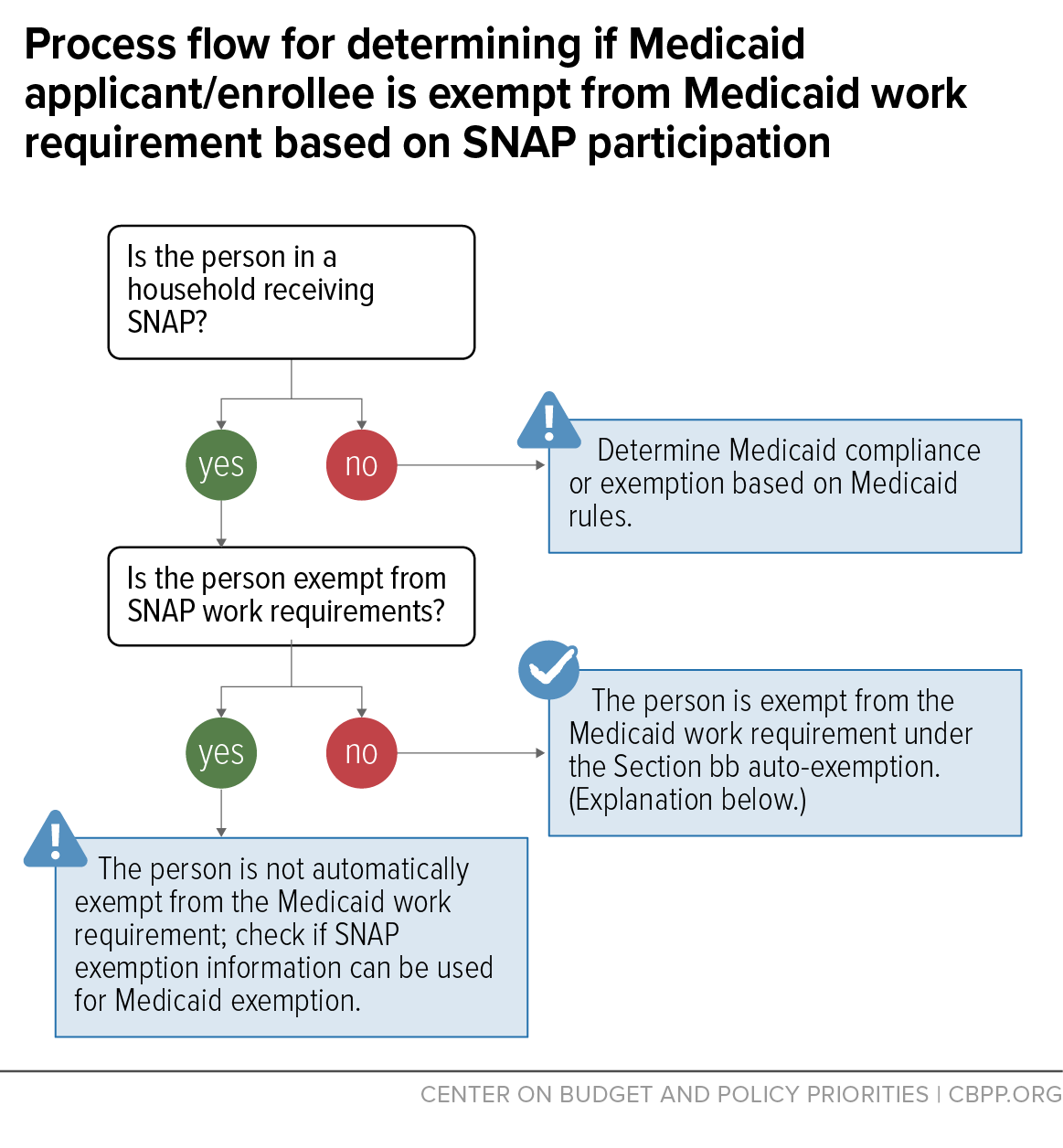
This paper outlines ways for states to fulfill their obligations to share information across programs. While the policies are complicated, states should strive to streamline determinations across programs wherever possible to reduce administrative burden. In Medicaid, the 2025 reconciliation law mandates that states automatically exempt[2] certain SNAP participants from the Medicaid work requirement and use available data from SNAP to determine exemptions or compliance for others. (See Figure 1.) In SNAP, there is an opportunity to leverage the information collected for Medicaid work requirements to increase automation of compliance and exemption determinations, increasing accuracy and freeing up workers’ time.

The new Medicaid work requirement[3] mandates that states covering the expansion population (certain non-disabled non-elderly adults) require individuals to have household income equal to or above $580 per month, participate in countable activities 80 hours per month (or be enrolled in an education program at least half time), or qualify for an exception. Medicaid applicants must be exempt or compliant in the one, two, or three months (at state option) prior to their application. For enrollees, the work requirement is evaluated at renewal, and the individual must have been exempt or compliant for one or more months (at state option) since the last determination. States also have the option to verify compliance more frequently. States are required to use available data sources to verify compliance and exemptions before requiring individuals to submit information.
SNAP has long had a work requirement for able bodied adults without dependents (ABAWDs), who are limited to benefits for three months in a three-year period (SNAP’s so-called time limit) unless they work or participate in a training program for at least 20 hours a week, live in an area with insufficient jobs for which the state has obtained a waiver based on elevated unemployment, or are exempt based on a disability or other factors. (In addition to the time limit, SNAP also has a “general” work requirement. People exempt from the general work requirement are exempt from the time limit work requirement.) The 2025 reconciliation law extended the time limit work requirement to adults through age 64 and parents without a child under 14; eliminated exemptions for veterans, former foster youth, and people experiencing homelessness; and limited most area waivers to areas with an unemployment rate over 10 percent. Because now adults with dependents may be subject to SNAP’s three-month time limit, we use the phrase “time-limited adults” or “individuals subject to the time limit.”
Medicaid Work Requirement Exemption Based on SNAP Participation (the Section bb Auto-Exemption)
The 2025 reconciliation law adds Section 1902xx(9)(A)(ii)(VI)(bb) to the Social Security Act and requires states to exempt certain Medicaid applicants and enrollees from the Medicaid work requirement based on SNAP participation. The law describes certain “specified excluded individuals” who do not need to meet the Medicaid work requirement, including an individual who “is a member of a household that receives supplemental nutrition assistance program benefits under the Food and Nutrition Act of 2008 and is not exempt from a work requirement under such Act” (emphasis added). (Since people exempt from the general work requirement are exempt from the time limit work requirement, both sets of exemption criteria are used in this analysis.) Unfortunately, the reconciliation law’s provision is not as simple as saying anyone participating in SNAP is exempt from the Medicaid work requirement. It requires a more detailed analysis of (1) whether the individual is part of a household receiving SNAP, and (2) whether the individual is exempt from a SNAP work requirement.
Examples of situations where an individual is exempt from the Medicaid work requirement under this provision include: [4]
- An individual who is receiving SNAP and is participating in activities that meet the SNAP time limit work requirement;
- An individual who is receiving SNAP and not meeting the SNAP time limit work requirement, but is within the allotted three-month time period before reaching the time limit;
- An individual who is not receiving SNAP, but someone in their household is (e.g., a parent who lost benefits due to non-compliance with the work requirement but their child living in their household continues to receive SNAP benefits);
- An individual who is receiving SNAP and living in an area where the time limit is waived due to high unemployment;
- An individual who is receiving SNAP and has not met the SNAP work requirement, but was granted good cause for non-compliance (e.g., because of an illness);
- An individual who is receiving SNAP and has not yet been screened for exemptions from the SNAP work requirement (e.g., someone who turns 18 and hasn’t been recertified yet); and
- An individual whose SNAP benefits were terminated due to not meeting the work requirement but is receiving benefits pending appeal.
Exempt Based on Data From Other Programs
In addition to the above circumstances requiring Section bb auto-exemptions, many individuals may be exempt from the Medicaid work requirements for the same or similar reason they are exempt from the SNAP work requirements. For example, a pregnant adult who is exempt from the SNAP work requirement would not be exempted under the Section bb auto-exemption. However, since pregnancy is also an exemption reason for Medicaid work requirements, the individual should be exempted from the Medicaid work requirement based on pregnancy, and the Medicaid agency should use the information from SNAP. And, likewise, individuals could be exempt from the SNAP work requirement for the same or similar reason they are exempt from the Medicaid work requirement.
In some situations, like pregnancy, the exemptions are the same in both programs. For other exemption reasons, there may be overlap in some situations but not all. For example, both programs exempt caregivers of a child who lives in a different household. But SNAP only exempts participants caring for a child under 6 years old, while Medicaid exempts those caring for a child under 14. Further, the Medicaid exemption requires that the individual either be related to the child or care for the child for at least 80 hours per month, which the SNAP exemption does not require. Therefore, eligibility workers would have to review the specific case circumstances to determine if the exemption from one program could carry over to the other.
Both Medicaid and SNAP have certain health-based exemptions, presenting an important opportunity for alignment and coordination. Medicaid has an exemption for medical frailty, including people with a substance use disorder, disabling mental disorder, certain physical and other disabilities, or a serious or complex medical condition. The rule implementing the Medicaid work requirement added that the health condition must “significantly impair[] the individual’s ability to comply with the community engagement requirement.”[5] SNAP has an exemption for individuals who are unfit for work, as determined through a medical certification or by the agency. Since these definitions largely overlap, agencies could set policy stating people qualifying for SNAP’s exemption can qualify for Medicaid’s medically frail designation, and vice versa.[6] Since the Medicaid medically frail designation will often be determined using claims and diagnostic information, SNAP can leverage the Medicaid designation to significantly streamline the SNAP exemption determination for vulnerable individuals without requiring additional paperwork.
States should review the scenarios outlined below and streamline implementation where possible. Medicaid programs are required to use reliable information available to the state to make a determination of work requirement compliance or exemption status, without requesting information from the individual. The preamble to the Medicaid rule makes clear that this includes using SNAP data.[7] How a state shares data will depend on whether the state has shared systems and/or workers across Medicaid and SNAP. In states with integrated eligibility systems and workers, the system should be able to identify the SNAP Section bb auto-exemption from the Medicaid work requirement, as well as most of the scenarios outlined below where one program can use the exemption from the other. In states without integration, where SNAP and Medicaid are in different systems and have different eligibility workers, states will need to develop a strategy to ensure they are fully using SNAP data in accordance with the rule.
Table 1 below outlines the exemptions that can be shared across the programs. In some instances, such as pregnancy, the definitions match and one program can use information from the other program. In other instances, there are differences that may require a more detailed case review for Medicaid expansion enrollees and SNAP participants subject to work requirements.
| TABLE 1 | |||||
|---|---|---|---|---|---|
Crosswalk of Exemptions in Medicaid and SNAP | |||||
| Exemption Reason | Medicaid Work Requirement Policy | SNAP Work Requirement Policy* | Can Medicaid Use SNAP Information for Exemption? | Can SNAP Use Medicaid Information for Exemption? | Notes |
| Pregnancy | Exempt | Exempt | Yes | Yes | If pregnancy is reported to one program, that information can be used to exempt an individual from the work requirement in the other program (and Medicaid is required to use information available to it in determining exemptions). |
| Living with a Child in Same Household | Exempt if parent, guardian, caretaker relative, or family caregiver of a dependent child under 14 | Exempt if parent or other member of a household responsible for a dependent child under 14 | Yes | Yes | Both SNAP and Medicaid exempt individuals when there is a child under 14 in the home, regardless of whether the individual is the parent or primary caretaker of the child. (Medicaid requires the care to be regular and not solely incidental in nature.) |
| Caring for a Child in Different Household | Exempt if providing regular care for a related child under 14; if child is unrelated, care must be 80 hours per month | Exempt if responsible for the care of a child under 6 | With further eligibility worker review | With further eligibility worker review | Differences in age and hourly requirement necessitate eligibility workers to review specific circumstances of each case. |
| Caregiver of a Disabled Individual | Exempt if parent, guardian, caretaker relative, or family caregiver of a disabled individual | Exempt if responsible for care of incapacitated person | With further eligibility worker review | With further eligibility worker review | These definitions largely overlap, though details may vary by state. There is an additional Medicaid requirement that care must be 80 hours per month if the person being cared for is unrelated and in a different household, so further review is required. |
| Medical Condition | Medical condition that substantially impairs ability to comply with the community engagement requirement | Medically certified as physically or mentally unfit for work, including if the individual is obviously mentally or physically unfit for employment as determined by the state agency. | Yes | Yes | A state could designate someone determined unfit for work for SNAP purposes as medically frail in Medicaid. Similarly, a state could designate someone determined medically frail for Medicaid as “obviously” unfit for work in SNAP.[8] |
| Indian | Exempt if Indian, urban Indian, California Indian, or determined eligible for Indian Health Services (IHS) | Exempt if Indian, urban Indian, California Indian | Yes | With further eligibility worker review | SNAP would have to gather further information if the Medicaid exemption is based solely on the individual being eligible for IHS, which is not included in the SNAP exemption (though it’s relatively rare that a non-Indian would be eligible for IHS). |
| Veteran | Exempt if veteran has total disability rating | Exemption for veteran status eliminated in H.R. 1 (but any Veterans Affairs disability rating exempts an individual as unfit for work) | N/A | Yes | SNAP can designate as unfit for work disabled veterans exempt from Medicaid work requirement. |
| Participating in Rehab Program | Participating in drug addiction or alcoholic treatment and rehabilitation program | Participating in drug addiction or alcoholic treatment and rehabilitation program | Yes | Yes | If participation in a rehab program is reported to one program, that information can be used to exempt an individual from the work requirement in the other program (and Medicaid is required to use information available to it in determining exemptions). |
| TANF Participation | Exempt if compliant with TANF work requirements | Exempt if meeting TANF work rules | Yes | Yes | If compliance with a TANF work program is reported to one program, that information can be used to exempt an individual from the work requirement in the other program (and Medicaid is required to use information available to it in determining exemptions). |
* Since SNAP participants are exempt from the time limit if they are exempt from the general work requirement, this column combines the two. Note: TANF = Temporary Assistance for Needy Families | |||||
Sharing Compliance Data Across Programs
Similar to data sharing related to exemptions, if an individual reports employment or other activities that meet the work requirements to one program, the state should ensure that information is shared with the other program to reduce the burden of individuals having to report the same information multiple times, as well as eligibility workers having to process the same information for multiple programs.
- In Medicaid, under the SNAP Section bb auto-exemption, an individual who participates in qualifying activities that meet the SNAP work requirement is automatically exempt from the Medicaid work requirement. No detailed comparison of compliance activities is required. If someone is compliant with the SNAP work requirement, they are exempt from the Medicaid work requirement.
- In SNAP, most people found to have met the Medicaid work requirement will also meet SNAP work rules. For example, someone engaged in 80 hours of work or community service is compliant with both Medicaid and SNAP rules, and programs should share information reported to one with the other. As outlined below, further review will be required if the Medicaid enrollee is using education hours toward their monthly 80-hour requirement, as that is only allowable in SNAP if part of a SNAP employment and training (E&T) program. Further, if the Medicaid enrollee is determined compliant for having income over $580 per month, that cannot be used to determine SNAP compliance.
Table 2 is a crosswalk of compliance rules across programs.
| TABLE 2 | |||||
|---|---|---|---|---|---|
Crosswalk of Compliance Activities in Medicaid and SNAP | |||||
| Activity | Medicaid Work Requirement Policy | SNAP Work Requirement Policy | Can Medicaid use SNAP Information? | Can SNAP use Medicaid Information? | Notes |
| Working | Compliant if working 80 hours/month | Compliant if working 20 hours/week, including unpaid and in-kind work | Yes – if someone meets the SNAP requirement, they are exempt under Section bb auto-exemption. | Yes | |
| Income | Compliant if income over $580/month | N/A (though exempt if weekly income over $217.50/week ($870/month))* | N/A | No | |
| Community Service | Compliant if engaging in community service 80 hours/month | Compliant if engaging in community service 20 hours/week | Yes – if someone meets the SNAP requirement, they are exempt under Section bb auto-exemption. | Yes | |
| Work Program | Compliant if participating in work program 80 hours/month | Compliant if engaging in work program 20 hours/week | Yes – if someone meets the SNAP requirement, they are exempt under Section bb auto-exemption. | Yes | Medicaid uses SNAP definition of work program |
| Education | Compliant if enrolled half time or more in higher education or Perkins program | Exempt if enrolled half time or more in higher education or Perkins program | Yes – if someone meets the SNAP requirement, they are exempt under Section bb auto-exemption. | Yes | |
| Combination of Activities | Can combine working, community service, work program, or education to reach 80 hours | Can combine working, work program, community service, and education (if part of E&T) to reach 20 hours/week | Yes – if someone meets the SNAP requirement, they are exempt under Section bb auto-exemption. | With further review | Medicaid allows all education hours to count toward the 80 hours, while SNAP only allows education hours that are part of an E&T program to count. Therefore, SNAP would have to do further review of the Medicaid details before deeming someone compliant. |
| Workfare | N/A | Maximum monthly work hours are equal to benefit divided by the higher of the federal or state minimum wage. (This is generally fewer than 80 hours per month.) | Yes – if someone meets the SNAP requirement, they are exempt under Section bb auto-exemption. | N/A | |
* This income level may vary by states. While states can use four times 30 hours per week to determine the exemption from the work requirement, they can also use 4.3 times 30 hours per week based on their budgeting methodology. Note: SNAP has exemptions for receiving unemployment insurance (UI), working an average of 30 hours per week, or having earnings of $217.50. In Medicaid, such individuals will likely be determined to meet the work requirement in regular processes based on their income, so no specific Medicaid-SNAP coordination is required for those exemptions. | |||||
End Notes
[1] The Medicaid work requirement (referred to as “community engagement” requirement in the 2025 reconciliation law) applies to certain non-elderly non-disabled adults in the 40 states and D.C. that have expanded Medicaid under the Affordable Care Act, as well as certain adults in states that cover a similar population through a waiver, including Wisconsin and Georgia.
[2] The programs use the terms “exemptions,” “exceptions,” and “exclusions” to describe people who don’t have to meet work requirements. In this paper we will generally use exemptions to refer to this population.
[3] Jennifer Wagner, Symonne Singleton, and Maani Stewart, “A Guide to Reducing Coverage Losses Through Effective Implementation of Medicaid’s New Work Requirement,” CBPP, November 3, 2025, https://www.cbpp.org/research/health/a-guide-to-reducing-coverage-losses-through-effective-implementation-of-medicaids.
[4] In the preamble to the rule on Medicaid work requirements, Centers for Medicare and Medicaid Services (CMS) interprets “not exempt from a work requirement” in the 2025 reconciliation law to mean “subject to” a work requirement. 91 Fed. Reg. 33377 (June 3, 2026), However, the corresponding regulation uses “not exempt from a work requirement.” 42 C.F.R. § 435.554(c)(7). This analysis is not changed by the preamble or the rule.
[5] 42 C.F.R. §435.554(c)(5)(i).
[6] SNAP regulations define unfit for work as including someone who “is obviously mentally or physically unfit for employment as determined by the State agency.” 7 CFR 273.24(c)(2). States could specify in policy that someone Medicaid designates as medically frail (through claims data or an attestation) is obviously unfit for employment, and use that designation to exempt the individual from the SNAP work requirement.
[7] 91 Fed. Reg. 33393, 42. C.F.R. §435.557(a)(ii).
[8] There was previously an exemption in SNAP for homelessness implemented in 2023 that was then eliminated by the 2025 reconciliation law. Some states have used chronic homelessness alongside other factors as evidence someone is unfit for work. However, someone cannot be exempt from work requirements in SNAP for simply experiencing homelessness.