

SNAP’s Contingency Reserve Is Available for Regular SNAP Benefits, as USDA and OMB Have Ruled in Past
The Trump Administration recently claimed that SNAP benefits are not available for November 2025 because SNAP’s “contingency funds are not legally available to cover regular benefits.”[1] This stands in opposition to the law and prior practice, including by the Trump Administration itself. Also, the Administration could use its legal transfer authority — the same authority it already used to provide additional funds to WIC — to supplement the contingency reserves, which alone are not enough to fund families’ full benefits for November. The Administration must use all available options to fund November benefits for the 1 in 8 people in the U.S. who need SNAP to afford their grocery bill.
The Administration’s assertion that it cannot use SNAP’s contingency reserves to cover regular SNAP benefits is contrary to:
- The plain language of the law;
- Prior Trump Administration practice ― including as recently as a few weeks ago in the Agriculture Department (USDA) Lapse of Funding Plan, which the agency has since removed from its website;[2]
- The first Trump Administration’s understanding, as communicated repeatedly in multiple USDA documents and confirmed by the Government Accountability Office (GAO), that contingency funds could be used for SNAP benefits during the 2018-2019 shutdown.
- Previous administrations’ understanding that contingency funds could be used for SNAP benefits during a shutdown.
Under past shutdowns, during both Republican and Democratic administrations, SNAP benefits have always been provided using available funding sources to prevent a break in benefits. While it is not clear whether past administrations used the contingency reserve or instead used other available funding sources, making use of the contingency reserve unnecessary, the guidance documents from past shutdowns or near-shutdowns make it clear that the SNAP contingency reserve was available to cover regular SNAP benefits. (The Administration now baselessly asserts the SNAP contingency reserve cannot be used for regular SNAP benefits but remains available for the Disaster-SNAP (D-SNAP) program, which is also funded by the SNAP appropriation.)
SNAP Appropriation Law’s Plain Language Makes Contingency Reserve Broadly Available for Program Operations
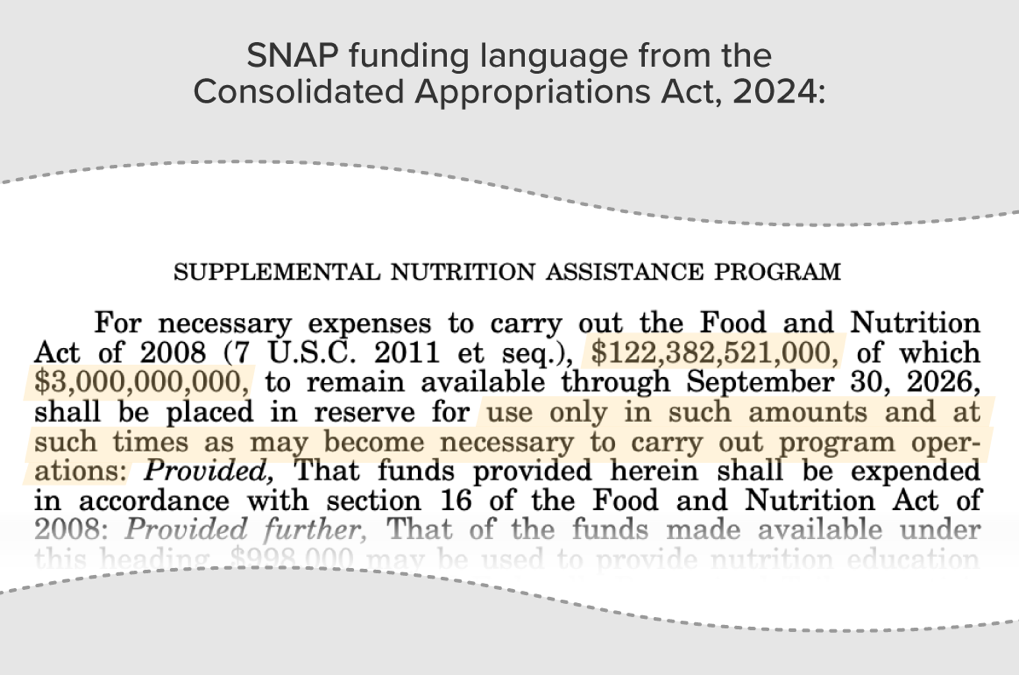
By law, individuals and families who meet SNAP’s eligibility requirements are entitled to benefits. Despite this requirement, historically Congress has treated SNAP as what is known as an “appropriated entitlement,” [3] funding SNAP through the annual appropriations process with the following language (using the fiscal year 2024 language as an example[4]):

Breaking this down:
- The first number ($122.4 billion in 2024) covers all of the activities funded under the Food and Nutrition Act (FNA). SNAP benefits ($108 billion in 2024) account for about 90 percent of FNA funding. SNAP benefits include “regular” monthly benefits and D-SNAP benefits ― one-time SNAP food assistance benefits after a disaster for households affected by the disaster who may not normally qualify for or participate in SNAP. As a result, the law does not support the Administration’s claim that the contingency reserve is available for D-SNAP but not regular benefits.[5]
- The second number ($3 billion in 2024) is known as the “contingency reserve.” In recent years this reserve has been available for two subsequent fiscal years and, as the law provides, is available for “program operations” as “may become necessary.” At the beginning of fiscal year 2026, SNAP had $6 billion in contingency reserves available: $3 billion from the fiscal year 2024 appropriation and $3 billion from the fiscal year 2025 full-year continuing resolution.[6]
The amount available through the contingency reserve may now be somewhat lower ― likely between $5 and $6 billion ― depending on how much USDA may have used to fund state administrative costs in October. (The Administration indicated in its Lapse of Funding Plan that it planned to use the contingency reserve to pay for state administrative costs during October 2025. That is inconsistent with saying that the contingency reserve is not available for SNAP benefits because benefits and administrative costs are part of the same appropriations item.)
Previous USDA Guidance Under Both Trump Administrations Indicated That the Contingency Reserve Is Available to Pay Regular SNAP Benefits
In anticipation of a lapse in appropriations and during the lapse the Agriculture Department has provided guidance in the form of shutdown plans, letters to state agencies, and detailed questions and answers (Q&As) for state agencies and participants. On numerous occasions, the Administration has made clear that SNAP’s contingency fund would be available for SNAP benefits.
2025 shutdown: USDA’s 2025 Lapse of Funding Plan, dated September 30, 2025, is no longer available on the USDA website. It explained, however, that the Office of Management and Budget had instructed USDA that fiscal year 2025 funding would cover SNAP benefits for October, the first month of the fiscal year,[7] and that the contingency reserves would be available to pay subsequent months’ benefits, as well as state administrative costs:

2018-2019 shutdown: On December 21, 2018, during the first Trump Administration, a continuing resolution (CR), under which SNAP had been funded, expired. For SNAP and other appropriated entitlements CRs have historically provided that funds are available for “payments due on or about the first day of any month” that begins within 30 days of the end of the CR. As a result, states were able to issue SNAP benefits for January 2019.
On January 8, 2019, the Administration directed states to issue SNAP benefits for February 2019 by January 20, before the end of the 30-day window authorized by the CR.[8] Every state was able to do so. Another CR was enacted on January 25, 2019, ending the shutdown, but USDA issued several pieces of guidance during this period that spoke to the availability of SNAP’s contingency fund for SNAP benefits.[9]
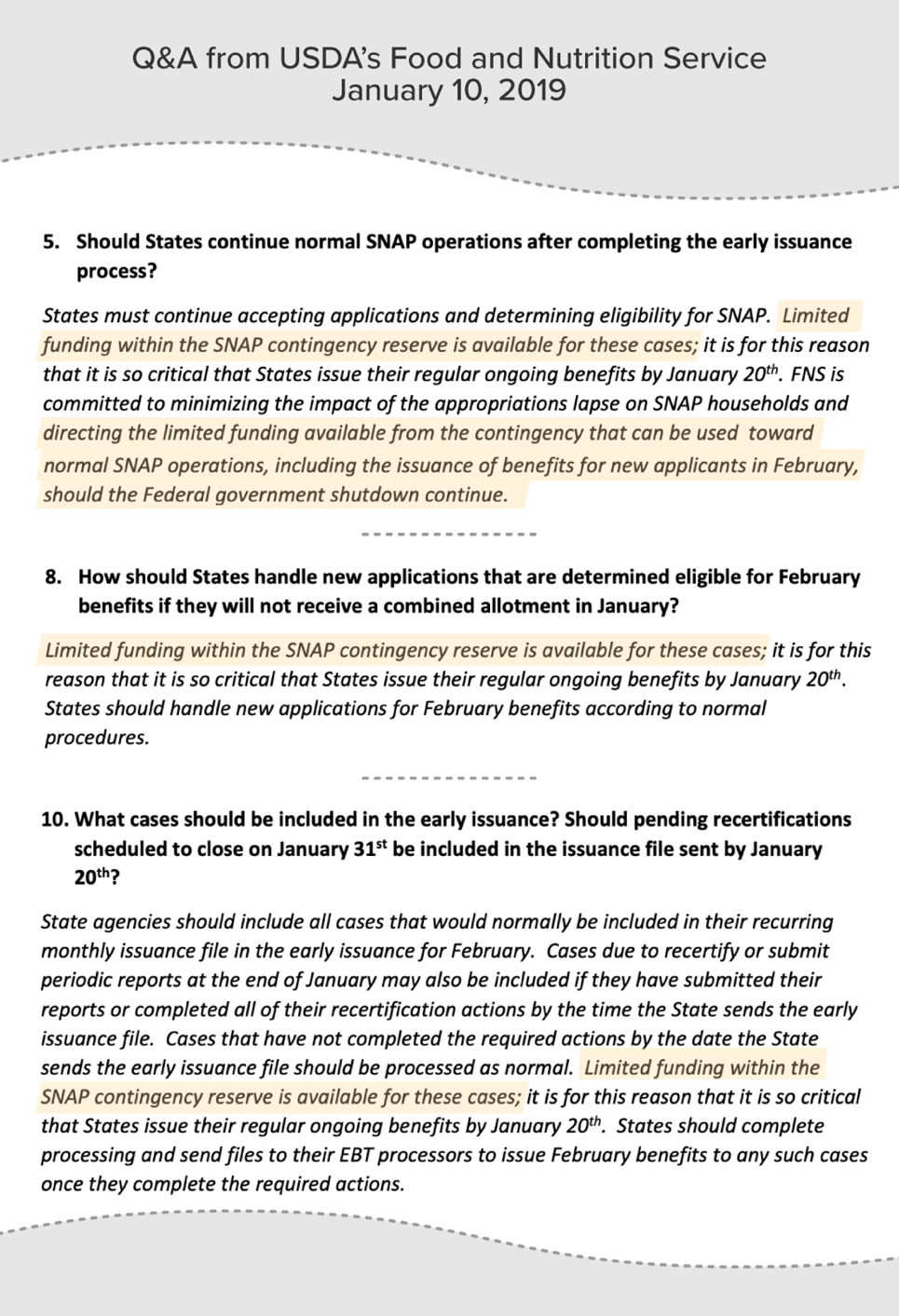
In a January 10, 2019 Q&A,[10] USDA’s Food and Nutrition Service (FNS) stated that contingency funds could be used to pay benefits for new applicants:

In a second Q&A from January 14, 2019,[11] and a third Q&A from January 18, 2019,[12] USDA reiterated that contingency funds could be used for the following month’s benefits.
Finally, a subsequent GAO report on the Trump Administration’s early issuance of February 2019 SNAP benefits during the shutdown found that USDA had contingency funds available to pay benefits:[13]



USDA Guidance During the Obama Administration Indicated That the Contingency Reserve Is Available to Pay Regular SNAP Benefits
October 2015 averted shutdown: In September 2015 a possible shutdown was averted with a continuing resolution enacted on September 30, 2015. But USDA issued several pieces of guidance that contemplated using SNAP’s contingency reserve, if necessary.
A September 23, 2015 letter instructed states to send their issuance files to their Electronic Benefit Transfer (EBT) vendors to ensure that October benefits would be issued in a timely manner because the Administration expected an appropriations bill would be enacted by the start of the next fiscal year, during the following week. USDA’s letter noted, however, that if there were no funding bill, then limited funds would be available.[14] A Q&A for SNAP recipients from that time provided detail that the contingency reserve would provide the limited funding.[15]
End Notes
[1] U.S. Department of Agriculture, “Impact of the Government Lapse on November Supplemental Nutrition Assistance Program (SNAP) Household Benefits,” October 24, 2025, politico.com/f/?id=0000019a-17b3-dc69-abda-fff3f76a0000&source=email.
[2] U.S. Department of Agriculture, “Lapse of Funding Plan,” September 30, 2025, p. 15, https://www.documentcloud.org/documents/26196921-fy2026-usda-lapse-plan-sept30/.
[3] Under some legal interpretations, SNAP may have a permanent appropriation under the Food and Nutrition Act that would fund the program during lapses in appropriations. Our analysis here focuses on the Administration’s obligations if it continues to treat SNAP as an appropriated entitlement, as it has to date.
[4] P.L. 118-42, Consolidated Appropriations Act, 2024, https://www.congress.gov/118/plaws/publ42/PLAW-118publ42.pdf.
[5] The other activities funded under the FNA are the federal share of state administrative costs (about $7 billion in 2024, including employment and training and nutrition education), the Nutrition Assistance Block Grant for Puerto Rico and other U.S. territories that do not participate in SNAP (about $3 billion in 2024), among other smaller costs (that together totaled about $1.2 billion in 2024).
[6] P.L. 119-4, Section 1109, which funded SNAP and other appropriated entitlements at “the amounts necessary to maintain program levels under current law and under the authority and conditions provided in the applicable appropriations Acts for fiscal year 2024.”
[7] U.S. Department of Agriculture, “Lapse of Funding Plan,” op. cit.
[8] U.S. Department of Agriculture, “USDA Announces Plan to Protect SNAP Participants’ Access to SNAP in February,” January 8, 2019, https://www.usda.gov/about-usda/news/press-releases/2019/01/08/usda-announces-plan-protect-snap-participants-access-snap-february.
[9] It is likely that some contingency reserve funding was used for SNAP benefits issued between January 20 and January 25, but the later appropriation allowed for the contingency fund to be replenished.
[10] U.S. Department of Agriculture, “Early Issuance of February 2019 SNAP Benefits, Questions and Answers #1,” January 10, 2019, https://fns-prod.azureedge.us/sites/default/files/EarlyIssuanceQAEmail1-10-19.pdf.
[11] U.S. Department of Agriculture, “Early Issuance of February 2019 SNAP Benefits, Questions and Answers #2,” January 14, 2019, https://fns-prod.azureedge.us/sites/default/files/EarlyIssuanceStateQAEmail1-14-19.pdf. See response to questions 1 and 5.
[12] U.S. Department of Agriculture, “Early Issuance of February 2019 SNAP Benefits, Questions and Answers #3,” January 18, 2019, https://fns-prod.azureedge.us/sites/default/files/SNAPEarlyIssuanceQA1-18-19_0.pdf. See response to questions 1 and 3.
[13] U.S. Government Accountability Office, “U.S. Department of Agriculture―Early Payment of SNAP Benefits,” B-331094, September 5, 2019, https://www.gao.gov/products/b-331094.
[14] U.S. Department of Agriculture, “Supplemental Nutrition Assistance Program (SNAP) State Issuance Files for October, 2015,” September 23, 2015, https://s3.documentcloud.org/documents/2430653/second-letter-to-states-usda.pdf.
[15] U.S. Department of Agriculture, “Q&A for SNAP Recipients in the Event of a Government Shutdown,” September 2015, https://web.archive.org/web/20150929143006/https://www.fns.usda.gov/snap/2015-qas/.