

Congress Must Fully Fund WIC in 2026 Spending Bill and Prevent Administration Overrides
With only a few weeks left before the start of fiscal year 2026, Congress is considering attaching the Agriculture appropriations bill[1] — which funds, among other programs, the Special Supplemental Nutrition Program for Women, Infants, and Children (WIC) — to a stopgap funding measure. It’s critical that Congress “fully fund” WIC by providing enough funding to ensure that all eligible people who seek help can receive WIC’s full science-based nutrition benefits. The funding provided in final legislation must also be accompanied by an enforceable mechanism to ensure the Trump Administration does not claw back funding by seeking partisan rescission legislation or by unlawfully and unilaterally impounding funds, including through so-called pocket rescissions. If Congress reaches a deal on funding for WIC and other areas, that deal must be honored throughout the year by Congress and the President.
The Senate Agriculture appropriations bill would fully fund WIC.[2] But the House bill would not, forcing states to turn away nearly half a million eligible children and new parents by the end of fiscal year 2026 (see Figure 1; Table 1 provides state estimates). Moreover, the House bill would cut WIC’s fruit and vegetable benefits[3] for more than 4 million young children and breastfeeding participants.
WIC provides nutritious foods, counseling on healthy eating, breastfeeding support, and health care referrals to almost 7 million pregnant, postpartum, and breastfeeding people, infants, and children under 5 in families with low incomes.[4] Extensive research over the last few decades shows that WIC participation contributes to healthier births[5] and more nutritious diets,[6] among other positive outcomes.[7] Access to WIC’s full, science-based food benefit helps ensure that low-income families with young children can afford the foods they need for a healthy diet.
In recognition of WIC’s critical role in safeguarding the health of families with young children, Congress, on a bipartisan basis, has fully funded WIC consistently for more than 25 years. To avoid jeopardizing the health of half a million preschoolers and new parents in low-income families, lawmakers must take the Senate approach to WIC funding for fiscal year 2026. And given the Trump Administration’s actions this year to override bipartisan spending agreements through partisan rescission legislation and unlawful withholding of funds (including so-called “pocket” rescissions[8]), lawmakers must also pair the sufficient funding with enforceable provisions that ensure that any bipartisan deal on WIC funding is honored throughout the year and the funds provided reach the parents and children they are intended for.
Senate Bill Fully Funds WIC, While House Bill Falls Far Short and Cuts Benefits
The fiscal year 2026 Agriculture appropriations bill approved by the Senate Appropriations Committee in July would fully fund WIC.[9] Both the number of eligible people participating in WIC and food costs have risen over the last year. In recognition of those increases, the Senate bill provides $8.2 billion for WIC in 2026, an increase over the $7.6 billion that was appropriated in 2025. The Senate bill also maintains the current value of WIC’s cash value benefit for fruits and vegetables, a critical resource for helping to improve health[10] and prevent chronic disease[11] among young children.
In contrast, the funding bill passed by the House Appropriations Committee in June would underfund WIC, providing the same amount of new funding as last year despite rising participation and food costs.[12] The House bill would cut WIC’s fruit and vegetable benefits for 4.3 million young children and breastfeeding participants, starting the process proposed in President Trump’s 2026 budget of sharply cutting those benefits for all child and postpartum participants.
Even with the benefit reduction, the House funding level would be insufficient to serve all eligible applicants. Table 1 below illustrates how many applicants would be affected and the aggregate reduction in benefits by state, which reduces purchases at grocery stores. Cutting fruit and vegetable benefits for WIC participants would raise the risk that young children in families with low incomes wouldn’t get enough healthy food to eat, which can cause long-term harm.[13]
The House bill included report language committing to “take additional action as necessary to ensure that funding provided in fiscal year 2026 remains sufficient to serve all eligible participants.”[14] By agreeing to the Senate funding bill, House appropriators could honor this commitment and promote the health of all eligible young children and new parents with low incomes who seek help.
House Bill Would Force States to Turn Away 500,000 Children and New Parents by September 2026
Participation in WIC has been increasing since 2022,[15] a trend that is likely to continue and could accelerate if an economic downturn makes more families eligible or if a greater share of eligible families seek benefits. Families are more likely to seek out help from WIC when they have a harder time affording groceries — for example, due to cuts to SNAP benefits resulting from the harmful Republican megabill and during recessions.[16]
In addition, food prices are expected to continue to rise as a result of the President’s tariff policies. Rising food costs could lead to increased participation as families struggle to afford groceries, and, if the prices of the foods WIC provides increase, would directly increase the cost of WIC’s food benefits.
If Congress adopts the House approach of failing to increase WIC funding, states would be forced to put eligible new parents and preschoolers on waiting lists for the first time in decades, jeopardizing access to this highly effective program during an important window for child development.

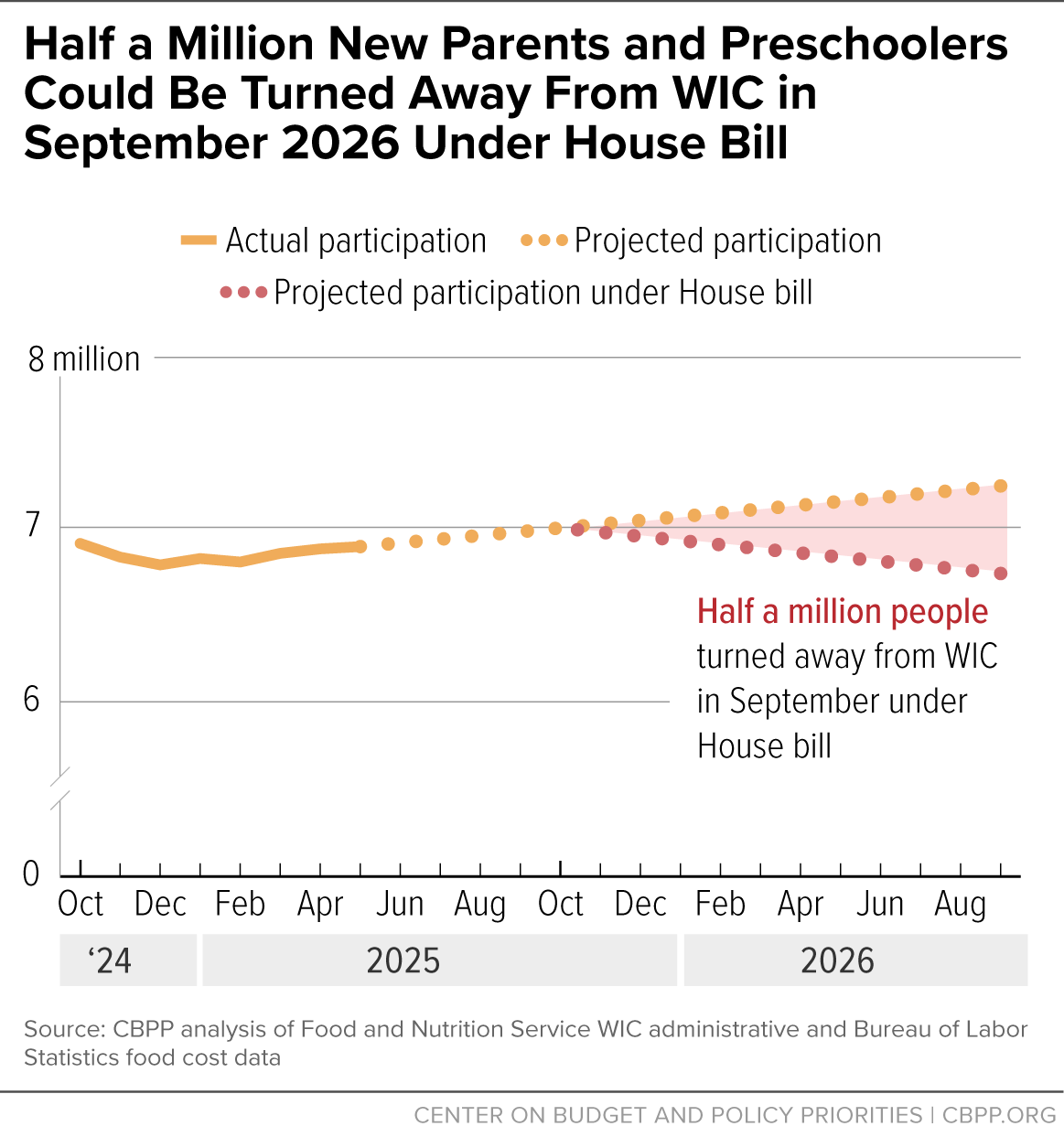
To illustrate the impact of flat WIC funding, we estimated the participation reductions that would occur over fiscal year 2026 if states reduced spending by turning away eligible applicants. We estimate that flat funding would support average monthly participation of about 250,000 fewer people than would be able to participate with adequate funding, if the full $150 million contingency fund were used.
WIC’s rules generally require states to turn people away only when they apply for WIC or need to renew their benefits. The more people the state turns away early in the fiscal year, the more quickly the savings accumulate and the less steep the caseload reductions that will be needed in the final months of the fiscal year. But if states chose to limit those turned away to preschoolers and postpartum people — rather than younger children or pregnant or breastfeeding applicants — the participation reduction and savings would accumulate more slowly. As a result, we estimate that by September 2026, WIC would be able to serve half a million fewer people nationwide than if Congress provided full funding. (See Figure 1 for the nationwide impact and Table 1 for participation reductions by state.)
Required Cuts Under House Bill Would Disproportionately Impact Black and Hispanic Families, Have Long-Term Consequences
Turning eligible people away from WIC would affect participants of all races and ethnicities but would disproportionately harm Black and Hispanic families. Black and Hispanic families face greater economic hardship due to long-standing barriers to housing, education, and employment opportunities and other forms of discrimination impacting people of color, and thus are more likely to qualify for and seek out assistance from WIC than families of other races or ethnicities.
Under WIC’s prioritization rules, those who would be turned away first are postpartum adults who are not breastfeeding and preschoolers.[17] Because breastfeeding rates are lower among Black parents,[18] including among WIC participants, Black parents are more likely than other groups to be turned away from WIC if there is inadequate funding — causing further harm for a group already at higher risk for severe pregnancy-related health conditions,[19] which often develop in the postpartum period.
In addition, once word begins to spread that states are denying benefits to some applicants, more vulnerable individuals, including pregnant individuals and parents of newborns, may mistakenly believe they would be turned away and choose not to apply for WIC. Recognizing that take-up rates among those eligible have been relatively low — only 54 percent of eligible people participated in 2022[20] — federal and state policymakers have worked for many years to modernize the program and to connect more low-income families with WIC’s proven benefits. Turning people away due to insufficient funding would severely undermine this progress by leaving a lasting impression that could discourage eligible families from applying for years to come.
Provisions to Prevent the Trump Administration From Overriding Spending Laws Are Also Critical
If Congress adopts the Senate funding level, there is still no guarantee that WIC will be able to serve all eligible applicants. That is because the Trump Administration has acted to override bipartisan spending agreements by clawing back funds using a partisan rescission process and bypassing Congress entirely to illegally impound funds, including through so-called pocket rescissions.[21] Any 2026 funding deal must include enforceable provisions to ensure that the funding provided by Congress reaches, in full, the people and services for which Congress appropriated it, including families eligible for WIC.
To avoid turning eligible preschoolers and new parents away from WIC’s proven benefits, Congress must adopt the Senate approach to WIC funding and accompany it with provisions that ensure the Trump Administration cannot override spending laws.
| TABLE 1 | |||
|---|---|---|---|
Estimated Impact of WIC Funding Shortfall and Benefit Cut in House Bill | |||
| Jurisdiction | Eligible People Turned Away by September 2026 | WIC Participants Who Would Experience Fruit and Vegetable Benefits Cut | Annual Fruit and Vegetable Benefits Cut |
| Alabama | 8,000 | 63,000 | $1,679,000 |
| Alaska | 1,000 | 10,000 | $289,000 |
| American Samoa | Less than 1,000 | 3,000 | $79,000 |
| Arizona | 11,000 | 93,000 | $2,661,000 |
| Arkansas | 5,000 | 35,000 | $951,000 |
| California | 74,000 | 697,000 | $19,934,000 |
| Colorado | 7,000 | 62,000 | $1,806,000 |
| Connecticut | 4,000 | 33,000 | $940,000 |
| Delaware | 2,000 | 15,000 | $414,000 |
| District of Columbia | 1,000 | 8,000 | $240,000 |
| Florida | 32,000 | 272,000 | $8,054,000 |
| Georgia | 17,000 | 137,000 | $3,916,000 |
| Guam | Less than 1,000 | 4,000 | $122,000 |
| Hawai’i | 2,000 | 17,000 | $508,000 |
| Idaho | 2,000 | 21,000 | $629,000 |
| Illinois | 13,000 | 100,000 | $2,923,000 |
| Indian Tribal Organizations | 3,000 | 28,000 | $783,000 |
| Indiana | 11,000 | 96,000 | $2,783,000 |
| Iowa | 5,000 | 39,000 | $1,111,000 |
| Kansas | 4,000 | 31,000 | $882,000 |
| Kentucky | 8,000 | 64,000 | $1,769,000 |
| Louisiana | 7,000 | 51,000 | $1,460,000 |
| Maine | 1,000 | 12,000 | $353,000 |
| Maryland | 9,000 | 78,000 | $2,296,000 |
| Massachusetts | 9,000 | 85,000 | $2,428,000 |
| Michigan | 14,000 | 120,000 | $3,302,000 |
| Minnesota | 8,000 | 68,000 | $1,980,000 |
| Mississippi | 4,000 | 32,000 | $883,000 |
| Missouri | 7,000 | 54,000 | $1,567,000 |
| Montana | 1,000 | 9,000 | $259,000 |
| Nebraska | 3,000 | 24,000 | $679,000 |
| Nevada | 4,000 | 35,000 | $1,000,000 |
| New Hampshire | 1,000 | 9,000 | $245,000 |
| New Jersey | 12,000 | 111,000 | $3,298,000 |
| New Mexico | 3,000 | 24,000 | $704,000 |
| New York | 33,000 | 303,000 | $8,984,000 |
| North Carolina | 18,000 | 150,000 | $4,338,000 |
| North Dakota | 1,000 | 6,000 | $182,000 |
| Northern Marianas | Less than 1,000 | 2,000 | $54,000 |
| Ohio | 13,000 | 108,000 | $3,123,000 |
| Oklahoma | 5,000 | 43,000 | $1,251,000 |
| Oregon | 6,000 | 53,000 | $1,537,000 |
| Pennsylvania | 14,000 | 113,000 | $3,111,000 |
| Puerto Rico | 7,000 | 60,000 | $1,631,000 |
| Rhode Island | 1,000 | 12,000 | $325,000 |
| South Carolina | 7,000 | 61,000 | $1,711,000 |
| South Dakota | 1,000 | 9,000 | $249,000 |
| Tennessee | 10,000 | 81,000 | $2,341,000 |
| Texas | 59,000 | 495,000 | $15,740,000 |
| Utah | 3,000 | 30,000 | $887,000 |
| Vermont | 1,000 | 7,000 | $213,000 |
| Virgin Islands | Less than 1,000 | 2,000 | $54,000 |
| Virginia | 8,000 | 66,000 | $1,867,000 |
| Washington | 10,000 | 90,000 | $2,515,000 |
| West Virginia | 3,000 | 22,000 | $601,000 |
| Wisconsin | 7,000 | 61,000 | $1,703,000 |
| Wyoming | 1,000 | 5,000 | $134,000 |
| Total | 502,000 | 4,314,000 | $125,475,000 |
Note: Figures are rounded to the nearest 1,000 and do not sum to totals due to rounding. Participation cuts are calculated by allocating the nationwide cut by each jurisdiction’s share of national participation in fiscal year 2024, the most recent fiscal year for which 12 months of data are available. When implementing waiting lists, actual state participation cuts and who is affected by them would reflect additional factors including the age distribution of participants, WIC food costs in the state, how quickly waiting lists can be implemented, and how states prioritize applicants and reapplicants. Source: CBPP analysis of USDA FNS WIC administrative data and BLS food cost data | |||
End Notes
[1] Andrew Desiderio, “GOP heading in different directions as funding fight begins,” Punchbowl News, September 3, 2025, https://punchbowl.news/article/washington/funding-fight-begins-gop-in-different-directions/.
[2] Ty Jones Cox, “Senate Fully Funds WIC But Serious Threats to Nutrition Aid Remain,” CBPP, July 30, 2025, https://www.cbpp.org/blog/senate-fully-funds-wic-but-serious-threats-to-nutrition-aid-remain.
[3] Elisabet Eppes, “Trump Budget Would Slash WIC Fruit and Vegetable Benefits for Millions,” CBPP, June 3, 2025, https://www.cbpp.org/blog/trump-budget-would-slash-wic-fruit-and-vegetable-benefits-for-millions.
[4] U.S. Department of Agriculture, Food and Nutrition Service, WIC Data Tables, https://www.fns.usda.gov/pd/wic-program/.
[5] CBPP, “WIC Helps Mothers Give Birth to Healthier Infants and Reduces Infant Mortality,” https://www.cbpp.org/sites/default/files/atoms/files/5-8-15fa-healthyinfants.pdf.
[6] CBPP, “WIC Supports More Nutritious Diets,” https://www.cbpp.org/sites/default/files/atoms/files/5-8-15fa-nutritiondiet.pdf.
[7] Steven Carlson and Zoë Neuberger, “WIC Works: Addressing the Nutrition and Health Needs of Low-Income Families for More Than Four Decades,” CBPP, updated January 27, 2021, https://www.cbpp.org/research/food-assistance/wic-works-addressing-the-nutrition-and-health-needs-of-low-income-families.
[8] David Super and Sam Berger, “Pocket Rescissions Are Illegal,” CBPP, July 30, 2025, https://www.cbpp.org/research/federal-budget/pocket-rescissions-are-illegal.
[9] S. 2256, https://www.congress.gov/119/bills/s2256/BILLS-119s2256rs.pdf.
[10] Donato Angelino et al., “Fruit and vegetable consumption and health outcomes: an umbrella review of observational studies,” International Journal of Food Sciences and Nutrition, Vol. 70, Issue 6, 2019, https://www.tandfonline.com/doi/full/10.1080/09637486.2019.1571021.
[11] Chiara Devirgiliis et al., “Effect of Fruit and Vegetable Consumption on Human Health: An Update of the Literature,” foods, Vol. 19, No. 19, October 2, 2024, https://www.mdpi.com/2304-8158/13/19/3149.
[12] Ibid.
[13] Klébya Hellen Dantas de Oliveira et al., “Household food insecurity and early childhood development: Systematic review and meta-analysis,” Maternal and Child Nutrition, February 12, 2020, https://onlinelibrary.wiley.com/doi/full/10.1111/mcn.12967.
[14] Report to accompany the Agriculture, Rural Development, Food And Drug Administration, And Related Agencies Appropriations Bill, 2026, H.R. 4121, https://www.congress.gov/119/crpt/hrpt172/CRPT-119hrpt172.pdf.
[15] U.S. Department of Agriculture, Food and Nutrition Service, WIC Data Tables.
[16] Katie Bergh and Dottie Rosenbaum, “Many Low-Income People Will Soon Begin to Lose Food Assistance Under Republican Megabill,” CBPP, September 10, 2025, https://www.cbpp.org/research/food-assistance/many-low-income-people-will-soon-begin-to-lose-food-assistance-under.
[17] 7 CFR § 246.7(e)(4)
[18] Centers for Disease Control and Prevention, “About Breastfeeding Data,” July 7, 2025, https://www.cdc.gov/breastfeeding-data/about/index.html.
[19] Latoya Hill et al., “Racial Disparities in Maternal and Infant Health: Current Status and Efforts to Address Them,” KFF, October 25, 2024, https://www.kff.org/racial-equity-and-health-policy/racial-disparities-in-maternal-and-infant-health-current-status-and-efforts-to-address-them/.
[20] Zoë Neuberger, Luis Nuñez, and Linnea Sallack, “WIC’s Critical Benefits Reach Only Half of Those Eligible,” CBPP, updated May 8, 2025, https://www.cbpp.org/research/food-assistance/wics-critical-benefits-reach-only-half-of-those-eligible-0.
[21] Brendan Duke et al., “2026 Appropriations Must Protect Against Further Partisan Cuts and Illegal Withholding of Funds,” CBPP, September 4, 2025, https://www.cbpp.org/research/federal-budget/2026-appropriations-must-protect-against-further-partisan-cuts-and-illegal.