

House Republican Budget’s $4.5 Trillion Tax Cut Doubles Down on Costly Failures of 2017 Tax Law
Following a presidential campaign in which Donald Trump promised to improve the economic circumstances of working families, House Republicans are instead pushing to extend all expiring provisions of the costly 2017 tax law — which are heavily skewed to people with high incomes — and add new tax cuts on top. The Republican-controlled House passed a budget resolution on February 25 authorizing $4.5 trillion in tax cuts through 2034 and calling on committees to partially offset the cost with $2 trillion in cuts; these cuts will inevitably hit programs such as Medicaid and SNAP, which help millions of families afford essential needs.[1]
Extending the expiring tax cuts for individuals and large estates would double down on the flaws in the 2017 law by:
- Giving the biggest benefits to the wealthy. Households with incomes in the top 5 percent, who have incomes over around $320,000, would receive roughly half of the benefits of extending the expiring tax cuts.
- Ballooning the deficit. Along with the 2001 and 2003 tax cuts enacted under President Bush, the 2017 law has severely eroded our nation’s revenue base. The House budget would compound the damage, adding hundreds of billions of dollars to deficits each year. Extending the 2017 tax cuts would cost $3.6 trillion through 2034.
- Failing to significantly boost economic growth, workers’ earnings, or other benefits for workers. The trickle-down benefits that proponents claimed the 2017 law would produce never materialized, and the law hasn’t come close to paying for itself. Yet the House budget claims that extending the tax cuts would generate trillions in revenue — far more than any independent estimate.
As in 2017, an alternative path is available. Congress should work toward creating a fairer federal tax system that raises more revenues from wealthy people and corporations and supports high-value investments that expand opportunity and promote shared prosperity.
Biggest Benefits to the Wealthy
Extending the expiring individual income and estate tax provisions of the 2017 tax law would benefit households with considerable wealth and high incomes far more than households with low or moderate incomes, the central focus during the campaign. Households with incomes in the top 1 percent (who make more than roughly $743,000 per year) would get tax cuts averaging $62,000 a year, compared to only about $400 a year for households with incomes in the bottom 60 percent (who make roughly $96,000 or less).[2] Those at the top would enjoy a 4 percent increase in their after-tax incomes, roughly four times the 1 percent gain for households in the bottom 60 percent, according to the Treasury Department.[3]
The richest 0.1 percent of taxpayers, those with incomes over $3.5 million a year, would receive an average annual tax cut of $314,000.[4] These 200,000 multi-millionaires would receive more total dollars in tax cuts than the 187 million families with incomes in the bottom 60 percent.
Roughly half the cost of extending the expiring tax cuts would flow to households with incomes in the top 5 percent (those with incomes over around $320,000).[5] (See Figure 1.)

Trillions in Added Deficits and Debt
The Congressional Budget Office (CBO) estimated in 2018 that the 2017 law would cost $1.9 trillion over ten years,[6] and recent estimates show that making the law’s temporary individual income and estate tax cuts permanent would cost roughly another $4.2 trillion through 2035.[7] Together with the 2001 and 2003 tax cuts enacted under President Bush (most of which were made permanent in 2012), the 2017 law has severely eroded our nation’s revenue base.
Revenue as a share of gross domestic product (GDP) fell from about 19.5 percent in the years immediately preceding the Bush tax cuts to just 16.3 percent in the years immediately following the Trump tax cuts,[8] though CBO expects revenue to rise modestly to 17.1 percent of GDP in 2025.[9] In dollar terms, the difference is stark: revenues this year, for example, would be over $700 billion higher if they were 19.5 percent of GDP, as in the years before the Bush tax cuts.
Current revenue levels are simply not enough to meet the nation’s investment needs and our retirement and health care commitments to seniors.[10] Making the 2017 law’s individual and estate tax cuts permanent would double down on this problem, and the House budget resolution would go even further by adding more tax cuts on top. It instructs the Ways and Means Committee to increase the deficit by up to $4.5 trillion over the ten-year budget window (2025-2034) — $900 billion more than the $3.6 trillion needed over this period for the extension.[11] (See Figure 2.) (Since the 2017 provisions are already in effect through 2025, the budget resolution only includes nine years of tax cuts, reducing the cost of an extension.)
Instead of making a course correction by working toward a more robust revenue base that supports commitments to seniors and enables needed investments, House Republicans are again doubling down on a flawed path of costly tax cuts.

Little or No Economic Benefit


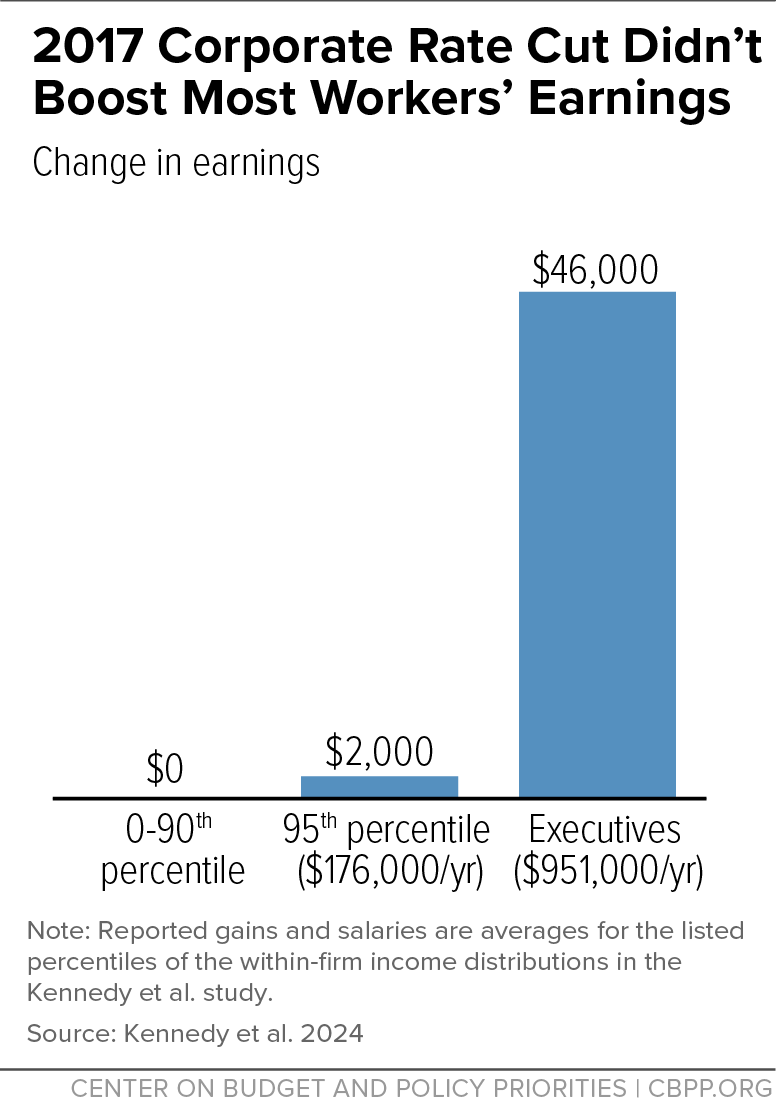
During the 2017 debate, Trump Administration officials and prominent proponents claimed the tax law would yield broadly shared benefits by boosting economic growth. President Trump’s Council of Economic Advisers claimed the centerpiece corporate tax rate cut would “very conservatively” lead to a $4,000 boost in household income.[12] But research to date has failed to find evidence that the gains from the corporate rate cut trickled down to most workers. A study by economists from the Joint Committee on Taxation and the Federal Reserve Board found that workers below the 90th percentile of their firm’s income scale — a group whose incomes were below roughly $114,000 in 2016 — saw no change in earnings from the rate cut.[13] (See Figure 3.)
Proponents’ claims that the tax cuts would pay for themselves haven’t panned out either. In fact, a study by economists from Harvard, Princeton, the University of Chicago, and the Treasury Department estimates that the law’s total corporate tax cuts — the rate cut as well as full expensing for capital investments and international tax changes — reduced revenue by roughly 98 cents for every dollar of tax cuts, even after accounting for increases in economic activity due to those cuts.[14]
Similarly, proponents argued the law’s 20 percent deduction for pass-through businesses (partnerships, S corporations, and sole proprietorships) would boost investment and create jobs.[15] Then-Treasury Secretary Steven Mnuchin, for example, argued the deduction would “be good for the economy; good for growth.”[16] But researchers have found no evidence that it provided any significant boost in economic activity and little evidence that it increased investment or broadly benefited workers, other than the owners themselves.[17]
Despite this underwhelming performance, the House Republican budget resolution assumes that enacting $4.5 trillion in new or extended tax cuts will produce enough additional economic growth to generate an extra $2.6 trillion in revenue through 2035, partially offsetting the cost of the tax cuts. The Committee for a Responsible Federal Budget has derided this claim as “fantasy math,” noting that it is many times greater than even the most optimistic independent estimate.[18]
End Notes
[1] The House budget specifies committees that must cut in total at least $1.5 trillion in spending for programs and services through 2034. If they don’t cut $2 trillion, then the instruction to the Ways and Means Committee allowing it to increase the deficit by $4.5 trillion through 2034 would be reduced by the amount these other committees fall short.
[2] Department of the Treasury, Office of Tax Analysis, “The Cost and Distribution of Extending Expiring Provisions of the Tax Cuts and Jobs Act of 2017,” January 10, 2025, https://home.treasury.gov/system/files/131/The-Cost-and-Distribution-of-Extending-Expiring-Provisions-of-TCJA-01102025.pdf.
[3] Ibid.
[4] Ibid.
[5] Ibid.
[6] Congressional Budget Office (CBO), “The Budget and Economic Outlook: 2018 to 2028,” April 9, 2018, https://www.cbo.gov/publication/53651.
[7] Department of the Treasury, op. cit.
[8] Congressional Budget Office, Historical Budget Data, Jan 2025, 2a. Revenues as a Share of GDP, https://www.cbo.gov/data/budget-economic-data#2.
[9] Congressional Budget Office, Historical Budget Data and Revenue Projections by Category, Jan 2025, https://www.cbo.gov/data/budget-economic-data#2.
[10] Richard Kogan et al., “More Revenue Is Required to Meet the Nation’s Commitments, Needs, and Challenges,” CBPP, June 17, 2024, https://www.cbpp.org/research/federal-budget/more-revenue-is-required-to-meet-the-nations-commitments-needs-and.
[11] Samantha Jacoby, “House Republican Budget Takes Away Health Care, Food Aid to Pay for Expanded Tax Cuts for Wealthy,” CBPP, February 21, 2025, https://www.cbpp.org/blog/house-republican-budget-takes-away-health-care-food-aid-to-pay-for-expanded-tax-cuts-for.
[12] Council of Economic Advisers, “Corporate Tax Reform and Wages: Theory and Evidence,” October 2017, https://trumpwhitehouse.archives.gov/sites/whitehouse.gov/files/documents/Tax%20Reform%20and%20Wages.pdf.
[13] Patrick J. Kennedy et al., “The Efficiency-Equity Tradeoff of the Corporate Income Tax: Evidence from the Tax Cuts and Jobs Act,” March 21, 2024, https://patrick-kennedy.github.io/files/TCJA_KDLM_2024.pdf. The $114,000 threshold for the 90th percentile of the within-firm earnings distribution appears in an earlier version of the paper, dated December 9, 2022 (Table 5, Panel A).
[14] Gabriel Chodorow-Reich et al., “Tax Policy and Investment in a Global Economy,” NBER Working Paper 32180, March 2024, https://www.nber.org/papers/w32180. For claims that the 2017 tax law would pay for itself, see, e.g., Kate Davidson, “Treasury Secretary Steven Mnuchin: GOP Tax Plan Would More Than Offset Its Cost,” Wall Street Journal, September 28, 2017, https://www.wsj.com/articles/treasury-secretary-steven-mnuchin-gop-tax-plan-would-more-than-offset-its-cost-1506626980.
[15] Steven Mufson, “Sen. Johnson Is a ‘No’ on the Tax Bill. He Says it Hurts Businesses (Like His Own),” Washington Post, November 16, 2017, https://www.washingtonpost.com/business/economy/sen-johnson-is-a-no-on-the-tax-bill-he-says-it-hurts-businesses-like-his-own/2017/11/16/c47b2a56-ca54-11e7-b0cf-7689a9f2d84e_story.html.
[16] Matthew J. Belvedere, “Mnuchin: GOP Tax Reform Would Give Small Business Owners the Lowest Rates ‘Since the 1930s,’” CNBC, November 17, 2017, https://www.cnbc.com/2017/11/17/mnuchin-gop-tax-plan-gives-small-business-lowest-rates-since-1930s.html.
[17] Lucas Goodman et al., “How Do Business Owners Respond to a Tax Cut? Examining the 199A Deduction for Pass-Through Firms,” NBER Working Paper 28680, January 2024, https://www.nber.org/system/files/working_papers/w28680/w28680.pdf.
[18] Committee for a Responsible Federal Budget, “$3 Trillion of Dynamic Feedback Is Fantasy Math,” February 7, 2025, https://www.crfb.org/blogs/3-trillion-dynamic-feedback-fantasy-math; Gbenga Ajilore, “House Budget Economic Claims Don’t Add Up,” CBPP, February 25, 2025, https://www.cbpp.org/blog/house-budget-economic-claims-dont-add-up.