MÁS ALLÁ DE LOS NÚMEROS
House Republican Budget Takes Away Health Care, Food Aid to Pay for Expanded Tax Cuts for Wealthy
In a party line vote, the Republican-controlled House Budget Committee advanced their budget resolution to move forward legislation that would give tax cuts to the wealthy and partially pay for them by taking health care and food away from people who face challenges affording these essential needs.
The House Republicans’ budget resolution calls for committees to enact $2 trillion in deeply harmful cuts through 2034 in programs and services for families and communities, including cuts to Medicaid, SNAP, and student loans. The resolution also authorizes the Ways and Means Committee to increase the deficit by $4.5 trillion over the same time period — this is the “instruction” that allows the committee to craft legislation cutting taxes by this amount.
Here are some important things to know about the House Republicans’ instruction to the Ways and Means Committee:
The House Republicans’ budget resolution paves the way for the Ways and Means Committee to continue all the expiring tax cuts through 2034 and then add $900 billion in skewed tax cuts on top. Extending the 2017 law’s expiring individual income and estate tax provisions would cost the nation $3.6 trillion in revenue through 2034, while delivering large benefits to the nation’s wealthiest business owners and households. The instruction to increase the deficit by up to $4.5 trillion is $900 billion more than is needed to extend those expiring provisions over that same period, signaling that even more expensive and skewed tax cuts will be added on top of the already expensive and skewed 2017 tax cuts.
How are Republicans planning to use that extra $900 billion for tax cuts? Though Republicans have discussed various additional tax cuts beyond extending the expiring provisions of the 2017 tax law, they are likely to start by pursuing additional tax cuts for corporations.
In 2017, congressional Republicans added several provisions to the law to partially offset the cost of the large cut in the corporate tax rate, from 35 percent to 21 percent. These provisions included, for example, requiring research and experimentation costs to be amortized over time instead of immediately expensed, phasing out full expensing for capital investments, and imposing stricter limitations on deductions for interest expenses.
Republicans have long wanted to reverse these business tax increases — but without a corresponding increase in the corporate tax rate. In total, reversing these provisions would add around $1 trillion more in tax cuts for corporations, approximately equal to the extra tax cuts in the Ways and Means instruction.
The House Republicans’ budget plan pays for this additional $900 billion in tax cuts with steep cuts to Medicaid. The House Republicans’ budget resolution directs the House Energy and Commerce Committee to reduce the deficit by at least $880 billion over ten years, a target Republicans have indicated they will hit primarily by cutting Medicaid. Putting it all together, Republicans are planning roughly $1 trillion in new tax cuts, much or all of which could go to corporations, paid for primarily through cuts that put health coverage in jeopardy for the 72 million people covered by Medicaid. (See chart.)
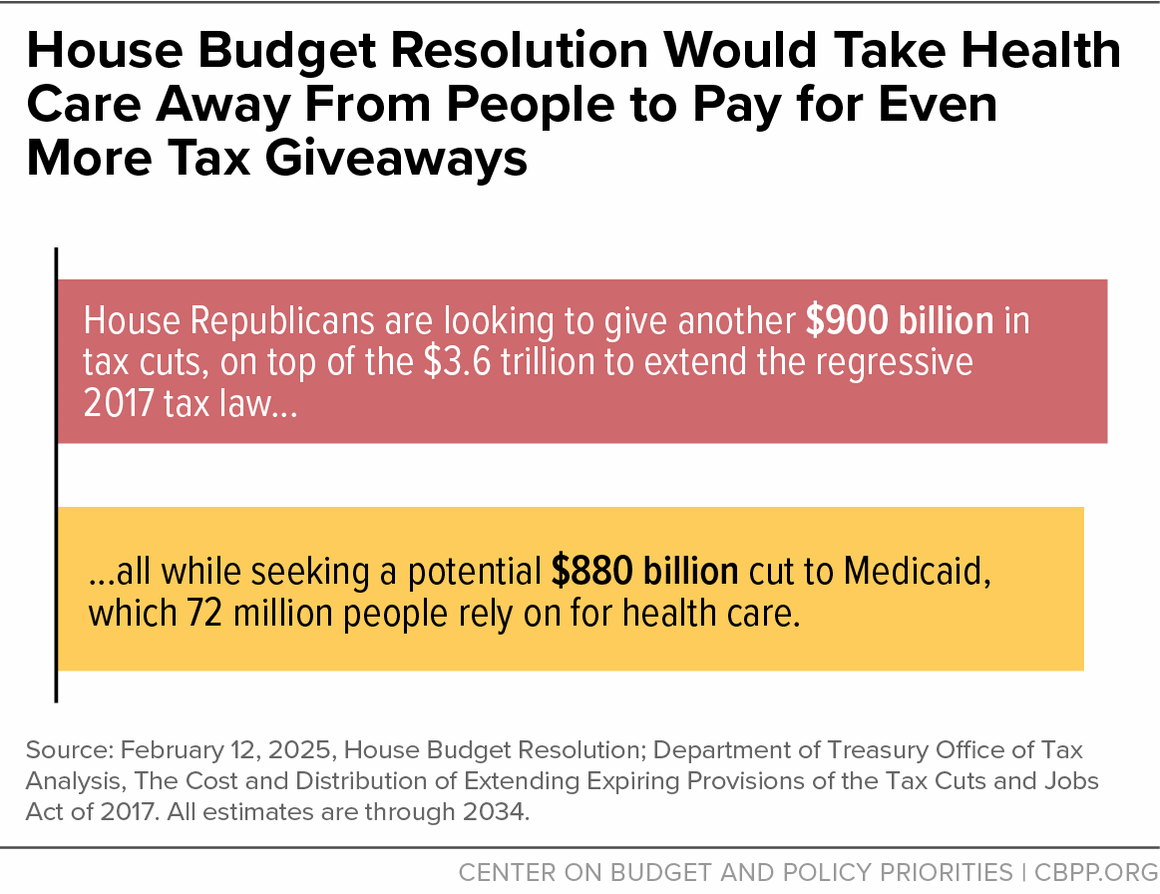
The House Republicans’ budget plan would give major tax cuts to high-income, wealthy households. Extending the expiring individual income and estate tax provisions for households with incomes in the top 5 percent of the income distribution (households with incomes over $321,000) costs around $1.8 trillion through 2034, accounting for 49 percent of the total $3.6 trillion cost of extension through 2034. That $1.8 trillion for wealthy and high-income households is close to the amount of the spending cuts House Republicans have outlined — including at least $880 billion primarily from Medicaid, $230 billion primarily from SNAP benefits, and $330 billion primarily from making student loans more expensive. Of the tax cuts for wealthy households, nearly $200 billion is for an estate tax giveaway that showers some $6 million per estate on the 1 in 1,000 wealthiest estates. In contrast, the average SNAP benefit is $6.20 per person per day, which helps struggling families put food on the table.
House Republicans could cut even more economic security programs for families with low incomes in addition to giving tax cuts to the wealthy. The budget resolution specifies that other committees’ cuts must total at least $1.5 trillion, but if they don’t cut $2 trillion, then the Ways and Means Committee must reduce its $4.5 trillion allowance by the amount the other committees fall short. But that doesn’t mean the committee’s very expensive tax cuts will shrink. If, for example, the Ways and Means allowance falls from $4.5 trillion to $4 trillion, the committee could hit that target while keeping all $4.5 trillion in tax cuts by making another $500 billion in cuts to programs in its jurisdiction, such as Medicare, Supplemental Security Income, Unemployment Insurance, Temporary Assistance for Needy Families, the Earned Income Tax Credit, or energy tax credits. Ways and Means could face pressure to make cuts in these areas even if the other committees hit the $2 trillion target to make room for still larger tax cuts.
Lawmakers should reject this upside-down approach. Instead of extending and expanding costly tax breaks for those who least need help, Congress should create a fair federal tax system that raises more revenues from wealthy people and corporations and supports high-value investments that expand opportunity and promote shared prosperity.