

New Data Show Trump Administration’s Illegal, Targeted Withholding of Funds
Newly released federal data provide evidence of the Trump Administration’s illegal withholding of fiscal year 2025 funding that Congress approved and the President signed into law in March, ahead of a critical September 30 deadline to use these funds.
Since taking office, the Administration has engaged in a widespread campaign to delay, withhold, cancel, or claw back funding approved by Congress, violating federal law. The Administration has not only attacked programs and funding provided in law before the President’s second term started, but also sought to delay and block 2025 funding provided by the bipartisan March funding deal.[2] These efforts have undermined lawmakers’ ability to reach future funding deals and have driven the federal government closer to a shutdown.[3]
The new data illustrate the Administration’s refusal to abide by the March deal, even as lawmakers begin negotiations over 2026 funding. The data also document the extent to which the Administration has targeted its funding freezes — known as impoundments — at particular programs and agencies to achieve its own preferred policies, rather than faithfully executing the law passed by Congress.
While the Administration has made clear its plans to illegally block some of this lawfully provided 2025 funding and cause it to expire unused, it has been difficult to determine how widespread the Administration’s impoundment efforts have been and which programs and agencies have been particularly affected — in part owing to Administration actions to hide that information.[4] The new data help answer those questions, showing that the Administration was almost $26 billion behind the expected pace of 2025 spending commitments through July — ten months into the fiscal year.
The fact that the delay has been concentrated in a limited set of programs and agencies provides additional evidence that the Administration has intentionally restricted the use of funds in areas where it has proposed deep cuts to programs or their wholesale elimination in its 2026 budget.
This analysis is not intended to capture the full extent of Administration impoundments, such as estimates from the Democratic staff of the House and Senate Appropriations committee that the Administration has frozen, cancelled, or fought in court to block more than $410 billion as of early September.[5] That analysis includes a much broader set of funding than what was in the 2025 funding bill. Instead, this analysis focuses on 2025 funds provided in the March 2025 funding agreement that are set to expire on September 30 to help shed light on how the Administration may undermine a 2026 funding agreement if it does not include enforceable legislative provisions to ensure that the money provided by Congress is put to the purposes for which it was intended, without interruption or interference.
New Data Suggest Effect of Administration Funding Freezes Through July
Newly released federal data show that as of July 31, the Trump Administration had obligated (committed) approximately $26 billion less in 2025 funding than would have been expected based on the historical average.[6] These funds will expire at the end of September if they have not been committed or spent.
By itself, the $26 billion figure understates the extent of the Administration’s withholding of 2025 funds to date.[7] For example, it doesn’t reflect the Administration’s earlier efforts to freeze funding — such as for grants for early childhood education, afterschool and summer school programs, heating and cooling assistance for low-income households, and others — where, after a delay and public blowback, funding patterns returned to normal by the end of July. [8] Nor does it reflect the Administration’s illegal efforts to suspend, delay, or cancel funding that will not expire this year, such as:
- Withholding billions in funding for electric vehicle infrastructure projects, an action the Government Accountability Office (GAO) has already determined violated federal law.[9]
- Clawing back billions in support for state and local public health departments.[10]
- Cancelling billions in funding already awarded for clean energy projects through the Department of Energy’s Office of Clean Energy Demonstrations, while freezing billions more in expected investments.[11]
- Announcing the termination of the Building Resilient Infrastructure and Communities (BRIC) program, which supports disaster mitigation projects, while canceling hundreds of millions in planned support for projects.[12]
- Delaying — and potentially imperiling — the use of tens of billions for high-speed internet infrastructure and affordability provided by the 2021 bipartisan infrastructure law.[13]
While the last two months of a fiscal year typically see an accelerated use of funds — and the Trump Administration could significantly close this gap in the pace of historical obligations — the July data illustrate the risks should it continue its illegal impoundments.
Delays Concentrated in Agencies and Programs the Administration Opposes
The Administration’s delays through July in using funding were not evenly distributed across programs, as might occur if the cause were broad capacity challenges. In many areas, the pace of obligations was roughly in line with (or even ahead of) historical averages.[14] Instead, the delays were concentrated in a relatively small set of agencies and programs, many of which the President proposed radically cutting or eliminating in his 2026 budget.
In 24 accounts, obligations of 2025 funding through July were at least 20 percentage points behind the historical ten-year average for the account.[15] These accounts constitute less than 2 percent of the 2025 funding set to expire at the end of September but 22 percent of the missing $26 billion that typically would have been obligated by July 31 under prior-year trends.
As detailed below, some of the most extreme examples of the slow use of funds in the July data fall into three categories: (1) health-focused agencies and programs the Administration has targeted for large cuts; (2) smaller agencies the Administration has targeted for elimination; and (3) foreign assistance programs the Administration later targeted as part of its illegal “pocket rescission” proposal. This evidence suggests that the delays in the use of funding through July were intentional.
Health Agencies
The Trump Administration has sought to radically cut back the federal government’s role in supporting lifesaving biomedical research and discovering breakthrough cures. It also has sought to radically restructure how the Department of Health and Human Services (HHS) addresses public health and has imposed mass layoffs. At the same time, the new data show, the Administration has restricted the pace of funding commitments in HHS’s health research and public health divisions.
The National Institutes of Health (NIH) had used less than two-thirds of its 2025 resources through the end of July. This is 8 percentage points behind what is typical, a gap representing roughly $4 billion that should have already been committed or spent on discovering lifesaving cures and pathbreaking medical research.
Spending was particularly slow in certain institutes within NIH. For example, the National Institute on Alcohol Abuse and Alcoholism, which conducts and funds research on neuroscience, behavioral health, and alcoholism prevention and treatment, had obligated less than half of the $600 million Congress provided for 2025. It was more than 22 percentage points, or roughly $130 million, behind its historical average with only two months remaining to use its funding.
The slow use of funds at NIH is not surprising given the widespread disruption caused by Administration actions earlier this year, including canceled competitions, suspended grant review meetings, and grant terminations, as well as the revelation — gleaned from documents that the Administration illegally sought to keep hidden — highlighted in a recent CBPP report that the Administration illegally withheld funds from the agency until late July.[16] In reviewing these actions, GAO concluded that the Administration “intended to withhold [NIH] budget authority from obligation and expenditure” in violation of federal law.[17]
The Administration removed some restrictions on the availability of NIH funds at the end of July, and some evidence suggests NIH is on pace to award all of its remaining funding in the last two months of the fiscal year.[18] The question is whether, after the unnecessary delays, the Administration has accelerated NIH obligations by abandoning rigor in the award selection process or by “forward-funding” more multi-year projects — providing more years’ worth of funding up front to awardees in order to obligate resources quicker.[19] That approach might enable the agency to commit all of its congressionally provided funds, but at the expense of a reduction in the amount of medical research funded and performed next year with those dollars.
The data tell a similar story for the Centers for Disease Control and Prevention (CDC), which has suffered from mass layoffs and aggressive political interference.[20] Through July, CDC had used only 65 percent of its funding, 12 percentage points behind a typical year.
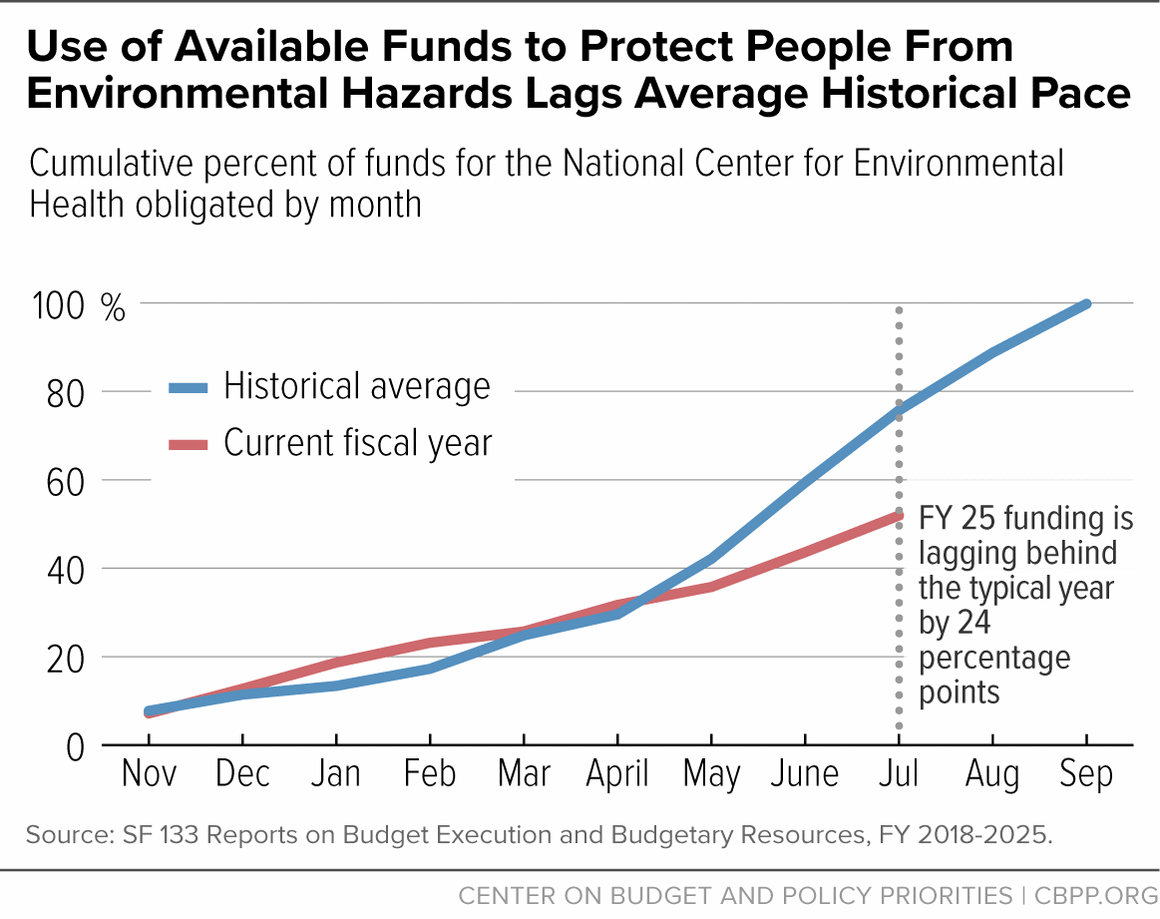
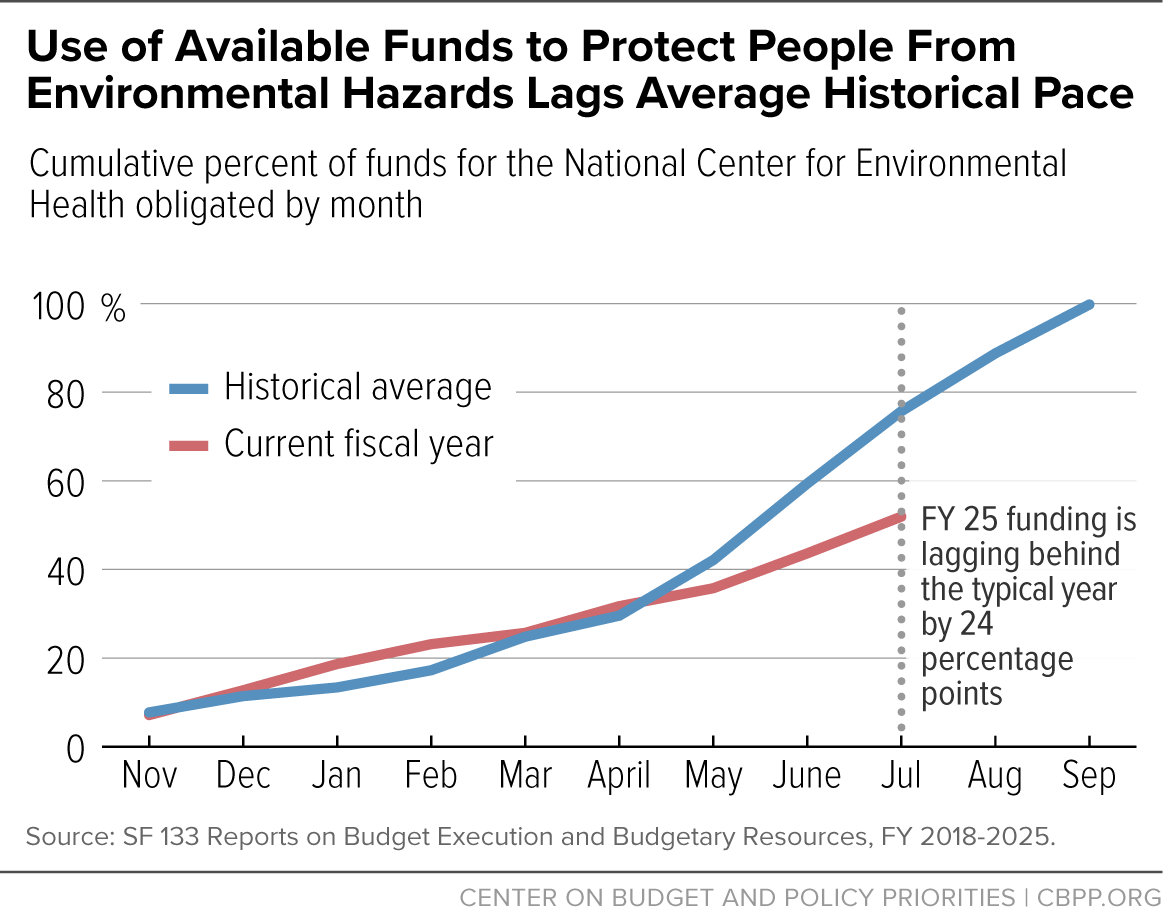
At CDC’s National Center for HIV, Viral Hepatitis, STD, and Tuberculosis Prevention — which develops prevention strategies and treatment for the nation’s most prevalent infectious diseases — obligations of the $1.4 billion Congress appropriated for 2025 were 12 percentage points ($167 million) behind the historical account average. For the National Center for Environmental Health, charged with reducing childhood lead exposure and other toxins, spending and commitments of 2025 funds lagged the typical year by nearly a quarter (23.8 percentage points) of available funding. (See Figure 1.)
Similarly, at the Substance Abuse and Mental Health Services Administration’s Mental Health account — which funds suicide prevention and mental health crisis response efforts — 2025 obligations at the end of July trailed a typical year by nearly 35 percentage points, leaving the account $860 million behind what would have been expected.
The Administration’s large delays in the use of 2025 funding for health research and public health programs mirror the Administration’s 2026 budget proposals targeting these same agencies and programs for massive cuts. The budget proposes to slash NIH funding — long a bipartisan funding priority — next year by roughly 40 percent and cut billions from CDC and SAMHSA.[21]
Small Agencies Targeted for Elimination
In a March 14 executive order, President Trump made clear his intent to eliminate the Department of Commerce’s Minority Business Development Agency (MBDA) and the Institute for Museum and Library Services (IMLS).[22] The spending data show that the Administration has sought to freeze funding for these programs through illegal impoundments.

MBDA’s Minority Business Development account had obligated less than a quarter of its funding (roughly $16 million) through July, 36 percentage points behind its historical average at that point in the year. (See Figure 2.) In IMLS’s Grants and Administration account, obligations of its $312 million appropriation lagged the average historical pace by 25 percentage points. On June 16, GAO concluded that the Administration had unlawfully impounded funds at IMLS.[23]
Foreign Assistance Funding, in Preparation for an Illegal Unilateral Rescission
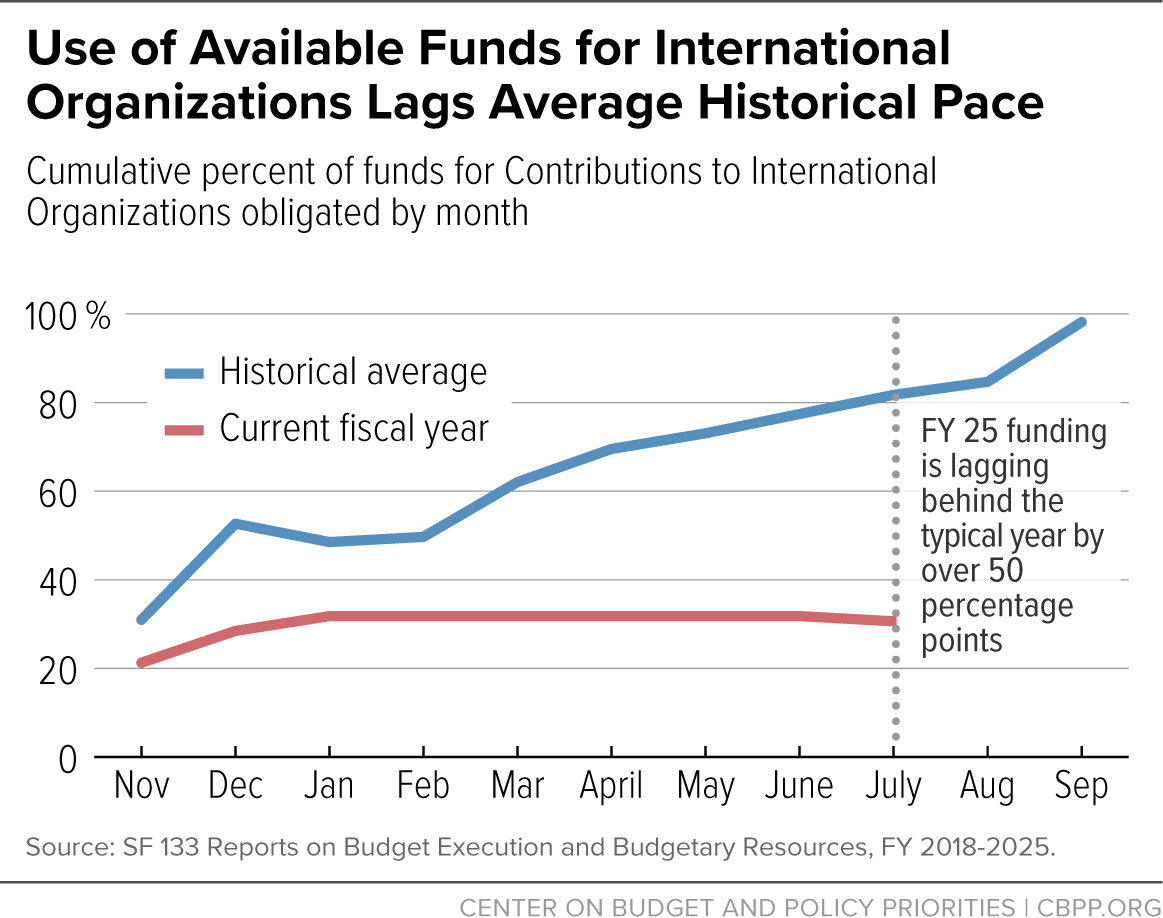
Since taking office in January, President Trump has asserted a broad and unprecedented authority to dismantle foreign affairs agencies and freeze related funding. On February 4, he issued an executive order blocking funding to several international organizations.[24] In March, Congress appropriated $1.5 billion to the State Department for its Contributions to International Organizations account as part of the year-long continuing resolution, which President Trump signed. By the end of July, however, less than one-third (30.6 percent) of the $1.5 billion appropriation had been obligated — more than 50 percentage points below the historical average. (See Figure 3.)


Meanwhile, in late May the Administration sent Congress a fast-track proposal to rescind $169 million from the account, which the President signed into law on July 24.[25] And on August 28, the Administration announced its intention to unilaterally rescind an additional $530 million from the account, regardless of whether Congress approves the cut, as part of its illegal “pocket rescission” proposal.[26]
The data show that from January to July, the Trump Administration obligated no additional funds for the account, revealing just how blatantly the Administration had been withholding the funding long before it transmitted its rescission requests to the Congress — an illegal impoundment.
Conclusion
The newly released data through July show that the Trump Administration significantly delayed 2025 funding even beyond those programs and accounts included in the illegal unilateral pocket rescission proposal it has put forward. These delays are concentrated in programs the Administration has targeted for severe cuts or elimination, which suggests an intentional effort to impound the funding.
With 2025 funds set to expire at the end of September, there is little time for the Administration to course-correct and spend these resources as required by law. And as Congress attempts to reach a 2026 funding agreement, the data through July emphasize the need for such an agreement to include enforceable provisions to prevent the Administration from illegally delaying or restricting funding enacted by Congress. If the Administration’s actions go unchecked by Congress, it could take a far broader approach to illegal impoundments in 2026. Overall, the Administration’s budget requests $167 billion less in funding for non-defense appropriated programs in 2026 than were provided by the 2025 funding agreement — and billions less in areas like cancer research, education, clean water, and other critical priorities than is likely to be approved in a bipartisan 2026 funding agreement.[27]
| TABLE 1 | ||||
|---|---|---|---|---|
Accounts Lagging Historical Obligation Rates by More than 20 Percentage Points Through July | ||||
| Share of Funds Obligated Through July 2025 | Difference from Historical Average (pp) | Amount Below Historical Average ($M) | Had a Restrictive Footnote | |
| Contributions to International Organizations Department of State | 31% | -51 | $789 | Y |
| International Fisheries Commissions Department of State | 44% | -45 | $30 | Y |
| Chemical Agents and Munitions Destruction, Defense Department of Defense | 36% | -45 | $11 | |
| CDC-wide Activities and Program Support Department of Health and Human Services | 19% | -43 | $271 | |
| Minority Business Development Department of Commerce | 24% | -36 | $25 | * |
| Mental Health Department of Health and Human Services | 39% | -35 | $860 | Y |
| Substance Abuse Prevention Department of Health and Human Services | 12% | -33 | $79 | Y |
| Family Planning Department of Health and Human Services | 50% | -32 | $92 | Y |
| Higher Education Department of Education | 14% | -32 | $1,011 | Y |
| Operations and Support Department of Homeland Security | 42% | -32 | $86 | |
| Research and Education Activities Department of Agriculture | 48% | -32 | $261 | Y |
| Integrated Research, Education, and Extension Competitive Grants Department of Agriculture | 4% | -32 | $10 | |
| East-West Center Department of State | 70% | -30 | $7 | Y |
| Ryan White HIV/AIDS Program Department of Health and Human Services | 50% | -29 | $105 | Y |
| Refugee and Entrant Assistance Department of Health and Human Services | 19% | -28 | $14 | Y |
| Substance Abuse Treatment Department of Health and Human Services | 26% | -26 | $1,081 | Y |
| Office of Museum and Library Services, Grants and Administration Institute of Museum and Library Services | 64% | -25 | $78 | Y |
| Injury Prevention and Control Department of Health and Human Services | 30% | -24 | $184 | Y |
| Environmental Health Department of Health and Human Services | 52% | -24 | $46 | |
| National Institute of Nursing Research Department of Health and Human Services | 58% | -23 | $46 | Y |
| National Institute of Alcohol Abuse and Alcoholism Department of Health and Human Services | 48% | -22 | $133 | Y |
| Chronic Disease Prevention and Health Promotion Department of Health and Human Services | 54% | -22 | $259 | Y |
| National Human Genome Research Institute Department of Health and Human Services | 53% | -22 | $152 | Y |
| Healthcare Research and Quality Department of Health and Human Services | 52% | -21 | $81 | Y |
Source: SF 133 Reports on Budget Execution and Budgetary Resources, FY 2024 and FY 2025, accessed on September 16, 2025. Data reflects "one-year" funding in non-financing accounts with budgetary resources greater than $15 million (i.e., provided in fiscal year 2025 and available for obligation until September 30, 2025), by TAFS with a more than -20 percentage points difference between the July 2025 execution rate and the historical July execution rate; “Share of funds obligated through July 2025” reflects new obligations and upward adjustments (line 2190) divided by total budgetary resources (line 2500); "Difference from historical average" compares the percentage point difference between the share of funds obligated through July 2025 in the FY 2025 SF 133 to the share of funds obligated in July in the FY 2013-2024 SF 133s, averaged; Amount below historical average reflects total budgetary resources (line 2500) multiplied by the difference from the historical average; "Had a restrictive footnote" means that the account had a category A footnote in an OMB apportionment that conditioned the availability of funds on an agreed-upon spend plan between the agency and OMB and that the contents of that plan were binding on the agency's ability to obligate funds. * reflects that the Minority Business Development account had not yet received an apportionment following the March spending law as of September 15, 2025. | ||||
End Notes
[1] Joe Carlile most recently served as Associate Director for General Government Programs at the Office of Management and Budget during the Biden Administration. Prior to that, he was a Senior Advisor to the Secretary at the Department of Housing and Urban Development and spent over 13 years working on the House Committee on Appropriations.
[2] For example, the Administration has attempted to terminate programs supported by the $27 billion Greenhouse Gas Reduction Fund. Rachel Jacobson, “EPA Announces Termination of $7 Billion in Grants to States, Tribes, and Territories to Bring Solar Energy to Low-Income Households,” CBPP, August 7, 2025, https://www.cbpp.org/research/federal-budget/executive-action-watch?item=30254.
[3] Brendan Duke et al., “2026 Appropriations Must Protect Against Further Partisan Cuts and Illegal Withholding of Funds,” CBPP, September 4, 2025, CBPP, https://www.cbpp.org/research/federal-budget/2026-appropriations-must-protect-against-further-partisan-cuts-and-illegal.
[4] For example, for over 100 accounts, the Administration made apportioned funds available only on approval of spending plans that are hidden from public view, obscuring the conditions placed on approval and the timing of when funds were actually made available to agencies. Devin O’Connor and Joe Carlile, “Trump Administration Abused Spending Safeguards to Advance Its Agenda — and Illegally Hid Its Actions,” CBPP, September 5, 2025, https://www.cbpp.org/research/federal-budget/trump-administration-abused-spending-safeguards-to-advance-its-agenda-and.
[5] House Committee on Appropriations, “Weeks Away from End of Fiscal Year, Trump is Blocking $410+ Billion in Funding Owed to Communities Nationwide,” September 8, 2025, https://democrats-appropriations.house.gov/weeks-away-end-fiscal-year-trump-blocking-410-billion-funding-owed-communities-nationwide.
[6] This analysis looks at discretionary, non-financing, single-year accounts expiring on September 30, 2025 available in SF-133: Reports on Budget Execution and Budgetary Resources data through July 31, 2025, accessed on September 16, 2025. Obligation rates were calculated by dividing cumulative obligations (Line 2190) for July by total budgetary resources (Line 2500). The obligation rates were compared against the July obligation-rate calculations from historical SF-133 data for fiscal years 2014-2024. The analysis encompasses 308 single-year discretionary accounts — defense and non-defense — totaling $992.3 billion in resources. In fiscal years 2014 through 2024, an average of 79.9 percent of all single-year discretionary budgetary resources were obligated (committed to grant recipients, contracts, or grant agreements by agencies) by July 31. In 2025, the Trump Administration has obligated 77.3 percent, or 2.6 percentage points less than the historical average. The Administration’s obligation rate in 2025 lags each of the two previous presidential transition years: 80.2 percent in 2021 (-2.9 percentage points) and 78.2 percent in 2017 (-0.8 percentage points).
[7] For example, the analysis only partially captures the nearly $5 billion in congressionally approved foreign aid funding that the Administration has publicly declared it intends to withhold until expiration, regardless of congressional action, through a so-called “pocket rescission.” Catie Edmondson, “Defying Congress, Trump Moves to Cut $4.9 Billion in Foreign Aid,” New York Times, August 29, 2025, https://www.nytimes.com/2025/08/29/us/politics/trump-foreign-aid.html.
[8] This analysis also might not capture all funding that was initially provided or committed to recipients before the Administration engaged in a series of grant and contract terminations without cause. For example, by one estimate, through early September over $2.3 billion in awarded National Institutes of Health grant funding had been pulled back through terminations. In those cases, it is often unclear whether those cancelled funds have been re-awarded or recorded as unobligated. And it does not fully capture 2025 funding that may be at risk of late-in-the-year impoundment efforts, particularly among programs that typically use most of their funding in the last two months of the fiscal year and so are unlikely to have diverged from previous spending patterns to a large degree prior to those months. See: “Weekly Terminated NIH Grants Report,” Grant Witness, September 3, 2025, https://grant-witness.us/reports.html.
[9] Edda Emmanuelli Perez, “B-337137, U.S. Department of Transportation, Federal Highway Administration—Application of the Impoundment Control Act to Memorandum Suspending Approval of State Electric Vehicle Infrastructure Deployment Plans,” GAO, May 22, 2025, https://www.gao.gov/assets/880/877916.pdf.
[10]Henry Larweh, Rachana Pradhan, and Rae Ellen Bichell, “Blue States That Sued Kept Most CDC Grants, While Red States Feel Brunt of Trump Clawbacks,” KFF Health News, August 26, 2025, https://kffhealthnews.org/news/article/cdc-grant-trump-clawbacks-blue-red-state-comparison/.
[11] Department of Energy, “Secretary Wright Announces Termination of 24 Projects, Generating Over $3 Billion in Taxpayer Savings,” May 30, 2025, https://www.energy.gov/articles/secretary-wright-announces-termination-24-projects-generating-over-3-billion-taxpayer; David Hart and Maximillian Hoppold, “Trump’s Energy Innovation Retreat Is a Win for China, Loss for Climate,” Council on Foreign Relations, September 8, 2025, https://www.cfr.org/expert-brief/trumps-energy-innovation-retreat-win-china-loss-climate. The Office of Clean Energy Demonstrations reported obligations of less than $800 million in the first six months after President Trump took office, compared with roughly $3.9 billion in the previous six months.
[12] Hannah Marr, “20 states sue DHS, FEMA for cuts to disaster mitigation program,” CBS News, July 17, 2025, https://www.cbsnews.com/news/states-sue-dhs-fema-cuts-disaster-mitigation-program/; Department of Homeland Security, “FEMA Ends Wasteful, Politicized Grant Program, Returning Agency to Core Mission of Helping Americans Recovering from Natural Disasters,” April 4, 2025, https://web.archive.org/web/20250407135920/https://www.fema.gov/press-release/20250404/fema-ends-wasteful-politicized-grant-program-returning-agency-core-mission.
[13] Jon Brodkin, “Can we please keep our broadband money, Republican governor asks Trump admin,” Ars Technica, September 10, 2025, https://arstechnica.com/tech-policy/2025/09/can-we-please-keep-our-broadband-money-republican-governor-asks-trump-admin/.
[14]For example, obligations in funding from the Department of Labor’s Veterans Employment and Training and the Department of Health and Human Services’ Rural Health accounts were in-line with historical trends through July.
[15] There were 24 accounts — roughly 6 percent of all accounts — provided with at least $15 million in “one-year” funding in 2025 through annual appropriations (i.e., the funding will expire if unobligated after September 30, 2025).
[16] Carolyn Y. Johnson and Joel Achenbach, “NIH reels with fear, uncertainty about future of scientific research,” Washington Post, March 5, 2025, https://www.washingtonpost.com/science/2025/03/05/nih-trump-turmoil-grants/; Katherine Wu, “How Many Times Can Science Funding Be Canceled?” Atlantic, August 6, 2025, https://www.theatlantic.com/health/archive/2025/08/nih-funding-whiplash/683773/; O’Connor and Carlile.
[17] GAO, “B-337203, Department of Health and Human Services—National Institutes of Health—Application of Impoundment Control Act to Availability of Funds for Grants,” August 5, 2025, https://www.gao.gov/assets/890/880607.pdf.
[18] Megan Molteni, Anil Oza, and J. Emory Parker, “NIH is on track to spend its entire budget,” STAT, September 12, 2025, https://www.statnews.com/2025/09/12/nih-spending-47-billion-budget/.
[19] Erin Schumaker and Ruth Reader, “NIH’s ‘forward-funding scheme,’” Politico, June 11, 2025, https://www.politico.com/newsletters/future-pulse/2025/06/11/nih-forward-funding-scheme-00398712.
[20] Mary Kekatos, Cheyenne Haslett, and Youri Benadjaoud, “Mass layoffs, resignations and major vaccine policy changes: Timeline of turmoil at CDC,” ABC News, August 28, 2025, https://abcnews.go.com/Health/mass-layoffs-resignations-major-vaccine-policy-timeline-turmoil/story?id=125056783.
[21] Niamh Ordner, “NIH budget cuts threaten the future of biomedical research — and the young scientists behind it,” Los Angeles Times, July 6, 2025, https://www.latimes.com/science/story/2025-07-06/nih-budget-cuts-threaten-the-future-of-medical-research-and-young-scientists; Rachel Gold and Julia Ingram, “HHS budget proposal eliminates CDC’s chronic disease, global health centers in favor of new ‘MAHA’ agency,” CBS News, June 10, 2025, https://www.cbsnews.com/news/hhs-budget-proposal-cdc-chronic-disease-global-health-maha-agency/; Elana Gordon and David Ovalle, “SAMHSA has fought drug and mental health crises. Now it’s in crisis itself,” Washington Post, June 19, 2025, https://www.washingtonpost.com/health/2025/06/19/samhsa-addiction-mental-health-cuts/.
[22] White House, “Continuing the Reduction of the Federal Bureaucracy,” March 14, 2025, https://www.whitehouse.gov/presidential-actions/2025/03/continuing-the-reduction-of-the-federal-bureaucracy /.
[23] GAO, “Institute of Museum and Library Services—Applicability of the Impoundment Control Act to Reduction of Agency Functions,” June 16, 2025, https://www.gao.gov/products/b-337375.
[24] White House, “Withdrawing the United States From and Ending Funding to Certain United Nations Organizations and Reviewing United States Support to All International Organizations,” February 4, 2025, https://www.whitehouse.gov/presidential-actions/2025/02/withdrawing-the-united-states-from-and-ending-funding-to-certain-united-nations-organizations-and-reviewing-united-states-support-to-all-international-organizations /.
[25] White House, “Proposed Rescissions of Budgetary Resources,” May 28, 2025, https://www.whitehouse.gov/wp-content/uploads/2025/03/Proposed-Rescissions-of-Budgetary-Resources.pdf; Rescissions Act of 2025, H.R. 4, https://www.congress.gov/bill/119th-congress/house-bill/4.
[26] Catie Edmondson, “Defying Congress, Trump Moves to Cut $4.9 Billion in Foreign Aid,” New York Times, August 29, 2025, https://www.nytimes.com/2025/08/29/us/politics/trump-foreign-aid.html.
[27] Duke et al. The $167 billion excludes additional non-defense funds provided in the megabill, primarily for Homeland Security.