

2026 Appropriations Must Protect Against Further Partisan Cuts and Illegal Withholding of Funds
Fiscal year 2026 begins in less than a month, on October 1. Congress routinely finalizes funding levels for the roughly one-quarter of the federal budget funded by annual appropriations only after the fiscal year begins, and 2026 will be no exception. What is exceptional about the fiscal 2026 appropriations process is that the Trump Administration has repeatedly undermined last March’s bipartisan appropriations law, covering fiscal 2025, both by working with congressional Republicans to claw back funds using a partisan rescission process and by bypassing Congress to illegally impound funds. And in late August, the Trump Administration announced it will, for the first time ever, misuse the Impoundment Control Act to illegally withhold funding until it expires, whether Congress acts or not.[1]
Congressional negotiators must assume that, given the chance, the Trump Administration will repeat this kind of sabotage of any appropriations deal reached for 2026 — taking away Congress’s constitutional authority to set funding levels. In fact, the Administration has claimed powers that would allow it to implement much of its own proposed budget by unilaterally reducing funding levels set through bipartisan appropriations law to the levels it put forward in its recommendations to Congress. In a little-noticed change to federal budget guidance, the Administration has paved the way for these attacks on Congress’s spending authority to continue and intensify.[2] This could allow the Administration to implement, for example, its proposed cut of over 40 percent in medical research, which Congress would be unlikely to enact in appropriations legislation. It is therefore vital that any 2026 funding deal includes enforceable legislative provisions to ensure that the money provided by Congress reaches, in full, the people and services for which Congress appropriated it.
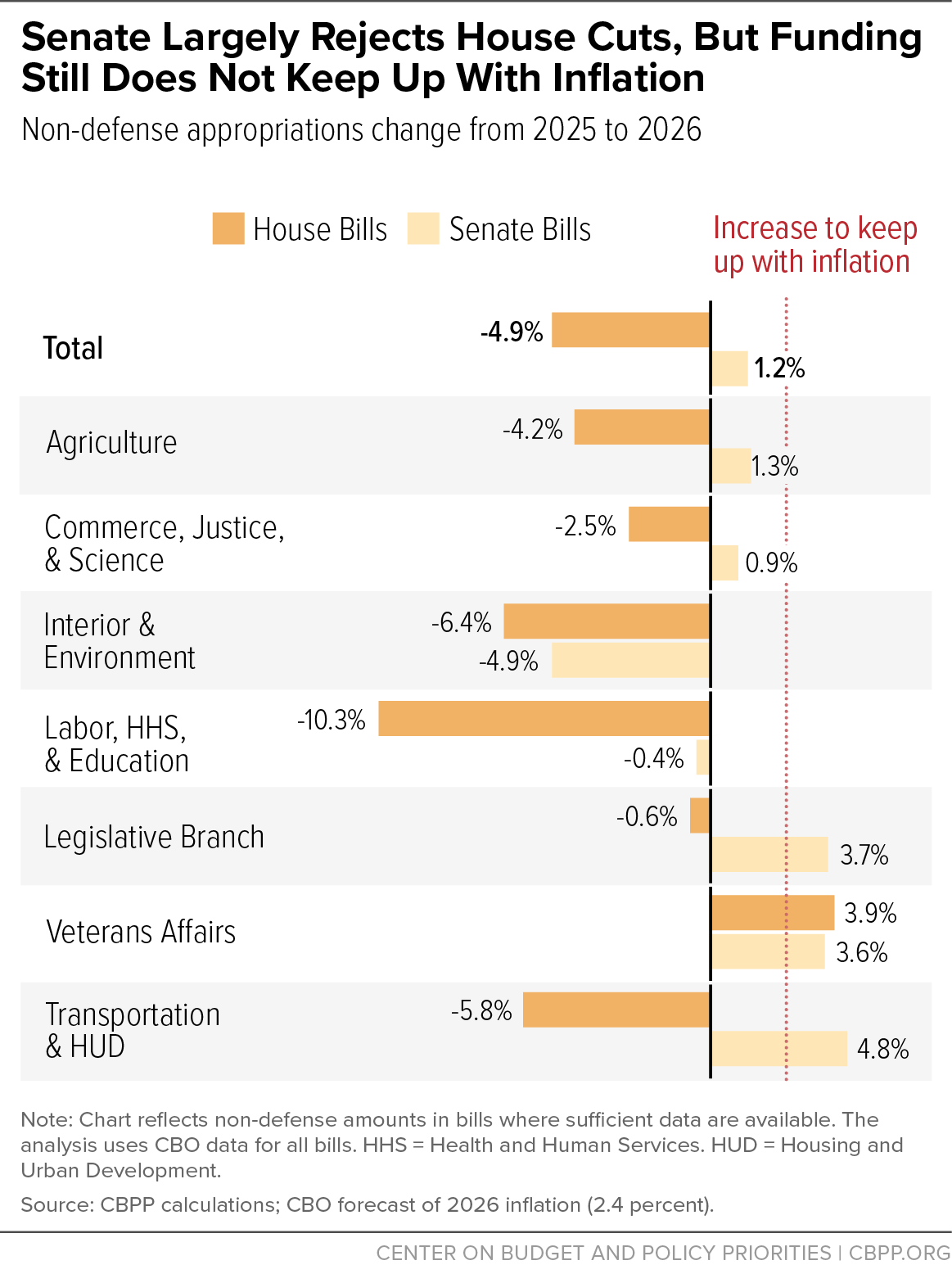
Funding for non-defense appropriated programs has fallen in recent years, with 2025 funding at its lowest inflation-adjusted level since 2017. Nonetheless, President Trump’s 2026 budget proposes extremely deep cuts to non-defense funding relative to 2025 levels. The House appears to be adopting the Administration’s approach of emphasizing cuts, although on a smaller scale; the Senate has mostly rejected deep cuts, though its modest increases mostly wouldn’t keep up with inflation.
Given that bipartisan support is required for appropriations bills to pass the Senate because such bills are subject to a filibuster, any agreement on appropriations bills or continuing resolutions that become law could well avoid deep cuts in most areas. But the Administration’s actions to date suggest that it is likely to pursue its desired cuts even after a bipartisan agreement is reached through illegal impoundment, partisan rescission bills, and unlawful unilateral rescissions at the end of the fiscal year, undermining the conditions for reaching such an agreement in the first place. It has employed these tools since taking office to go back on the bipartisan 2025 appropriations deal that the President signed in March:
- For the first time ever on a partisan basis, the Administration used the Impoundment Control Act’s expedited process to rescind, with just 51 Republican votes in the Senate, funding that originally required the approval of at least 60 senators.[3]
- Since January, the Administration has repeatedly — and illegally — blocked or delayed lawfully provided funding for a range of programs it opposes, ranging from health research to education to disaster preparedness.[4]
- And last week the Administration deployed an illegal maneuver, which it has called a “pocket rescission,” to unilaterally withhold nearly $5 billion of funding for foreign assistance programs, and declared that it would hold the funds until they expire, regardless of any action Congress takes on the rescission request.[5]
Because of these acts by the Administration, no 2026 appropriations law — even one that seemingly avoids the most devastating cuts the President proposed in his 2026 budget — would be worth the paper it is written on unless Republicans join with Democrats to include necessary, enforceable legislative safeguards and credibly commit to protecting the agreements reached in a funding deal. If the Administration and congressional Republicans do not provide those enforceable safeguards and commitments, they will bear the responsibility for making a bipartisan funding deal impossible to achieve, and for potentially triggering a government shutdown.
Trump Budget and House Republican Funding Bills Include Deep Cuts, Senate Bipartisan Bills Reject This Approach
The discretionary portion of the federal budget — the part of the budget where Congress has the legal authority (discretion) to decide funding levels each year through the annual appropriations process — funds many critical national priorities.[6] The largest is national defense, but areas outside of defense include health care for veterans, aid to school districts educating students with disabilities or from families with low incomes, research on cures to cancer, and more. Programs such as Social Security and Medicare are called mandatory programs; the laws that determine their funding are developed outside of the annual appropriations process.[7]
The 2026 Trump budget requested a freeze in defense funding relative to 2025 (though overall defense spending would rise, given the funding provided in the Republican megabill enacted in July, which cuts taxes for the wealthy and makes deep cuts to basic needs programs[8]) and a $167 billion (nearly 22 percent) cut in non-defense discretionary funding (excluding the additional non-defense funds provided in the megabill, primarily for Homeland Security).[9] Some of the largest proposed cuts would occur in areas such as foreign aid, the Environmental Protection Agency, the Centers for Disease Control, the National Institutes of Health, the National Science Foundation, K-12 and higher education, and Housing Choice Vouchers.[10]
The House and Senate delayed work on 2026 appropriations bills until after passage of the Republican megabill. The House Appropriations Committee has set a 2026 funding level for non-defense programs that is $37 billion below the current 2025 level[11] and has passed all 12 funding bills out of committee or subcommittee, two of which have passed the full House. The Senate Appropriations Committee has not yet agreed on an overall funding level but has passed eight bills through the committee process, three of which have been adopted on the floor. While action in the House has been mostly partisan, the Senate process has been bipartisan.

We cannot compare overall non-defense funding levels, given that the Senate has not yet released its total. But we have enough data for seven House and Senate bills to make basic comparisons (see Figure 1), and they show a clear pattern: the House bills call for significant cuts in non-defense appropriations, though smaller than the President proposed, while the Senate bills call for very modest increases, overall by less than is needed just to keep pace with inflation.[12] Only for the Veterans Affairs and Interior bills are the House and Senate funding levels mostly in sync. For the seven bills overall, representing about three-quarters of non-defense funding, the House calls for a cut of $30 billion or 4.9 percent from the 2025 level (without adjusting for inflation), while the Senate calls for a nominal increase of $7 billion or 1.2 percent.
Purchasing Power of Non-Defense Programs Already at Lowest Levels in Years
Funding for non-defense programs has been constrained over the past decade and half, most recently following the 2023 Fiscal Responsibility Act.[13] The current 2025 level is below the 2024 level even without adjusting for inflation and at its lowest inflation-adjusted level since 2017.
While veterans’ medical care has received substantial funding increases over the past 15 years, other non-defense discretionary programs have seen a large, multi-year reduction in their purchasing power as a result of rising prices and a growing population. Adjusted for inflation and population growth, non-defense appropriations for 2025 outside veterans’ medical care have fallen nearly 10 percent below the levels President Trump signed in December 2019, prior to the COVID-19 pandemic. (See Figure 2.)


Administration’s Illegal Funding Freezes and Deferrals, Partisan Rescissions, Unprecedented Attempt at Unilateral Rescissions Impede Future Agreements
The inability of the House, Senate, and President to agree on appropriations levels even as the start of the fiscal year approaches has been typical in recent years. But it is now occurring against a backdrop that is anything but typical. With little pushback from congressional Republicans and at times with their direct support, the President has repeatedly undermined last March’s bipartisan funding agreement.
Partisan Rescissions Undercut Bipartisan Appropriations Deal
Earlier this summer, the Administration worked with Republicans in Congress to claw back $9.0 billion in funding for foreign aid and public broadcasting that had largely been provided just a few months earlier in the bipartisan appropriations agreement that became law in March.[14] That agreement, providing full-year funding for fiscal year 2025, required at least eight Democratic senators to join with 52 Republican senators to invoke cloture. But enactment of the Administration’s rescission package required merely 51 Senate Republican votes.
The use of partisan rescissions votes effectively transforms a traditionally bipartisan appropriations negotiation that sets funding levels for each program into a process that sets funding ceilings, leaving only one side — the Administration and congressional Republicans — free to break the deal later on by cutting below those levels if they choose. This would render bipartisan compromises to arrive at an agreement meaningless, as members of Congress would face the prospect of voting on a funding deal without knowing what level of funding their votes would ultimately provide.
Concretely, this means that a partisan process can cut funding for education, medical research, or transportation that was included as bipartisan compromise legislation.
Administration Has Also Illegally Blocked Funding
In addition, the Administration has repeatedly flouted bipartisan funding agreements by blocking appropriated funds from being spent, a process known as impoundment. The nonpartisan Government Accountability Office (GAO) and federal courts have determined that these impoundments are illegal.[15] Yet the Administration continues to withhold funding in a range of programs, jeopardizing investments in schools, early education, cutting-edge medical and scientific research, weather monitoring and disaster resilience, and other critical national priorities.
Even in those cases in which funds have eventually been released, the delays have caused prolonged uncertainty and real consequences for families and communities. For example, an unprecedented delay in releasing Department of Education funding at the beginning of this school year created havoc for school districts across the country.[16]
Administration Is Seeking to Unilaterally Cancel Funding
The Administration is set on trying to unlawfully impound funds through whatever means it can until the funds expire at the end of the fiscal year. Indeed, last week the Administration escalated its unilateral impoundment of funds by publicly declaring it would, through a so-called “pocket rescission,” intentionally cause $4.9 billion in congressionally appropriated foreign aid funding to expire at the end of September regardless of any action taken by Congress.[17] Office of Management and Budget (OMB) Director Russell Vought has claimed that a President, by sending a formal rescission request to Congress to eliminate funds with fewer than 45 days remaining before expiration and then withholding those funds until they expire, can unilaterally cancel funds.[18] This is clearly illegal, and the first time that a President has sought to misuse the Impoundment Control Act to violate the Constitution by cancelling funds unilaterally without congressional action.
The Administration claims to be unconstrained in its ability to deploy such pocket rescissions, meaning Congress should assume the Administration will attempt to use them for any future appropriations as well. In August, OMB quietly changed longstanding government-wide guidance to agencies on budget execution to claim an ability to unilaterally rescind funds and delay funding for policy reasons. Both claims are inconsistent with statutory requirements and relevant judicial case law and would rob Congress of a large part of its constitutional spending power.
In fact, when Congress voted to give the President a more limited authority to unilaterally reduce funding through the Line Item Veto Act in the 1990s, the Supreme Court held it unconstitutional, whereas here the Trump Administration is making a more radical claim about its executive authority in the complete absence of statutory authority.
The Administration’s use of these tactics means that Republicans must work with Democrats in Congress to include enforceable provisions preventing these abuses, or risk being responsible for no funding deal being reached at all.
Funding for Critical Programs at Risk
The Trump Administration’s actions to date render the traditional purpose of the appropriations process — to establish how much the Administration must spend on a given program for the coming year — moot because the Administration asserts that appropriations levels are a ceiling, not a prescribed funding level. In other words, the Administration is arguing that Congress can appropriate funding for any area — a defense program, K-12 funding, food safety inspections, homeland security — and the Administration can then simply choose not to spend some or all of the funds Congress has provided.
The Administration’s actions over the course of 2025 make clear that its proposed 2026 appropriations levels remain important even if Congress passes and the President signs legislation providing higher funding, since the Administration may use some combination of legal rescissions, illegal impoundments, and illegal unilateral rescissions at the end of the fiscal year to achieve those funding levels. Without credible and enforceable assurances that the Administration will carry out the appropriations laws as enacted, there is little reason to be confident that more reasonable funding levels — such as some in the Senate bills or even continuing 2025 levels — will hold.
In the key programs below, the Administration has not only proposed deep cuts in 2026 funding but also blocked, delayed, or otherwise interfered with current 2025 funding:
- Medical research. The President’s 2026 budget cuts the budget of the National Institutes of Health (NIH) by 41 percent, to $27.7 billion.[19] The Senate Appropriations Committee Labor-HHS-Education bill provides a 0.9 percent increase over the 2025 level, while the House Appropriations subcommittee bill makes a cut of 0.9 percent for NIH. Predictable funding for medical research is essential to long-term advances in health care; even a short delay in funding can set research back years. Yet for 2025 the Administration has attempted to freeze billions of dollars for life-saving NIH research; significantly delayed the awarding of funds for Alzheimer’s, diabetes, cancer, and other important medical research; and illegally terminated hundreds of NIH grants.[20] Actions like these led GAO to find that the Administration had violated the Impoundment Control Act by unlawfully blocking spending. With its claim to have unilateral rescission authority, the Administration could simply eliminate NIH funding provided by Congress, instead setting funding at its proposed level.
K-12 education. The President’s budget cuts the Department of Education by 15 percent relative to 2025, as does the House bill. The Senate bill, in contrast, mostly holds education funding steady. For example, in K-12 education the President’s budget consolidates 18 education grant programs, including for after-school and summer programs, English language learning support, teacher professional development, and tutoring programs, into one block grant and cuts funding by more than two-thirds, from $6.5 billion to $2 billion. The House takes a different approach to K-12 funding, cutting Title I, funds that support schools serving families with low incomes, by almost $5 billion or 25 percent. The Senate bill holds funding for most K-12 programs at their 2025 levels.
While state and local governments provide the large majority of K-12 funding, federal support is crucial. It will be even more important in coming years because the Republican megabill imposes substantial new costs on already stressed state and local government finances (through its cuts in federal Medicaid and food assistance funding going to states), raising the risk that states will cut education funding or be unable to make up for federal cuts.[21]
At the same time, as part of its broader attempt to eliminate the Department of Education, the Administration has blocked and undermined education funding enacted for 2025. Earlier this year the Administration illegally withheld $6.2 billion in K-12 funding, relenting only in the face of significant media and congressional attention and court challenges.[22]
Wherever funding lands in an appropriations bill, left unchecked, the Administration may claim the authority to simply rescind education funds to reduce funding to its preferred level.
- Home energy assistance for low-income households. The President’s budget eliminates in 2026 the Low-Income Home Energy Assistance Program (LIHEAP), which provides heating and cooling assistance to 6 million low-income households to help prevent utility shutoffs. The President also attempted to zero out LIHEAP in his first term. In addition, in April the Administration made clear its intention to do away with LIHEAP by firing the entire staff.[23] The Senate bill provides $4.0 billion for LIHEAP, a 0.5 percent increase above the 2025 level. The House bill provides a smaller increase of 0.25 percent above the 2025 level. (Due to limited funding, LIHEAP currently aids only one-sixth of eligible households.) Here too, the Administration could claim authority to cut or even eliminate LIHEAP funding.
- Social Security Administration (SSA) customer service. The President’s budget freezes SSA’s customer service budget in 2026, which would be the third straight year of flat funding — a real cut in SSA resources after accounting for increasing costs. The Senate bill proposes a $99 million or 0.8 percent increase. The House bill, like the President’s budget, holds funding steady. The Trump Administration proposal to lock in an SSA customer service budget and staffing levels that are roughly a quarter lower than 15 years ago — even as the number of Social Security beneficiaries has grown by nearly 187 million — would be problematic.[24] The Administration has also taken a number of damaging steps at SSA this year despite flat funding, including deep staff cuts, new restrictions on SSA services, and reduced transparency — as well as potentially dangerous mismanagement of SSA data and systems.[25]
Other important programs facing large potential funding cuts from the Administration and/or House Republicans, which the Senate has partly or entirely rejected, include:
Nutrition assistance for new and expecting parents and young children. The Special Supplemental Nutrition Program for Women, Infants, and Children (WIC) provides a science-based food benefit that helps ensure that low-income families with young children can afford the foods they need for a healthy diet. The WIC funding levels in the House 2026 Agriculture Appropriations bill and the President’s budget would break Congress’s nearly 30-year commitment to provide enough funding to serve all eligible families who seek support from WIC and to provide full benefits. The House bill also starts the process laid out in the President’s budget to slash WIC’s science-based fruit and vegetable benefit for more than 5 million participants.[26] The Senate bill, in contrast, provides $8.2 billion for WIC, maintaining the commitment to provide full benefits to all eligible families who seek support from WIC.
The Administration has already made unilateral cuts to other child nutrition programs. For example, it cancelled the bipartisan Farm-to-School Grant program, which helps public schools buy produce from local farmers.[27]
Clean water projects. The EPA’s Clean Water State Revolving Fund (CWSRF) and Drinking Water State Revolving Fund (DWSRF) provide funds to states and territories to help finance water infrastructure projects, such as replacing lead pipes and improving wastewater facilities, to help ensure public water systems comply with safe drinking water standards and promote public health. The House Interior Appropriations bill cuts CWSRF by 26 percent and DWSRF by 21 percent below their 2025 levels; the President’s budget cuts the funds by 91 percent and 87 percent, respectively. The Senate bill holds funding steady at the 2025 levels ($1.6 billion for CWSRF and $1.1 billion for DWSRF).
The Administration has also given reason to believe that it will not spend appropriated funds for clean water in 2026, having already attempted to withhold funding for a variety of EPA grant programs, including those for clean water projects.[28]
Rental assistance. Federal rental assistance helps roughly 10 million people — struggling seniors, people with disabilities, veterans, and working families — keep a roof over their heads, often by helping them afford rental units they find in the private market. The House Transportation and Housing Appropriations bill would result in about 411,000 fewer people receiving Housing Choice Vouchers. It also cuts funding for public housing by nearly $1.5 billion (about 17 percent), reducing the maintenance and repairs needed to protect residents’ health and safety. The Senate bill’s funding levels are higher but would still cut public housing by $410 million (about 5 percent) and result in about 243,000 fewer people receiving vouchers. Housing Choice Vouchers are tied to rental costs so require additional funding each year to continue assisting the same number of people; only about a quarter of those who are eligible receive vouchers due to limited funding.[29]
Neither bill includes the President’s budget proposal to replace existing rental assistance programs, including public housing and housing vouchers, with a new state-based formula grant that would receive 43 percent less funding. The Administration has already attempted to place new conditions on existing grants to states and localities that support housing and transportation needs. It also continues to withhold funding for investigating housing [30]
In all of these cases, absent enforceable requirements that the Administration will follow the law as written, there is a significant risk that the Administration (with the support of congressional Republicans) will seek to impose its preferred harmful policies through other means even if Congress enacts adequate funding levels. These reckless actions have created an environment in which it is difficult to reach a bipartisan funding deal, because no member of Congress has any assurance that the funding they are voting for will, indeed, be spent by the Administration.
But Congress can act to curb the Administration’s illegal actions and prohibit partisan deal-breaking to restore the ability of lawmakers to reach a true bipartisan agreement. It could take steps to speed up the distribution of funding and take away executive branch discretion that has been repeatedly abused by the Administration to slow spending. It could strengthen the penalties when the Administration engages in illegal impoundments. It could prohibit partisan rescissions in funding provided through bipartisan funding legislation. And it could limit the Administration’s politicization of the grantmaking process and improve transparency to aid in oversight and public pushback. Enacting these changes will require bipartisan support. Without them, it is hard to see how Congress can reach a bipartisan budget agreement and avert a damaging government shutdown.
End Notes
[1] Devin O’Connor and Sam Berger, “Trump Administration’s New Spending Cuts Package Is Clearly Illegal,” CBPP, August 29, 2025, https://www.cbpp.org/research/federal-budget/executive-action-watch?item=30256. While the Trump Administration has cited rare instances of rescission proposals from decades ago that were submitted late in the fiscal year, in none of those cases did an administration claim an ability to unilaterally rescind funding. See: Cerin Lindgrensavage and William Ford, “Past Pocket Rescissions Are Not Precedents for Power Vought Claims,” Lawfare, August 15, 2025, https://www.lawfaremedia.org/article/past-pocket-rescissions-are-not-precedents-for-power-vought-claims.
[2] The Trump Administration amended the Office of Management and Budget (OMB)’s Circular A-11 — providing guidance to agencies on budget formulation and execution — to assert a broad authority to engage in unilateral cancellations of funding at the end of fiscal years, as well as an expansive power to freeze funding for policy reasons. Both assertions are inconsistent with the law and relevant judicial opinions. See OMB, “Circular No. A–11, Preparation, Submission, and Execution of the Budget, Section 112 – Deferrals and Presidential Proposals to Rescind or Cancel Funds,” August 2025, https://www.whitehouse.gov/wp-content/uploads/2025/08/a11.pdf; Paul Krawzak, “White House budget guidance asserts more authority on rescissions,” CQ, September 1, 2025, https://plus.cq.com/doc/news-8311865?5&utm_medium=newsletter&utm_source=btmorning.
[3] Devin O’Connor, Sam Berger, and Jacob Leibenluft, “Trump Rescission Proposal Builds on Illegal Impoundments, Would Undermine Future Funding Deals,” CBPP, July 10, 2025, https://www.cbpp.org/research/federal-budget/trump-rescission-proposal-builds-on-illegal-impoundments-would-undermine.
[4] Devin O’Connor and Jacob Leibenluft, “Deferral Requests Would Be Another Tactic in the Trump Administration’s Illegal Strategy to Withhold Congressionally Approved Funding,” CBPP, August 5, 2025, https://www.cbpp.org/research/federal-budget/deferral-requests-would-be-another-tactic-in-the-trump-administrations.
[5] David Super and Sam Berger, “‘Pocket Rescissions’ Are Illegal,” CBPP, July 30, 2025, https://www.cbpp.org/research/federal-budget/pocket-rescissions-are-illegal; Jennifer Scholtes and Kyle Cheney, “White House declares $4.9B in foreign aid unilaterally canceled in end-run around Congress’ funding power,” Politico, August 29, 2025, https://www.politico.com/news/2025/08/29/trump-asks-congress-to-claw-back-5b-in-foreign-aid-amid-threat-of-pocket-cancellation-00535396.
[6] CBPP, “Policy Basics: Non-Defense Discretionary Programs,” updated December 19, 2024, https://www.cbpp.org/research/federal-budget/non-defense-discretionary-programs.
[7] While some mandatory programs are funded by annual appropriations, their actual costs are determined by the mandates in their authorizing legislation, not by the funding levels in the appropriations bills.
[8] See https://www.cbpp.org/research/resource-lists/resources-on-harmful-republican-megabill for CBPP analyses related to the bill.
[9] In this analysis, all dollar figures for non-defense discretionary funding represent a topline total that best shows regular, ongoing funding. For a more detailed discussion of topline calculations, see the Appendix of David Reich and Richard Kogan, “Congress Should Reject Proposals to Cut Non-Defense Program Funding,” CBPP, March 8, 2023, https://www.cbpp.org/research/federal-budget/congress-should-reject-proposals-to-cut-non-defense-program-funding. The 2025 levels include the rescissions enacted in July (P.L. 119-28).
[10] Sharon Parrott, “Trump’s Budget Plan Continues Agenda of Hurting Those He Pledged to Help,” CBPP, May 2, 2025, https://www.cbpp.org/press/statements/trumps-budget-plan-continues-agenda-of-hurting-those-he-pledged-to-help.
[11] House Appropriations Committee Chairman Cole claimed a $45 billion reduction, but that was before $7.9 billion of 2025 funding and $0.5 billion of 2026 funding were rescinded (in P.L. 119-28). House Committee on Appropriations - Republicans, “Committee Approves Updated FY26 Subcommittee Allocations,” July 17, 2025, https://appropriations.house.gov/news/press-releases/committee-approves-updated-fy26-subcommittee-allocations. We also adjust the Chairman’s $45 billion figure to reflect small methodological differences between how we and Chairman Cole calculate toplines for non-defense appropriations. See footnote 9 for more detail.
[12] This analysis uses CBO data for all bills.
[13] See Figure 2 in David Reich, “Non-Defense Funding Will Continue to Erode Under Current Funding Caps,” CBPP, May 16, 2024, https://www.cbpp.org/research/federal-budget/non-defense-funding-will-continue-to-erode-under-current-funding-caps.
[14] The $9.0 billion rescission comprised $7.9 billion in foreign aid funding that was available in 2025 and two enacted advance appropriations, one to become available in 2026 and the other in 2027, for the Corporation for Public Broadcasting.
[15] For a few examples, see GAO, “B-337137: U.S. Department of Transportation, Federal Highway Administration—Application of the Impoundment Control Act to Memorandum Suspending Approval of State Electric Vehicle Infrastructure Deployment Plans,” May 22, 2025, https://www.gao.gov/assets/880/877916.pdf; GAO, “B-337203: Department of Health and Human Services—National Institutes of Health—Application of Impoundment Control Act to Availability of Funds for Grants,” August 5, 2025, https://www.gao.gov/products/b-337203; Katherine Tully-McManus, “Trump-backed judge rules administration’s withholding of funds illegal,” Politico, August 11, 2025, https://www.politico.com/news/2025/08/11/judge-administrations-withholding-funds-illegal-00504650.
[16] Juan Perez Jr., Eric He, and Andrew Atterbury, “‘None of us were worrying about this’: Trump’s latest school money move has state authorities scrambling,” Politico, July 2, 2025, https://www.politico.com/news/2025/07/02/trump-school-money-state-authorities-scrambling-00436737.
[17] Josh Boak, “Trump blocks $4.9B in foreign aid Congress OK’d, using maneuver last seen nearly 50 years ago,” Associated Press, August 29, 2025, https://www.washingtonpost.com/politics/2025/08/29/trump-foreign-aid-pocket-rescission/86374dd0-84df-11f0-a8f4-28ba053d904b_story.html.
[18] Tony Romm, “White House Eyes Rarely Used Power to Override Congress on Spending,” New York Times, June 17, 2025, https://www.nytimes.com/2025/06/17/us/politics/trump-vought-congress-spending-rescission.html.
[19]Funding levels described in the examples are nominal and not adjusted for inflation.
[20] O’Connor and Leibenluft; Jacqueline Howard, “Uncertainty around NIH funding leaves Alzheimer’s studies in limbo,” CNN, April 24, 2025, https://www.cnn.com/2025/04/24/health/alzheimers-research-nih-funding/.
[21] Wesley Tharpe, “Shifting Federal Costs for Food Assistance, Health Care, Other Priorities to States Would Cause Widespread Harm,” CBPP, April 9, 2025, https://www.cbpp.org/blog/shifting-federal-costs-for-food-assistance-health-care-other-priorities-to-states-would-cause.
[22] Collin Binkley and Annie Ma, “Education Department says it will release billions in remaining withheld grant money for schools,” Associated Press, July 25, 2025, https://apnews.com/article/trump-education-freeze-school-grants-released-gop-f9ac79dd44595fc9d8a3c72609cb5574.
[23] Brad Plumer, “Entire Staff Is Fired at Office That Helps Poorer Americans Pay for Heating,” New York Times, April 2, 2025, https://www.nytimes.com/2025/04/02/climate/trump-layoffs-energy-assistance-liheap.html.
[24] Social Security Administration, “Covered Workers and Beneficiaries — 2025 OASDI Trustees Report,” https://www.ssa.gov/oact/TR/2025/lr4b3.html.
[25] Kathleen Romig and Devin O’Connor, “Reassignment Won’t Fix the Largest-Ever Social Security Staffing Cut,” CBPP, June 23, 2025, https://www.cbpp.org/research/social-security/reassignment-wont-fix-the-largest-ever-social-security-staffing-cut; Kathleen Romig, “Nearly 2 Million More People Will Need to Visit Social Security Offices Under Revised Policy,” CBPP, May 2, 2025, https://www.cbpp.org/blog/nearly-2-million-more-people-will-need-to-visit-social-security-offices-under-revised-policy.
[26] Ty Jones Cox, “Senate Fully Funds WIC But Serious Threats to Nutrition Aid Remain,” CBPP, July 30, 2025, https://www.cbpp.org/blog/senate-fully-funds-wic-but-serious-threats-to-nutrition-aid-remain.
[27] Unlike other funding cancellations, this action was legal. Marcia Brown, “USDA moves to cancel $5 million in farm-to-school funding,” Politico, March 24, 2025, https://subscriber.politicopro.com/article/2025/03/usda-cancels-5-million-in-farm-to-school-funding-00246482.
[28] Michael Phillis, Alexa St. John, and Matthew Daly, “Democrats say EPA illegally canceled hundreds of grants aimed at boosting ‘environmental justice,’” Associated Press, March 25, 2025, https://apnews.com/article/epa-zeldin-environmental-justice-grants-diversity-equity-ddbcedb1c7d1c3c3f310abaf4044446c.
[29] Sonya Acosta and Erik Gartland, “House Bill Would Leave Over 400,000 More People Without Stable, Affordable Housing,” CBPP, July 31, 2025, https://www.cbpp.org/research/housing/house-bill-would-leave-over-400000-more-people-without-stable-affordable-housing.
[30] Tim Henderson, “More cities, counties join immigrant sanctuary lawsuit seeking to block Trump funding cuts,” Stateline, July 9, 2025, https://stateline.org/2025/07/09/more-cities-counties-join-immigrant-sanctuary-lawsuit-seeking-to-block-trump-funding-cuts/.