

Gross Domestic Product: What It Is and What It Isn’t
When we ask how the economy is doing, it is important to center people, who are at the heart of the economy. People work jobs, run businesses, buy goods, and make the rules of doing business — the economy is a means to an end and that end is to provide for the needs of people. We all contribute to and participate in the economy in some fashion.
This makes the question of how the economy is doing extremely important, but also complicated. With so many people involved in so many different ways, there is no perfect way to capture everyone’s experience. There are a variety of indicators that consumers, businesses, and policymakers can use to understand what’s happening in the broader economy. But when economists are forced to rely on a single indicator, they tend to use gross domestic product (GDP) — the sum of all economic activity in a particular place and time.
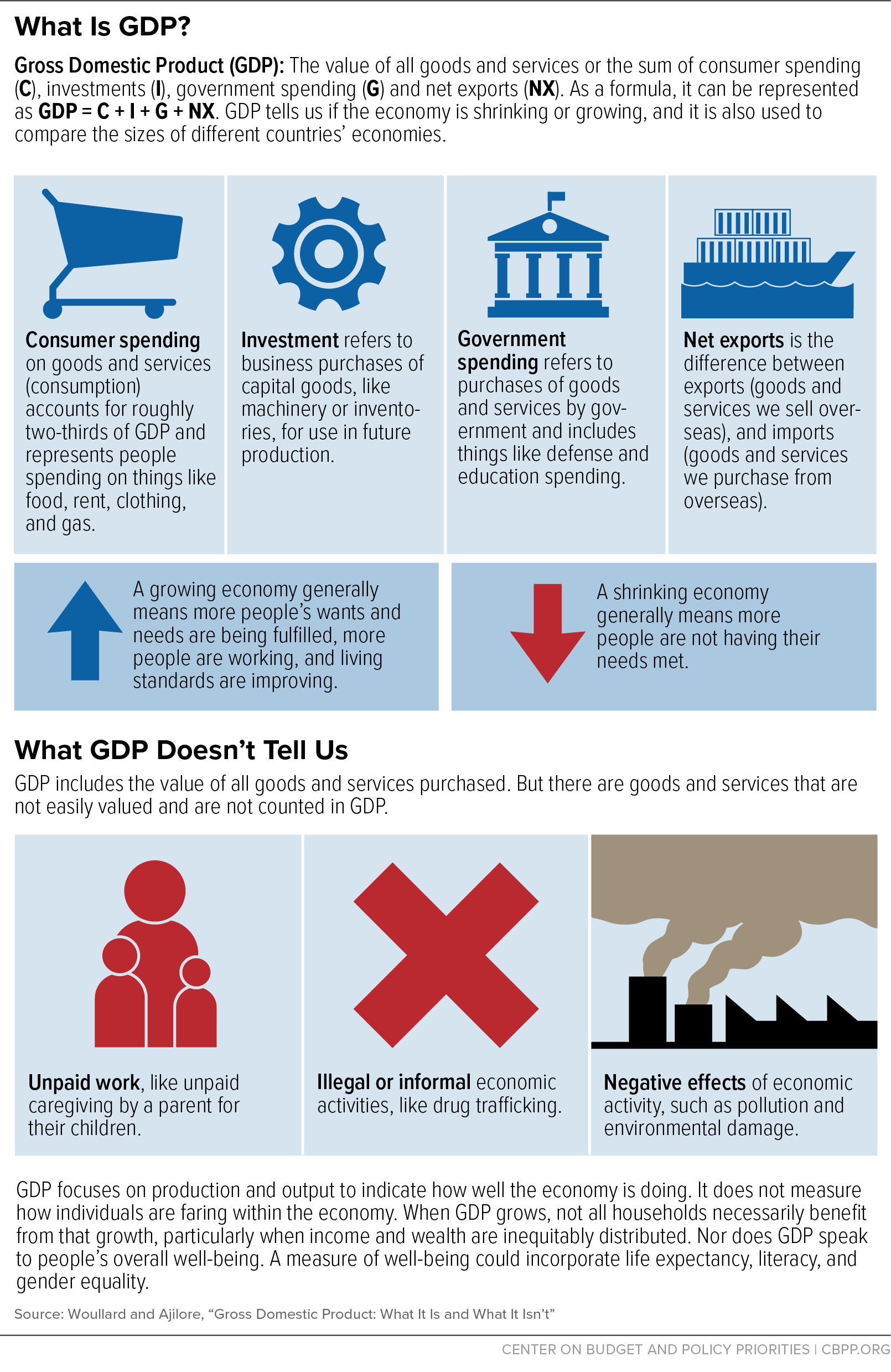
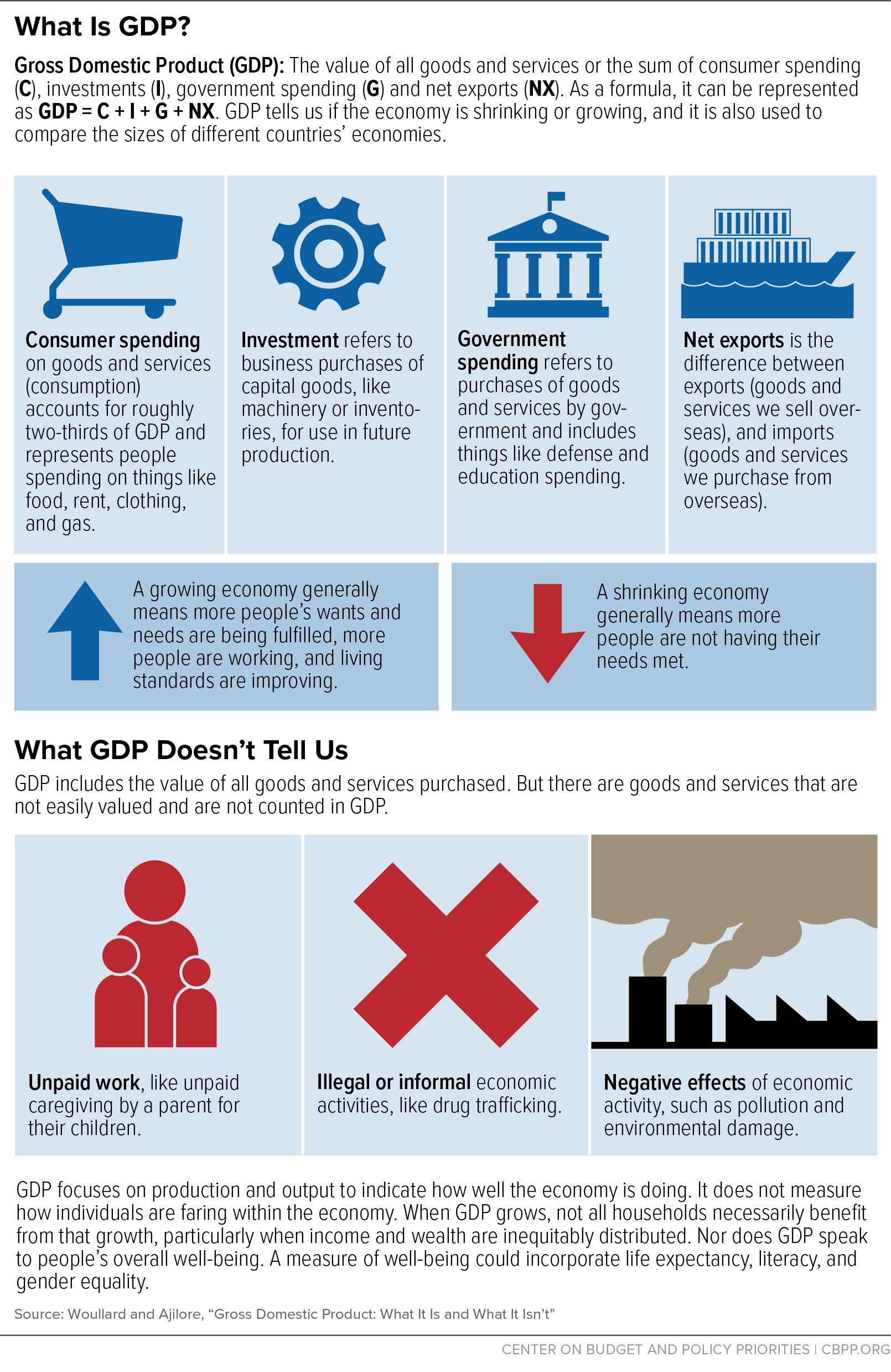
GDP can be viewed as an economic health indicator, as its change over time represents the change in the size of the economy. GDP tells us if the economy is shrinking or growing, and it is also used to compare the sizes of different countries’ economies. A growing economy generally means more people’s wants and needs are being fulfilled, more people are working, and living standards are improving. A shrinking economy generally means more people are not having their needs met. But as with any single indicator, there are limits to what it can tell us about the well-being of the people behind the number.
What Is Gross Domestic Product (GDP)?
GDP is defined as the value of all goods and services (or the sum of consumer spending), investment, government spending, and net exports. (See Figure 1.) Consumer spending on goods and services (consumption) accounts for roughly two-thirds of GDP and represents people spending on things like food, rent, clothing, and gas. Investment refers to business purchases of capital goods, like machinery or inventories, for use in future production. Investment also includes consumer spending on residential housing, including the construction of new single- and multi-family homes. Government spending refers to purchases of goods and services by government and includes things like defense and education spending. The final component of GDP is net exports, which is the difference between exports, or goods and services we sell overseas, and imports, or goods and services we purchase from overseas. Net exports are also referred to as a nation’s trade balance. Exports add to GDP, because they are produced domestically but purchased abroad, while imports decrease GDP, because the purchase of items produced abroad are already captured in the other categories of spending.
How Is GDP measured?
In the United States, GDP is estimated by the Bureau of Economic Analysis (BEA) using detailed data from the Economic Census (which happens every five years) and a combination of methods including business survey data for other years.[1]
Since GDP is the value of goods and services, changes in GDP from year to year reflect both changes in the amount of goods and services produced and changes in the price of those goods and services. Nominal GDP uses current prices, and so does not distinguish between changes in production or prices. So, if nominal GDP rises, it could be due to an increase in production, or it could reflect an increase in prices or inflation — or some combination of both.
The BEA adjusts GDP data for inflation using various price indices, like the consumer price index or the producer price index. When GDP is adjusted for inflation, it is called real GDP. Because it removes the effects of prices, a change in real GDP isolates the effects of production, making it a better measure for assessing the health of the economy.
In addition, it can be helpful to control for population when comparing across countries, as one country may have a larger GDP simply because it has a larger population, not because it has greater production. Per-capita GDP is total GDP divided by population and gives the average GDP per person. While some use per-capita GDP as a proxy for how well people within a country are doing, it can be misleading in highly unequal economies. Because per-capita GDP is an average, it is likely not a good indicator of how much the typical person is sharing in a country’s prosperity when income and wealth are concentrated.
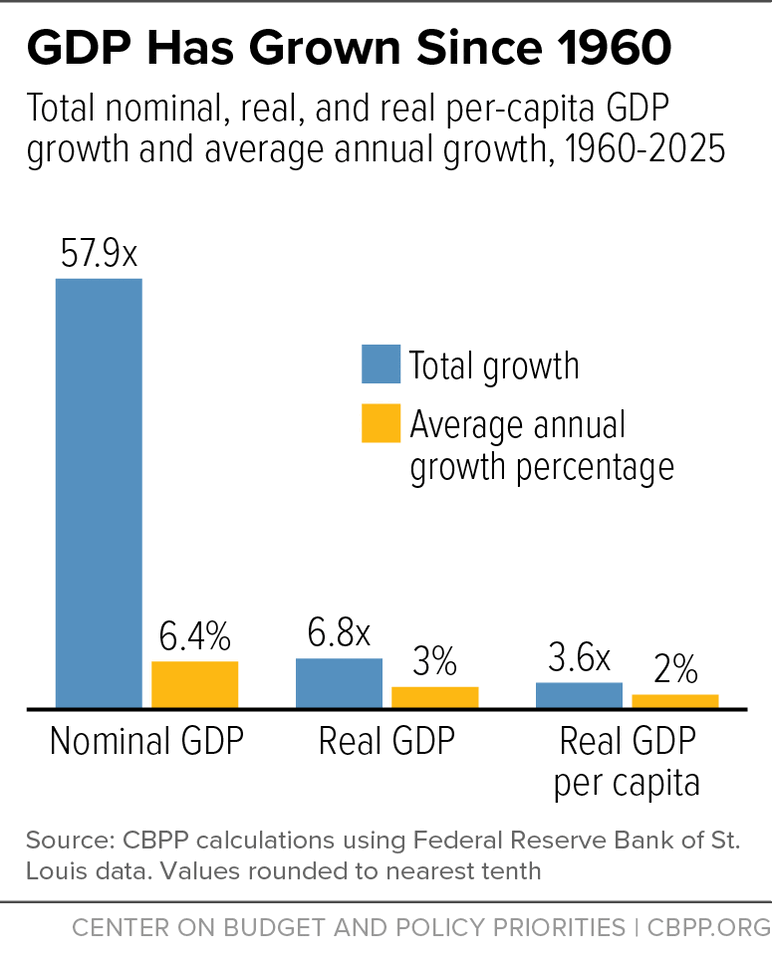
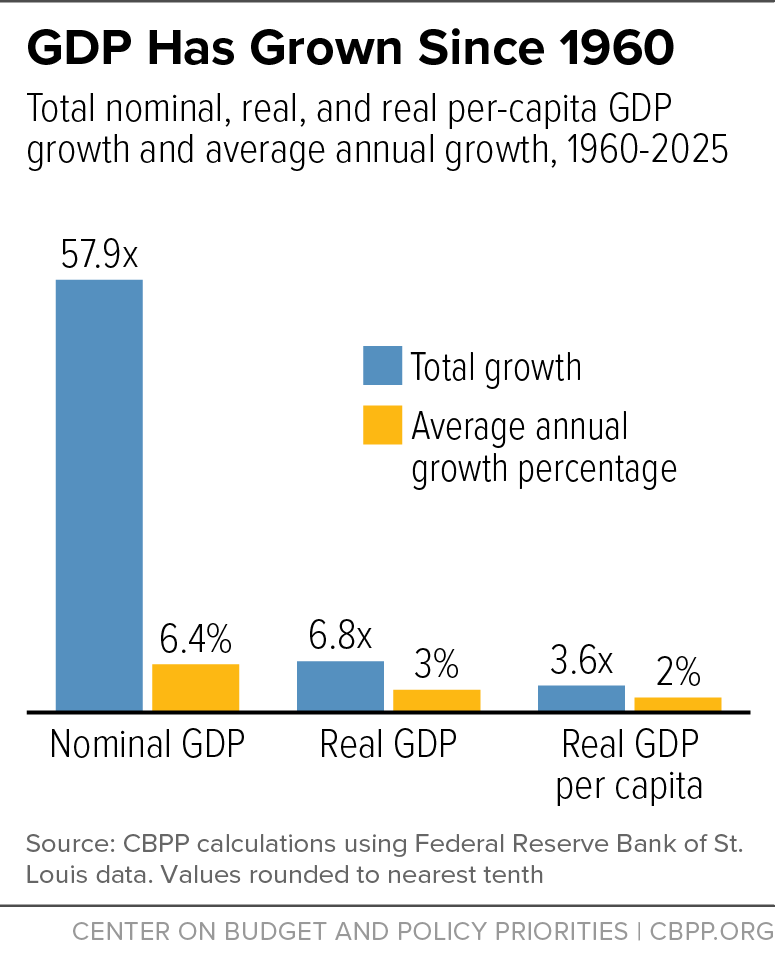
As shown in Figure 2, GDP has grown over time. Nominal GDP has shown the greatest amount of growth though that includes rising prices. Accounting for inflation, real GDP has averaged 3 percent growth per year over the last 65 years, and per-person growth, as measured by per-capita GDP, has averaged around 2 percent per year.
Business Cycles and Recessions
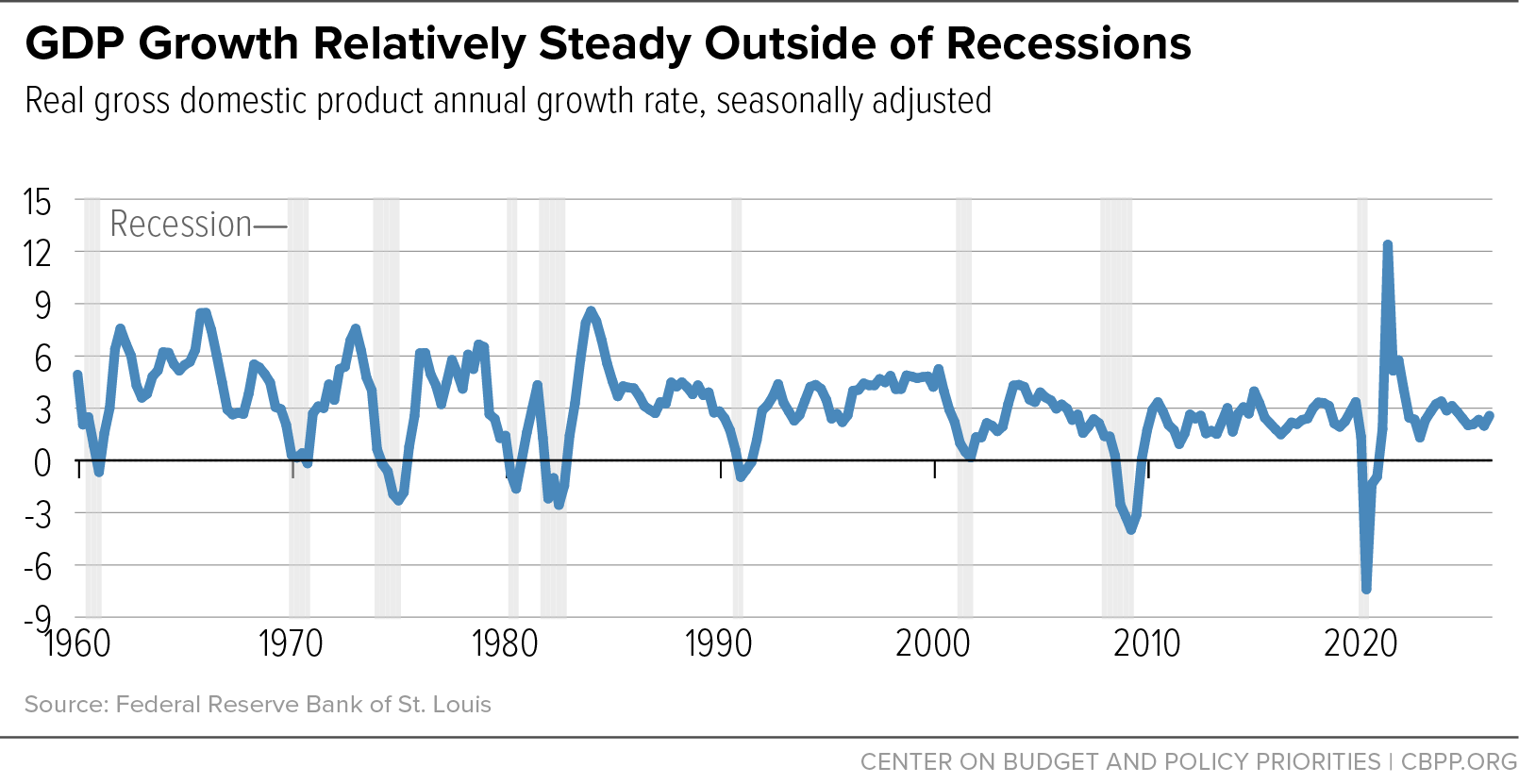
The economy is driven by the behavior of individual consumers and businesses interacting in markets that operate subject to regulation (or deregulation) by government. This activity creates cycles of booms when the economy is surging, and busts when the economy is faltering; economists refer to this as the business cycle. (See Figure 3.) Formally, the National Bureau of Economic Research (NBER) Business Cycle Dating Committee monitors the path of each business cycle and, as part of that duty, officially determines when a recession occurs. Generally, when GDP declines for at least two consecutive quarters, a recession has occurred. But the NBER committee uses a variety of measures to make its determination, including non-farm payroll employment, real personal consumption expenditures, and industrial production, to get a fuller picture of economic activity.
During a recession, GDP falls and unemployment rises, which can have profound human and economic costs.[2] In a recession, people lose jobs, businesses lose revenue and may end up shuttering, and state and local finances diminish due to the erosion of the local tax base.[3] Unemployment carries serious human costs as families are less able to afford the basics, like food, shelter, and health care.[4] Recessions can have long-lasting, even permanent, harmful impacts on households and communities. Wage losses persist after recessions,[5] and areas with large job losses during a recession tend to experience persistent declines in employment and population in subsequent years as compared to communities that fared better during the downturn[6].
Policymakers have tools at their disposal that, if employed quickly and judiciously, can effectively mitigate the harm caused by an economic downturn and speed up a recovery. The tools to combat a recession fall under one of two categories: monetary policy and fiscal policy.

Monetary policy refers to tools the Federal Reserve Board (Fed) uses to achieve its dual mandate of price stability and full employment.[7] The primary tool that the Fed uses is the federal funds rate, which is the rate at which banks borrow from and lend to one another on overnight loans. By lowering the rate, the Fed makes borrowing less expensive, providing an incentive for businesses and consumers to borrow and spend, thereby spurring demand for goods and services.
Fiscal policy refers to the higher spending or lower taxes, or both, that the federal government uses to shore up households’ and businesses’ demand for goods and services and stimulate the economy during a recession. In addition to supporting the economy, some fiscal policies, like expanded food or health assistance, directly address the financial hardship families face as result of job loss and fewer hours worked.
What Is Not in GDP and Why That Matters
GDP includes the value of all goods and services purchased. But there are goods and services that are not easily valued and are not counted in GDP. For instance, economic activity like unpaid work, such as a parent caring for a child at home, is not counted, since it is not traded in the marketplace and therefore is difficult to value in the calculation of GDP.[8] Similarly, illegal or informal economic activities are not counted. This means that GDP as a measure of output is missing non-market activities that occur in the economy, leading to an undercount.
On the other hand, some negative effects of economic activity, such as pollution and other environmental damage or the depletion of finite natural resources, are not taken out of GDP and can result in GDP overstating the value of certain economic activity.
GDP focuses on production and output to indicate how well the economy is doing. It does not speak to how individuals are faring within the economy. When GDP grows, not all households are necessarily benefiting from that growth, particularly when income and wealth are inequitably distributed. Nor does it speak to people’s well-being overall.[9] A measure of well-being could incorporate life expectancy, literacy, and gender equality.
Other indicators attempt to rectify these shortcoming, like the United Nation’s Human Development Index,[10] which incorporates dimensions like life expectancy, education, and standard of living; the Organization for Economic Cooperation and Development’s Better Life Index,[11] which looks across different factors affecting well-being that include income and wealth, but also extend to areas such as housing, social connections, environmental quality, health, and safety; and the World Happiness Report,[12] which relies on a self-assessed life evaluation.
GDP is an important indicator that measures the output of a given country and is useful to measure changes over time and compare across countries. But it is important to understand there are limitations of GDP as a measure of the economy and economic activity and of the well-being of the people in the economy.
End Notes
[1] J. Steven Landefeld, Eugene P. Seskin, and Barbara M. Fraumeni, “Taking the Pulse of the Economy: Measuring GDP,” Journal of Economic Perspectives, Vol. 22, No. 2, 2008, https://www.bea.gov/sites/default/files/methodologies/jep_spring2008.pdf.
[2] Gbenga Ajilore, “With Economic Risks High, Here are Three Facts to Remember About Recessions,” CBPP, April 17, 2025, https://www.cbpp.org/blog/with-economic-risks-high-here-are-three-facts-to-remember-about-recessions.
[3] Brendan Duke, “Emerging Tax and Budget Bill Flunks Basic Rules for Fighting Recessions,” CBPP, April 24, 2025, https://www.cbpp.org/blog/emerging-tax-and-budget-bill-flunks-basic-rules-for-fighting-recessions.
[4] Joe Peck, “Quantifying the Costs of Rising Unemployment,” WorkRise, November 2023, https://workrisenetwork.org/sites/default/files/2023-11/quantifying-costs-rising-unemployment.pdf.
[5] Kevin Rinz, “Did Timing Matter? Life Cycle Differences in Effects of Exposure to the Great Recession,” Journal of Labor Economics, Vol. 40, No. 3, July 2022, https://www.journals.uchicago.edu/doi/10.1086/716346.
[6] Brad Hershbein and Bryan Stuart, “The Evolution of Local Labor Markets after Recessions,” AEJ: Applied Economics, Vol. 16, No. 3, July 2024, https://www.aeaweb.org/articles?id=10.1257/app.20220132.
[7] Malik Woullard and Gbenga Ajilore, “Inflation: Key Measures to Understand,” CBPP, January 16, 2026, https://www.cbpp.org/research/economy/inflation-key-measures-to-understand.
[8] Bureau of Economic Analysis, “Why isn’t household production included in GDP?” April 16, 2018, https://www.bea.gov/help/faq/1297.
[9] For an analysis of GDP’s shortcomings, see Joseph E. Stiglitz, Jean-Paul Fitoussi, and Martine Durand, “Beyond GDP: Measuring What Counts for Economic and Social Performance,” Organization for Economic Cooperation and Development (OECD), November 27, 2018, https://www.oecd.org/en/publications/beyond-gdp_9789264307292-en.html.
[10] United Nations Development Program, “Human Development Index,” https://hdr.undp.org/data-center/human-development-index#/indicies/HDI.
[11] OECD Well-being Data Monitor, “Better Life Index,” https://www.oecd.org/en/data/tools/well-being-data-monitor/better-life-index.html.
[12] John F. Helliwell et al., “World Happiness Report 2026,” World Happiness Report, March 11, 2026, https://www.worldhappiness.report/.