

MÁS ALLÁ DE LOS NÚMEROS
Upcoming Tax Reform Bill Should Address Over 650,000 Children in Veteran Families Who Are Left Out of Full Child Tax Credit
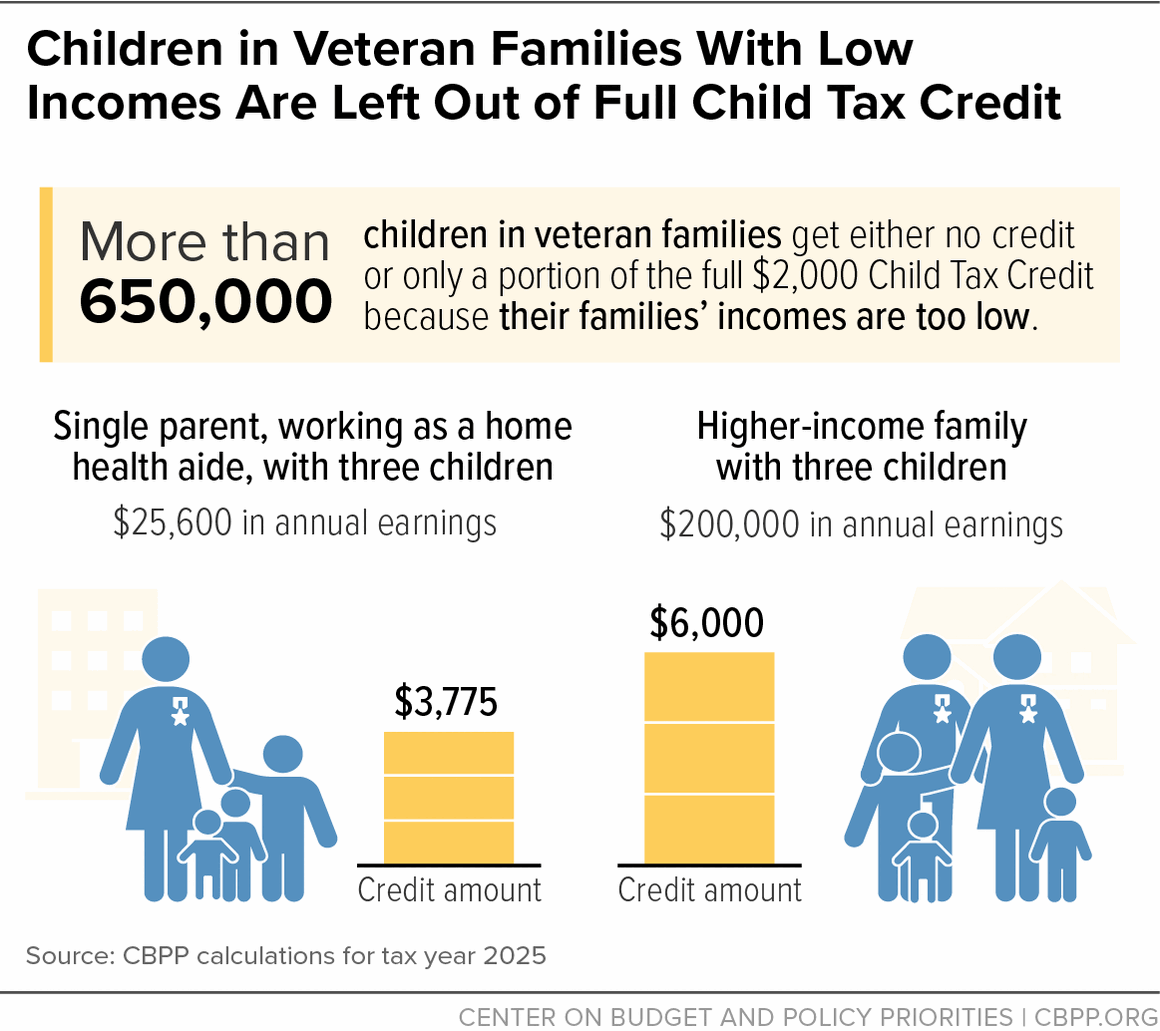
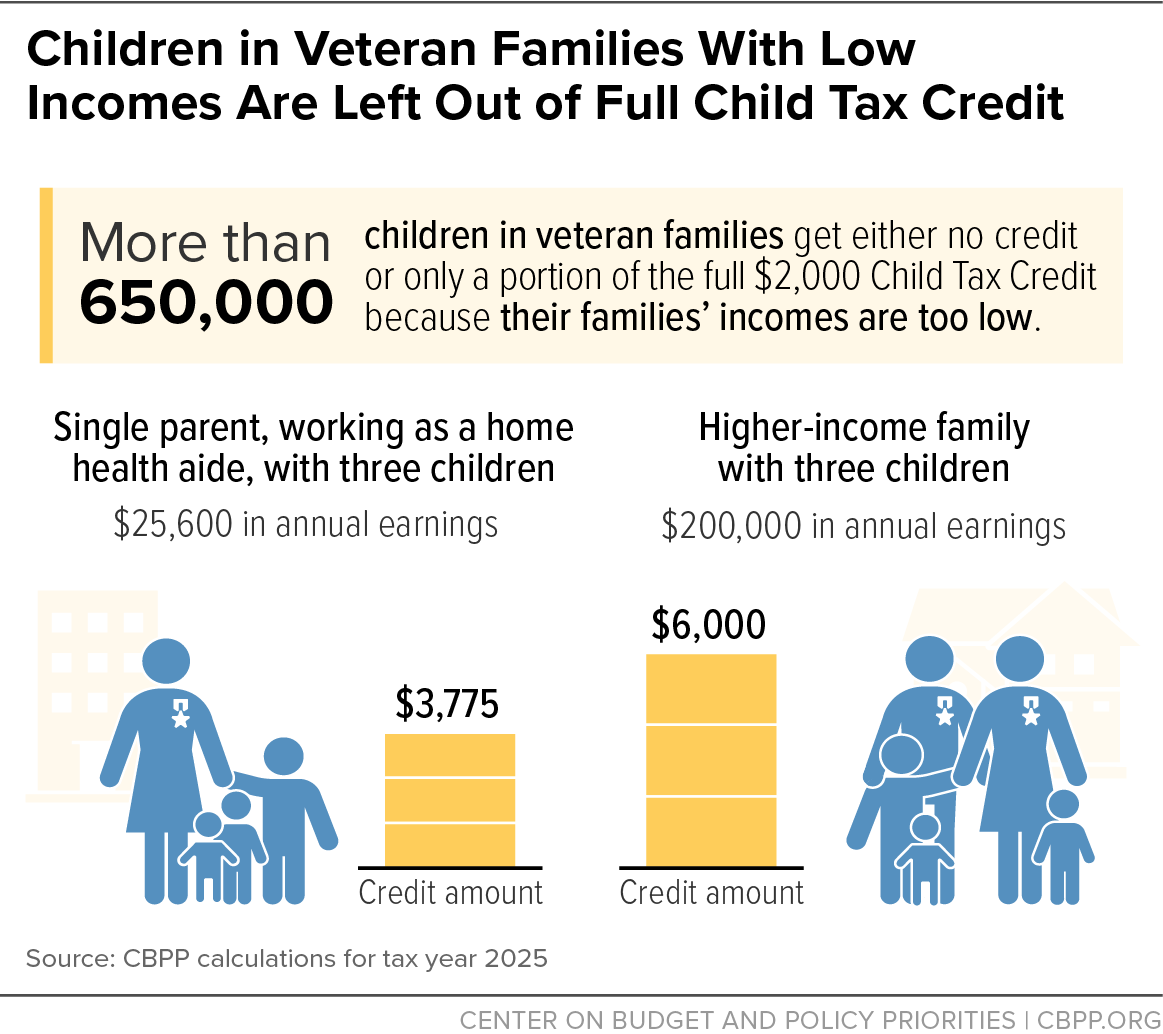
Over 650,000 children under age 17 in veteran families get either no credit or only a portion of the full $2,000 Child Tax Credit because their families’ incomes are too low. (See table below for a state-by-state breakdown.) This group is among the 17 million kids in low- and moderate-income families in the U.S. who are denied the full credit, whereas children in higher-income families get the full credit. This is due to the upside-down structure of the credit: specifically, the credit’s slow 15 percent phase-in rate for earnings that exceed $2,500, and the lower maximum credit amount for children in families with low incomes, often called a “refundability cap.” Congress has a critical opportunity in the upcoming tax bill to address this upside-down structure and help these veteran families.
The vast majority of these 17 million children are in families who work important jobs for low pay or who are out of work due to unemployment, illness, caregiving responsibilities, or for other reasons. While veterans on average do relatively well, some veterans struggle with the transition back to the civilian workforce, so Congress should do all it can to help this group.
Take a veteran who has three kids aged 2, 5, and 8 and now works as a home health aide making $25,600. Under current law, she would receive a Child Tax Credit worth $3,775. Contrast this to a higher-income family making $200,000 with three children, which receives a Child Tax Credit worth $6,000.
As congressional Republicans move forward with budget reconciliation and their subsequent tax bill, they are likely to extend most or all of the 2017 tax law, including the law’s changes to the Child Tax Credit. These changes included doubling the maximum credit from $1,000 to $2,000 for many, but not all, families, as well as limiting those with lower incomes to a lower maximum amount (the “refundability cap”). Millions of families with lower incomes saw their credit rise by just $75 or less, compared to the $1,000-per-child increase that families with higher incomes received.
Simply extending the 2017 tax law, or increasing the maximum credit, would do nothing for the 17 million children currently left out of the full credit — including over 650,000 children in veteran families. Congress should prioritize an expansion that would increase the credit for these families.
In fact, 169 House Republicans voted last year for a bipartisan bill to structurally improve the Child Tax Credit over the course of three years for children in lower-income families, including veteran families. The bipartisan bill championed by House Ways and Means Chair Jason Smith made changes that would have increased the credit for more than 80 percent of children left out of the full credit in its first year, boosting the credit for children in working families.
Research shows that for children in families with low incomes, additional income during childhood, like the Child Tax Credit, is correlated with better health and educational outcomes, as well as higher earnings in adulthood.
As congressional Republicans draft a tax bill, they should prioritize changing the upside-down structure of the Child Tax Credit so that the 17 million children in low- and moderate-income families, including the over 650,000 children in veteran families, can also receive the full credit.
| TABLE 1 | |
|---|---|
More Than 650,000 Children Under 17 in Veteran Families Are Left Out of the Full $2,000 Child Tax Credit Estimates of children by state | |
| Estimated number of children | |
| Total | 655,000 |
| Alabama | 17,000 |
| Alaska | 3,000 |
| Arizona | 19,000 |
| Arkansas | 10,000 |
| California | 51,000 |
| Colorado | 10,000 |
| Connecticut | 3,000 |
| Delaware | N/A |
| District of Columbia | N/A |
| Florida | 47,000 |
| Georgia | 27,000 |
| Hawai‘i | 4,000 |
| Idaho | 5,000 |
| Illinois | 17,000 |
| Indiana | 15,000 |
| Iowa | 6,000 |
| Kansas | 6,000 |
| Kentucky | 14,000 |
| Louisiana | 17,000 |
| Maine | 2,000 |
| Maryland | 9,000 |
| Massachusetts | 5,000 |
| Michigan | 16,000 |
| Minnesota | 6,000 |
| Mississippi | 9,000 |
| Missouri | 15,000 |
| Montana | 4,000 |
| Nebraska | 3,000 |
| Nevada | 7,000 |
| New Hampshire | N/A |
| New Jersey | 7,000 |
| New Mexico | 8,000 |
| New York | 17,000 |
| North Carolina | 31,000 |
| North Dakota | N/A |
| Ohio | 25,000 |
| Oklahoma | 13,000 |
| Oregon | 9,000 |
| Pennsylvania | 20,000 |
| Rhode Island | N/A |
| South Carolina | 13,000 |
| South Dakota | 2,000 |
| Tennessee | 23,000 |
| Texas | 70,000 |
| Utah | 8,000 |
| Vermont | N/A |
| Virginia | 20,000 |
| Washington | 16,000 |
| West Virginia | 7,000 |
| Wisconsin | 8,000 |
| Wyoming | N/A |
Notes: Children under 17 left out of the full $2,000 Child Tax Credit are eligible for a smaller credit because their families lack earnings or have earnings that are too low. Figures are rounded to the nearest 1,000. N/A indicates reliable data are not available due to small sample size; data are included in totals. Children in the five U.S. Territories — Puerto Rico, Guam, U.S. Virgin Islands, Northern Mariana Islands, and American Samoa — are not included due to data limitations. Source: Tax Policy Center (TPC) national estimate for 2025 allocated by state based on CBPP analysis of American Community Survey (ACS) for 2017-2019, with earnings adjusted for growth to 2024 levels and other income adjusted for inflation to 2024 dollars, and using tax year 2024 parameters. TPC, “T24-0082 - Distribution of Tax Units, Children, and Dependents by Size of Child Tax Credit (CTC), 2025,” December 10, 2024, https://taxpolicycenter.org/model-estimates/CTC-Dec-2024/T24-0082. | |