MÁS ALLÁ DE LOS NÚMEROS
The 2017 Tax Law Did Not Boost the Economy
Despite claims from President Trump and the Administration’s Council of Economic Advisers, there is no evidence that the 2017 tax law, which included deep tax cuts skewed to the wealthy and corporations and drove up deficits, had significant positive impacts on the economy during Trump’s first term. As my colleague Brendan Duke and I explain in a new paper, the combination of extending and adding more tax cuts skewed to the wealthy, executive actions that undermine basic governance, and enormous tariffs (assuming they are implemented) will cost jobs and raise prices for consumers and businesses, making it harder for families to afford the basics. Given the heightened recession concerns, this agenda may well hurt the economy.
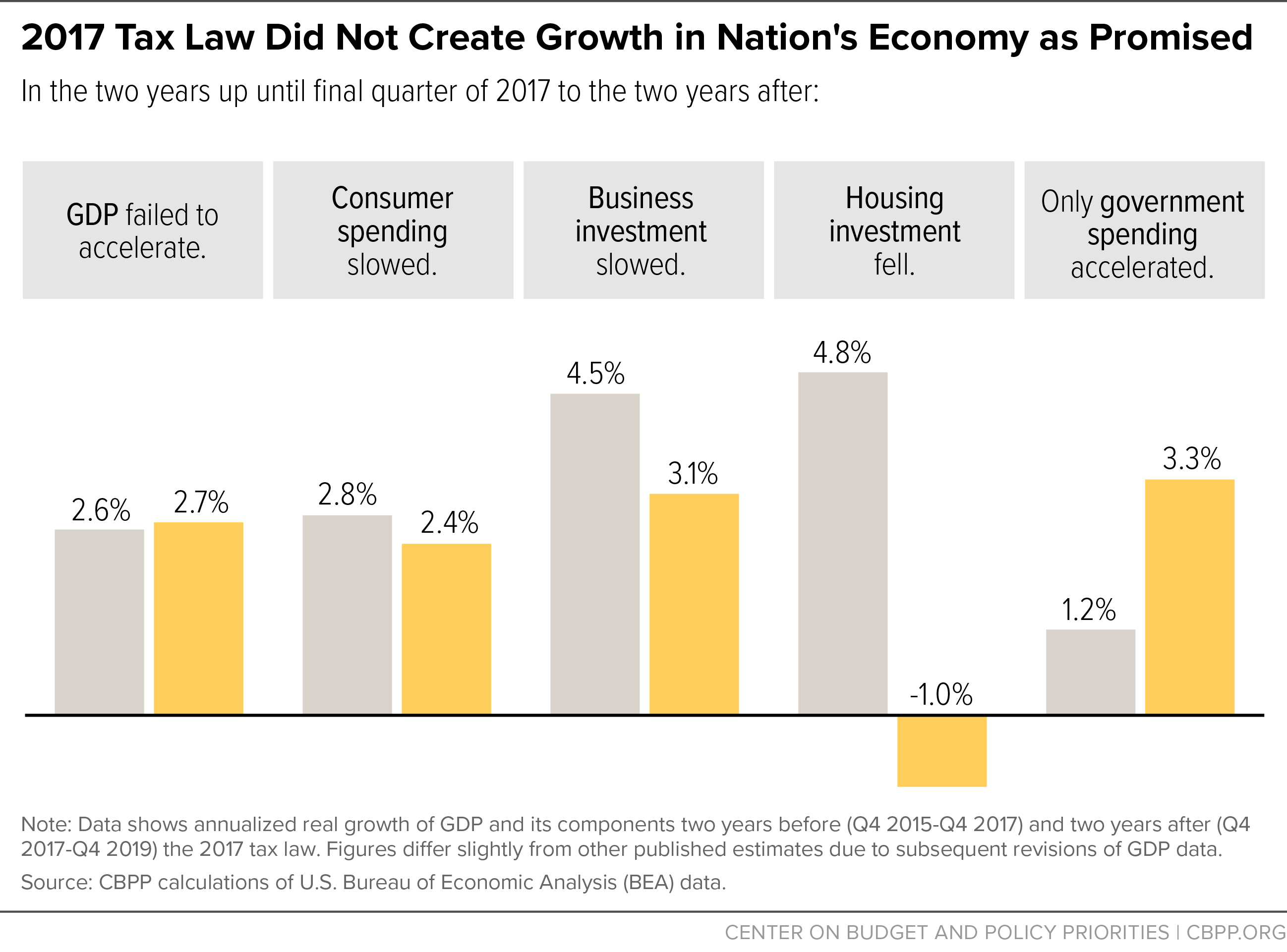
The original legislation did little to spur economic growth during the pre-pandemic period. Economic growth barely changed in the two years after the law relative to the two years before the law. The rate of overall business investment slowed after the tax law’s enactment, as did consumption. Ironically, real GDP growth rose slightly because of increases in government spending following passage of the 2018 Bipartisan Budget Act, which boosted defense and non-defense appropriations funding (see chart).
Rigorous research into some of the law’s key provisions also shows the lack of evidence for the Trump Administration’s claims. For example, despite Republicans’ promises that the special 20 percent deduction for pass-through business income would boost investment and create jobs, researchers have found no evidence that the deduction significantly increased investment, wages for non-owners, or employment.
Similarly, though the Trump Administration promised the corporate rate cut would “very conservatively” lead to a $4,000 boost in household income, a study by economists from the Joint Committee on Taxation and the Federal Reserve Board found that workers in the bottom 90th percentile of their firm’s income scale saw “no change in earnings” from the rate cut. In addition, the authors find that the revenue loss from the decrease in corporate tax revenues far outweighs any boost in output from the tax cut.
As William Gale, Jeffrey Hoopes, and Kyle Pomerleau wrote, “Aggregate studies generally do not find a significant short-term impact of the [Tax Cuts and Jobs Act] on macro variables such as GDP, investment, employment, and labor compensation.” A recent Tax Policy Center analysis of the individual provisions’ distributional effects finds that households with incomes in the bottom quintile received only $100, while households with incomes in the top 1 percent received $61,500. This skewed distribution was due to rate reductions, the deduction for pass-through firms, and corporate tax cuts.
Therefore, any discussions about extending the 2017 law, which would make the income tax rate reductions and pass-through deductions permanent and further reduce federal revenues, must acknowledge not only that it would not benefit the economy, but that it would be harmful due to its high cost and further shift of large sums upward to the richest people in the country. Indeed, a recent Congressional Budget Office analysis finds that extending the 2017 law would shrink the economy in the long run, due to rising deficits from higher interest rates.
Proponents of the 2017 tax law made a lot of promises about how it would boost the economy. These effects were never borne out in the data; there was no significant impact on GDP growth, investment, or wages. Instead, the 2017 tax law reduced federal revenues and exacerbated income and wealth inequality by giving more money to households with incomes in the top 1 percent.
Extending the 2017 tax law along with a combination of cuts to Medicaid and SNAP and sweeping tariffs will result in higher costs for low- and moderate-income families while the rich get large tax cuts.