MÁS ALLÁ DE LOS NÚMEROS
House Republican Attacks on Medicaid Expansion Would Threaten Coverage for 20 Million People
The House Republican budget would require deep cuts to Medicaid, and recent statements from House Energy and Commerce Committee Chair Brett Guthrie suggest the Affordable Care Act’s (ACA) Medicaid expansion to adults with low incomes — which covers more than 20 million people — will be a prime target. Cutting Medicaid by hundreds of billions of dollars and focusing many of those cuts on the Medicaid expansion would lead millions of people to become uninsured. Eliminating Medicaid expansion was a key goal of Republicans’ failed effort to repeal the ACA eight years ago, and Congress should once again reject efforts to undermine it.
Recent Republican proposals such as reducing the federal matching rate for Medicaid expansion, repealing the 2021 Rescue Plan’s incentive for new states to expand, or taking away Medicaid coverage from certain adult enrollees by imposing work requirements would leave expansion enrollees at risk. They could lose their coverage due to work requirements, or their state might drop their coverage due to a drastic increase in state costs. Twelve states have “poison pill laws” that would automatically end expansion coverage or require review of the coverage if the federal matching rate drops below 90 percent. In these states, expansion enrollees are at even greater risk.
Rep. Guthrie’s recent statement confirms that Republicans are eyeing proposals such as work requirements, a reduction in the federal matching rate, or a per capita cap on funding for the expansion group. This last option could shift between $72 billion and $190 billion in costs to states from 2026 to 2034, increasing the state costs of expansion by 41 to 108 percent and jeopardizing coverage for millions of people.
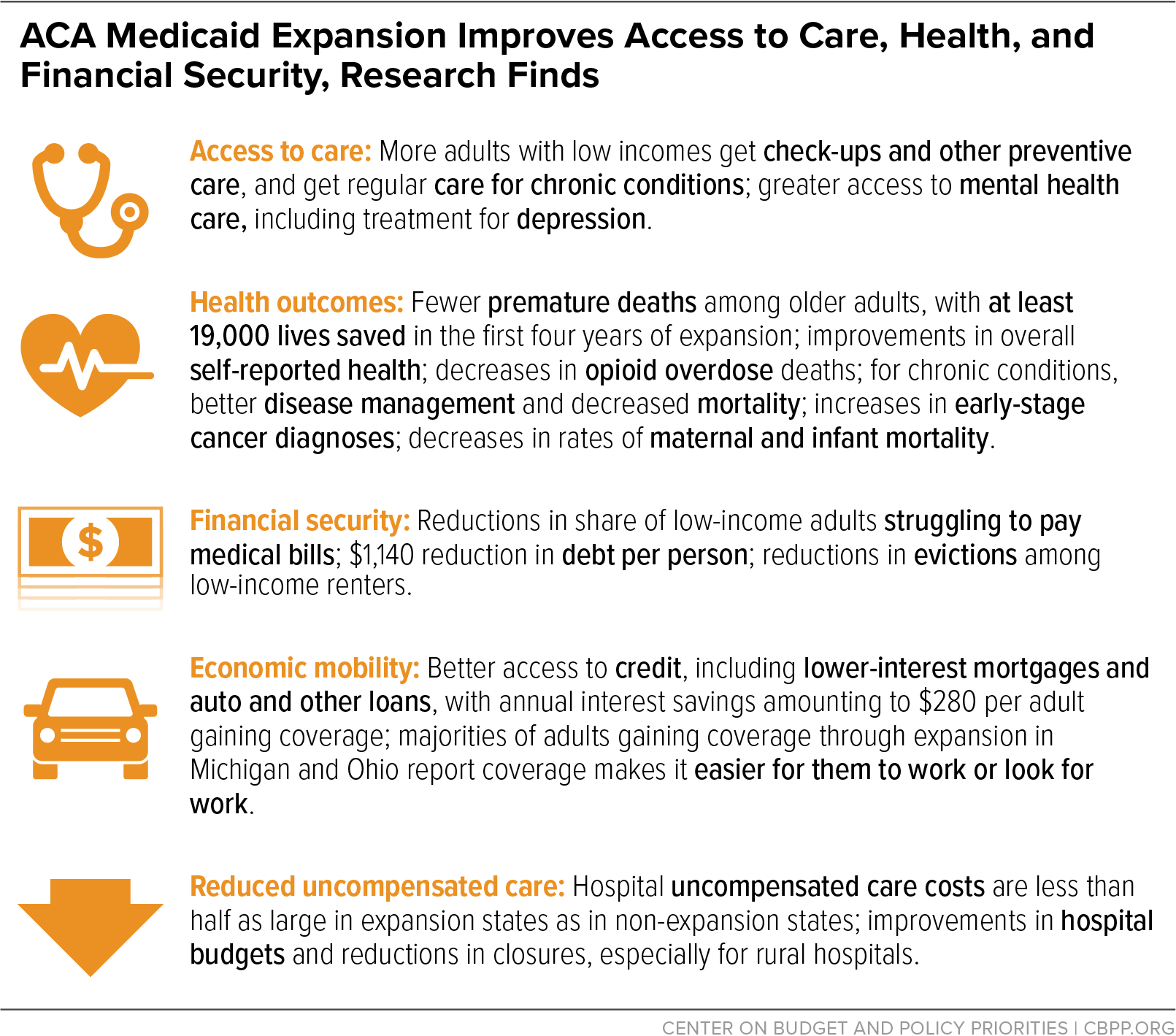
Forty states plus Washington, D.C. have adopted the Medicaid expansion, helping adults with low incomes become healthier and more financially secure. Health coverage through expansion improves people’s access to preventive and primary care, provides care for chronic illnesses, prevents premature deaths, and protects people from catastrophic out-of-pocket medical costs (see graphic).
Having health coverage also makes it easier for adults to work or to look for a job. Considering that Medicaid supports work and that 9 out of 10 Medicaid adults are already working, caring for family, attending school, or are ill or disabled, work requirements are unnecessary and burdensome. Proposals to use work requirements as a way to take away Medicaid coverage from certain adults are just another way to undermine the Medicaid expansion.
Attacks on the Medicaid expansion are often based on false claims that covering adults with low incomes takes away care from groups traditionally eligible for Medicaid. In reality, Medicaid expansion supports better outcomes for all groups, including children, older adults, and people with disabilities.
Medicaid expansion has driven coverage gains for parents, which improves their access to care as well as the overall well-being of their children. Expansion has also driven coverage gains among people with disabilities. People with disabilities who receive Supplemental Security Income generally also qualify for Medicaid, but 2 out of 3 people with disabilities who participate in Medicaid qualify on another basis, meaning Medicaid expansion is an important path to coverage for those with low incomes.
Medicaid expansion also supports hospitals and other health care providers by reducing their uncompensated care costs and improving their operating margins, especially for rural and safety-net hospitals. If all states were to drop the Medicaid expansion in response to a decline in federal support, a recent analysis found that provider revenues would fall by $80 billion and uncompensated care costs would increase by $19 billion in 2026.

In the ten remaining states that have not adopted the Medicaid expansion, about 1.4 million uninsured people with incomes below the poverty line are in a coverage gap, without affordable health coverage options. Two-thirds of people in non-expansion states want their state to expand.
Over a decade since the Medicaid expansion took effect, the evidence is clear: it has helped dramatically reduce the country’s uninsured rate by providing coverage to millions of people, while also improving families’ access to care and financial security, generating budget savings and increased revenue for states, and keeping more hospitals open. It has proven to be popular as well. Cutting the program would increase families’ health care costs, harm health care providers, and shift costs to states. Instead, Congress should maintain support for the expansion and consider federal solutions to close the coverage gap in the remaining ten states.