Tax — Federal Archive
Results per page: 50 | 100
Results by year: 2013 | 2012 | 2011 | 2010 | 2009 | 2008 | 2007 | 2006 | 2005 | 2004 | 2003 | 2002 | 2001 | 2000 | 1999 - 1991
-
Correcting Misunderstandings About Obama’s Latest Tax Offer Vs. Boehner’s “Plan B”
December 20, 2012
On the tax side of the “fiscal cliff” talks between President Obama and House Speaker John Boehner, the differences between Obama’s latest offer and Boehner’s “Plan B” proposal are far greater than much of the news coverage has suggested. The same holds true for the differences between … -
Policy Basics: The Estate Tax
Updated December 14, 2012
A long-standing part of the tax system, the estate tax is a tax on property (cash, real estate, stock, or other assets) transferred from deceased persons to their heirs. It is levied not on the full estate but rather on the portion of the estate’s value that exceeds a specified amount … -
Coordinating Human Services Programs with Health Reform Implementation
Updated December 11, 2012
Executive Summary By making affordable health care available to millions of low-income, uninsured Americans, the Affordable Care Act (ACA) will go a long way towards helping families who struggle on a daily basis to afford life’s most basic necessities. Health care reform’s impact on low-income people’s lives, however, goes beyond … -
Chart Book: The Bush Tax Cuts
December 10, 2012
To provide context for the debate about addressing expiring tax provisions and reducing long-term deficits, we’ve collected some of our charts related to the Bush tax cuts, which show that the tax cuts (1) are costly, (2) have worsened inequality, and (3) should be allowed to expire on schedule for incomes over $250,000. 1. The Bush Tax Cuts Are Costly … -
Statement of Robert Greenstein, President, in Response to Republican Budget Offer
December 4, 2012
House Republican leaders portray the deficit-reduction offer that they issued yesterday as a fair middle ground. It isn’t. On the crucial issue of revenues, the new Republican offer proposes $800 billion over ten years. Contrast that with the plan that Erskine Bowles, Alan Simpson, and some members of their commission issued in December 2010, … -
Restraining Tax Expenditures Should Complement, Not Replace, Letting High-Income Bush Tax Cuts Expire
November 29, 2012
Some policymakers have suggested capping itemized deductions for taxpayers with incomes over $250,000 (for couples) and $200,000 (for singles) as an alternative to letting President Bush’s tax cuts for these taxpayers expire on schedule. To raise the same amount of revenue, however, would require tax changes that pose serious … -
$2 Trillion in Deficit Savings Would Achieve Key Goal: Stabilizing the Debt Over the Next Decade
November 1, 2012
Some budget watchers are urging the President and Congress to enact $4 trillion in savings over the next ten years in order to address the deficit problem. The $4 trillion figure has assumed something of a life of its own. In fact, there is no single magic number. For example, policymakers could achieve the most essential … -
The Tension Between Reducing Tax Rates and Reducing Deficits
October 26, 2012
Over the past few months, a number of analyses have highlighted the difficulty of cutting income tax rates deeply, producing a significant revenue contribution to deficit reduction (as part of a larger deficit-reduction package), and maintaining the progressivity of the tax code.[1] Most recently, the Joint Committee on Taxation (JCT) … -
Video: Policy Basics: Where Do Our Federal Tax Dollars Go?
October 25, 2012
The Center's Tax Policy Analyst, Chye-Ching Huang, and Director of Federal Tax Policy, Chuck Marr, discuss where our federal tax dollars go. Topics include defense and international security assistance, Social Security, and health insurance and safety net programs. Chuck Marr, "Obviously, … -
Payroll Tax Cut and Emergency Unemployment Insurance Still Needed to Support the Recovery
October 16, 2012
Among the various tax and spending measures scheduled to expire at the end of this year, the temporary payroll tax cut enacted in 2010 and emergency federal unemployment insurance (UI) are among the most cost-effective at supporting the economic recovery without endangering efforts to control long-term deficits and debt. Given the state … -
State-Level Estimates Show Stark Contrasts Under Proposals To Extend Cut in Estate Tax While Failing to Extend Improvements in Tax Credits For Working Families
October 15, 2012
In recent proposals to extend expiring tax cuts beyond the end of the year, Republican leaders in the House and Senate have called for extending an estate-tax cut enacted in 2010 that provides a large tax break to the estates of the wealthiest 0.3 percent of Americans who die each year — about 7,000 people — while ending a … -
Downturn and Legacy of Bush Policies Drive Large Current Deficits
Updated October 10, 2012
This analysis has been updated. To view the updated analysis, click here. Some lawmakers, pundits, and others continue to say that President George W. Bush’s policies did not drive the projected federal deficits of the coming decade — that, instead, it was the policies of President Obama and Congress in 2009 and 2010. But, the fact remains: … -
Misguided “Fiscal Cliff” Fears Pose Challenges to Productive Budget Negotiations
Updated September 24, 2012
The sooner policymakers enact legislation to put the budget on a sustainable long-term path without threatening the vulnerable economic recovery, the better. But, as they prepare for an almost certain post-election "lame duck" session of Congress, policymakers should not make budget decisions with long-term consequences based … -
Romney Budget Proposals Would Necessitate Very Large Cuts in Medicaid, Education, Health Research and Other Programs
Updated September 24, 2012
Governor Mitt Romney’s proposals to cap total federal spending at 20 percent of gross domestic product (GDP) and boost defense spending to 4 percent of GDP would require very large cuts in other programs, both entitlements and discretionary programs. This update of an earlier analysis is based on updated economic and budget … -
Chart Book: 10 Things You Need to Know About the Capital Gains Tax
Revised September 20, 2012
1. Capital gains tax rates are the lowest since the Great Depression. The capital gains tax rate on assets that have been held for more than one year is 15 percent for people above the 15 percent income tax bracket. (People in or below the 15 percent bracket owe no capital gains tax.) This is far below the top marginal tax rate on ordinary income — currently … -
Raising Today’s Low Capital Gains Tax Rates Could Promote Economic Efficiency and Fairness, While Helping Reduce Deficits
September 19, 2012
The large tax preferences that capital gains enjoy over “ordinary” income, such as salary and wages, add to budget deficits, widen income inequality, and do little if anything to promote economic growth. Recent bipartisan deficit commissions have called for eliminating or sharply reducing these tax preferences, as the … -
Misconceptions and Realities About Who Pays Taxes
Updated September 17, 2012
Executive Summary Close to half of U.S. households currently do not owe federal income tax. The Urban Institute-Brookings Tax Policy Center estimates that 46 percent of households will owe no federal income tax for 2011. [1] A widely cited figure is a Joint Committee on Taxation estimate that 51 percent of households paid no … -
Statement of Robert Greenstein, President, on Census’ 2011 Poverty, Income, and Health Insurance Data
September 12, 2012
Today’s Census data contained the good, the fair, and the ugly. The good news is that the number of uninsured Americans dropped by 1.3 million and the share of Americans without insurance fell by more than in any year since 1999; the fair news is that the poverty rate stayed flat after … -
Media Briefing: Examining the 2011 Census Data on Poverty, Health Insurance Coverage, and Income
September 12, 2012
The Center on Budget and Policy Priorities held a conference call briefing to examine the Census Bureau data for 2011 on poverty, health insurance coverage, and income trends.
Robert Greenstein, the Center’s President, was joined by Jared Bernstein, Senior Fellow, to discuss the new data.
-
Proposed “Tax Reform” Requirements Would Invite Higher Deficits and a Shift in Taxes to Low- and Moderate-Income Families
July 31, 2012
Republican legislation that was introduced in the Senate by Minority Leader Mitch McConnell (R-KY) and Finance Committee ranking member Orrin Hatch (R-UT) and in the House by Ways and Means Committee Chairman Dave Camp (R-MI) would establish requirements for tax-reform legislation that could generate higher deficits and substantially shift tax burdens … -
Renters’ Tax Credit Would Promote Equity and Advance Balanced Housing Policy
Revised July 25, 2012
Related files Report without appendices (31pp.) Appendix 1: Comparison of Capped and Uncapped Credits (3pp.) Appendix 2: Method Used to Estimate Cost and Impact of a Renters’ Credit (3pp.) Appendix 3: State Tables (6pp.) One-Page Fact Sheet Over the past several decades, the nation’s housing policy has focused predominantly on increasing homeownership. Most federal housing expenditures now benefit families with relatively little need for … -
Senate and House GOP Leaders' Tax Proposals Would Provide Windfall for Heirs of Largest Estates
Revised July 24, 2012
Senate and House Republican leaders are proposing to provide extremely large tax breaks averaging over $1 million per estate to the heirs of the biggest 0.3 percent of estates — that is, to the heirs of the richest three of every 1,000 people who die. The Senate and House leadership proposals each would do so by extending the … -
Why Uniform, Across-the-Board Cuts in Tax Rates Disproportionately Benefit Those with the Highest Incomes
July 23, 2012
Several policymakers, including Governor Mitt Romney and Senator Pat Toomey (R-PA), have proposed cutting all marginal income tax rates by the same percentage. Further, Senators Hatch and McConnell have proposed that instructions to Congress for tax reform include a requirement that individual tax rates be reduced “proportionally.… -
Allowing High-Income Bush Tax Cuts to Expire Would Affect Few Small Businesses
July 19, 2012
Allowing the top two marginal tax rates to return to pre-2001 levels as scheduled next year would affect very few small businesses, a recent Treasury Department study found.[1] The study shows that only 2.5 percent of small business owners face the top two rates. The claims that allowing the Bush tax cuts for high-income people … -
Video: Jared Bernstein and Chuck Marr Discuss How Tax Reform Could Become a Trap
June 28, 2012
Jared Bernstein and Chuck Marr, Director of Federal Tax Policy at the Center on Budget and Policy Priorities, discuss the implications of tax reform if it is not done carefully. The discussion focuses on a recent report, "How Tax Reform Could Become a Trap: Tax Reform Holds Promise, But if Not Done Carefully, Could Increase the Deficit and Inequality and Harm … -
Testimony of Jared Bernstein, Senior Fellow, Before the Subcommittee on Human Resources of the Committee on Ways and Means on Work Disincentives and the Safety Net
June 27, 2012
Chairmen Davis and Tiberi and ranking members Rep. Doggett and Rep. Neal, I thank you for inviting me to testify on this important question of our safety net and tax benefit programs and their impact on work. My first point, however, is that I believe it is essential to broaden the question at the heart of this hearing. For policy makers to gain a full … -
History Shows Spending Cuts in Deficit-Reduction Packages “Stick”
June 27, 2012
Some opponents of including any revenue increases in a deficit-reduction deal — no matter how outweighed by spending cuts — argue that such cuts never “stick.” They claim — as Grover Norquist’s Americans for Tax Reform recently did — that “when bipartisan deals are struck promising to … -
Budget Plans Should Not Rely on "Dynamic Scoring"
Revised June 21, 2012
Some Members of Congress and outside groups are calling for the use of "dynamic scoring" to estimate the budgetary effects of major legislation, notably tax reform proposals. In February, for instance, the House passed a bill (H.R. 3582) requiring the Congressional Budget Office (CBO) and the Joint Committee on Taxation (JCT) … -
How Tax Reform Could Become a Trap:
June 8, 2012
Policymakers are increasingly discussing the need for tax reform, with a number of them calling for large cuts in tax rates — to levels well below the Bush tax rates — as a core element of reform. They contend that sweeping but unspecified cuts in tax expenditures (credits, deductions, and other tax preferences) will offset … -
Joint Tax Committee: Raising Threshold for Bush Tax Cuts from $250,000 to $1 Million Would Lose $366 Billion — Nearly Half the Revenue
May 30, 2012
House Minority Leader Nancy Pelosi's proposal to extend President Bush's income tax cuts for households making up to $1 million a year would lose nearly half of the revenue that President Obama's proposal to extend the tax cuts only for households making up to $250,000 would raise, according to new estimates from Congress' Joint Committee on … -
Statement by Robert Greenstein, President, on Speaker Boehner's Recent Remarks Concerning the Debt Limit
May 16, 2012
No one should underestimate the significance of House Speaker John Boehner's declaration yesterday that he will block an increase in the debt limit next winter unless policymakers match each dollar of debt limit increase with at least a dollar in budget cuts, with no revenue increases. This … -
Romney Budget Proposals Would Require Massive Cuts in Medicare, Medicaid, and Other Programs
Revised May 12, 2012
This report has been superseded by a new version, dated September 24, 2012, that reflects updated data and other information. Click to view the new analysis. Governor Mitt Romney’s proposals to cap total federal spending, boost defense spending, cut taxes, and balance the budget would require extraordinarily large cuts in other programs, both … -
Cantor Proposal for 20 Percent Business Tax Deduction Would Provide Windfall for Wealthy, Not Create Jobs
Updated May 11, 2012
Though billed as a measure to create jobs by aiding small businesses, House Majority Leader Eric Cantor's (R-VA) proposal for a 20 percent tax deduction in 2012 for businesses with fewer than 500 employees would benefit many high-income taxpayers — including many affluent doctors, lawyers, and stockbrokers — while failing to … -
Toomey Budget Similar to House-Passed Ryan Budget
May 9, 2012
The Senate may take up, as early as this week, a budget proposal from Senator Patrick J. Toomey (R-PA)[1] that is similar in most important respects to the budget resolution from House Budget Committee Chairman Paul Ryan (R-WI), which the House passed on March 29. [2] Like the Ryan budget, the Toomey plan (S. Con. Res. 37) would protect and extend tax cuts that … -
Video: Jared Bernstein and Chye-Ching Huang Discuss Tax Rates and the Economy
May 8, 2012
Jared Bernstein and Chye-Ching Huang discuss the Center's new, comprehensive analysis of recent findings on the economic effects of raising federal income taxes on upper-income taxpayers as part of a balanced effort to reduce budget deficits.
Duration 8:25
-
Media Briefing: The Effect on the Economy of Raising Tax Rates on High-Income Households as Part of a Balanced Effort to Reduce Deficits - What the Evidence Shows
April 25, 2012
The Center on Budget and Policy Priorities held a conference call briefing on Wednesday, April 25 to discuss the Center’s new, comprehensive analysis of recent findings on the economic effects of raising federal income taxes on upper-income taxpayers.
The panel featured leading authorities on tax policy, Leonard E. Burman, Daniel Patrick Moynihan Professor of Public Affairs at Syracuse University, and William G. Gale, Co-Director of the Urban-Brookings Tax Policy Center, and Chye-Ching Huang, Tax Policy Analyst with the Center on Budget and Policy Priorities.
-
Recent Studies Find Raising Taxes on High-Income Households Would Not Harm the Economy
April 24, 2012
Many policymakers and pundits assume that raising federal income taxes on high-income households would have serious adverse consequences for the economy. Yet this belief, which has been subject to extensive research and analysis, does not fare well under scrutiny. As three leading tax economists recently concluded in a … -
Media Briefing: Understanding the Annual Reports of the Social Security and Medicare Trustees
April 23, 2012
The Center on Budget and Policy Priorities held a conference call briefing on Monday, April 23 at 4:00 pm (ET) to discuss the 2012 reports of the Social Security and Medicare Trustees.
Paul Van de Water, Senior Fellow at the Center and one of Washington’s leading experts on both Social Security and Medicare, and Robert Greenstein, President of CBPP discussed what the reports say about the long-term financial status of Social Security and Medicare.
-
Statement of Robert Greenstein on the 2012 Social Security Trustees' Report
April 23, 2012
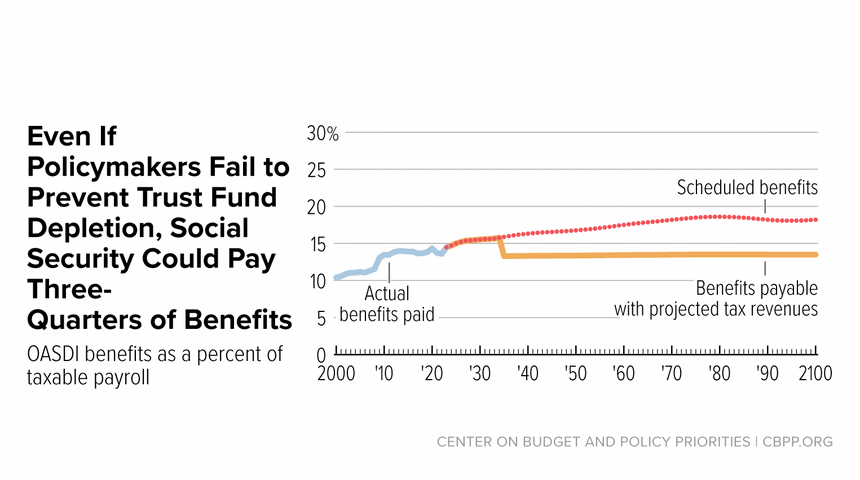
The trustees’ report, with its projection that, in the absence of policy changes, Social Security will be able to pay full benefits only until 2033 — and about 75 percent of scheduled benefits after that — indicates Congress should act soon to address the program’s long-term … -
The False Choice of National Defense Versus Helping the Poor
April 20, 2012
House committees this week approved sharp cuts in the Supplemental Nutrition Assistance Program (SNAP, formerly known as food stamps), the elimination of the Social Services Block Grant, and other cuts that would harm large numbers of low- and moderate-income Americans.[1] Proponents claim the cuts are needed to generate enough savings … -
Statement by Chad Stone, Chief Economist, on Pending House Tax Cut and House Committee SNAP Benefit Cuts
April 18, 2012
The House majority is pursuing legislation this week that makes no economic sense. The full House will pass a $46 billion tax cut that’s advertised as a “job-creating” measure, while the House Agriculture Committee approved a plan today to save $36 billion by cutting the … -
New Tax Cuts in Ryan Budget Would Give Millionaires $265,000 on Top of Bush Tax Cuts
Revised April 12, 2012
Even as House Budget Committee Chairman Paul Ryan’s budget would impose trillions of dollars in spending cuts, at least 62 percent of which would come from low-income programs,[1] it would enact new tax cuts that would provide huge windfalls to households at the top of the income scale. New analysis by the Urban-Brookings Tax Policy Center (TPC) … -
Tax Foundation Figures Do Not Represent Typical Households’ Tax Burdens
April 2, 2012
This report has been updated. Click here for the updated analysis. The Tax Foundation released its annual “Tax Freedom Day” report today that, once again, leaves a strikingly misleading impression of tax burdens — announcing an “average” tax rate across the United States that’s likely higher than the tax … -
Blog Post: Ryan Plan Unlikely to Balance the Budget for Decades
March 28, 2012
Despite its massive spending cuts, House Budget Committee Chairman Paul Ryan’s budget (which the House is considering this week) would still have a deficit of $287 billion in fiscal year 2022. And the Congressional Budget Office estimates that it wouldn’t produce a surplus until 2040. Chairman Ryan disagrees, saying in … -
Cooper-LaTourette Budget Significantly to the Right of Simpson-Bowles Plan
March 28, 2012
Reps. Jim Cooper (D-TN) and Steven LaTourette (R-OH) unveiled a budget plan on March 27 that they call the “Simpson-Bowles Budget.” It departs significantly, however, from the Bowles-Simpson commission plan in key respects — raising taxes much less, cutting much more from non-security discretionary programs and less from defense and … -
Blog Post: Another Quarter-Million for Millionaires Under Ryan Tax Plan
March 28, 2012
Our new report shows that House Budget Committee Chairman Paul Ryan’s tax plan would provide $265,000-a-year tax cuts to the nation’s highest-income households. Here’s an excerpt: Even as House Budget Committee Chairman Paul Ryan’s budget would impose trillions of dollars in spending cuts, 62 percent of which would come from … -
Blog Post: Chairman Ryan’s Misleading Chart
March 27, 2012
House Budget Committee Chairman Paul Ryan recently summarized his new tax proposal this way: [W]e’re saying get rid of all the special interest loopholes and tax shelters that are disproportionately used by those higher income earners, get rid of those tax shelters, so you can lower tax rates for everybody, and make us better wired for economic growth and job creation. Chairman Ryan has also said that most tax-expenditure benefits go to high-income people. The lead tax chart in Chairman Ryan’s budget document seems to support his statement, suggesting that the tax code includes a series of egregious loopholes (or “tax expenditures”) that mostly flow to very rich individuals. It gives the impression that we can easily eliminate tax … -
Blog Post: Chairman Ryan’s Misleading Chart
March 27, 2012
House Budget Committee Chairman Paul Ryan recently summarized his new tax proposal this way: [W]e’re saying get rid of all the special interest loopholes and tax shelters that are disproportionately used by those higher income earners, get rid of those tax shelters, so you can lower tax rates for everybody, and make us better wired for economic growth and job creation. Chairman Ryan has also said that most tax-expenditure benefits go to high-income people. The lead tax chart in Chairman Ryan’s budget … -
Blog Post: Ryan Roundup, 2012: Everything You Need to Know About Chairman Ryan's Budget
March 23, 2012
Below is a compilation of the CBPP blog posts to date on House Budget Committee Chairman Paul Ryan’s new budget. Check back here frequently, as we will update this list as we put out new material. http://bit.ly/RyanPosts Overview/General Greenstein Statement March 21, 2012 "The new Ryan budget is a … -
Blog Post: Low-Income Programs Would Bear the Brunt of Ryan Cuts
March 23, 2012