

2025 Budget Stakes: People With Disabilities Could Lose Vital Health, Food, and Other Assistance
Proposals that Congress could enact this year, including through fast-track “reconciliation” legislation, would take away medical coverage, food assistance, and other critical aid from millions of individuals with disabilities, significantly raising their costs for buying groceries and addressing their health care needs. These effects would be on top of the harmful impacts of administrative changes being attempted under the Trump Administration, including threatening timely disability benefits by significantly cutting staff at the Social Security Administration.

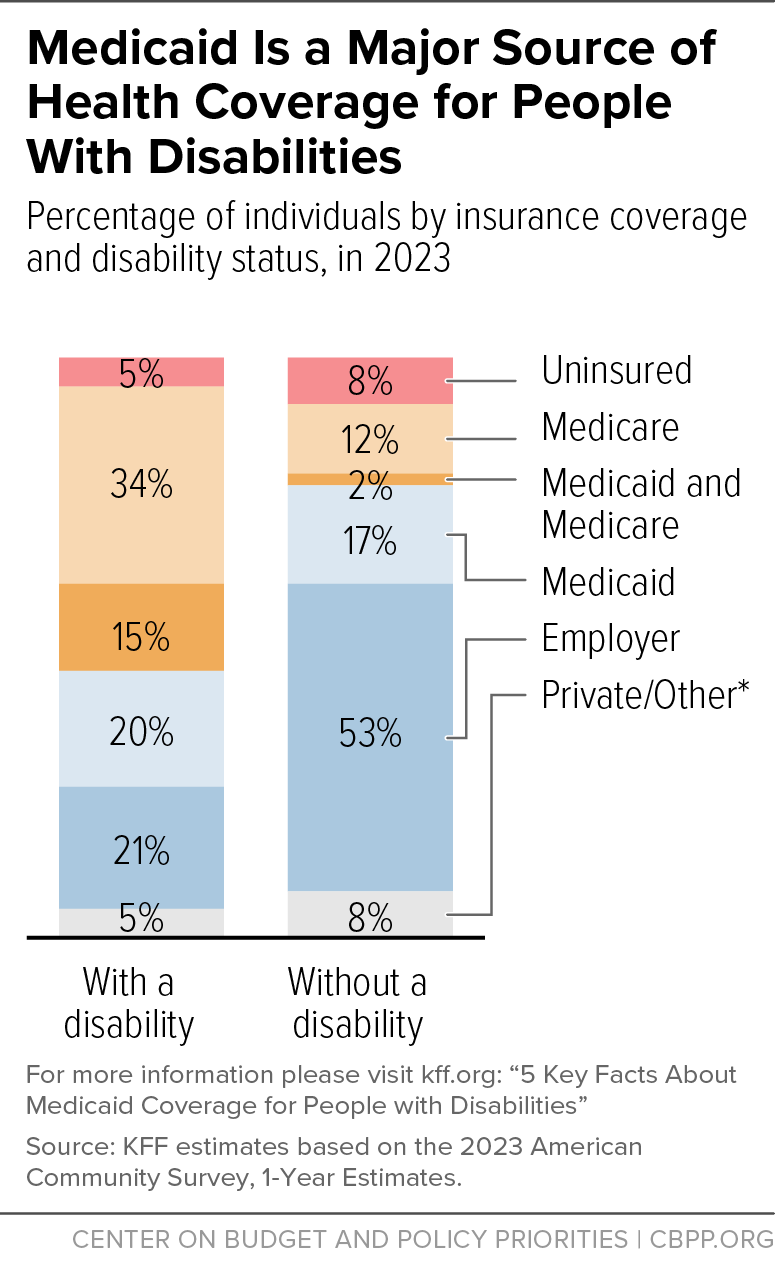
People With Disabilities Receive Critical Support From Medicaid and SNAP
Having a disability can raise expenses and make it harder for people to work, put food on the table, and afford adequate health care. People with disabilities have poverty rates over twice that of those without disabilities. Medicaid and the Supplemental Nutrition Assistance Program (SNAP) help millions of people with disabilities meet these challenges. Medicaid provides health coverage, including for home- and community-based services, for about 15 million people with disabilities, representing over one-third of all people with disabilities, according to KFF. In 2022, SNAP provided food assistance to about 4 million households that include non-elderly individuals who receive disability benefits, representing 19 percent of all SNAP households.
Cuts to Medicaid or SNAP Would Hurt People With Disabilities
Significant changes in the funding structures of Medicaid or SNAP, such as reducing or capping the amount of federal Medicaid matching payments provided to states or requiring states to absorb new costs in SNAP, would directly threaten health coverage and food assistance to people with disabilities. Many states would likely respond to cost shifts by reducing assistance or by eliminating coverage for certain groups of people or for specific services. Cuts in these programs could have particularly harsh impacts on people with disabilities because of their much higher levels of health care spending and significantly higher levels of food insecurity.
Policies That Threaten Support to People With Disabilities
Limiting Medicaid eligibility pathways for people with disabilities. Because of the strict standards for federal disability benefits, many people with disabilities don’t qualify for traditional Medicaid based on their disability. But in states that expanded Medicaid eligibility under the Affordable Care Act, more people with disabilities qualify based on their income. Cutting federal funding for Medicaid expansion states could lead to many of these individuals losing their Medicaid coverage. One study estimates that 20 million people could lose Medicaid — likely including millions of people with disabilities —- if all states responded to such a funding reduction by dropping their expansions.
Reducing states’ ability to fund home- and community-based care. Capping federal payments to states, such as through per capita caps, including those that target the Medicaid expansion population; reducing federal matching rates; or restricting the way states are able to finance their programs, like changes to provider taxes, will shift further costs to states, which may not be able to absorb them. This could force states to make cuts in eligibility, benefits, or provider payments and could put optional services like home- and community-based care for seniors and people with disabilities at risk. Don’t be fooled by a bill that doesn’t explicitly cut these services; if significant costs are shifted to states, home- and community-based services will be in serious jeopardy.
Shifting SNAP benefit costs to states. Requiring states to pay a portion of SNAP benefit costs, which are currently 100 percent federally funded, would strain state budgets and force states to cut benefits or restrict eligibility, including for people with disabilities who depend on the program. Virtually all states must balance their budgets each year, so shifting even a small portion of SNAP benefit costs to states would require them to cut SNAP, raise revenue, and/or cut funding for other programs — and this strain would grow further during an economic downturn, when the need for SNAP rises.
Slashing SSI benefits to families with disabled children. Cutting children’s Supplemental Security Income (SSI) if another member of the family also receives SSI would harm hundreds of thousands of families, pushing many into, or further into, poverty. SSI provides monthly benefits to low-income seniors and people with disabilities, including children with conditions such as Down syndrome, cerebral palsy, autism, intellectual disability, and blindness.
Eliminating flexible funding for helping people with disabilities. Proposals to eliminate the Social Services Block Grant (SSBG) would hinder the ability of states to provide services to very vulnerable populations, including at-risk children, seniors in need of home-based services, and people with disabilities. In 2022, $270 million in SSBG funds were spent on special services for the disabled, such as respite care, transportation assistance, and the use of special aids and appliances with goal of helping people live at home or in the least restrictive environment possible.
Taking away benefits from people not meeting harsh work requirements. Enacting strict work requirements for Medicaid recipients or expanding already harsh work requirements for SNAP recipients would directly threaten benefits for individuals with disabilities. Even if they are supposed to be exempt, people with disabilities may get tripped up by complicated paperwork and red tape requirements. For example, in Arkansas’ failed attempt at a Medicaid work requirement in 2018, people with disabilities were “particularly vulnerable” to having their Medicaid coverage terminated. Another study found people who reported they have a disability — who also likely should have been exempt from SNAP’s harsh work requirement — lost benefits at the same rate as people without a disability.
Alternative Path Can Help People With Disabilities Succeed
The extreme agenda represented by proposals like these, which would make millions of people with disabilities worse off while extending and expanding tax breaks for wealthy households and businesses, is the wrong direction for our nation. A much better path would be to provide people with disabilities the support they need to thrive, including by providing timely determinations of their eligibility for Social Security disability benefits by investing in the staff needed to make that happen.