

Non-Defense Discretionary Programs
Non-defense discretionary (NDD) programs comprise domestic and international programs outside of national defense that Congress funds on an annual basis. These programs are called “discretionary” because policymakers have discretion to decide their funding levels each year through the appropriations process — in contrast to “mandatory” programs such as Social Security, Medicare, and Medicaid, where the law governing the program and the benefits it provides determines the spending.
Introduction
The non-defense discretionary (NDD) federal budget category comprises domestic and international programs outside of national defense that Congress funds through annual appropriations. These programs are called “discretionary” because policymakers have discretion to decide their funding levels each year through the appropriations process — in contrast to “mandatory” programs such as Social Security, Medicare, and Medicaid, where the law governing the program and the benefits it provides determines the spending. The term “discretionary” does not mean that these programs are less important than mandatory programs.
All estimates used in this Policy Basic are for federal fiscal years, and the 2025 estimates are based on data from the Congressional Budget Office. Fiscal year 2025 ran from October 1, 2024, through September 30, 2025.
Funding the government’s NDD programs requires the enactment of 12 appropriations bills each year covering the various federal agencies, though Congress often combines those bills into broader omnibus packages. Congress also enacts supplemental appropriations bills from time to time, when needed to respond to natural disasters and other situations. And when regular appropriations are not in place for the entire government by the start of a new fiscal year, Congress enacts temporary, stopgap appropriations bills, called “continuing resolutions,” to continue government operations and services — generally at the prior year’s level. Without a “continuing resolution,” the programs that would normally have been funded by the regular appropriations bills or the stopgap continuing resolution generally shut down. For 2025, Congress initially adopted a series of temporary continuation resolutions and then, in March 2025, adopted a continuing resolution that covered the remainder of fiscal year 2025.
There are two ways of looking at the amounts provided by annual appropriations bills. Fundamentally, these bills provide agencies with authority to make financial commitments or obligations, for specific purposes, over a given period. The dollar amount of this authority is known as funding or budget authority. But actual payments to individuals, businesses, or state and local governments from the Treasury to fulfill an obligation are known as spending or outlays.
Both measures are meaningful, and we use both in this Policy Basic: budget authority in the first section as a way of categorizing and describing the funding decisions Congress made through the appropriations process for 2025, and outlays in later sections because that approach facilitates comparisons over time, with the rest of the government, and with the economy. NDD funding or spending is a relatively small share of the total budget, roughly one-seventh or one-eighth, and its share has tended to decrease over time.
NDD Funding Supports Key Public Services
NDD programs cover a wide variety of policy priorities such as education, public health, scientific research, infrastructure, national parks and forests, environmental protection, and some low-income assistance, as well as many basic government operations including law enforcement, courts, and tax collection. The category also includes many programs related to national security, including diplomacy and foreign aid, homeland security, and health care and services for veterans. In 2025, budget authority for NDD programs totaled an estimated $783 billion. (This total is for regular, ongoing annual appropriations. It does not include funding for disaster relief or other emergencies and certain other special categories of discretionary funding.)

In the following discussion, we break NDD programs into nine categories, as the chart above shows. (We assign each program to a single category to avoid double counting.)
The categories are:
1. Economic Security and Social Services
Economic security programs and social services constituted 17 percent ($134 billion) of NDD appropriations in 2025. Programs in this category primarily help households meet basic needs such as housing, energy, child care, and food costs.
More than half of the funding in this category goes to housing assistance, including vouchers and other rental assistance for low-income households, aid for people experiencing homelessness, and assisted housing for older adults and people with disabilities.
This category also covers food and nutrition programs such as the Special Supplemental Nutrition Program for Women, Infants, and Children (WIC), which provides food assistance to about 7 million people in families with low incomes; it also covers other forms of assistance to low- and moderate-income people, such as the Low Income Home Energy Assistance Program and the Child Care and Development Block Grant. It includes Social Security’s administrative costs as well.
2. Justice and General Government
Justice and general government programs constituted 15 percent ($117 billion) of NDD funding in 2025.
About two-thirds of this category goes to law enforcement, criminal justice, and correctional institutions and activities, such as the Federal Bureau of Investigation, the Border Patrol, and assistance to states and localities for prevention and prosecution of domestic violence and reduction of drug trafficking.
Nearly a quarter of this category goes to funding the Internal Revenue Service, Congress, and other basic government operations. The rest goes to non-medical veterans’ benefits such as housing, education, and operating costs for the Department of Veterans Affairs.
3. Veterans’ Health
Veterans’ health constituted 15 percent ($117 billion) of NDD funding in 2025. This includes funding for hospitals and medical care for veterans. These veterans’ programs are an increasingly large component of non-defense appropriations.
Other programs for veterans are included in General Government.
4. Public Health and Medical Research
Public health and medical research programs constituted 13 percent ($104 billion) of NDD funding in 2025. These programs support health research, public health measures, and some health care services but do not include Medicare, Medicaid, and Affordable Care Act premium subsidies, which are mandatory programs. Also, this category does not include medical care for veterans, which is instead included in a separate category (see Veterans’ Health). If veterans’ health care were included, health care and health research would be the largest category, constituting 28 percent of NDD appropriations in 2025.
Roughly half of this category finances research ranging from cancer treatments to vaccine development, primarily through the National Institutes of Health. The rest funds other health agencies such as the Centers for Disease Control and Prevention, the Indian Health Service, and the Food and Drug Administration, and provides some support for local nonprofit providers such as community health centers. This category also funds Medicare’s administrative costs.
5. Education and Job Training
Education and training programs constituted 12 percent ($94 billion) of NDD funding in 2025. The bulk of this funding goes to K-12 and vocational education (53 percent) — primarily to aid school districts in educating students with disabilities and students with low incomes — and to higher education programs (32 percent), including Pell Grants, which help about 6 million students from low- and moderate-income households afford college.
This category also includes Head Start, an early childhood education program that helps over 700,000 children in families with low incomes prepare for school, and job training programs.
6. Transportation, Energy, and Agriculture
Programs relating to transportation, energy, and agriculture constituted 11 percent ($87 billion) of NDD funding in 2025. About half of appropriated funding in this category goes to transportation. This includes funding for the Coast Guard, the Transportation Security Administration, air traffic controllers, and other transportation safety and research programs. Other programs in this category ensure the nation has a reliable supply of energy, and the funding also supports community development, the Federal Emergency Management Agency, and the Bureau of Indian Affairs.
Note that these budget authority figures do not include funding for programs that support highways, mass transit, and air travel that are financed through the transportation trust funds. Appropriations bills use obligation limitations rather than budget authority to control funding for these programs. If these programs had instead received regular discretionary budget authority, this category would be 19 percent of the (adjusted) total, with total funding of $168 billion. (Outlays associated with these programs are categorized as discretionary, and so are included in the spending discussion below.)
7. International Affairs
International affairs programs constituted 7 percent ($53 billion) of NDD appropriations in 2025. They had initially received $61 billion in the appropriations bill enacted in March 2025, but $8 billion was rescinded by Congress in July 2025.
Over half of the funding in this category goes to international development and humanitarian assistance. This subcategory includes international disaster assistance, the Peace Corps, the global HIV and AIDS initiative, and contributions to international agencies such as the World Health Organization.
The remaining funding supports international security activities and programs such as peacekeeping operations, efforts to prevent the proliferation of nuclear weapons, and the maintenance and protection of U.S. embassies and consulates.
8. Science and Space
Science and space programs constituted 5 percent ($41 billion) of NDD funding in 2025. This includes funding for scientific research through the National Science Foundation as well as science and space exploration through the National Aeronautics and Space Administration. Some of the scientific research done at the Department of Energy is also included in this category.
9. Environment and Conservation
Environment and conservation programs constituted 5 percent ($36 billion) of NDD funding in 2025. Over 40 percent of this category goes to land management programs such as the National Forest Service and Bureau of Land management. This category also funds the regulatory and pollution reduction programs of the Environmental Protection Agency and the National Park Service.
NDD Spending to Assist People with Low Incomes and to Provide Grants to States and Localities
NDD spending, also known as outlays, reflects what the government pays out each year — the actual expenditure or outflow of cash to fulfill an obligation. These totals include spending from funds appropriated in previous years that were intended to be spent later, spending on emergencies and disasters, and spending from the transportation trust funds.
NDD programs provide an important source of assistance to people and families with low incomes. Of total NDD outlays in 2025, 21 percent went to assistance for people with low income, through programs such as rental assistance, college student financial aid, child care, Head Start, funding for K-12 schools through Title I, the Low Income Home Energy Assistance Program, and legal services for low-income communities.
These programs benefit many underserved communities, including people with low incomes in both urban and rural areas. NDD programs are some of the most important investments in communities of color, particularly Black, Latino, and Indigenous communities, which have been under-resourced for decades and face long-standing barriers to economic, educational, and health-related opportunities.
In addition, about one-third of NDD outlays are historically for grants to states and localities, such as for K-12 education, highway and mass transit projects, and housing assistance. These two categories are not mutually exclusive; of these grants, a sizable share goes to programs that assist people with low incomes. Spending from these NDD federal grants is an important part of state and local budgets, making up about 7 percent in 2023, the last year for which we have data and similar to the historical average. Grants from mandatory programs, such as Medicaid and Temporary Assistance for Needy Families, are larger, accounting for about 20 percent of state and local budgets in 2023. (These numbers were calculated using data from the Office of Management and Budget.)
NDD Spending as Share of Economy Is Historically Low
Since 2010, NDD spending has been declining as a share of the economy, and in 2019 it reached a record low of 3.1 percent of gross domestic product (GDP), according to official data going back to 1962. The percentage increased sharply but temporarily in 2020 as the COVID-19 pandemic and the necessary responses caused a spike in spending and a reduction in GDP, similar to what happened in the Great Recession a decade earlier. The percentage resumed declining in 2021, however, and is now back below the long-term average.


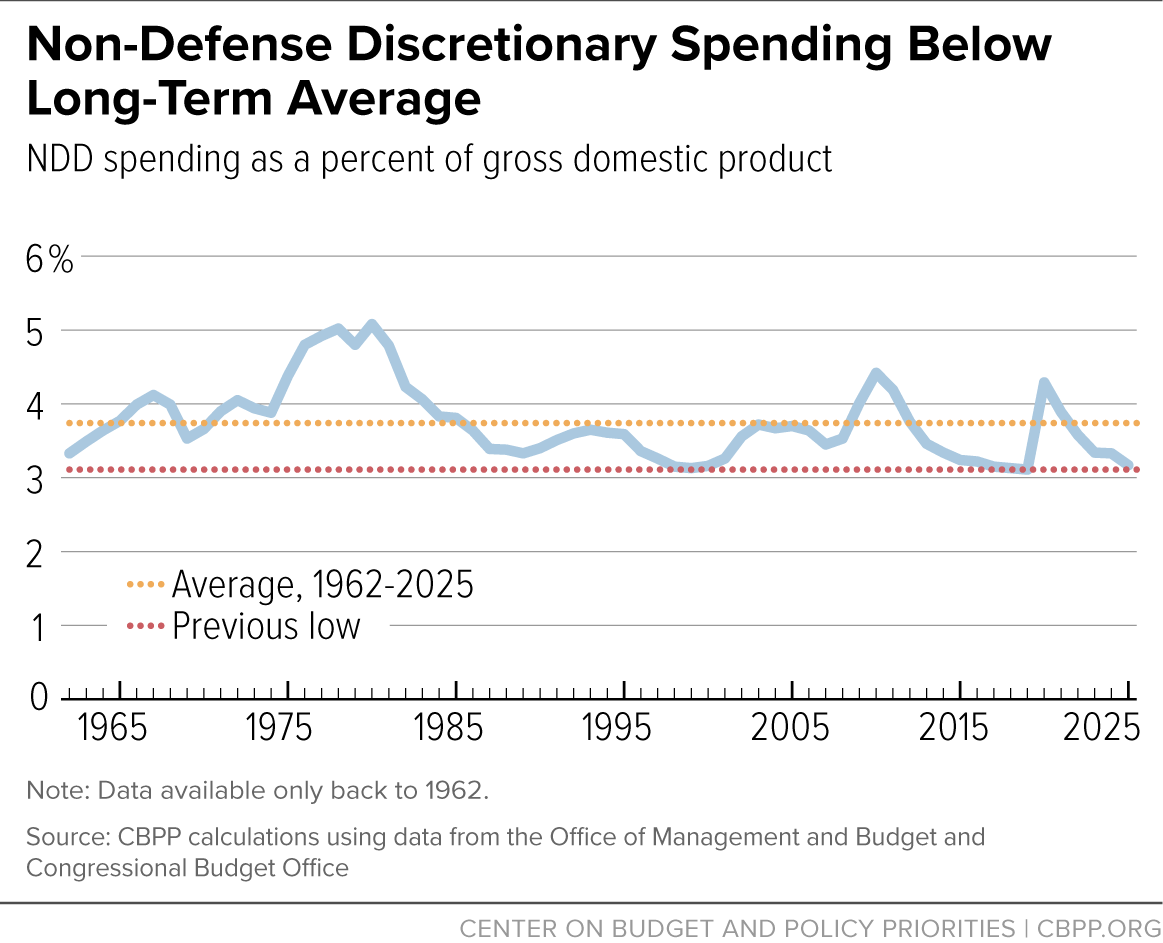
The decline that started after 2010 reflects both the temporary nature of assistance provided to mitigate hardship caused by the Great Recession and, more importantly, the impact of the Budget Control Act of 2011, which set statutory caps limiting defense and non-defense discretionary funding for ten years. Similar, tight funding caps were imposed on defense and non-defense funding for 2024 and 2025. In 2025, NDD spending was 3.2 percent of GDP, just above the record low of 3.1 percent.