

Federal Rental Assistance
Federal rental assistance enables 10.1 million people in 5.1 million low-income households to afford modest homes.
What Is Federal Rental Assistance?
Three major programs — Housing Choice Vouchers, Section 8 Project-Based Rental Assistance, and public housing — assist about 87 percent of the households receiving federal rental assistance.
Other programs serve specific populations, including the Section 202 and Section 811 supportive housing programs for older adults and people with disabilities, respectively; Housing Opportunities for Persons with AIDS (HOPWA); and the McKinney-Vento permanent housing programs for people experiencing homelessness.
Tribal governments can provide rental assistance for American Indians and Alaska Natives living on tribal lands through the Indian Housing Block Grant, the main source of federal housing assistance for tribal nations. Tribal nations do not generally receive funding for other federal rental assistance programs.
In addition, the Department of Agriculture (USDA) provides rental assistance for two-thirds of the units in properties it helps fund. For detailed, state-by-state data on most rental assistance programs see the National and State Housing Fact Sheets & Data.
The Department of Housing and Urban Development (HUD) oversees all federal rental assistance except the USDA Section 521 Rural Rental Assistance program.
Other federal programs provide grants, tax credits, or reduced-interest loans to build or rehabilitate rental housing. But such programs generally do not make units affordable to families with the lowest incomes unless these families also receive rental assistance.
How Does Federal Rental Assistance Help Recipients?
Federal rental assistance helps families afford uncrowded housing and avoid homelessness or other kinds of housing instability. By limiting housing costs, it also leaves families with more resources for other expenses such as food, medicine, child care, and transportation. Some HUD programs connected to federal rental assistance, such as the Family Self-Sufficiency Program, also provide families with opportunities to build savings and achieve other financial goals.
Rental assistance programs like Section 811, Section 202, and HOPWA are designed to provide affordable, accessible housing along with intensive coordinated services for specific populations through a supportive housing strategy. Housing Choice Vouchers can also be used for supportive housing when combined with services to address physical and mental health and substance use conditions, and to help with other issues such as finding employment or applying for benefits.
Rental assistance can also help expand housing choice and increase access to lower-poverty, higher-resource neighborhoods for families with low incomes. It is particularly effective in broadening choice for people of color, who disproportionately live in high-poverty areas due to a long history of discriminatory government policies, including those that have limited where people of color could live while simultaneously starving those neighborhoods of resources.
Research shows that when rental assistance enables families to live in lower-poverty neighborhoods, their children are significantly more likely to attend college and have higher earnings as adults, and parents can enjoy major health improvements such as lower rates of diabetes, extreme obesity, and depression.
Who Is Helped by Federal Rental Assistance?
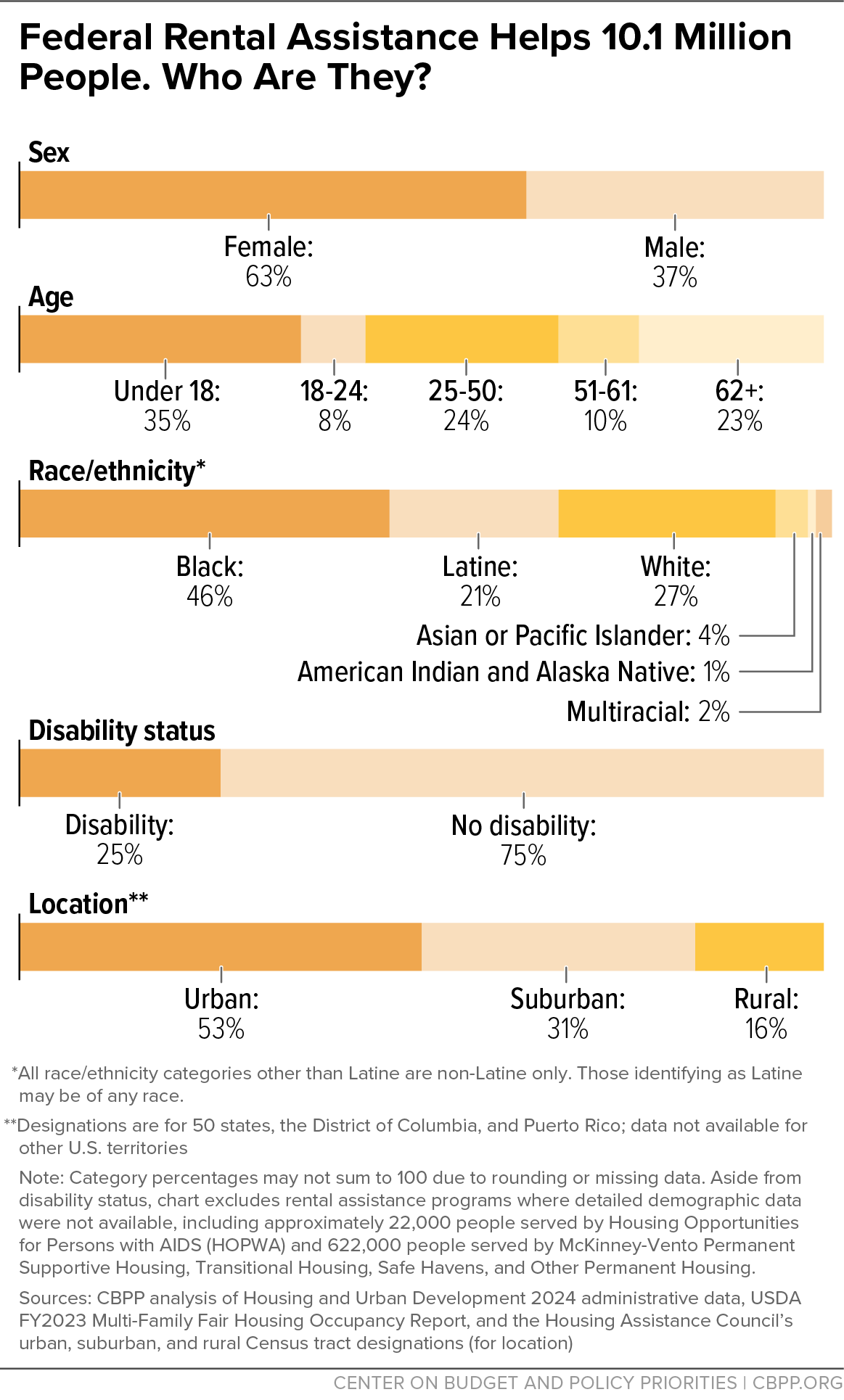
Federal rental assistance makes housing affordable for 10.1 million people, including 3.2 million children. Rental assistance is also important for providing accessible, affordable homes for 2.5 million people with disabilities and 2.1 million older adults.
In 2024, 85 percent of households in HUD-assisted programs were headed by an older adult or person with a disability, or had at least one member who was working or had recently worked.

Who Is Eligible for Federal Rental Assistance?
A household must have a “low income” (which HUD defines as below 80 percent of the local median) to begin receiving federal rental assistance. Some programs limit initial eligibility to households with incomes at or below 50 percent of the local median.
The main rental assistance programs also require that a share of new households admitted have “extremely low incomes,” — that is, not exceeding the higher of 30 percent of the local median or the federal poverty line. Over three-fourths of assisted households have extremely low incomes.
Some rental assistance programs are targeted to certain groups, such as older adults, people with disabilities, veterans, or families and individuals who previously experienced homelessness. Families that include a member whose immigration status makes them ineligible for rental assistance can receive prorated assistance based on the number of family members who are eligible.
Due to funding limitations, 3 in 4 eligible low-income renter households do not receive federal rental assistance, and 8.5 million renter households in 2023 did not receive rental assistance even though they paid more than half their income for housing, lived in substandard housing, or both. (HUD defines these as “worst case” housing needs.) There are long waits for housing assistance in most of the country.
How Much Do Assisted Families Pay for Housing?
Most households who receive rental assistance pay 30 percent of their income (after certain deductions are taken out) for rent and utilities. Households assisted through the major programs usually must pay a minimum rent of $25-$50 per month, even if this amount exceeds 30 percent of the family’s income.
What Role Does the Private Market Play?
Most federal rental assistance is used in privately owned properties. In some rental assistance programs (most notably the Housing Choice Voucher program), families can use vouchers to rent any private apartment that meets program guidelines. In the other programs, rental assistance is “attached” to particular properties.
About 3,700 state and local housing agencies administer the Housing Choice Voucher and public housing programs. These agencies and private owners of properties assisted under the other programs manage the waiting lists, select the tenants who will receive rental assistance, and determine families’ monthly rent contributions in accordance with federal rules.
Where Do Families With Federal Rental Assistance Live?
Families use Housing Choice Vouchers and other federal rental assistance in most communities and in all 50 states, the District of Columbia, and several territories. (See the National and State Housing Fact Sheets & Data for particular states.)
While most rental assistance is used in urban and suburban areas, 16 percent of assisted homes, or 1.5 million people, are in rural areas.
How Is Federal Rental Assistance Funded?
Congress funds rental assistance through annual appropriations. To maintain existing levels of housing assistance each year, Congress must provide sufficient funding for each program based on the number of households receiving assistance and adjustments for inflation. Failure to provide sufficient resources to cover program costs can result in a reduction of rental assistance, which already fails to meet the need.
Because rental assistance programs are funded on a yearly basis, the programs do not expand automatically when people need more help, such as during a recession.