

Trump Administration’s Undercutting of Oversight Hurts Taxpayers and Beneficiaries
Since the start of President Trump’s second term in January, the Trump Administration has consistently sought to evade accountability. It has engaged in a series of unprecedented, irresponsible, and often illegal steps — reversing long-standing bipartisan commitments to integrity and transparency through actions that will increase the risk of fraud and make it more difficult to impartially determine when the Administration is taking illegal or imprudent action. This hostility to oversight has been on display as the President has removed Inspectors General (IG) and the Administration has defunded operations supporting IGs’ work, undercutting independent agency oversight.
Last month, the President removed a Senate-confirmed Inspector General, in flagrant violation of legal removal procedures, for the 17th time this year.[3] Since firing many of these IGs in January, President Trump has kept most of these positions vacant for over eight months. (See Figure 1.) The President has continued active interference in IG offices, reportedly removing the U.S. Federal Housing Finance Agency's acting Inspector General early this week in retaliation for seeking to provide information to Congress and federal prosecutors consistent with the statutory responsibilities and duties of the office.[4]
And at the start of October, the Administration defunded the Council of the Inspectors General on Integrity and Efficiency (CIGIE), which supports the operations of more than 70 IGs across the federal government. This defunding brought down CIGIE’s website, which is a repository for tens of thousands of reports with IG findings on waste and fraud, as well as more than two dozen other IG websites run by CIGIE that provided whistleblower resources.[5]
Evidence indicates that President Trump did not fire the IGs for cause, but instead in retaliation or to prevent unwanted investigations. Indeed, despite media reports and allegations of misconduct across many executive branch agencies, few IGs have published investigations into allegations of illegal actions, self-dealing, and mismanagement by the second Trump Administration during its first nine months.
Fears of Trump Administration retribution and congressional inaction may be contributing to IG silence and a less-informed public. For example, a whistleblower at the Social Security Administration (SSA) earlier this year alleged that the acting IG instituted an informal policy not to contradict or criticize the so-called Department of Government Efficiency (DOGE).[6] Among the issues the SSA OIG has yet to report on: DOGE’s access to sensitive SSA data, in violation of laws and protocols; a report that SSA had moved the sensitive data of hundreds of millions of people to an insecure cloud environment, without effective monitoring; and the impacts and risks from the largest staffing reduction in SSA history.[7]
Moreover, the Administration has not limited its attacks on oversight to IGs. President Trump also removed the director of the Office of Government Ethics and the head of the U.S. Office of Special Counsel.
These actions are enabling the Administration to act with limited accountability or independent oversight, reducing transparency and deterring whistleblowers who might report wrongdoing.
Inspectors General Serve Key Oversight Roles
More than 70 federal IGs are established by statute, including 36 who the President must appoint and the Senate must confirm.[8] By law, these IGs are nonpartisan officials selected “solely on the basis of integrity and demonstrated ability” who serve the public (and the executive branch and Congress) by leading independent oversight of an agency’s programs and operations across administrations.[9]
IGs conduct audits and investigations on the programs and operations of their agencies, including in response to whistleblower reports of wrongdoing. They make recommendations to promote economy, efficiency, and effectiveness, as well as to prevent and detect problems. Unless removed or transferred by a President with a substantive rationale provided to Congress, most IGs may serve indefinitely, and as a result, they typically serve across multiple administrations.
While IGs are not tasked with questioning the merits of policy goals or the organizational aims of an agency’s leadership, it is their responsibility to investigate and report on:[10]
- Waste, fraud, and abuse — including abuse of authority
- Violations of the law, rules, or regulations, and other forms of misconduct
- Mismanagement of agency operations
- Allegations of whistleblower retaliation
In fiscal year 2024, the federal IG community issued 2,042 audit, inspection, and evaluation reports and conducted investigations that resulted in 3,675 criminal prosecutions and 1,015 civil actions.[11]
President Trump’s Mass Firing of Inspectors General Is Unjustified and Illegal
The Administration has intentionally sought to silence, defang, or end cooperation with independent, nonpartisan government oversight bodies. In the first week of the Trump Administration, the President illegally removed, without cause, 15 of the 25 presidentially appointed and Senate-confirmed IGs who were serving at the beginning of his Administration.
These firings violated the bipartisan-enacted requirements of the Inspector General Act that the Administration provide 30 days of advance notification and detailed and case-specific reasons for the terminations.[12] The President’s January mass firing of IGs was — according to a District Court judge — an “obvious” violation of the Inspector General Act and the first time in over four decades that a President removed any IGs at the start of a Presidential term.[13] Presidents have traditionally allowed IGs to serve across administrations, even when there is a change in the party affiliation of the President or a turnover in agency leadership, to avoid even the appearance of seeking to install loyalists and undercutting the independence and credibility of IGs.[14]
There is compelling evidence that President Trump did not fire the IGs for cause, but instead in retaliation or to prevent unwanted investigations. For instance, the Inspector General of the Department of Homeland Security could have been fired for cause after being recommended for potential removal by a panel of fellow IGs in 2024 after the panel found he had abused his authority, engaged in substantial misconduct, and acted in ways that undermined the independence and integrity of his office.[15] But he was one of the few presidentially appointed IGs who President Trump did not fire.
In contrast, two weeks after the mass removal of IGs to at the start of Trump’s term, USAID’s Inspector General was fired after his office released a report warning that the Administration’s actions had “significantly impacted USAID’s capacity to disburse and safeguard its humanitarian assistance programming” and left oversight of humanitarian aid “largely non-operational.”[16]
The 2025 IG firings reflect a pattern that was evident in the first Trump Administration. In early 2020, during President Trump’s first term, five IGs and acting IGs were removed in what appeared to be retaliation over critical reports or to stifle unwanted investigations. At the time, then-Senator Mitt Romney described the firings as a “threat to accountable democracy and a fissure in the constitutional balance of power.”[17]
After Mass Firings, Inspectors General Have Been Quiet on Trump Administration Misconduct
Following the wave of January 2025 IG firings, President Trump has kept most of these positions vacant for over eight months without even nominating replacements, leaving career officials serving indefinitely as acting IGs.[18] (See Figure 1.)

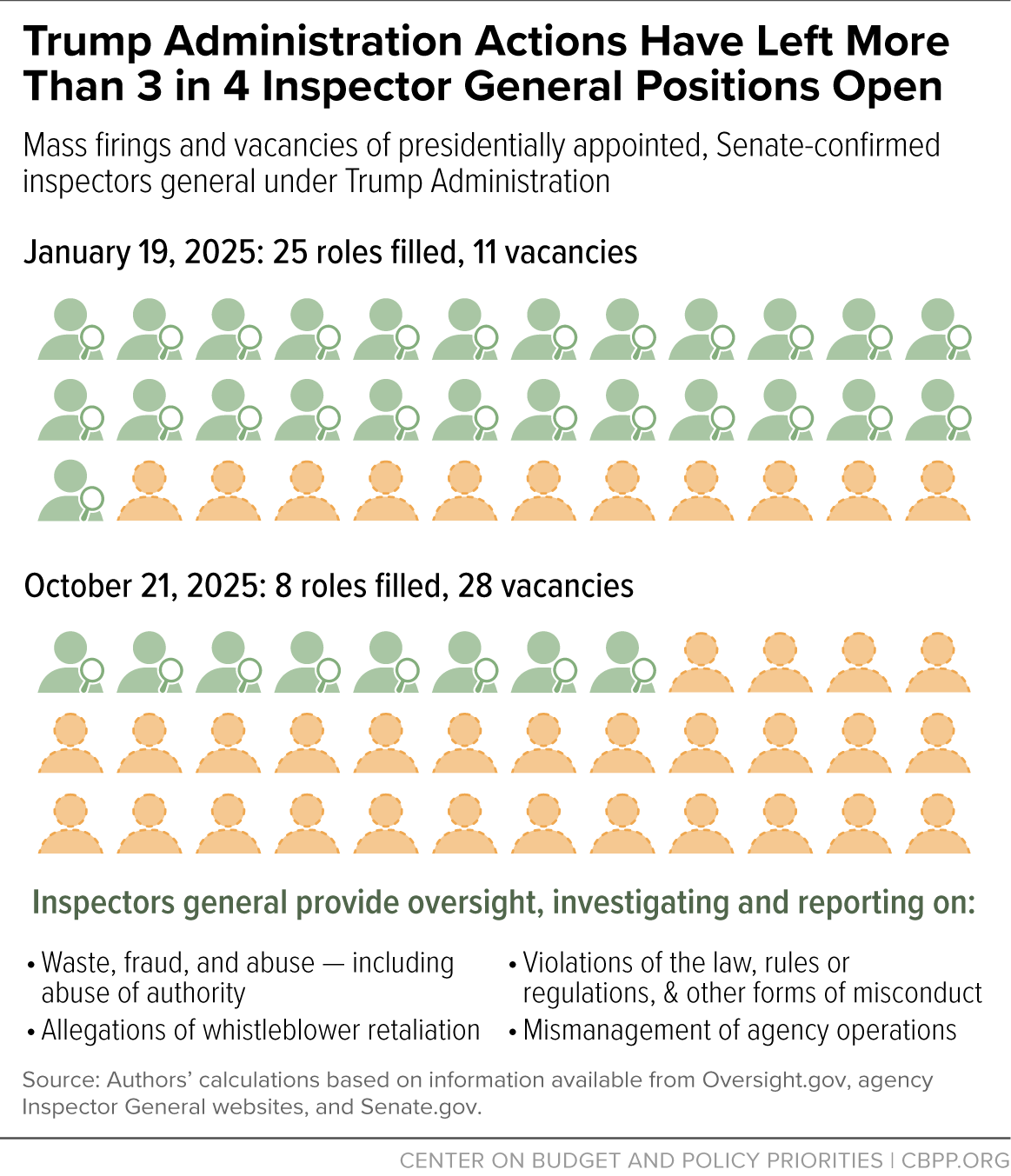
These firings and vacancies raise significant concerns about the ability of IG offices (OIGs) to act independently and assertively. Having seen their predecessors fired without cause, or in apparent retaliation for investigations that displeased the Administration, acting IGs and their staff may be reluctant to pursue new investigations into Administration misconduct or law breaking, for fear of removal or retaliation, or due to decreased morale.[19] Indeed, few IGs have published investigations into allegations of illegal actions, self-dealing, and mismanagement by the Trump Administration during its first nine months, despite extensive media reports and allegations of such misconduct across many executive branch agencies.[20] While IG staff can take a long time to complete thorough and fair investigations, they may also opt for fast-track reviews using agile oversight practices when agencies face critical vulnerabilities or challenges — as the USAID IG did within less than three weeks of the Trump Administration’s staffing reductions and pause on foreign assistance affecting the agency’s operational capacity.[21] The widespread silence of IG offices since then suggests that some acting IGs may be avoiding or delaying investigations into subjects that may trigger backlash by the Administration.
One such example is at the Social Security Administration (SSA), where a whistleblower reported that the acting IG instituted an informal policy not to contradict or criticize the so-called Department of Government Efficiency (DOGE).[22] The SSA OIG has yet to weigh in on, for example:
- DOGE’s access to sensitive SSA data, in violation of laws and protocols, which led to the ouster of SSA’s acting commissioner in February and an ongoing legal fight in federal court.[23]
- SSA’s decision to temporarily suspend electronic birth and death reporting in Maine, despite leaked correspondence indicating that agency leadership knew it would increase improper payments, fraud, and identity theft, and that the action was taken in retaliation for Governor Mills’s comments to President Trump.[24]
- The decision to intentionally and illegally mark living people as dead in the Death Master File to — according to the DOGE-selected acting Commissioner — “terminate the financial lives” of immigrants whose status the Trump Administration revoked, in an effort to force them out of the country.[25]
- An August whistleblower report that SSA had moved the sensitive data of hundreds of millions of people to an insecure cloud environment, without effective monitoring, which an assessment by career staff deemed to have a high risk of “catastrophic impact.”[26]
- The operational impacts and risks stemming from the largest-ever staffing reduction in SSA history.[27]
OIGs also appear to be encountering hurdles in concluding investigations and audits, in part due to the Administration’s lack of cooperation — such as the reported refusal of the Department of Education to release information to its OIG regarding the agency’s reductions in force and the Administration’s attempts to shutter the agency.[28]
Chilling Effects on Whistleblowing Amid Reduced OIG Capacity
The removal of IG leadership with next to no pushback or consequences is likely having a chilling effect on whistleblowing. After all, if Congress will not protect Inspectors General from removal without cause, a whistleblower is unlikely to feel confident that acting IGs will protect them from retaliation.[29] In addition, whistleblower reporting portals at least temporarily shut down when the Trump Administration illegally defunded the Council of the Inspectors General on Integrity and Efficiency (CIGIE), a cross-government effort that helps to train inspectors general staff and hosts important oversight resources, at the end of September.[30]
The Office of Management and Budget (OMB) denying available funds to CIGIE led Republican Senators Chuck Grassley and Susan Collins to warn that “important functions that help prevent and detect waste, fraud, and abuse throughout the government” would be terminated.[31] An OMB spokesperson accused the IGs of having “become corrupt, partisan, and in some cases, have lied to the public”— with no evidence or support for the claim.[32]
Some agencies are going further to chill whistleblowing, with Secretary of Defense Pete Hegseth directing changes to due process for Inspector General processing of whistleblower reports, placing increased scrutiny on those who make multiple complaints.[33]
The Administration has also degraded the capacity of IG offices across government through significant reductions in staffing. When the Administration sought to push out hundreds of thousands of federal employees, IG offices were typically not excepted from the threats of mass layoffs or involuntary reassignment that pushed many to take resignation incentives and buyouts. Many offices were also hit with hiring freezes. For example, the SSA OIG lost roughly 14 percent of its staff in the first six months of the Administration, the largest decline in that office’s history, as trained auditors and investigators were pushed out or reassigned to take claims in SSA field offices.[34] Various staff of other OIGs have briefed bipartisan staff of the Senate Committee on Homeland Security and Governmental Affairs about similar or even larger losses of staff capacity.[35]
Rather than seeking to rebuild this lost oversight capacity, and despite the sizeable annual return on investment that OIGs produce, the Administration instead proposed cutting funding for OIGs by up to 30 percent in the President’s fiscal year 2026 budget request.[36]
Attacks on Oversight Hindering Investigations Into Ethics Compliance and Prohibited Personnel Practices
The Administration’s attacks on oversight have not been limited to IGs. In February, President Trump removed the director of the Office of Government Ethics — the agency responsible for overseeing ethics compliance across the executive branch, including enforcement of the ethics rules for special government employees such as those who have worked for DOGE.[37] President Trump also removed the head of the U.S. Office of Special Counsel (OSC), which is meant to safeguard federal employees from illegal personnel actions, including whistleblower retaliation, and enforces restrictions on partisan political activity by government employees.[38]
The Administration temporarily replaced the leaders of both offices with the same Cabinet official holding three jobs on an acting basis for several months. That created immediate conflicts of interest, which “functionally impaired” OSC as a pathway for relief for federal employees, according to one federal judge, and neutered the independent functioning of both offices.[39] After the Special Counsel was replaced, OSC immediately closed its investigation into the Administration’s mass firings of probationary employees and admonished those agencies that did not engage in them, despite a district court finding that agencies followed an “unlawful directive” in carrying out the terminations. The former Special Counsel has said that OSC is no longer independent and should not be “considered a safe place for whistle blowers to go.”[40]
The Administration has also sought to hinder the nonpartisan Government Accountability Office’s (GAO) ability to provide oversight of agencies on behalf of Congress, particularly in fulfilling its responsibilities in determining whether the Administration has illegally withheld funds provided by Congress. After GAO found on several occasions that the Administration violated spending laws and engaged in illegal impoundments, the OMB director said that GAO is “something that shouldn’t exist.”[41]
OMB also publicly directed agencies not to “feel compelled to cooperate at all with GAO.”[42] OMB also sought to block GAO, Congress, and other auditors’ ability to oversee the Administration’s compliance with spending laws by illegally hiding required budget data until lawsuits once again forced disclosure of the information.[43]
Together, these actions are enabling the Administration to act with limited accountability or independent oversight, reducing transparency for the public into areas of potential or actual fraud, waste, and abuse, and having a chilling effect on whistleblowers who might otherwise report wrongdoing. Absent action by Congress or the courts, integrity, efficiency, effectiveness, and enforcement of the rule of law in federal activities will inevitably further suffer as a result.
End Notes
[1] Cristin Dorgelo served as Senior Advisor for Management in the Office of Management and Budget during the Biden Administration. She is President Emerita of the Association of Science and Technology Centers. Previously, she served as the Chief of Staff and as Assistant Director for Grand Challenges in the Office of Science and Technology Policy during the Obama Administration.
[2] Nia Law is a Special Assistant and Research Associate at Groundwork Collaborative.
[3] Luke Broadwater, “Trump Dismisses Another Inspector General, Fueling Oversight Concerns,” New York Times, October 21, 2025, https://www.nytimes.com/2025/10/21/us/politics/trump-inspectors-general.html.
[4]Sarah N. Lynch, Chris Prentice and Marisa Taylor, “Exclusive: Trump ousts watchdog of US housing regulator involved in mortgage probes of his foes, sources say,” Reuters, November 4, 2025, https://www.reuters.com/world/us/watchdog-being-ousted-us-housing-regulator-involved-trump-crackdown-sources-say-2025-11-03/.
[5] Nataline Alms, “Judiciary Democrats launch watchdog website amid withheld funding from inspector general group,” Nextgov, October 16, 2025, https://www.nextgov.com/digital-government/2025/10/judiciary-democrats-launch-watchdog-website-amid-withheld-funding-inspector-general-group/408861/. For an archive of oversight.gov as of September 30, 2025, see https://web.archive.org/web/20250930215117/https://www.oversight.gov/.
[6] HSGAC Minority Staff Report, “Unchecked and Unaccountable: How DOGE Jeopardizes Americans’ Data Without Regard for Law and Congress,” September 2025, https://www.hsgac.senate.gov/wp-content/uploads/DOGE_REPORT_FINAL_7.pdf.
[7] Kathleen Romig and Devin O’Connor, “Reassignment Won’t Fix the Largest-Ever Social Security Staffing Cut,” CBPP, June 23, 2025, https://www.cbpp.org/research/social-security/reassignment-wont-fix-the-largest-ever-social-security-staffing-cut.
[8] Congressional Research Service, “Statutory Inspectors General in the Federal Government: A Primer,” November 13, 2023, https://www.congress.gov/crs-product/R45450
[9] Inspector General Reform Act of 2008, https://www.govinfo.gov/content/pkg/PLAW-110publ409/pdf/PLAW-110publ409.pdf.
[10] Inspector General Act of 1978, https://www.govinfo.gov/content/pkg/USCODE-2012-title5/pdf/USCODE-2012-title5-app-inspector.pdf.
[11] Andrew Rice, “CIGIE Report: IGs Saved Over $71 Billion in FY24,” MeriTalk, March 21, 2025, https://www.meritalk.com/articles/cigie-report-igs-saved-over-71-billion-in-fy24/.
[12] Zeke Miller, Eric Tucker, and Will Weissert, “Trump fires more than a dozen independent inspectors general,” Associated Press, January 25, 2025, https://apnews.com/article/trump-inspectors-general-fired-congress-unlawful-4e8bc57e132c3f9a7f1c2a3754359993.
[13] Ana Reyes, “Memorandum Opinion: Civil Action No. 25-cv-415,” US District Court for the District of Columbia, September 24, 2025, https://storage.courtlistener.com/recap/gov.uscourts.dcd.277385/gov.uscourts.dcd.277385.54.0_2.pdf.
[14] The one exception was President Reagan, the first President to serve following enactment of the original Inspector General Act of 1978. After firing all the presidentially appointed IGs on Inauguration Day, the Reagan Administration faced bipartisan pushback — including the ranking Republican member of the House Government Operations Committee calling it a “mistake.” President Reagan reappointed five of the dismissed IGs at the end of March. See: Robert Pear, “Ouster of all Inspectors General by Reagan Called a Political Move,” New York Times, February 3, 1981, https://www.nytimes.com/1981/02/03/us/ouster-of-all-inspectors-general-by-reagan-called-political-move.html; and Francis Clines, “Reagan Reappoints Five to be Inspectors General,” New York Times, March 27, 1981, https://www.nytimes.com/1981/03/27/us/reagan-reappoints-five-to-be-inspectors-general.html.
[15] Council of the Inspectors General on Integrity and Efficiency, “Report of Findings for Integrity Committee Case 20-059,” October 2, 2025, https://oversightdemocrats.house.gov/sites/evo-subsites/democrats-oversight.house.gov/files/evo-media-document/2024-10-02-IC20-059-Letter-to-the-President-Redacted-w-Encls.pdf.
[16] Jennifer Hansler, “USAID IG fired day after report critical of Trump administration’s dismantling of the agency,” CNN, February 11, 2025, https://www.cnn.com/2025/02/11/politics/usaid-inspector-general-fired-trump.
[17] C.J. Ciaramella, “Trump Is Gutting the Inspector General System, and Most Republicans Don’t Care,” Reason, May 20, 2020, https://reason.com/2020/05/20/trump-is-gutting-the-inspector-general-system-and-most-republicans-dont-care; J. Edward Moreno, “Romney denounces multiple IG firings as ‘threat to accountable democracy’,” The Hill, May 16, 2025, https://thehill.com/homenews/senate/498165-romney-denounces-multiple-ig-firings-threat-to-accountable-democracy/.
[18] As of October 21, 2025, following the confirmation of two nominees earlier in the year, there were six nominees for 28 vacant Inspector General roles requiring Presidential appointment and Senate confirmation. In a few of the instances where a nominee has been put forward, the nominee’s impartiality and credibility has been questioned, including a Republican former state representative accused of violating ethics law and a Republican state official who was forced to resign for mishandling taxpayer funds. See Mark Lee Greenblatt, “These inspector general nominees serve their own interests, not America’s,” The Hill, May 2, 2025, https://thehill.com/opinion/congress-blog/5277564-white-house-inspector-general-nominees/.
[19] See, for example, Senate Committee on Homeland Security and Governmental Affairs Minority Staff Report, “Undermining the Watchdogs: The 19 Independent Inspectors General Fired by President Trump Uncovered Billions in Fraud, Waste, and Abuse,” May 2025, pp.50-54, https://www.hsgac.senate.gov/wp-content/uploads/REPORT.pdf.
[20] There are exceptions. For example, the Treasury Inspector General for Tax Administration (TIGTA) has released reports analyzing the firing of probationary employees and other workforce reductions at the IRS that have provided important information for oversight of these significant personnel moves. See TIGTA, “Snapshot Report: IRS Workforce Reductions as of May 2025,” July 18, 2025, https://www.tigta.gov/sites/default/files/reports/2025-08/2025ier027fr.pdf; and TIGTA, “IRS Terminated Probationary Employees Without Following Internal Procedures and Considering Individual Performance,” August 14, 2025, https://www.tigta.gov/sites/default/files/reports/2025-08/2025ier028fr.pdf.
[21] Pandemic Response Accountability Committee, “Agile Oversight in a Time of Crisis,” March 5, 2024, https://pandemicoversight.gov/media/file/agile-oversight-a-time-crisis-lessons-learned-and-best-practices; USAID OIG, “Oversight of USAID-Funded Humanitarian Assistance Programming Impacted by Staffing Reductions and Pause on Foreign Assistance,” February 10, 2025, https://oig.usaid.gov/sites/default/files/2025-02/USAID%20OIG%20-%20Oversight%20of%20USAID-Funded%20Humanitarian%20Assistance%20Programming%20021025.pdf.
[22] HSGAC Minority Staff Report, “Unchecked and Unaccountable: How DOGE Jeopardizes Americans’ Data Without Regard for Law and Congress,” September 2025, https://www.hsgac.senate.gov/wp-content/uploads/DOGE_REPORT_FINAL_7.pdf.
[23] Jacob Leibenluft, Devin O’Connor, and Kathleen Romig, “Trump Administration, DOGE Activities Risk SSA Operations and Security of Personal Data,” CBPP, April 1, 2025, https://www.cbpp.org/research/social-security/trump-administration-doge-activities-risk-ssa-operations-and-security-of.
[24] Fatima Hussein and Patrick Whittle, “SSA acting chief faces calls to resign over decision to cut Maine contracts,” Associated Press, April 2, 2025, https://apnews.com/article/social-security-benefits-retirement-trump-mills-transgender-100540d59a1a8a2c919397ce047e5a75.
[25] Devin O’Connor and Sam Berger, “Trump and DOGE Claim Power to Falsely List Living Persons as Dead in Social Security Records,” CBPP, April 15, 2025, https://www.cbpp.org/blog/trump-and-doge-claim-power-to-falsely-list-living-persons-as-dead-in-social-security-records.
[26] Dana Gold and Andrea Meza, “Protected Whistleblower Disclosure of Charles Borges Regarding Violation of Laws, Rules & Regulations, Abuse of Authority, Gross Mismanagement, and Substantial and Specific Threat to Public Health and Safety at the Social Security Administration,” Government Accountability Project, August 26,, 2025, https://whistleblower.org/wp-content/uploads/2025/08/08-26-2025-Borges-Disclosure-Sanitized.pdf.
[27] Kathleen Romig and Devin O’Connor, “Reassignment Won’t Fix the Largest-Ever Social Security Staffing Cut,” CBPP, June 23, 2025, https://www.cbpp.org/research/social-security/reassignment-wont-fix-the-largest-ever-social-security-staffing-cut.
[28] Arthur Jones, II, “Democrats accuse McMahon of stonewalling Department of Education IG,” ABC News, June 4, 2025, https://abcnews.go.com/Politics/democrats-accuse-mcmahon-stonewalling-department-education-ig/story?id=122462890
[29] Government Accountability Project, “Government Accountability Project, Lawyers for Good Government, and Stand Up For Science Announce Representation of FEMA Whistleblowers Facing Retaliation,” September 2, 2025, https://whistleblower.org/press/government-accountability-project-lawyers-for-good-government-and-stand-up-for-science-announce-representation-of-fema-whistleblowers-facing-retaliation-2/.
[30] Meryl Kornfield, “Trump administration moves to defund inspector general watchdog group,” Washington Post, September 30, 2025, https://www.washingtonpost.com/politics/2025/09/30/inspector-general-watchdog-cuts-trump/.
[31] U.S. Senate Committee on the Judiciary, “Grassley, Collins Urge OMB to Release Appropriated Inspector General Funds,” September 30, 2025, https://www.judiciary.senate.gov/press/rep/releases/grassley-collins-urge-omb-to-release-appropriated-inspector-general-funds.
[32] Kornfield.
[33] Memorandum for Secretaries of Military Departments, “IG Oversight and Reform: Enhancing Timeliness, Transparency, and Due Process in Administrative Investigations,” September 30, 2025, https://media.defense.gov/2025/Sep/30/2003812317/-1/-1/1/SECRETARY-OF-WAR-ANNOUNCED-MEMORANDUMS.PDF.
[34] Unpublished SSA data shows that the total number of OIG employees declined from nearly 500 in early February 2025 to fewer than 430 in early August 2025, excluding employees who accepted deferred resignations. Historical data going back to SSA OIG’s establishment in 1995 shows that the previous largest single-year decline was less than 4 percent. OIGs staffing has likely reached its lowest level in over 25 years. See William Morton, “Social Security Administration (SSA) Staffing Levels: Data Brief,” Congressional Research Service, September 29, 2025, https://www.congress.gov/crs-product/R48725.
[35] Senate Committee on Homeland Security and Governmental Affairs Minority Staff Report, “Undermining the Watchdogs: The 19 Independent Inspectors General Fired by President Trump Uncovered Billions in Fraud, Waste, and Abuse,” May 2025, https://www.hsgac.senate.gov/wp-content/uploads/REPORT.pdf, pp.54-56.
[36] Caroline Cornett, “Report Outlines Contributions of Inspectors General Fired by Trump,” Lawfare, July 23, 2025, https://www.lawfaremedia.org/article/report-outlines-contributions-of-inspectors-general-fired-by-trump. For example, the President’s 2026 budget request included proposed reductions for OIGs in the Department of Justice (30 percent cut), National Science Foundation (26 percent cut), Department of Agriculture (10 percent cut), Department of Defense (7 percent cut), Department of Housing and Urban Development (6.5 percent cut), among others. See Patty Murray, “Senator Murray on President Trump’s Budget Request,” May 30, 2025, https://www.murray.senate.gov/senator-murray-on-president-trumps-budget-request-2/.
[37] Cristin Dorgelo and Sam Berger, “Unprecedented Use of Special Government Employees Raises Serious Ethical Concerns,” Center on Budget and Policy Priorities, May 1, 2025, https://www.cbpp.org/blog/unprecedented-use-of-special-government-employees-raises-serious-ethical-concerns.
[38] Sean Michael Newhouse, “Ethics and whistleblower officials fired by Trump,” Government Executive, February 11, 2025, https://www.govexec.com/management/2025/02/ethics-and-whistleblower-officials-fired-trump/402887/.
[39] William Alsup, “Order on Cross-Motions For Summary Judgement, No. C 25-0180 WHA” United States District Court Northern District of California, September 12, 2025, https://storage.courtlistener.com/recap/gov.uscourts.cand.444883/gov.uscourts.cand.444883.261.0_1.pdf.
[40] Andrea Hsu and Carrie Johnson, “Beyond ‘draining the swamp’: How Trump is knocking down checks on presidential power,” NPR, September 17, 2025, https://www.npr.org/2025/09/17/nx-s1-5475191/trump-executive-power-supreme-court-whistleblower.
[41] Jason Miller, “From Director Vought to A-11 update, OMB minimizing GAO’s role,” Federal News Network, September 4, 2025, https://federalnewsnetwork.com/congress/2025/09/from-director-vought-to-a-11-update-omb-minimizing-gaos-role/.
[42] Mark Paoletta, “OMB OGC Letter to DOT Re GAO NEVI Opinion,” Office of Management and Budget, June 3, 2025, https://www.whitehouse.gov/wp-content/uploads/2025/08/OMB-OGC-Letter-to-DOT-Re-GAO-NEVI-Opinion-6-3-25.pdf.
[43] Devin O’Connor and Joe Carlile, “Trump Administration Abused Spending Safeguards to Advance Its Agenda — and Illegally Hid Its Actions,” CBPP, September 5, 2025, https://www.cbpp.org/research/federal-budget/trump-administration-abused-spending-safeguards-to-advance-its-agenda-and.