

The Economy: Is It Bad? Well, It’s Not Good
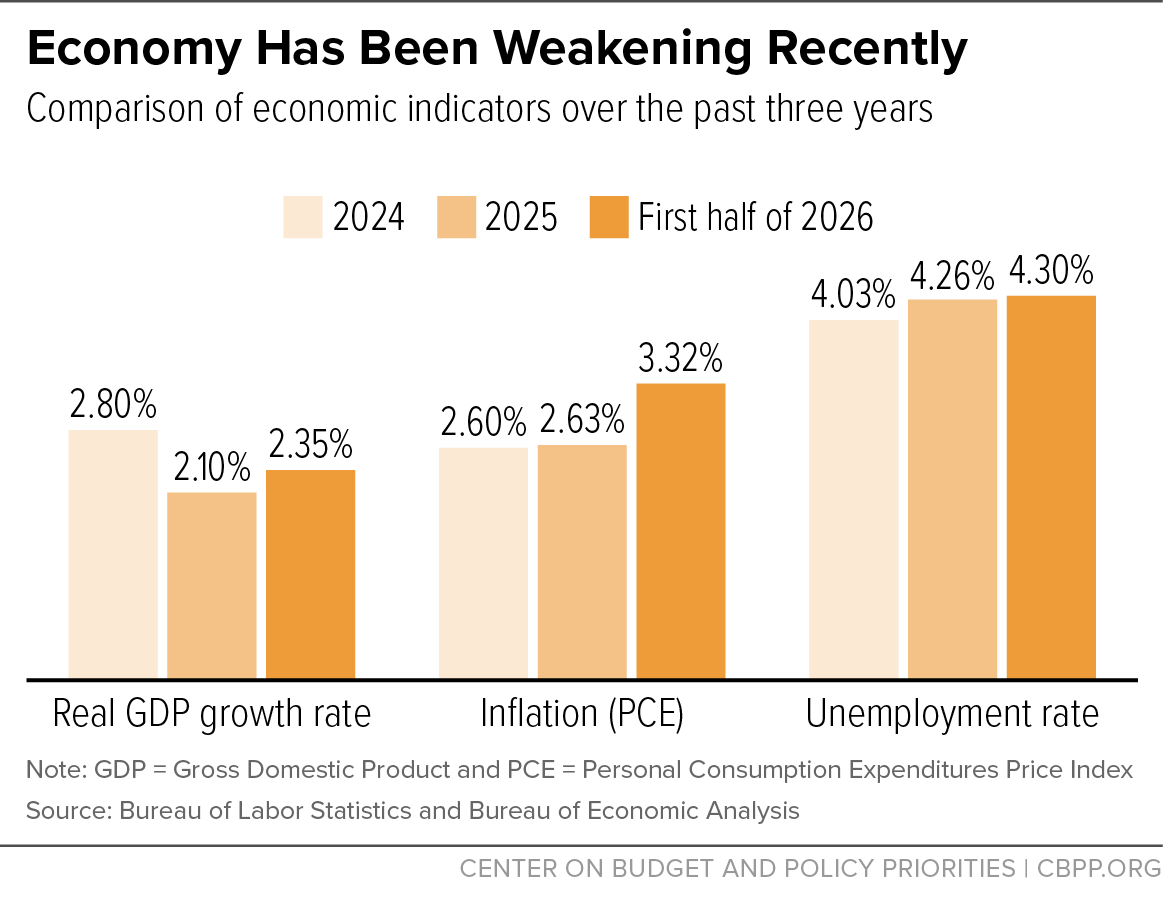
People in the U.S. are not feeling good about the economy. Public sentiment about the economy reached historic lows in the first half of 2026, falling to levels typically seen during recessions. This was true whether consumers, businesses, or farmers were surveyed. While the economy may not be as bad as these surveys suggest, several key economic indicators did weaken in 2026, a trend that started in 2025.[1]
Two major factors have contributed to the softness in the overall economy during the first half of 2026: the Trump Administration’s chaotic and harmful tariff policy and its war in Iran, which led to the closure of the Strait of Hormuz, the destruction of energy infrastructure in the region, and high oil prices that are rippling through the economy.
The economy was in relatively good shape at the end of 2024, at least according to standard macroeconomic indicators. Economic growth and unemployment in 2024 were basically on par with pre-pandemic years, albeit with elevated inflation.[2]
Since then, the economic growth rate has fallen and inflation has risen. (See Figure 1.) Unemployment has remained relatively stable, but workers are facing a low-hire labor market, and wage growth has dropped below inflation. Warning signs are also coming from the bond market where interest rates are rising, resulting in higher borrowing costs for businesses, consumers, and the federal government.

Moderate Economic Growth
The real GDP growth rate was propped up in the first half of 2026 by consumer spending and massive business investment in artificial intelligence (AI), which masked some worrisome trends. The slight uptick in GDP in the first half of 2026 may also reflect the rebound in spending from the resumption of government activity after a shutdown ended in late 2025. The shutdown had dragged down GDP growth at the end of 2025, with some estimating it reduced growth by 0.1 to 0.2 percentage points.[3]
Consumer spending represents two-thirds of GDP and is a key driver of GDP growth. Consumer spending growth was small in the first quarter of 2026, contributing only 0.5 percentage points to GDP growth, but it rebounded in the second quarter, contributing 2.5 percentage points to GDP growth. However, this spending was driven not by rising incomes, but rather by declining savings. The consumer savings rate fell from 5.6 percent in January 2026 to 4.1 percent in September 2026, indicating that facing higher prices, households are lowering savings to keep up their consumption. This trend is likely not sustainable; at some point if the trend continues, consumer spending will slow.
Business investment spending was strong in the first half of 2026, supporting GDP growth. Much of this is related to spending on AI, even though a large share of AI investment includes purchases of parts and equipment from overseas, which mutes the impact of this investment on domestic economic growth.[4]
Rising Inflation
The rise in prices in the first half of 2026 has been driven by the Administration’s chaotic and haphazard tariff regime and the conflict in the Middle East.
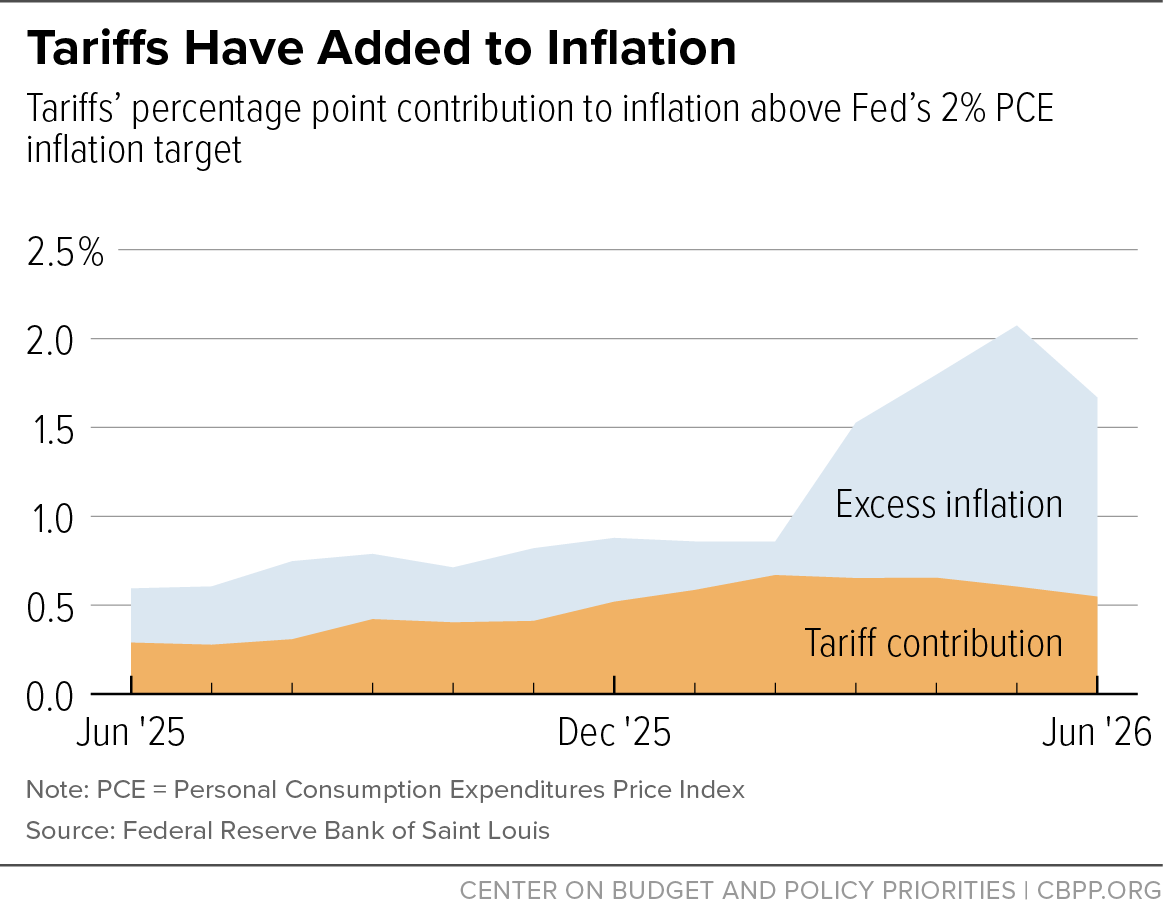
The tariffs caused prices to rise not just for consumers but for businesses of all sizes. The on-again, off-again nature of the tariff regime also led to uncertainty in the economy. While the volatility slowed after the Supreme Court struck down the International Emergency Economic Powers Act tariffs in February 2026, the Administration continued imposing tariffs through other authorities, keeping prices high.
Consumers have seen higher prices as a result of the tariffs. (See Figure 2.) Economists have estimated that tariffs added nearly two-thirds of a percentage point to the inflation rate.[5] While some businesses did not initially pass on the higher cost of inputs to consumers, it has become more difficult for businesses to absorb those costs over time.

Tariffs continue to squeeze small businesses, since they have limited ability to shift supply chain strategies to avoid tariffs. Small businesses also lack the resources to navigate the complexity of the Administration’s tariff regime and therefore experience higher costs that put them at greater risk of bankruptcy.[6]
At the end of February 2026, the Administration started a war in Iran, which led to the closure of the Strait of Hormuz. This conflict expanded throughout the region, leading to the destruction of energy infrastructure. Since a large share of the world’s oil flows through the region, prices of gas, diesel, and fertilizer have spiked, disrupting the global economy. In the U.S.:
- Gas prices jumped from an average of $3 per gallon in February 2026, prior to the war, to over $4 per gallon as of October 2026.
- Diesel prices have reached record highs of over $6 per gallon, as of October 2026.[7] Since most goods are transported by truck, rail, or ship, rising diesel prices increase the cost of moving freight, which is typically passed on to consumers as higher prices on goods, including groceries. A 2013 study found that trucks ship 83 percent of agricultural products and 92 percent of dairy, fruit, vegetables, and nuts.[8]
- Fertilizer prices spiked earlier in the year by 30 percent, putting a financial strain on farmers who were already struggling with the effects of tariffs on steel, aluminum, and even fertilizer itself.
Low-Hire Labor Market
While the unemployment rate has remained relatively low, at around 4 percent, the labor market has not been good for workers. It has been characterized by low hiring and slowing wage growth.

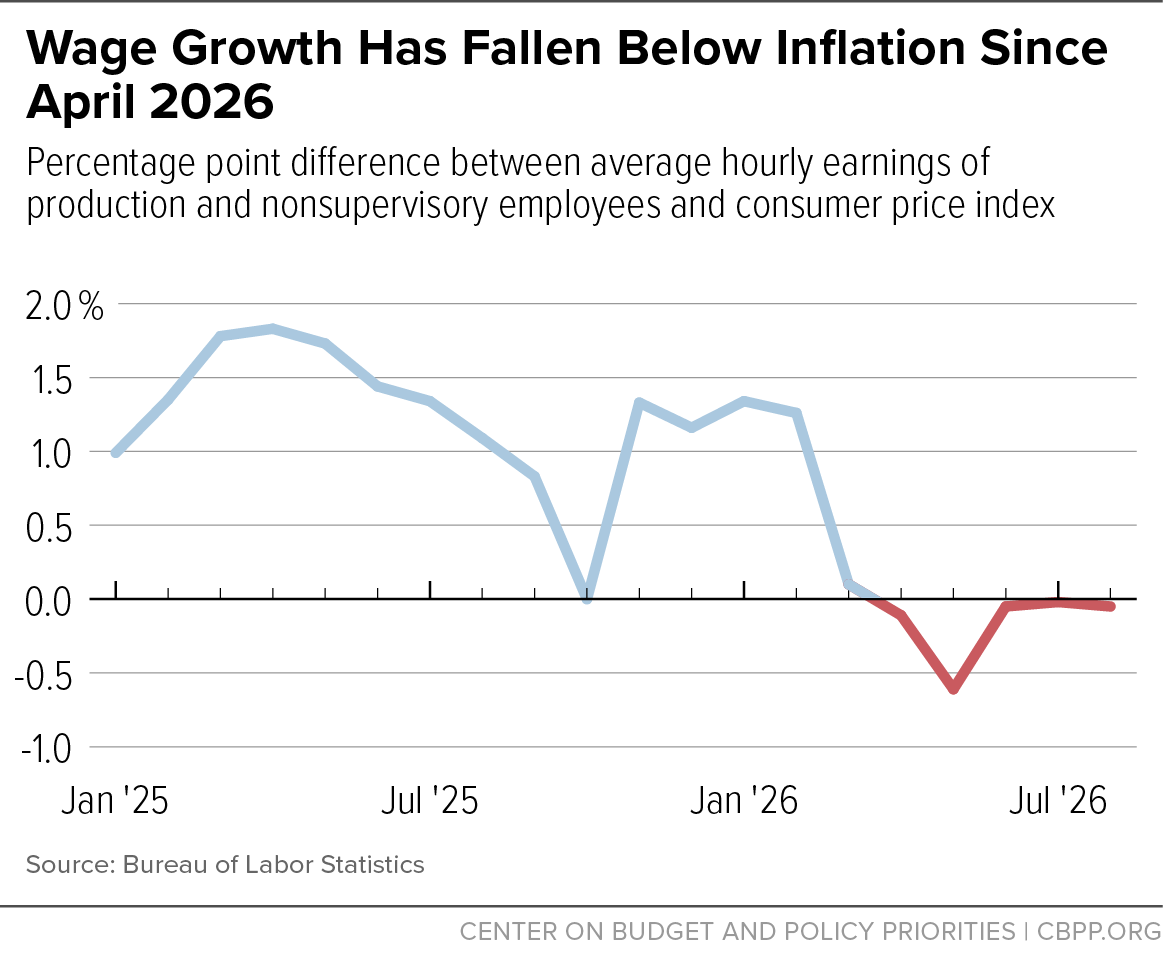
Wage growth occurs when workers have options to leave their jobs. If hiring is low, that pathway to higher wages disappears.[9] In 2026, hiring has been low, as evidenced by Job Openings and Labor Turnover Survey (JOLTS) data[10], and average wage growth has slowed and has not kept up with rising inflation. (See Figure 3.) Moreover, since April 2026, average wage growth has fallen below the inflation rate. When wage growth is not keeping pace with rising prices, people, particularly those with low or middle incomes, are less able to afford the goods and services they are used to purchasing and must find ways to stretch their dollars even further.
The labor force participation rate, which is the share of the population that is employed or actively looking for work, has fallen by nearly a full percentage point since the beginning of 2026. But the decline in the rate largely reflects a longer-term trend resulting from an aging population rather than something specific to 2026. As people age, they are more likely to leave the workforce. In contrast, prime-age labor force participation (those ages 25-54) has been fairly steady and at historically high levels, averaging 83.5 percent over the past year and a half. This is one of the strong points of today’s economy, but the labor market is not strong enough currently to result in wage growth.
Warning Signs From the Bond Market
Other measures beyond the standard macroeconomic indicators of growth, inflation, and unemployment suggest headwinds for the economy. A notable example is the interest rate on Treasury bonds. The yield on a 10-year Treasury first rose to 5 percent on September 16, 2026, which is its highest level since 2007, right before the Great Recession. This is particularly concerning because many interest rates that affect consumers and businesses are based on the 10-year Treasury. For example, the 30-year mortgage rate follows the 10-year Treasury, and mortgage rates are now over 7 percent, having fallen below 6 percent at the end of February 2026.
There are several major drivers of higher interest rates including rising inflation; the nation’s large federal debt; and corporate bond issuance, including by AI-related companies. Inflation is rising from the conflict in the Middle East, which has caused rising energy prices. With higher inflation, bond holders need a higher rate on the bond to make purchasing it worthwhile.
The persistently high annual deficit, which is estimated to have hit 6 percent of GDP in fiscal year 2026, has driven higher interest rates. In fact, the 2021-2025 non-interest deficits were the highest since World War II (measured as a percent of GDP) excluding those years when the unemployment rate exceeded 7 percent, when we expect deficits to rise in response to recession. To finance our growing debt, which is now roughly equal to the size of the economy, the federal government must issue more bonds. To a lesser extent, rising corporate bond issuance has impacted bond yields. These bonds have been competing with government bonds, and to get investors to purchase them, government bond yields have needed to rise.
The Bottom Line
The economy is not in recession — unemployment remains relatively low and there continues to be real GDP growth. But there is a reason polls find that people in the U.S. are negative on the economy – wages aren’t keeping up with inflation, workers correctly perceive that there are few new or alternative job opportunities for them in this low-hire labor market, and inflation and interest rates are making purchases and borrowing more expensive. These issues don’t stem from natural disasters or even the business cycle. The Trump Administration’s policies — tariffs, the war in the Middle East, and deficit-increasing tax cuts — are harming the economy by limiting economic growth, increasing inflation, weakening the labor market, and pushing up interest rates.
End Notes
[1] Gbenga Ajilore, “A Weakening Economy, and a Drastically Cut Economic Support System,” CBPP, November 5, 2025, https://www.cbpp.org/blog/a-weakening-economy-and-a-drastically-cut-economic-support-system.
[2] Ajilore, op. cit.
[3] Congressional Research Service, “The 2025 (FY2026) Government Shutdown: Economic Effects,” January 29, 2026, https://www.congress.gov/crs-product/R48832.
[4] Michael Waugh, “Trade in AI-Related Products,” National Bureau of Economic Research Working Paper 35053, April 2026, https://www.nber.org/papers/w35053.
[5] Maximiliano A. Dvorkin et al., “Tariff Effects on Inflation Stabilize in Recent Months,” Federal Reserve Bank of St. Louis, August 18, 2026, https://www.stlouisfed.org/on-the-economy/2026/aug/tariff-effects-inflation-stabilize-recent-months.
[6] Scott Lincicome, “Small Businesses Despise Trump’s Tariffs – For Good Reason,” Bloomberg, August 14, 2026, https://www.bloomberg.com/opinion/articles/2026-08-14/trump-s-tariffs-are-an-existential-threat-to-small-businesses.
[7] Mark Niquette and Steven T. Dennis, “Record Diesel Prices Hit at Worst Time in Key Battleground States,” Bloomberg, September 16, 2026, https://www.bloomberg.com/news/features/2026-09-16/midterm-elections-rising-us-diesel-heating-oil-prices-hit-voters-in-key-states.
[8] Richard Volpe, Edward Roeger, and Ephraim Leibtag, “How Transportation Costs Affect Fresh Fruit and Vegetable Prices,” Economic Research Service, November 2013, https://www.ers.usda.gov/publications/45168.
[9] Erik Hurst et al., “Sticky Wage Norms and the Real Wage Cost of Unexpected Inflation,” National Bureau of Economic Research Working Paper 35624, August 2026, https://www.nber.org/papers/w35624.
[10] Stephanie Hughes, “The Latest JOLTS Survey Shows More of the Same Low-Hire, Low-Fire Economy,” Marketplace, September 29, 2026, https://www.marketplace.org/story/2026/09/29/low-hire-low-fire-economy-marches-on-latest-jolts-data-shows.