Fuera de Serie
PERSPECTIVAS SOBRE LAS POLÍTICAS
MÁS ALLÁ DE LOS NÚMEROS
MÁS ALLÁ DE LOS NÚMEROS
Este contenido no está disponible en Español.
New York Times Warns Against “Dynamic Scoring”
A New York Times editorial this weekend raised several red flags about so-called “dynamic scoring” — that is, including estimates of the macroeconomic effects of policy changes in official cost estimates for tax and spending legislation. We strongly agree. Our recent paper making the case against dynamic scoring, and a short summary we released today, explain that:
- Current budget estimates aren’t “static.” The Congressional Budget Office (CBO) and the Joint Committee on Taxation (JCT) incorporate in their cost estimates many changes in individuals’ and companies’ behavior in response to proposed changes in tax rates and other policies.
- Dynamic estimates are highly uncertain. Different models and assumptions produce widely varying estimates of how policy changes would affect the overall economy. Some models’ results depend on assumptions about how future Congresses will reduce deficits. And the models all have significant gaps.
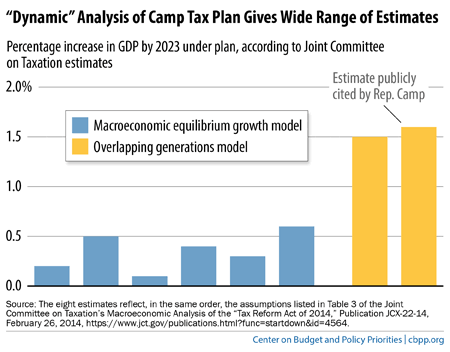
- Dynamic estimates are prone to manipulation. Because of this uncertainty, congressional leaders will likely cherry-pick the model and assumptions that give the most favorable estimates. That’s exactly what House Ways and Means Chairman Dave Camp did in touting the highest estimates of economic and revenue growth for his tax reform proposal — estimates more than ten times greater than JCT’s lowest ones. (See figure.)
- CBO did not use dynamic scoring for the 2013 Senate immigration bill. Some members of Congress claim, incorrectly, that CBO used dynamic scoring to estimate the bill’s budgetary effects. CBO’s official cost estimate took account of the bill’s direct effect on the U.S. population and labor force. But it did not include estimates of the bill’s more speculative and uncertain effects on the economy, such as its effects on investment and productivity.
You can follow me on Twitter at @PaulNVandeWater and my co-author Chye-Ching Huang at @dashching.
Imagen