Special Series: Economic Recovery Watch
Results per page: 50 | 100
-
Relief for States and Struggling Families Provides Substantial Boost to Employment
November 20, 2009
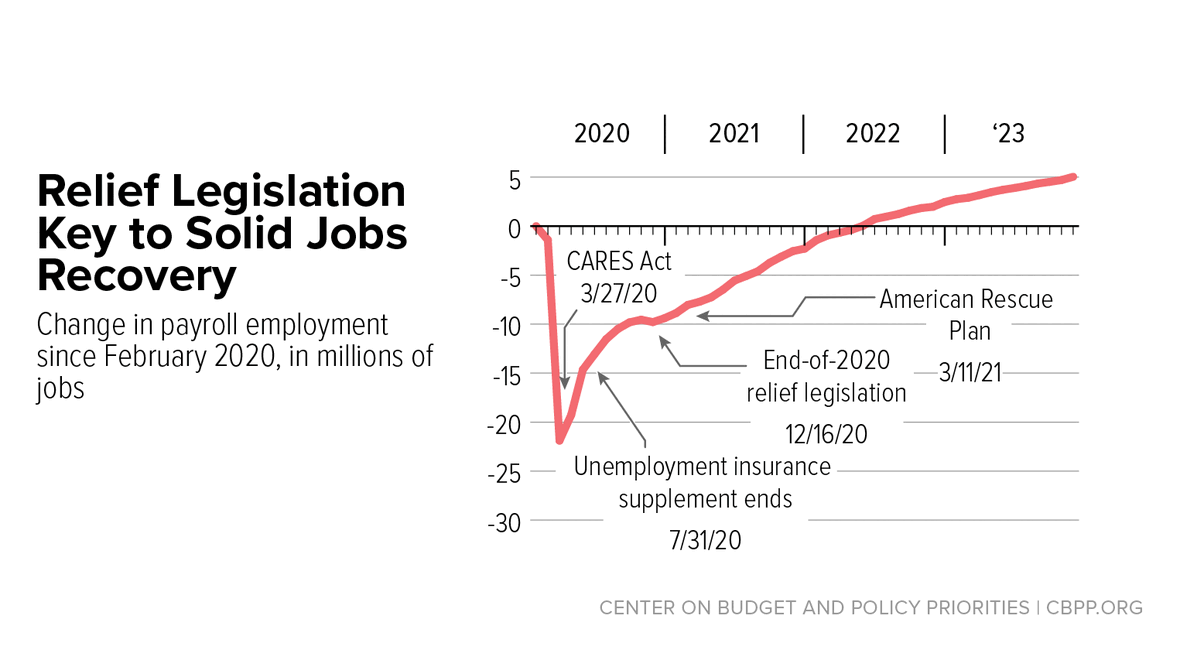
The economy is in a very deep hole and faces a long climb back to full employment. Policymakers can make that climb easier by extending or bolstering key provisions of the American Recovery and Reinvestment Act (ARRA) enacted at the start of the year — particularly those related to unemployment insurance and state … -
Additional Federal Fiscal Relief Needed to Help States Address Recession’s Impact
Updated November 19, 2009
States face a serious fiscal problem that could force them to institute additional deep budget cuts and tax increases in 2010, weakening the fragile economic recovery and harming vulnerable children, seniors, and people with disabilities, among others. The federal assistance that states received for their Medicaid programs … -
Video: CNBC Interviews Jim Horney on the Economy and the Federal Budget Deficit
November 12, 2009
CNBC interviews Jim Horney on the Economy and the Federal Budget Deficit
Duration: 6:02
-
Video: CNN cites CBPP on Potential Job Losses Due to State Budget Cuts
November 12, 2009
-
Podcast: State Budget Cuts and Tax Increases Put Fragile Economic Recovery at Risk
November 11, 2009
The risk that, without more federal aid, states efforts to address their budget problems could cost the economy 900,000 jobs is discussed by Bob Greenstein, Mark Zandi, chief economist of economy.com, and Senior Advisor Iris Lav.
Duration: 21:42
-
Podcast: The October Unemployment Report and What It Means for the Economy
November 6, 2009
The jobs report for October is discussed by Chief Economist, Chad Stone.
Duration: 2:35
-
Statement: Chad Stone, Chief Economist, on the October Employment Report
November 6, 2009
Today’s jobs report shows that although the economy turned up in the third quarter, the labor market did not. The unemployment rate crossed into double digits in October, and payrolls shrank for the 22nd straight month. The economy is in a very deep hole and faces a long climb back to full … -
Audio Clip: Michael Leachman Discusses Stimulus and Job Creation on National Public Radio
October 31, 2009
Michael Leachman Discusses Stimulus and Job Creation on National Public Radio
Duration: 1:17
-
The Administration’s October 30 Data Release on Jobs Created by the Economic Recovery Law: What it Will Tell Us and What it Won’t
October 28, 2009
The Obama Administration’s October 30 release of data on jobs created and saved by the American Recovery and Reinvestment Act (ARRA), which the Administration and Congress enacted early this year, will capture only a portion of the jobs created and saved due to ARRA’s limited reporting requirements. ARRA’s … -
Proposed Expansions of Homebuyer Tax Credit Would Be Highly Inefficient and Squander Federal Resources
October 27, 2009
Executive Summary Members of Congress are considering extending — and possibly substantially expanding — the $8,000 homebuyer tax credit enacted as part of the American Recovery and Reinvestment Act (ARRA) of 2009. The credit, which is available to first-time homebuyers with incomes up to $150,000 (up to $75,000 for … -
Case For a Social Security Cost-of-Living Adjustment in 2010 Is Weak
Updated October 15, 2009
Under current law, there will be no cost-of-living adjustment (COLA) in Social Security in 2010 — the first time that has happened since automatic cost-of-living adjustments began in 1975. Several bills before Congress would grant a special increase in Social Security payments for 2010. The inflation … -
Podcast: The Safety Net’s Response to the Recession
October 8, 2009
Director of the Center’s Welfare Reform and Income Support Division, Dr. LaDonna Pavetti, testifies on the safety net's response to the recession before the U.S. House of Representative's Ways and Means Subcommittee on Income Security and Family.
Duration: 10:55
-
Testimony: LaDonna Pavetti, Director of Welfare Reform and Income Support, on the Safety Net’s Response to the Recession
October 8, 2009
Thank you for the opportunity to testify today. My testimony will focus on four points: With recent Census data showing increases in poverty and declines in incomes even before Americans began experiencing the worst effects of the recession — and with further deterioration expected in both areas — policymakers face a … -
Podcast: Discussing the September Unemployment Report and What It Means For the Economy
October 2, 2009
The jobs report for September is discussed by Chief Economist, Chad Stone.
Duration: 3:20
-
Statement: Chad Stone, Chief Economist, on the September Employment Report
October 2, 2009
Today’s jobs report shows that employers will need stronger evidence of a reviving economy before they will start adding workers to their payrolls. Employers shed jobs for the 21st straight month in September (see graph) and the unemployment rate edged up to 9.8 percent. … -
Correcting Five Myths About the Stimulus Bill
Updated September 23, 2009
Some critics of the economic recovery law (or “stimulus” bill) that President Obama and Congress enacted early this year continue to mischaracterize how it was supposed to work and what it was supposed to do. For instance, some critics complain that, because unemployment has risen in recent months, the law is not working. Others claim … -
Harsh Labor Market Conditions Justify Extending Unemployment Benefits in Hard-Hit States
Updated September 23, 2009
On September 22, the House passed H.R. 3548, the Unemployment Compensation Extension Act of 2009, by an overwhelming bipartisan majority of 331 to 83. This legislation, which if enacted would provide additional weeks of unemployment insurance benefits in states with the highest unemployment rates, is an appropriate response to the continuing harsh conditions in the … -
Stimulus Keeping 6 Million Americans Out of Poverty in 2009, Estimates Show
September 9, 2009
Although meant chiefly to help the broad economy, the stimulus plan Congress enacted earlier this year (the American Recovery and Re-Investment Act of 2009, or ARRA) had the important secondary effect of significantly ameliorating the recession’s impact on poverty. This analysis, which comes one day before the Census Bureau will release updated poverty figures … -
Podcast: Discussing the August Unemployment Report and What It Means For the Economy
September 8, 2009
The jobs report for August is discussed by chief economist Chad Stone.
Duration: 2:54
-
Statement: Chad Stone, Chief Economist, on the August Employment Report
September 4, 2009
Today’s employment report shows little evidence that the emerging economic recovery is reviving the job market. Although job losses continued to moderate in August, the percentage of Americans with a job reached its lowest level since 1984 (See figure). Economic activity seems to be increasing, but employers remain reluctant to hire, … -
Podcast: Correcting Myths About the Stimulus Bill
August 17, 2009
Director of Federal Fiscal Policy, Jim Horney, and Director of the State Fiscal Project, Nick Johnson, discuss their paper “Correcting Five Myths About the Stimulus Bill.” They explain how the stimulus legislation is providing a much-needed boost to the economy.
Duration: 4:44
-
Podcast: Discussing the July Employment Report and What it Means for the Economy
August 10, 2009
Chief Economist Chad Stone discusses the jobs report for July and a troubling jump in long-term unemployment. -
Statement: Chad Stone, Chief Economist, on the July Employment Report
August 7, 2009
Today’s employment report shows that labor market conditions remain extremely harsh for job-seekers, generating a record level of long-term unemployment. One third of the unemployed (33.8 percent) have been looking for work for 27 weeks or more — the highest percentage ever … -
Myths and Realities About How States Are Using Economic Recovery Act Funds
July 9, 2009
Two major misconceptions about how state governments are using funds from the economic recovery law that President Obama and Congress enacted early this year are contributing to a broader misunderstanding about whether the law is, in fact, helping the U.S. economy. Evidence that includes a major new report from the Government Accountability Office (GAO) … -
Federal Fiscal Relief Is Working As Intended
Updated June 29, 2009
As dire as the states’ fiscal condition is — with dramatic revenue downturns leading in some cases to unprecedented service cuts — evidence shows this bad situation would be substantially worse if not for federal recovery assistance. The $787 billion American Recovery and Reinvestment Act package enacted in February included about $140 billion for states … -
Press Release: New Fiscal Year Brings Painful Spending Cuts, Continued Budget Gaps In Almost Every State
June 29, 2009
The 2010 fiscal year begins for most states July 1. It brings an austere continuation of recession-driven cuts in essential services and poor prospects for improvement through 2011, according to a series of updated reports on state budget conditions issued today by the Center on Budget … -
Podcast: Discussing the May Employment Report and What it Means for the Economy
June 8, 2009
"[May's] jobs report shows a labor market that is still deteriorating but that offers signs that the worst of the current recession may be over.
"Job losses in May, while still high at 345,000, were less than half of January’s level. The unemployment rate jumped to 9.4 percent but, for the second month in a row, the labor force grew as more people entered it to look for work than left it."
Duration: 4:10
-
Statement: Chad Stone, Chief Economist, on the May Employment Report
June 5, 2009
Today’s jobs report shows a labor market that is still deteriorating but that offers signs that the worst of the current recession may be over. Job losses in May, while still high at 345,000, were less than half of January’s level. The unemployment rate jumped to 9.4 percent but, for the second month in a row, the labor force grew as more people … -
Podcast: Discussing the April Employment Report and What it Means for the Economy
May 8, 2009
"Today’s jobs report brings more sobering news about the depth and duration of the recession. Even if the economy hits bottom soon and begins growing again, it will take time to reverse the severe job losses and sharp increase in unemployment that have already occurred.... [I]t is important that as many states as possible take advantage of the incentive funding to modernize their [unemployment insurance] programs."
Duration: 5:57
-
Statement by Chad Stone, Chief Economist, on the April Employment Report
May 8, 2009
Today’s jobs report brings more sobering news about the depth and duration of the recession. Even if the economy hits bottom soon and begins growing again, it will take time to reverse the severe job losses and sharp increase in unemployment that have already occurred. The official unemployment rate hit 8.9 … -
Policy Points: Congressional Budgets Pass Early Tests on Deficits and Economy, but Questions Remain
April 3, 2009
On the whole, the budget plans that the House and Senate approved yesterday pass the twin tests of: (1) beginning to address long-term deficits, or at least not making these deficits worse; and (2) not undermining the fiscal stimulus Congress recently passed. [i] The … -
House Republican Budget Would Aid Wealthy Individuals and Corporations, Cut Public Services, Slow Economic Recovery
April 2, 2009
The House Republican budget, introduced April 1 by Rep. Paul Ryan (R-WI), calls for a massive transfer of resources from the broad majority of Americans to the nation’s wealthiest individuals and corporations.[1] It provides the richest households with a new round of very costly tax reductions by extending the Bush high-income tax cuts and adding another set of tax cuts that … -
Medicaid and CHIP Eligibility Is Protected For Jobless Families That Receive Boost in Unemployment Benefits
March 20, 2009
An estimated 17.9 million jobless workers who become unemployed in 2009 will see their unemployment benefits increase by $25 per week under the American Recovery and Reinvestment Act (ARRA).[1] While unemployment benefits typically are included as income when determining eligibility for Medicaid and CHIP, ARRA excludes this additional $25 per week from the … -
Economic Recovery Package Would Give 3.8 Million Low- and Moderate-Income Students — Thousands in Every State —Access to Higher-Education Tax Credit
Revised February 26, 2009
The “Hope Credit,” which provides a tax subsidy for college tuition costs, was established in 1997. Its goal, in part, was to enable students who could not otherwise afford to attend college to do so. Yet until now, 3.8 million prospective college students — more than a fifth of all high-school-age children nationwide … -
Overview of the TANF Provisions in the Economic Recovery Act
February 26, 2009
The TANF provisions in section 2101 of the American Recovery and Reinvestment Act of 2009 create a new Emergency Contingency Fund under which states can receive 80 percent federal funding for increases (relative to a base year quarter) in certain TANF-related expenditures in federal fiscal years … -
Tax Aid in Recovery Package Would Reach Large Numbers of Workers in Every State
Updated February 26, 2009
Tax credits in the economic recovery package provide tax relief to most workers. The centerpiece of the tax relief is a new Making Work Pay Credit of up to $400 per worker. The credit phases in at the same rate as Social Security taxes and is available to all workers (except those claimed as another taxpayer's dependent) earning up to $95,000 and … -
American Recovery and Reinvestment Act of 2009: State-By-State Estimates of Key Provisions Affecting Low- and Moderate-Income Individuals
Updated February 25, 2009
The American Recovery and Reinvestment Act of 2009 is designed to boost employment and the economy. It contains a number of spending and tax measures crafted to inject more aggregate demand into the sagging economy. This paper provides state-by-state estimates for a number of the major spending and tax provisions that will affect low- and … -
If States Fail to Use Stimulus Funds as Intended, Efforts to Strengthen Economy Could Be Undercut
February 24, 2009
A few governors and legislative leaders have suggested that their states might not accept the full amount of fiscal relief in the new recovery legislation or might use the funds to finance tax cuts or build up reserves, rather than spend them as Congress intended.[1] Such actions could weaken the new law’s impact, and possibly even … -
Funding For States in Economic Recovery Package Will Close Less Than Half of State Deficits
February 20, 2009
The state fiscal situation is dire. Revenues are declining, and the need for services such as Medicaid is rising as people lose income and jobs. Before passage of the economic stimulus package, state deficits were projected to equal $350 billion over the next 30 months. Because nearly all states are required to balance their budgets, states have begun to cut … -
Despite Critics' Over-Heated Rhetoric, the Economic Recovery Bill Does Not Undermine Welfare Reform
February 17, 2009
The economic recovery legislation provides additional resources to states where more poor families need basic assistance due to the recession and the states have responded by serving more families in their TANF (Temporary Assistance for Needy Families) programs. TANF is the welfare-reform block grant that the 1996 welfare law established to replace … -
Recovery Act Provides Much-Needed, Targeted Medicaid Assistance To States
February 13, 2009
The American Recovery and Reinvestment Act includes an $87 billion temporary increase in the share of Medicaid that the federal government would pay over nine calendar quarters (October 1, 2008, through December 31, 2010). It would provide three elements of Medicaid fiscal relief assistance to states, as outlined below.… -
Recovery Agreement Temporarily Expands Child Tax Credit for Large Numbers of Children in Every State
February 12, 2009
The economic recovery plan that a congressional conference committee has approved will expand the Child Tax Credit for 13 million children in low-income working families. Under the agreement, the child credit will reach 2.9 million new children and will provide another 10 million children with a larger credit than they would have received … -
Statement: Robert Greenstein on the Conference Agreement on the Recovery Package
February 12, 2009
The economic recovery agreement is a major achievement that should provide timely and substantial stimulus to the deteriorating economy. The agreement improves significantly on the Senate bill, paring back several costly Senate-passed tax cuts that would have provided little “bang for the buck” in terms of economic stimulus, while … -
Testimony: Sharon Parrott at the Hearing "Building a Foundation for Families: Fighting Hunger, Investing in Children" before the House Budget Committee
February 12, 2009
Thank you for the opportunity to speak with you today about the current recession, its impacts on poverty and families, and the recovery package. The current recession already has pushed up the unemployment rate from 4.9 percent in December 2007 to 7.6 percent in January 2008. Alternative measures of the labor market paint a bleaker picture.… -
Podcast: Key Differences in the House and Senate Stimulus Plans
February 10, 2009
This podcast featuring Robert Greenstein and Len Burman (Co-director, Urban Institute-Brookings Institution Tax Policy Center and Senior Fellow, Urban Institute) discusses the key differences between the House and Senate economic recovery packages in both the tax and spending areas and address how Congress should resolve them.
Duration: 25:23
-
Senate Changes Make Recovery Package Less Effective
February 10, 2009
The Senate today passed a version of the American Recovery and Reinvestment Act (H.R. 1) that makes a number of changes in the House-passed bill. Contrary to their proponents' claim, these changes — in Senate committees and on the floor last week, as well as by a group of Senators led by Ben Nelson and Susan Collins — have reduced … -
Senate's Cuts to "Fiscal Stabilization Fund" Weaken Stimulus Value of the Economic Recovery Bill
February 10, 2009
Overview and Summary The House economic recovery bill includes a $79-billion “State Fiscal Stabilization Fund” to help state and local governments fund education and other key services. However, the Senate — as a result of the Collins-Nelson amendment — has reduced the amount of funding to $39 billion and … -
Costly Isakson Homebuyer Tax Credit Amendment Would Be Ineffective Stimulus
February 9, 2009
An amendment by Senator Isakson that the Senate added to its economic recovery legislation, providing a new $15,000 tax credit for home purchases in the 12 months after enactment,[1] has low bang for the buck as stimulus and is thus a dubious addition to the package. Unlike the $7,500 first-time homebuyer credit that Congress adopted as part of the Housing and Economic Recovery Act in July 2008 — which the new tax credit … -
Exchange Plan in House Recovery Bill Offers Best Fix For Low-Income Housing Tax Credit
Updated February 9, 2009
The economic downturn has sharply reduced the effectiveness of the Low-Income Housing Tax Credit, the nation’s primary subsidy for development of affordable rental housing. Faced with lower profits and reduced access to capital, fewer corporations are willing to invest in affordable housing in exchange for the credits. As … -
Measure in House Recovery Package — But Not Senate Package — Would Help Unemployed Parents Receive Health Coverage
February 9, 2009
The economic recovery package that the House passed on January 28 would establish a temporary option for states to provide Medicaid coverage to certain workers (and their families) who have become unemployed during this recession. This provision, which is not in the Senate package, would help address a problem many parents face … -
Podcast: Reality Check on the Stimulus Debate
February 5, 2009
This podcast featuring Robert Greenstein discusses whether stimulus proposals being offered in the Senate this week would make the overall recovery package more or less effective in boosting the economy. He also addresses a number of misconceptions circulating around the House and Senate recovery packages.
Duration: 16:50
-
House and Senate Recovery Packages Would Improve Higher-Education Tax Credits
Revised February 2, 2009
The economic recovery package passed by the House last week[1] contains a measure that both would extend the Hope tax credit to nearly 4 million low-income students and make the credit more valuable to millions of middle-income students. The Senate Finance Committee has included a similar proposal in its economic recovery package. The House measure would increase the credit’s maximum … -
Criticisms of House Recovery Package Are Misplaced
January 16, 2009
Contrary to criticisms by some, the House economic recovery package unveiled yesterday is well designed to boost employment and the economy. It contains a number of spending measures crafted to inject more aggregate demand into the sagging economy over the next two years. It also contains tax measures that, while generally less effective as stimulus … -
Economic Recovery Bill Would Add Little to Long-Run Fiscal Problem
January 16, 2009
The $825 billion economic recovery package offered by congressional leaders will have only a very small impact on the nation’s long-term fiscal problem, adding just 3 percent to the budget shortfall through 2050. While the package aims to put millions of unemployed Americans back to work, some question whether the nation can afford to add such a large amount … -
Number of Homeless Families Climbing Due To Recession
January 8, 2009
Executive Summary New data indicate that the number of homeless families with children has climbed in recent months and continues to mount. Although the recovery package that Congress will consider in coming weeks is expected to include measures to restore several million jobs, an unusually large number of people are still likely to fall into severe poverty and to be at risk … -
Converting State Fiscal Relief to Loans Would Render It Ineffective As Stimulus
January 7, 2009
Senate Minority Leader Mitch McConnell’s recent suggestion that the federal government give states loans, not grants, for fiscal relief would make the recovery package considerably less effective in stabilizing the economy and preventing the recession from becoming deeper and more prolonged.… -
Unemployment Insurance Reforms Should Be Part of Economic Recovery Package
January 6, 2009
As part of the forthcoming economic recovery package, Congress and President-elect Obama are reportedly considering a series of reforms to the unemployment insurance (UI) system. These reforms, based on the recommendations of a bipartisan advisory council, would encourage states to modernize the program (which was designed in the 1930s) so that fewer workers — … -
Policy Points: Four Helpful Hints for States Dealing With Deficits
March 12, 2008
States, facing their worst fiscal problems in five years, should consider the following four policy options when dealing with deficits: (1) protect their revenues from the effects of federal tax changes, (2) tap their "rainy day funds," (3) don't rule out revenue increases, and (4) avoid "stimulus" tax cuts. At least 25 states, including several of the … -
New Federal Law Could Worsen State Budget Problems
Revised February 28, 2008
The federal “economic stimulus” package enacted on February 13 not only cuts federal taxes, but also threatens to reduce many states’ corporate and personal income tax revenue this year and next year. The potential revenue loss comes at a particularly problematic time for states, because about half the states …