Policy Basics: Introduction to Public Housing

PDF of this Policy Basics (7pp.)

December 18, 2008

Related Areas of Research

What Is Public Housing?

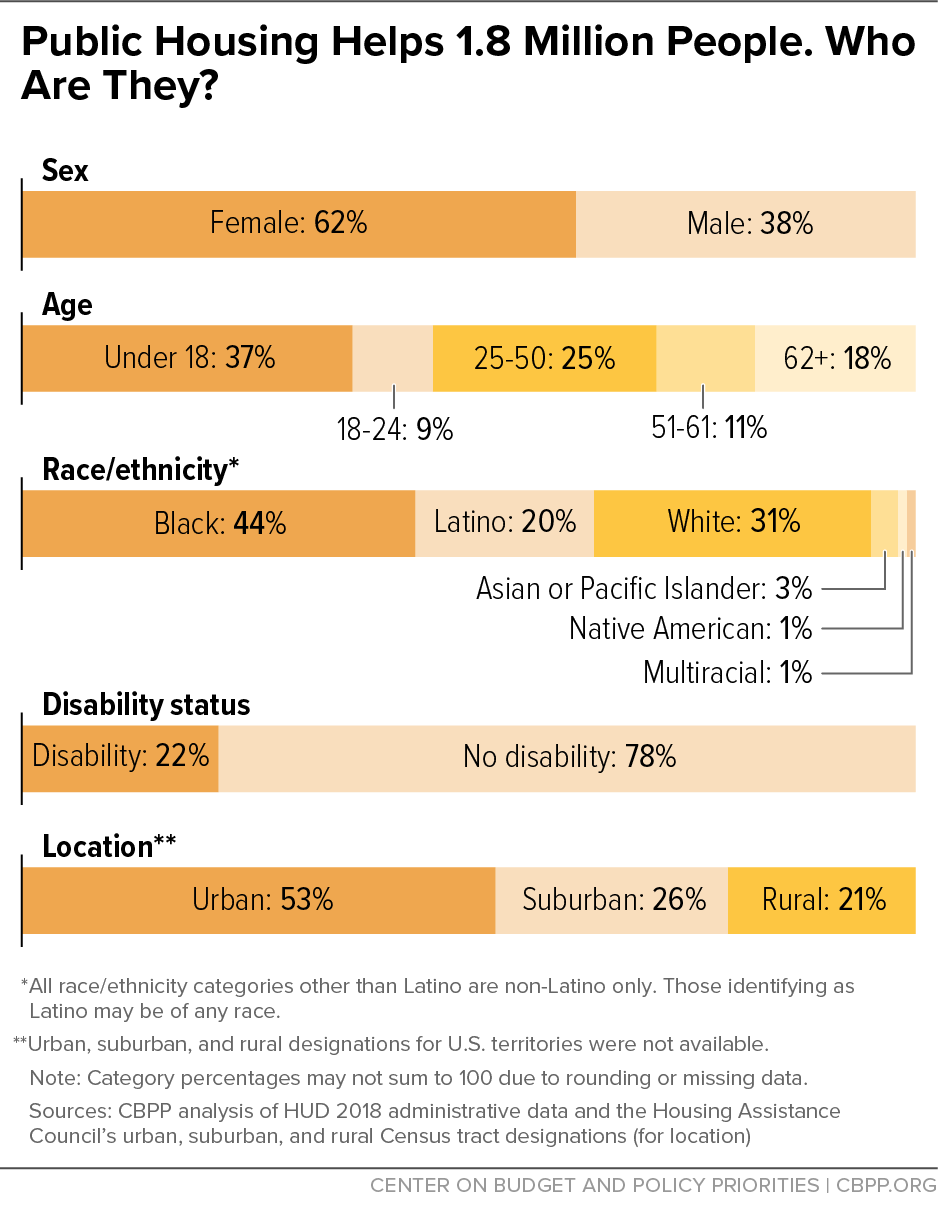
Public housing, one of the nation’s primary housing assistance programs, provides homes to 2.3 million low-income Americans.  Nearly two-thirds of public housing families have members who  are elderly or have a disability.  Public housing is separate from the Section 8 housing voucher program, which helps low-income tenants rent units of their choice in the private market.  It is also distinct from “project-based” Section 8 and other federal programs that subsidize privately-owned affordable housing. 

The nation’s 14,000 public housing developments are located in more than 3,500 cities and towns around the country; about one in five units is in a rural area.  Local public housing agencies own and operate most public housing developments.  Agencies receive federal subsidies to cover the gap between the rents that tenants can afford to pay and the cost of operating and maintaining the developments.

Public housing has changed considerably in recent years, in substantial part due to management reforms and the demolition of many large, troubled developments.  The bulk of the remaining public housing stock is in good physical condition, and few large high-rise developments are left (except in New York City, where high-rise housing is common at all income levels).  Among units where such data are available, more than 60 percent are in tracts with low or moderate poverty rates, meaning that less than 30 percent of residents are poor; only about a fifth of units are in tracts where at least 40 percent of residents are poor.

Because of funding limitations, only one in four households that are eligible for public housing receives any form of federal housing assistance.  Most agencies have long waiting lists for public housing, and some no longer accept new applications because of the size of the backlog.  

The need for housing assistance is very great.  More than 12 million low-income renter households receive no federal housing assistance and face housing problems that public housing (or other housing assistance) would alleviate.  From 2001 to 2005, the number of unassisted low-income renter households whose housing costs exceed 50 percent of their income — a group the Department of Housing and Urban Development (HUD) categorizes as having “severe housing cost burdens” — increased by more than 1 million, or 20 percent.  High housing-cost burdens contribute to housing instability and homelessness, which in turn have cascading effects on the well-being of children and other family members. 

Who Is Eligible for Public Housing?

Local housing agencies have substantial flexibility to determine which families they will serve in public housing, and they are permitted to give particular groups (such as working families or the homeless) preference as units become available.  Agencies must follow certain key requirements, however:

  • Income limits.  All residents of public housing must have incomes below 80 percent of the local area median income at the time they move in; HUD refers to these families as “low-income households.”  Nationally, HUD’s 2008 estimates of 80 percent of median income averaged $47,600 for a family of three and $37,000 for a person living alone.

  • Targeting to the neediest families.  At least 40 percent of households newly admitted to public housing each year must have incomes at or below 30 percent of the area median; HUD refers to these families as “extremely low-income households.”  Nationally in 2008, 30 percent of median income averaged $18,100 for a family of three and $14,100 for a person living alone, close to the poverty line. __Most agencies exceed this 40-percent threshold by a wide margin.  In 2006 (the most recent year for which data are available), 40 percent of newly admitted households had incomes below 15 percent of the area median income, and the median income of all public housing households was $8,788. 

In addition, applicants must meet citizenship and immigration status requirements.  Housing agencies also screen applicants for their suitability as tenants and exclude those who have committed certain (primarily drug-related or violent) crimes or who fail to meet other agency-selected criteria.

Housing agencies are required to apply the above income limits and targeting requirements only when a family moves into public housing, although agencies may evict tenants whose income later rises above 80 percent of the local median.  Otherwise, an agency cannot terminate or refuse to renew a lease unless the tenant engages in drug-related or other threatening criminal activity, or seriously or repeatedly violates the terms of the lease.

According to a 2008 HUD report to Congress, about 15 percent of public housing households leave the program each year, and a 2007 analysis of HUD data shows that the majority live in public housing for four years or less.  But about 25 percent of residents remain for ten years or more; a disproportionate share of such long-term residents are elderly.

Who Lives in Public Housing?

Sixty-four percent of households in public housing include at least one elderly person or an adult or child who has a disability.  More than 50,000 residents are 83 or older.  A number of public housing developments, containing about one-fourth of all public housing units, are set aside for the elderly and people with disabilities, and some additional developments set aside specific sections for those groups.  Many residents who are elderly or have disabilities, however, live in general occupancy or “family” developments, where units are available for all types of households.

Forty-one percent of public housing households are families with children.  Some of these families rely on welfare for income, but this segment has shrunk considerably since the mid-1990s.  Only 19 percent of families with children receive the largest share of their income from welfare, compared to 35 percent in 1997.  About half of public housing families with children rely primarily on earned income.

Nonetheless, a significant subpopulation of “hard-to-house” public housing residents struggle to find and retain jobs or face other serious challenges.  These include families with an array of problems, such as limited work histories, low levels of education, substance abuse, domestic violence, criminal records, and mental and physical health problems.

How Much Do Residents Pay for Rent and Utilities?

Most families who live in public housing are required to pay 30 percent of their income for rent and utilities, after certain deductions from their income.  Families can take deductions for each child and for the cost of child care; there are also deductions for households containing persons who are elderly or have a disability.

Residents are permitted to choose each year whether to pay a flat rent set by the housing agency based on local market rents rather than a rent based on their income.  According to a 2008 analysis of HUD data by Abt Associates, about 11 percent of households opt to pay flat rents.

Housing agencies pay most utility costs in public housing developments directly, generally because units in the developments do not have individual meters.  In buildings that do have individual meters, the family usually pays its own bill to the utility company; the agency then deducts a utility allowance from the family’s rent. 

How Is Public Housing Funded?

The federal government provides three primary funding streams to support public housing: 

  • Public housing operating fund.  This fund is intended to cover the gap between the rents that public housing tenants pay and the development’s operating costs, such as maintenance, security, and agency-paid utilities.  In recent years, however, the federal government has failed to provide enough funding to fill that gap, so agencies have received a “prorated” percentage of the funding for which they are eligible.  (In 2008, this percentage was 89 percent.)  __When agencies do not receive their full operating subsidies, they must make up the difference in other ways — for example, by tapping reserves.  The persistent funding shortfalls in recent years have forced some agencies to take more painful measures, such as charging tenants more for utilities or cutting back on critical services such as maintenance or security.

  • Public housing capital fund.  This fund supports renovation of public housing buildings and replacement of aging appliances and systems.  Congress has cut the capital fund sharply in recent years, and agencies now receive less than the estimated cost of covering the new capital needs that accumulate each year — let alone the cost of addressing the sizable backlog of existing capital needs (see below).

  • HOPE VI.  This program provides competitive grants to support revitalization of severely distressed public housing, where physical and social conditions are particularly poor.  HOPE VI funds can be used for rehabilitation, demolition, construction of replacement housing, acquisition of land (to allow some replacement housing to be built in new locations), and social services for residents who were displaced and families who move into the completed development.  HOPE VI has played a major role in the changes in public housing since the 1990s, but Congress has sharply cut its funding in recent years.  The $100 million provided for 2008 was adequate to revitalize only six severely distressed projects.

In addition to these three main funding streams, some agencies receive supplemental resources from states or localities, or from other federal programs.  One major source of supplemental federal funds is the Low-Income Housing Tax Credit, which supports development and rehabilitation of affordable housing. 

Who Owns and Manages Public Housing?

About 3,100 housing agencies administer public housing.  Most of them are independent housing authorities, whose boards may be appointed by other government officials or elected directly.  Other agencies are part of local or (in a handful of cases) state governments.  While most agencies own and manage their developments themselves, some contract with private companies to manage their developments or transfer ownership to a private subsidiary or other entity that guarantees to maintain the development as public housing. 

Some housing agencies have substantial added flexibility in their administration of public housing because they participate in the Moving-to-Work (MTW) demonstration.  MTW, which Congress authorized in 1996, permits HUD to enter into temporary agreements with a limited number of housing agencies to waive many of the federal rules governing the public housing and voucher programs. Twenty-nine agencies, administering 10 percent of public housing units, participate in MTW today.

Residents have greater opportunities to play a role in managing public housing than is typical in private rental housing.  Each housing agency must establish a resident advisory board that has input into agency planning and policy-making, and tenants have the right to establish additional resident councils at individual developments or for the agency as a whole.  (Agencies receive a small amount of federal funding to support resident participation activities.)  In addition, agencies must have either a public housing resident or voucher holder represented on their governing boards.

What Is the Physical Condition of Public Housing?

Most public housing units are in good condition.  More than 85 percent meet or exceed HUD’s standards, and at least 40 percent of developments are considered physically excellent.  Public housing tenants report physical problems in areas such as plumbing, heating, and electrical systems at rates similar to those for low-income renters generally, according to a HUD survey of tenants in 2003 (the most recent year available).

Nonetheless, developments have a substantial underlying need for capital repairs.  Most units are more than 30 years old, an age that is often considered the “useful life” of residential units absent major renovation.  The most recent assessment, which used 1998 data, estimated that there were $25 billion in unmet needs for capital repairs and improvements.  We estimate these unmet needs at approximately $22 billion in 2009, after taking into account the resources invested in renovating developments and the offsetting accumulation of new needs since 1998.  (Congress has directed HUD to conduct a new study of public housing capital needs, which is expected to be released in 2010.) 

Moreover, even this $22 billion figure is limited to the cost of repairing or replacing existing building features (such as roofs and heating and cooling systems) with only modest upgrades.  Some developments may require more extensive changes, including major reconfigurations of floor plans.  For example, as the nation’s population ages, some communities may determine that they need fewer public housing units large enough to house families and more small units designed to house seniors.  If, for example, 100,000 units were replaced rather than renovated, estimated capital needs would rise from $22 billion to $32 billion.

Why Has the Number of Units Declined Recently?

Congress created the public housing program in 1937; most of today’s developments had been built by the 1970s.  In the mid-1990s, the number of developments began to decline as Congress prohibited the construction of additional developments and federal policy changes made it easier to demolish obsolete buildings.  About 200,000 units have been removed from the program since 1995. In 2008, 1.16 million public housing units remained.

The bulk of the developments removed were demolished because they were obsolete or had deteriorated to the point of uninhabitability.  In other cases, agencies have sold a portion of their public housing stock to raise funds needed to help keep the remainder of their developments in operation.  In still other cases, agencies have retained ownership of their developments but withdrawn them from the public housing program, which allows the agency to charge higher rents but can reduce the share of the units available to poor families.

Housing agencies have built new units to replace only a portion of the public housing units that have been demolished.  For example, agencies that received HOPE VI grants in 2007 and before plan to build about 50,000 new public housing units to replace the 155,000 units demolished under that program.  (The agencies plan to build an additional 50,000 replacement units that are not public housing, most of which will not be affordable to poor families.)

Housing agencies must offer tenants displaced from public housing either a unit in another public housing development or a “tenant protection voucher” that the tenant can use to rent housing in the private market.  In addition, to prevent the elimination of developments from shrinking the number of housing subsidies available in the community, Congress has authorized HUD to issue housing vouchers to replace every unit lost from the public housing program.  HUD has not used this authority consistently, however.  Overall, HUD has issued vouchers for only about 57,000 of the more than 100,000 public housing units lost and not replaced under HOPE VI. 

For further information on public housing and discussion of policy issues facing the program, see “Preserving Safe, High Quality Public Housing Should Be a Priority of Federal Housing Policy.”

  1. Jobs
  2. RSS
  3. Contact Us
 

Sign Up for E-Mail Alerts

RSS Feeds

Multimedia

Browse Reports