An Update on State Budget Cuts
At Least 46 States Have Imposed Cuts That Hurt Vulnerable Residents and the Economy
- State Budget Cuts in the New Fiscal Year Are Unnecessarily Harmful, July 28, 2011
- New School Year Brings Steep Cuts in State Funding for Schools, October 7, 2011
With tax revenue still declining as a result of the recession and budget reserves largely drained, the vast majority of states have made spending cuts that hurt families and reduce necessary services. These cuts, in turn, have deepened states’ economic problems because families and businesses have less to spend. Federal recovery act dollars and funds raised from tax increases have greatly reduced the extent, severity, and economic impact of these cuts, but only to a point. And federal aid to states is slated to expire well before state revenues have recovered.
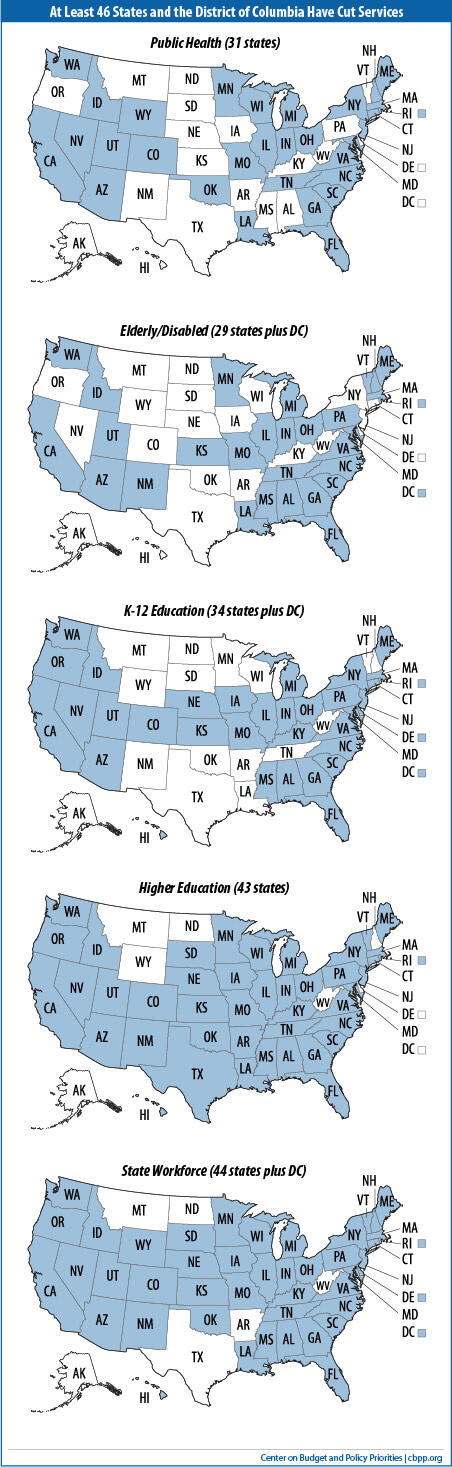
The cuts enacted in at least 46 states plus the District of Columbia since 2008 have occurred in all major areas of state services, including health care (31 states), services to the elderly and disabled (29 states and the District of Columbia), K-12 education (34 states and the District of Columbia), higher education (43 states), and other areas. States made these cuts because revenues from income taxes, sales taxes, and other revenue sources used to pay for these services declined due to the recession. At the same time, the need for these services did not decline and, in fact, rose as the number of families facing economic difficulties increased.
These budget pressures have not abated. Because unemployment rates remain high — and are projected to stay high well into next year — revenues are likely to remain at or near their current depressed levels. This has caused a new round of cuts. Based on gloomy revenue projections, legislatures and governors have enacted budgets for the 2011 fiscal year (which began on July 1, 2010 in most states). In many states these budgets contain cuts that go even further than those enacted over the past two fiscal years.
Cuts to state services not only harm vulnerable residents but also worsen the recession — and dampen the recovery — by reducing overall economic activity. When states cut spending, they lay off employees, cancel contracts with vendors, reduce payments to businesses and nonprofits that provide services, and cut benefit payments to individuals. All of these steps remove demand from the economy. For instance, at least 44 states and the District of Columbia have reduced overall wages paid to state workers by laying off workers, requiring them to take unpaid leave (furloughs), freezing new hires, or similar actions. State and local governments have eliminated over 400,000 jobs since August 2008, federal data show. Such measures are reducing not only the level and quality of services available to state residents but also the purchasing power of workers’ families, which in turn affects local businesses and slows recovery.
States are taking actions to mitigate the extent of these cuts. Since the recession began, over 30 states have addressed their budget shortfalls in part by increasing taxes. Like budget cuts, tax increases remove demand from the economy by reducing the amount of money people have to spend. But tax increases can be less detrimental to state economies than budget cuts because some of the tax increases affect upper-income households, so are likely to result in reduced saving rather than reduced consumption. Many more states will need to consider tax increases or other revenue measures, as well as such steps as tapping remaining state rainy day funds, as a way to minimize harmful budget cuts.
The cuts thus far in state-funded services — and the resulting harm to families’ well-being and to state economies — would have been much greater without federal assistance. The American Recovery and Reinvestment Act provided roughly $140 billion over two and a half years in the form of enhanced Medicaid funding and funding to pay for education, public safety and other services. In addition, H.R. 1586 — the August 2010 jobs bill — extended enhanced Medicaid funding through June 2011 and added $10 billion in additional education funding.
In some cases, it is possible to identify specific services that were slated for cuts but that have been protected in whole or in part by the federal funds; these include child care in Alabama and Arizona, public safety funding in Washington, prescription drugs for seniors and tuition assistance in New York, and education funding in a number of states. The Department of Education found that in an average quarter through June 30, the State Fiscal Stabilization Fund in the Recovery Act funded 266,000 education jobs and 49,000 jobs in other areas, for a total of 315,000 jobs.[1]
In other cases, it is impossible to know what would have happened if states had not received the federal funds. But it is indisputable that families and communities would be facing much more serious consequences from state cuts.
Federal aid to states, however, is scheduled to expire well before state budgets have recovered. Additional funding for Medicaid is set to end at the end of June 2011, the close of most states’ 2011 fiscal year. States will have used up much of their additional federal funding for education at that point also. But the latest available data show state revenues still far below pre-recession levels, resulting in significant state budget shortfalls that will persist into fiscal year 2012 and beyond. Indeed, historical experience and current economic projections suggest that due to declining federal assistance, fiscal year 2012 will be a more difficult budget year for states than any year to date, meaning that state budget cuts could deepen even further, causing deeper private-sector and public-sector job loss.
One way to mitigate the need for additional state spending cuts and protect the economy would be for the federal government to reduce state budget gaps by extending enhanced Medicaid funds over the period that states are expected to experience budget problems rather than cutting enhanced funding off in June 2011. At the very least, the federal government should not take any actions that make states’ budget situations worse. Certain federal tax reductions, for example, could also reduce state revenues, exacerbating state budget problems and slowing the economic recovery. Cuts to federal “domestic discretionary” spending also would worsen state budget problems and lead to job loss, since a large share of that spending takes the form of grants to states.
Whatever actions the federal government takes, states themselves can and should act to lessen the need for harmful cuts. They can do so by implementing a balanced approach to addressing their budget shortfalls, one that includes revenues rather than just ever deepening reductions in services.
Background: The Deep Recession Is Creating Widespread Deficits
The national recession is producing both declines in state and local revenues and increased need for public programs as residents lose jobs, income, and health insurance. In the 2009 and 2010 fiscal years, the imbalance between available revenues and what was needed for services opened up budget gaps in most states. In addition, states have now addressed significant budget shortfalls in enacting their 2011 budgets and even more budget gaps are projected for fiscal year 2012. Since the start of the recession, states have closed over $425 billion in budget shortfalls. Sizable budget gaps are likely to continue for the next several years.
Virtually all states are required to balance their operating budgets each year or biennium. Unlike the federal government, states cannot maintain services during an economic downturn by running a deficit. States had record reserves heading into this recession, but those have mostly been drawn down. Since federal economic assistance is slated to expire well before state budgets have recovered, states must address remaining shortfalls with a combination of spending cuts and/or tax increases.
Cuts Continue to Deepen, Affect Wide Range of Services
States began cutting their budgets in the spring of 2008, as the recession brought sharply weakened revenues. The cuts have intensified in the face of high and persistent unemployment. Even as the need for state-funded services rose, states cut funding for services by 4.2 percent for fiscal year 2009 and an additional 6.8 percent for 2010, according to estimates by the National Association of State Budget Officers (NASBO). NASBO projects that state spending for 2011 will remain 7.6 percent below 2008 levels.[2] Indeed, the cuts that many states have enacted for FY2011 have been even more severe than those implemented in previous years. For example:
- An estimated 8,200 families in Arizona lost eligibility for temporary cash assistance as the time limit for that assistance is cut back to 36 months from 60.
- Colorado cut public school spending by $260 million, nearly a 5 percent decline from fiscal year 2010. The cut amounts to more than $400 per student.
- Florida’s 11 public universities raised tuition by 15 percent for the 2010-11 academic year. This tuition hike, combined with a similar increase in 2009-10, results in a total two-year increase of 32 percent.
- In Minnesota, as a result of higher education funding cuts, approximately 9,400 students lost their state financial aid grants entirely, and the remaining state financial aid recipients will see their grants cut by 19 percent.
- Virginia’s $700 million in K-12 education cuts for the current biennium include the state’s share of an array of school district operating and capital expenses, and funding for class-size reduction in Kindergarten through third grade.
- Washington will reduce assistance for thousands of people who are physically or mentally incapacitated and unable to work in early 2011. For 28,000 adults receiving cash grants through the state’s Disability Lifeline program, the typical monthly benefit will fall by $81 to $258 from $339.
These cuts are affecting a wide range of important services. Since the recession began:
- At least 31 states have implemented cuts that will restrict low-income children’s or families’ eligibility for health insurance or reduce their access to health care services.
- At least 29 states plus the District of Columbia are cutting medical, rehabilitative, home care, or other services needed by low-income people who are elderly or have disabilities, or are significantly increasing the cost of these services.
- At least 34 states and the District of Columbia are cutting aid to K-12 schools and various education programs.
- At least 43 states have cut assistance to public colleges and universities, resulting in reductions in faculty and staff in addition to tuition increases.
- And at least 44 states and the District of Columbia have made cuts affecting state government employees.
Overall, at least 46 states plus the District of Columbia have made reductions in services. (These measures are discussed in greater detail in the Appendix)
The Role of Revenue Increases and Federal Aid
Several states facing large budget shortfalls have averted deep cuts in vital services by enacting temporary or permanent revenue increases.
- In late 2007 and 2008, some ten states enacted tax increases, closed loopholes, restricted tax credits, or implemented other revenue-raising measures. Major packages were enacted in Maryland, Michigan, and New York.
- Since the recession began, over 30 states have raised taxes, sometimes quite significantly. Increases have been enacted or are under consideration in personal income, business, sales, and excise taxes. Major state revenue packages have been enacted in California, Colorado, Connecticut, Delaware, Hawaii, Massachusetts, Nevada, New York, North Carolina, Washington and Wisconsin, among other states.
States also have used federal assistance to avert spending cuts. The American Recovery and Reinvestment Act, enacted in February 2009, gave states roughly $140 billion over a two-and-a-half year period to help fund ongoing programs, including enhanced funding for Medicaid and funding for K-12 and higher education. In August 2010, the federal government provided states an additional six months of enhanced Medicaid funding and an additional $10 billion in education funding. In state after state, it is abundantly clear that spending and service cuts in health care, education, human services, public safety, and other areas would have been much deeper had the federal funds not been available. [3] As noted above, however, federal fiscal relief will be largely exhausted by the end of states’ 2011 fiscal year, even though states are projecting substantial budget gaps for fiscal year 2012 and beyond. If the federal aid expires before state budgets have recovered, states will lose a critical tool for avoiding pro-cyclical actions such as budget cuts and tax increases that could slow the economic recovery even further. [4]
| AT LEAST 46 STATES AND THE DISTRICT OF COLUMBIA HAVE CUT SERVICES | |||||
| Public Health (31) | Elderly/ Disabled (29 plus DC) | K-12 and Early Education (34 plus DC) | Higher Education (43) | State Workforce (44 plus DC) | |
| Alabama | X | X | X | X | |
| Alaska | |||||
| Arizona | X | X | X | X | X |
| Arkansas | X | ||||
| California | X | X | X | X | X |
| Colorado | X | X | X | X | |
| Connecticut | X | X | X | X | |
| Delaware | X | X | |||
| Florida | X | X | X | X | X |
| Georgia | X | X | X | X | X |
| Hawaii | X | X | X | ||
| Idaho | X | X | X | X | X |
| Illinois | X | X | X | X | X |
| Indiana | X | X | X | X | X |
| Iowa | X | X | X | ||
| Kansas | X | X | X | X | |
| Kentucky | X | X | X | ||
| Louisiana | X | X | X | X | |
| Maine | X | X | X | X | X |
| Maryland | X | X | X | X | X |
| Massachusetts | X | X | X | X | X |
| Michigan | X | X | X | X | X |
| Minnesota | X | X | X | X | |
| Mississippi | X | X | X | X | |
| Missouri | X | X | X | X | X |
| Montana | |||||
| Nebraska | X | X | X | ||
| Nevada | X | X | X | X | |
| New Hampshire | X | X | X | ||
| New Jersey | X | X | X | X | |
| New Mexico | X | X | X | ||
| New York | X | X | X | X | |
| North Carolina | X | X | X | X | X |
| North Dakota | |||||
| Ohio | X | X | X | X | X |
| Oklahoma | X | X | X | ||
| Oregon | X | X | X | ||
| Pennsylvania | X | X | X | X | |
| Rhode Island | X | X | X | X | X |
| South Carolina | X | X | X | X | X |
| South Dakota | X | X | |||
| Tennessee | X | X | X | X | |
| Texas | X | ||||
| Utah | X | X | X | X | X |
| Vermont | X | X | X | ||
| Virginia | X | X | X | X | X |
| Washington | X | X | X | X | X |
| West Virginia | |||||
| Wisconsin | X | X | X | ||
| Wyoming | X | X | |||
| Dist. of Columbia | X | X | X | ||
Appendix: Budget Cuts by Area
At least 46 states plus the District of Columbia have enacted budget cuts that will affect services for children, the elderly, the disabled, and families, as well as the quality of education and access to higher education (see table on page 5). Those cuts are detailed below.
Public Health Programs
At least 31 states have implemented cuts that will restrict eligibility for health insurance programs and/or access to health care services.
- As a result of state budget cuts, over 1 million low-income Arizona residents have lost access to Medicaid services offered by the state, including emergency dental services, medically necessary dentures, insulin pumps, airway devices for people with chronic lung disease, gastric bypass surgery, certain hearing aids for the deaf or severely hard of hearing, and prosthetics.Image
- California cut funding for the Healthy Families program, the state’s CHIP program. To make up for the lost funds, the nearly 1 million children in the program will have to pay more for visits to health care providers, and many will have to pay higher premiums as well. These cost increases may cause some families to drop from the program. In addition to these changes, the state cut nearly all funding for services supporting HIV/AIDS patients, and it completely eliminated funding for the state’s domestic violence shelter program and maternal, child, and adolescent health programs.
- Because of changes that Connecticut made to its Medicaid program, on June 1, 2010, over 220,000 pregnant women, parents, caretaker relatives and disabled and elderly adults lost coverage for over-the-counter medications and nutritional supplements (with exceptions for insulin and supplies, nutritional supplements for those with feeding tubes, and prenatal vitamins).
- In its FY 2011 budget Massachusetts made a $2.2 million, or 6 percent, cut to HIV/AIDS prevention programs, and cut dental benefits for approximately 700,000 low-income residents enrolled in the state’s MassHealth (Medicaid) program. The budget also eliminated a health insurance program for low-income legal immigrants.
- Michigan ended a medical coverage program for 950 adults with dependent children unable to afford employer-sponsored health insurance after transitioning from welfare to work and exhausting the 12-month transitional medical assistance available to them.
- New Hampshire’s fiscal year 2011 budget reduced the state hospital’s beds by 15, which will result in 500 fewer patients treated per year.
- New Jersey’s FY2011 budget lowers the income eligibility limit for parents enrolled in the state’s CHIP program from 200 percent to 133 percent of the federal poverty line and entirely eliminates the eligibility of legal immigrant parents who have been in the United States for less than five years. These changes will result in approximately 50,700 low-income adults losing access to health care coverage.
- South Carolina eliminated a program that helps seniors pay for prescription drug costs not covered by Medicare part D.
- Washington is increasing premiums by an average of 70 percent for a health plan serving low-income residents. Premiums for the poorest plan members — those earning up to 125 percent of the poverty line — will double. The premium increase is expected to cause between 7,000 and 17,000 enrollees to leave the program.
- Several states, including California, Michigan, Nevada, and Utah, have dropped coverage of dental and/or vision services for adult Medicaid recipients.
- Other states that have enacted cuts in Medicaid or CHIP include Colorado, Florida, Georgia, Idaho, Illinois, Indiana, Louisiana, Maine, Maryland, Minnesota, Missouri, New Jersey, New York, North Carolina, Ohio, Oklahoma, Rhode Island, Tennessee, Utah, Virginia, Wisconsin, and Wyoming. Cuts include reduced or frozen reimbursements to health care providers.
Programs for the Elderly and Disabled
At least 29 states and the District of Columbia have cut medical, rehabilitative, home care, or other services needed by low-income people who are elderly or have disabilities or significantly increased the amounts that such people must pay for services.
- Alabama has ended homemaker services for approximately 1,100 older adults. These services often allow people to stay in their own homes and avoid nursing home care.
- Arizona has eliminated a host of behavioral health services for 4,000 children ineligible to receive such services through Medicaid, and has also cut case management, therapy, and transportation services for 14,500 individuals participating in a non-Medicaid program for the seriously mentally ill.
- Georgia has reduced such programs for the elderly as services for people with Alzheimer’s Disease, elder service centers, prescription drug assistance, and elder support, including a recent cut of 5 percent in the FY 2011 budget.
- Idaho’s Department of Health and Welfare has reduced or eliminated cash assistance to 1,250 low-income elderly adults and people with disabilities.
- Illinois ’ FY2011 budget makes cuts in community mental health services for children that will limit access to services. Community mental health services for adults who are not eligible for Medicaid are reduced or eliminated.
- Kansas has reduced grants to Centers for Independent Living, resulting in a loss of services for nearly 2,800 individuals with a disability.
- Massachusetts cut funding for the state’s elder home care program by 5 percent in its FY2011 budget. The program allows elderly residents to receive long-term care in their community rather than a nursing home. This cut could result in more than 1,000 elderly residents losing access to care.
- Michigan froze enrollment for long term care services and supports that help the developmentally disabled avoid institutionalization, resulting in 300 people with developmental disabilities being placed on a waiting list.
- Minnesota has capped enrollment at current levels for a program that provides expanded health services and care coordination for people with disabilities. The state has also restricted enrollment in or scaled back a number of programs that allow the elderly and disabled to receive services in their home that they might otherwise only be able to receive in a nursing home, hospital, or other institution. As a result, thousands of elderly and disabled Minnesotans will see their access to these services denied or significantly reduced.
- Mississippi’s mental health budget has been reduced 7 percent from FY10 budgeted levels and 22 percent from FY09 budgeted levels. Over time, these cuts have resulted in the reduction of 200 beds at the state mental health hospital, closure of 24 supervised apartments at a state residential center, closure of a state adolescent dorm, and elimination of some early intervention programs.
- New Hampshire is reducing reimbursements to 10 mental health centers for children’s support services in FY11, likely resulting in longer waiting lists and more costly inpatient care as outpatient services become less available.
- New Mexico has cut cash assistance payments for low-income disabled residents by one-third. The state provides these payments to an average of 2,100 disabled individuals each month who cannot work and are not eligible for Temporary Assistance for Needy Families (TANF).
- Pennsylvania has cut its state supplemental security income (SSI) supplement by $5 per month for individuals and $10 per month for couples.
- Ohio has eliminated virtually all state funding for mental health treatment for individuals who are not eligible for the state’s Medicaid program.
- Washington will reduce assistance for thousands of people who are physically or mentally incapacitated and unable to work in early 2011. For 28,000 adults receiving cash grants through the state’s Disability Lifeline program, the typical monthly benefit will fall by $81 to $258 from $339.
- Other states that have capped or reduced funding for programs that serve people who have disabilities or are elderly include California, theDistrict of Columbia, Florida, Indiana, Kansas, Louisiana, Maine, Maryland, Missouri, North Carolina, South Carolina, Rhode Island, Tennessee, Utah, Vermont, and Virginia.
K-12 Education and Other Childhood Education Programs
At least 34 states and the District of Columbia have implemented cuts to K-12 education.
- Arizona eliminated preschool for 4,328 children, funding for schools to provide additional support to disadvantaged children from preschool to third grade, aid to charter schools, and funding for books, computers, and other classroom supplies. The state also halved funding for kindergarten, leaving school districts and parents to shoulder the cost of keeping their children in school beyond a half-day schedule.
- California reduced K-12 aid to local school districts by billions of dollars and cut a variety of programs, including adult literacy instruction and help for high-needs students.
- Colorado has reduced public school spending in FY 2011 by $260 million, nearly a 5 percent decline from the previous year. The cut amounts to more than $400 per student.
- Georgia cut state funding for K-12 education for FY 2011 by $403 million or 5.5 percent relative to FY 2010 levels. The cut has led the state’s board of education to exempt local school districts from class size requirements to reduce costs.
- Hawaii shortened the 2009-10 school year by 17 days and furloughed teachers for those days.
- Illinois cut school education funding by $311 million or 4 percent in its FY 2011 budget relative to FY 2010 levels. Cuts include a significant reduction in funding for student transportation and the elimination of a grant program intended to improve the reading and study skills of at-risk students from kindergarten through the 6th grade.
- Maryland cut professional development for principals and educators, as well as health clinics, gifted and talented summer centers, and math and science initiatives.
- Michigan cut its FY 2010 school aid budget by $382 million, resulting in a $165 per-pupil spending reduction. In FY 2011, Michigan restored $11 in funding per student, so per-pupil funding remains $154 below 2009 levels.
- Over the course of FY10, Mississippi cut by 7.2 percent funding for the Mississippi Adequate Education Program, a program established to bring per-pupil K-12 spending up to adequate levels in every district.
- Massachusetts cut state education aid by $115.6 million, or 3 percent in its FY 2011 budget relative to FY 2010 levels. It also made a $4.6 million, or 16 percent cut relative to FY 2010 levels to funding for early intervention services, which help special-needs children develop appropriately and be ready for school.
- Missouri is cutting its funding for K-12 transportation by 46 percent. The cut in funding likely will lead to longer bus rides and the elimination of routes for some of the 565,000 students who rely on the school bus system.
- New Jersey cut funding for afterschool programs aimed to enhance student achievement and keep students safe between the hours of 3 and 6 p.m. The cut will likely cause more than 11,000 students to lose access to the programs and 1,100 staff workers to lose their jobs.
- North Carolina cut by 21 percent funding for a program targeted at small schools in low-income areas and with a high need for social workers and nurses. As a result, 20 schools will be left without a social worker or nurse. The state also temporarily eliminated funding for teacher mentoring.
- Rhode Island cut state aid for K-12 education and reduced the number of children who can be served by Head Start and similar services.
- Virginia’s $700 million in cuts for the coming biennium include the state’s share of an array of school district operating and capital expenses and funding for class-size reduction in kindergarten through third grade. In addition, a $500 million reduction in state funding for some 13,000 support staff such as janitors, school nurses, and school psychologists from last year’s budget was made permanent.
- Washington suspended a program to reduce class sizes and provide professional development for teachers; the state also reduced funding for maintaining 4th grade student-to-staff-ratios by $30 million.
- State education grants to school districts and education programs have also been cut in Alabama, Connecticut, Delaware, the District of Columbia, Florida, Idaho, Indiana, Iowa, Kansas, Kentucky, Maine, Nebraska, Nevada, New York, Ohio, Oregon, Pennsylvania, South Carolina, and Utah.
Colleges and Universities
At least 43 states have implemented cuts to public colleges and universities and/or made large increases in college tuition to make up for insufficient state funding.
- Alabama’s fiscal year 2011 cuts to higher education led to 2010-11 tuition hikes that ranged from 8 percent to 23 percent, depending on the institution.
- Arizona’s Board of Regents approved in-state undergraduate tuition increases of between 9 and 20 percent as well as fee increases at the state’s three public universities. Additionally, the three state universities implemented a 2.75 percent reduction in state-funded salary spending and through a variety of actions, such as academic reorganization, layoffs, furloughs, position eliminations, hiring fewer tenure-eligible faculty, and higher teaching workloads.
- The University of California has increased tuition by 32 percent since the middle of the 2009-10 school year.
- Colorado funding for higher education was reduced by $62 million from FY 2010 and this has led to cutbacks at the state’s institutions. For example, the University of Colorado system will lay off 79 employees in FY 2011 and has increased employee workloads and required higher employee contributions to health and retirement benefits.
- Florida’s 11 public universities will raise tuition by 15 percent for the 2010-11 academic year. This tuition hike, combined with a similar increase in 2009-10, results in a total two-year increase of 32 percent.
- Georgia cut state funding for public higher education for FY2011 by $151 million, or 7 percent. As a result, undergraduate tuition for the fall 2010 semester at Georgia’s four public research universities (Georgia State, Georgia Tech, the Medical College of Georgia, and the University of Georgia) will increase by $500 per semester, or 16 percent. Community college tuition will increase by $50 per semester.
- The University of Idaho has responded to budget cuts by imposing furlough days on 2,600 of its employees statewide. Furloughs will range from 4 hours to 40 hours depending on pay level.
- Indiana’s cuts to higher education have caused Indiana State University to plan to lay off 89 staff.
- Michigan reduced student financial aid by $135 million (over 61 percent), including decreases of 44 percent in competitive scholarships and 44 percent in tuition grants, as well as elimination of nursing scholarships, work-study, the Part-Time Independent Student Program, Michigan Education Opportunity Grants, and the Michigan Promise Scholarships.
- In Minnesota, as a result of higher education funding cuts, approximately 9,400 students will lose their state financial aid grants entirely, and the remaining state financial aid recipients will see their grants cut by 19 percent.
- Missouri’s fiscal year 2011 budget reduces by 60 percent funding for the state’s only need-based financial aid program, which helps 42,000 students access higher education. This cut was partially restored with other scholarship money, but will still result in a cut of at least 24 percent to need-based aid.
- New Mexico eliminated over 80 percent of support to the College Affordability Endowment Fund, which provides need-based scholarships to 2,366 students who do not qualify for other state grants or scholarships.
- In its FY2011 budget New York cut funding for public universities by 10 percent relative to the previous academic year, cut aid to community colleges by 11 percent and cut grants awarded by a financial aid program that serves students from low and moderate income families. The state’s university system previously increased resident undergraduate tuition by 14 percent beginning with the spring 2009 semester.
- In North Carolina, University of North Carolina students will see their tuition rise by $750 in the 2010-2011 school year and community college students will see their tuition increase by $200 due to fiscal year 2011 reductions in state higher education spending.
- South Dakota’s fiscal year 2011 budget cuts state support for public universities by $6.5 million and as a result the Board of Regents has increased university tuition by 4.6 percent and cut university programs by $4.4 million.
- Texas instituted a 5 percent across-the-board budget cut that reduced higher education funding by $73 million.
- Virginia’s community colleges implemented a tuition increase during the spring 2010 semester.
- Washington reduced state funding for the University of Washington by 26 percent for the current biennium; Washington State University is increasing tuition by almost 30 percent over two years. In its supplemental budget, the state cut 6 percent more from direct aid to the state’s six public universities and 34 community colleges, which will lead to further tuition increases, administrative cuts, furloughs, layoffs, and other cuts. The state also cut support for college work-study by nearly one-third and suspended funding for a number of its financial aid programs.
- Other states cutting higher education operating funding and financial aid include Arkansas, Connecticut, Hawaii, Illinois, Iowa, Kansas, Kentucky, Louisiana, Maine, Maryland, Massachusetts, Mississippi, Nebraska, Nevada, New Jersey, Ohio, Oklahoma, Oregon, Pennsylvania, Rhode Island, South Carolina, Tennessee, Utah, Vermont, and Wisconsin.
Cuts in Other Services
States also are making cuts in a variety of other programs, including those for very poor families and other vulnerable populations.
- Arizona is cutting the time limit for temporary cash assistance to 36 months from 60. As a result, an estimated 8,200 families will lose eligibility for that assistance.
- California is eliminating cost-of-living adjustments to cash assistance programs for low-income families and cutting child care subsidies.
- Colorado is cutting payment rates for mental health providers and eliminating funding for residential treatment for an estimated 626 patients each year in the state’s mental health institutes.
- In Connecticut, the governor has ordered budget cuts to programs that help prevent child abuse and provide legal services for foster children.
- The District of Columbia cut its homeless services funding by more than $12 million, or 20 percent. It also reduced its cash assistance payments to needy families and cut funding for services that help low-income residents stay in their own homes and communities.
- Georgia is cutting funding for low-income family support programs by 7 percent, primarily through staffing cuts including layoffs and furloughs of workers who help families apply for food stamps, Medicaid, and cash assistance.
- Idaho’s Department of Health and Welfare has closed nine of its 45 field offices across the state, limiting access to public assistance services.
- Michigan reduced funding by 38 percent for the No Worker Left Behind program, a job training and education grant program administered through the Department of Labor.
- As a result of state budget cuts Minnesota residents successfully transferring from welfare to work will see monthly cash bonuses that they receive from the state cut in half (from $50 to $25).
- Rhode Island has cut funds for affordable housing, eliminated health insurance for home-based child care providers, restricted TANF cash assistance for children, reduced health insurance for retired state workers, and cut support to localities by $10 million.
- The South Carolina Department of Juvenile Justice has lost almost one-fourth of its state funding, resulting in over 260 layoffs and the closing of five group homes, two dormitories, and 25 after-school programs.
- To operate within a reduced budget, the Chief Justice in Vermont ordered the court system to close for half a day each week.
- Texas has cut the number of children in a child care subsidy program by about 4,000 and increased waiting lists.
- A number of other states are making cuts to child care assistance programs, including Massachusetts and Ohio.
Some states, such as Connecticut, Delaware, Maryland, Michigan, Minnesota, New Hampshire, New Jersey, New York, Ohio, Rhode Island, Virginia, Wisconsin, and Wyoming, have implemented cuts to localities, leading to local concerns about reductions in funding for policing, child care assistance, meals for the elderly, hospice care, services for veterans and seniors, and other services.
Cuts in State Government Workforces
At least 44 states plus the District of Columbia are eliminating or not filling various state jobs, imposing mandatory furloughs (time off without pay), or making other cuts affecting their state workforce. Such steps can make it more difficult for residents to obtain state services. Cutting staff — whether on a permanent or temporary basis — also may contribute to increased unemployment.
- number of states are imposing furloughs and/or pay cuts for some state employees. These include Arizona, California, Colorado, Connecticut, Delaware, Georgia, Hawaii, Idaho, Iowa, Kentucky, Maine, Maryland, Massachusetts, Michigan, Nebraska, Nevada, New Jersey, New Mexico, North Carolina, Ohio, Oklahoma, Oregon, Rhode Island, South Carolina, Utah, Virginia, Washington, and Wisconsin.
- Arizona closed down 11 Department of Motor Vehicle offices, resulting in layoffs of 115 employees.
- Iowa laid off almost 200 state employees due to an across-the-board state agency cut of 10 percent.
- Mississippi’s Department of Human Services will lay off 124 workers, 115 of them from a community-based juvenile justice facility.
- New Jersey has eliminated 2,000 state positions by encouraging early retirement, leaving vacancies unfilled, and laying off staff.
- In recent rounds of budget cuts Maryland has laid off some 270 employees. Most of these positions have come from the Health, Public Safety, and Transportation departments.
- Missouri laid off nearly 700 workers to address its FY2010 mid-year deficit.
- The Tennessee governor announced elimination of over 2,000 state positions, about 5 percent of the state workforce. Some 1,500 employees accepted buy-outs for early retirement.
- In Washington, a hiring freeze imposed by the governor in August 2008 caused the state’s workforce to decline by more than 1,400. In January 2009 the state replaced the freeze with a cap on the number of budgeted positions at each state agency; the state’s workforce is expected to fall by another 2,600 under the cap.
- Virginia has laid off several hundred workers.
- Hiring freezes have also been ordered in Alabama, Arizona, California, Colorado, Connecticut, Delaware, the District of Columbia, Florida, Georgia, Hawaii, Iowa, Kansas, Louisiana, Maine, Michigan, Minnesota, Mississippi, New Hampshire, New Mexico, New York, North Carolina, Pennsylvania, South Dakota, Vermont, Wisconsin, and Wyoming.
- Additional states — such as Florida, Illinois, Indiana, Maine, Massachusetts, Michigan, Ohio, South Carolina, and Wisconsin, plus the District of Columbia — have laid off or announced plans to lay off state employees.
The U.S. Bureau of Labor Statistics confirms that these cuts are having a significant direct impact on employment. The total number of people employed by state and local governments has fallen by over 400,000 since August 2008, at a time when the need for the services produced by those workers has increased. These employment numbers are in addition to other measures such as furloughs and cuts to benefits and wages that also reduce workers’ purchasing power and thereby undermine the ability of the national economy to recover.
End Notes
[1] “US Department of Education, American Recovery and Reinvestment Act, Section 1512 Quarterly Reporting, through June 30, 2010 – by Program, posted at http://www2.ed.gov/policy/gen/leg/recovery/spending/impact4.html . The 418,000 figure includes 266,443 full-time equivalent jobs funded in an average quarter over the previous four quarters by the SFSF education fund and 48,526 by the SFSF “government services” fund. Other Recovery Act funds targeted to education also created or saved jobs: 51,228 full-time equivalent jobs were funded by the IDEA Part B grants and 46,850 by the Title I fund.
[2] See National Association of State Budget Officers, “The Fiscal Survey of the States,” June 2010.
[3] See “Federal Fiscal Relief Is Working as Intended,” revised June 29, 2009.
[4] “State Tax Changes in Response to the Recession,” March 8, 2010 and “Federal Fiscal Relief Is Working as Intended,” revised June 29, 2009.
More from the Authors

Areas of Expertise

Areas of Expertise