Budget — Federal Archive
Results per page: 50 | 100
Results by year: 2013 | 2012 | 2011 | 2010 | 2009 | 2008 | 2007 | 2006 | 2005 | 2004 | 2003 | 2002 | 2001 | 2000 | 1999 | 1998 | 1997 - 1990
-
Two Sequestrations
December 28, 2012
This report has been updated to reflect new data. A prominent part of the “fiscal cliff” is the automatic, across-the-board funding reductions known as sequestration. Required under the 2011 Budget Control Act (BCA), these automatic cuts will occur in both defense and non-defense programs on January 2, 2013 — absent action by the … -
Correcting Misunderstandings About Obama’s Latest Tax Offer Vs. Boehner’s “Plan B”
December 20, 2012
On the tax side of the “fiscal cliff” talks between President Obama and House Speaker John Boehner, the differences between Obama’s latest offer and Boehner’s “Plan B” proposal are far greater than much of the news coverage has suggested. The same holds true for the differences between … -
Chart Book: The Bush Tax Cuts
December 10, 2012
To provide context for the debate about addressing expiring tax provisions and reducing long-term deficits, we’ve collected some of our charts related to the Bush tax cuts, which show that the tax cuts (1) are costly, (2) have worsened inequality, and (3) should be allowed to expire on schedule for incomes over $250,000. 1. The Bush Tax Cuts Are Costly … -
Media Briefing: Peter Orszag Joins CBPP’s Robert Greenstein to Discuss Tax Rates, Tax Deductions, and the "Fiscal Cliff"
December 6, 2012
The Center on Budget and Policy Priorities held a conference call briefing to address growing interest among policymakers in a cap on itemized deductions as a way to achieve a substantial revenue contribution to deficit reduction while maintaining or lowering current tax rates. -
Fact Sheet: Reducing Federal Deficits Without a Significant Revenue Increase Would Shift Substantial Costs to States
December 6, 2012
If it fails to include significant new revenues, a major legislative package to shrink federal deficits would almost certainly make substantial cuts in federal funds that support states and localities. These cuts likely would force states and localities to reduce the quality and reach of their basic public systems — schools, clean … -
Non-Defense Discretionary Programs Will Face Serious Pressures Under Current Funding Caps
Revised December 6, 2012
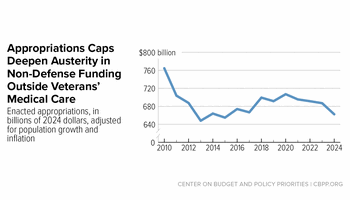
President Obama and Congress achieved $1.5 trillion in discretionary program cuts over the next ten years primarily by setting tight caps on annual discretionary funding in the Budget Control Act (BCA) of 2011.[1] Congress adhered to those caps in 2012 in writing its appropriations bills for that year, but has yet to enact final … -
Deficit-Reduction Package That Lacks Significant Revenues Would Shift Very Substantial Costs to States and Localities
Updated December 5, 2012
If it fails to include significant new revenues, a major legislative package to shrink federal deficits would almost certainly make deep cuts in federal funds that support states and localities as they perform many basic public functions, including educating children, building roads and bridges, protecting public health, and providing law … -
Statement of Robert Greenstein, President, in Response to Republican Budget Offer
December 4, 2012
House Republican leaders portray the deficit-reduction offer that they issued yesterday as a fair middle ground. It isn’t. On the crucial issue of revenues, the new Republican offer proposes $800 billion over ten years. Contrast that with the plan that Erskine Bowles, Alan Simpson, and some members of their commission issued in December 2010, … -
Deficit Reduction Deal Without Substantial New Revenues Would Almost Certainly Force Deep Cuts in Housing Assistance
November 26, 2012
The figures in Tables 1a and 1b showing the estimated effects of sequestration on housing assistance and community development programs have been updated and posted here: http://www.cbpp.org/cms/index.cfm?fa=view&id=3892 Any major legislation to reduce federal budget deficits that does not include substantial new revenues would almost certainly require … -
Congress Has Cut Discretionary Funding By $1.5 Trillion Over Ten Years
Revised November 8, 2012
Policymakers and budget experts generally agree on the need to reduce projected deficits and put the federal budget on a sustainable path. They have focused less attention, however, on the amount of deficit reduction that the 112th Congress and the President have enacted. Reductions in funding for discretionary (i.e., … -
Are Low-Income Programs Enlarging the Nation’s Long-Term Fiscal Problem?
Revised November 2, 2012
Several conservative analysts and some journalists lately have cited figures showing substantial growth in recent years in the cost of federal programs for low-income Americans. A recent report the Congressional Research Service prepared for Senator Jeff Sessions (R-AL) provides one such set of figures.[1] These figures can create … -
$2 Trillion in Deficit Savings Would Achieve Key Goal: Stabilizing the Debt Over the Next Decade
November 1, 2012
Some budget watchers are urging the President and Congress to enact $4 trillion in savings over the next ten years in order to address the deficit problem. The $4 trillion figure has assumed something of a life of its own. In fact, there is no single magic number. For example, policymakers could achieve the most essential … -
The Tension Between Reducing Tax Rates and Reducing Deficits
October 26, 2012
Over the past few months, a number of analyses have highlighted the difficulty of cutting income tax rates deeply, producing a significant revenue contribution to deficit reduction (as part of a larger deficit-reduction package), and maintaining the progressivity of the tax code.[1] Most recently, the Joint Committee on Taxation (JCT) … -
Video: Policy Basics: Where Do Our Federal Tax Dollars Go?
October 25, 2012
The Center's Tax Policy Analyst, Chye-Ching Huang, and Director of Federal Tax Policy, Chuck Marr, discuss where our federal tax dollars go. Topics include defense and international security assistance, Social Security, and health insurance and safety net programs. Chuck Marr, "Obviously, … -
Payroll Tax Cut and Emergency Unemployment Insurance Still Needed to Support the Recovery
October 16, 2012
Among the various tax and spending measures scheduled to expire at the end of this year, the temporary payroll tax cut enacted in 2010 and emergency federal unemployment insurance (UI) are among the most cost-effective at supporting the economic recovery without endangering efforts to control long-term deficits and debt. Given the state … -
Downturn and Legacy of Bush Policies Drive Large Current Deficits
Updated October 10, 2012
This analysis has been updated. To view the updated analysis, click here. Some lawmakers, pundits, and others continue to say that President George W. Bush’s policies did not drive the projected federal deficits of the coming decade — that, instead, it was the policies of President Obama and Congress in 2009 and 2010. But, the fact remains: … -
Moving “Dual Eligibles” Into Mandatory Managed Care and Capping Their Federal Funding Would Risk Significant Harm to Poor Seniors and People With Disabilities
October 10, 2012
As policymakers seek to reduce federal budget deficits, they may face proposals to reduce spending on low-income Medicare beneficiaries who also are eligible for Medicaid (the “dual eligibles”) by 1) requiring them to receive both their Medicare- and Medicaid-covered services through a single managed care plan that would operate … -
What Was Actually in Bowles-Simpson — And How Can We Compare it With Other Plans?
October 2, 2012
Many policymakers have said that they “support,” “endorse,” or otherwise look favorably on “Bowles-Simpson” — the budget plan that Erskine Bowles and Alan Simpson issued in December 2010 as co-chairs of President Obama’s National Commission on Fiscal Responsibility and Reform.[1] But … -
Misguided “Fiscal Cliff” Fears Pose Challenges to Productive Budget Negotiations
Updated September 24, 2012
The sooner policymakers enact legislation to put the budget on a sustainable long-term path without threatening the vulnerable economic recovery, the better. But, as they prepare for an almost certain post-election "lame duck" session of Congress, policymakers should not make budget decisions with long-term consequences based … -
Romney Budget Proposals Would Necessitate Very Large Cuts in Medicaid, Education, Health Research and Other Programs
Updated September 24, 2012
Governor Mitt Romney’s proposals to cap total federal spending at 20 percent of gross domestic product (GDP) and boost defense spending to 4 percent of GDP would require very large cuts in other programs, both entitlements and discretionary programs. This update of an earlier analysis is based on updated economic and budget … -
House Agriculture Committee Farm Bill Would Throw 2 to 3 Million People Off of SNAP
Updated September 5, 2012
On July 12th the House Agriculture Committee passed its 2012 farm bill, H.R. 6083, the Federal Agriculture Reform and Risk Management Act of 2012 (FARRM.) [1] The bill would cut the Supplemental Nutrition Assistance Program (SNAP, formerly known as the Food Stamp Program) by $16.5 billion over the next decade, eliminating food … -
Proposed “Tax Reform” Requirements Would Invite Higher Deficits and a Shift in Taxes to Low- and Moderate-Income Families
July 31, 2012
Republican legislation that was introduced in the Senate by Minority Leader Mitch McConnell (R-KY) and Finance Committee ranking member Orrin Hatch (R-UT) and in the House by Ways and Means Committee Chairman Dave Camp (R-MI) would establish requirements for tax-reform legislation that could generate higher deficits and substantially shift tax burdens … -
Renters’ Tax Credit Would Promote Equity and Advance Balanced Housing Policy
Revised July 25, 2012
Related files Report without appendices (31pp.) Appendix 1: Comparison of Capped and Uncapped Credits (3pp.) Appendix 2: Method Used to Estimate Cost and Impact of a Renters’ Credit (3pp.) Appendix 3: State Tables (6pp.) One-Page Fact Sheet Over the past several decades, the nation’s housing policy has focused predominantly on increasing homeownership. Most federal housing expenditures now benefit families with relatively little need for … -
History Shows Spending Cuts in Deficit-Reduction Packages “Stick”
June 27, 2012
Some opponents of including any revenue increases in a deficit-reduction deal — no matter how outweighed by spending cuts — argue that such cuts never “stick.” They claim — as Grover Norquist’s Americans for Tax Reform recently did — that “when bipartisan deals are struck promising to … -
Budget Plans Should Not Rely on "Dynamic Scoring"
Revised June 21, 2012
Some Members of Congress and outside groups are calling for the use of "dynamic scoring" to estimate the budgetary effects of major legislation, notably tax reform proposals. In February, for instance, the House passed a bill (H.R. 3582) requiring the Congressional Budget Office (CBO) and the Joint Committee on Taxation (JCT) … -
How Tax Reform Could Become a Trap:
June 8, 2012
Policymakers are increasingly discussing the need for tax reform, with a number of them calling for large cuts in tax rates — to levels well below the Bush tax rates — as a core element of reform. They contend that sweeping but unspecified cuts in tax expenditures (credits, deductions, and other tax preferences) will offset … -
Joint Tax Committee: Raising Threshold for Bush Tax Cuts from $250,000 to $1 Million Would Lose $366 Billion — Nearly Half the Revenue
May 30, 2012
House Minority Leader Nancy Pelosi's proposal to extend President Bush's income tax cuts for households making up to $1 million a year would lose nearly half of the revenue that President Obama's proposal to extend the tax cuts only for households making up to $250,000 would raise, according to new estimates from Congress' Joint Committee on … -
Statement by Robert Greenstein, President, on Speaker Boehner's Recent Remarks Concerning the Debt Limit
May 16, 2012
No one should underestimate the significance of House Speaker John Boehner's declaration yesterday that he will block an increase in the debt limit next winter unless policymakers match each dollar of debt limit increase with at least a dollar in budget cuts, with no revenue increases. This … -
Romney Budget Proposals Would Require Massive Cuts in Medicare, Medicaid, and Other Programs
Revised May 12, 2012
This report has been superseded by a new version, dated September 24, 2012, that reflects updated data and other information. Click to view the new analysis. Governor Mitt Romney’s proposals to cap total federal spending, boost defense spending, cut taxes, and balance the budget would require extraordinarily large cuts in other programs, both … -
House Budget Bills Would Target Programs for Lower-Income Families While Breaking Last Summer's Bipartisan Deal
Updated May 10, 2012
The House Budget Committee approved on May 7 a package of two bills that would alter the bipartisan deal between President Obama and congressional leaders that was reflected in last summer’s Budget Control Act (BCA). It would eliminate the “sequestration” (automatic cuts) in discretionary programs scheduled for 2013 as … -
Toomey Budget Similar to House-Passed Ryan Budget
May 9, 2012
The Senate may take up, as early as this week, a budget proposal from Senator Patrick J. Toomey (R-PA)[1] that is similar in most important respects to the budget resolution from House Budget Committee Chairman Paul Ryan (R-WI), which the House passed on March 29. [2] Like the Ryan budget, the Toomey plan (S. Con. Res. 37) would protect and extend tax cuts that … -
A Closer Look at Chairman Ryan's "Sequestration" Proposal
May 8, 2012
On May 7, the House Budget Committee approved a bill designed by Chairman Paul Ryan to alter three aspects of the debt-limit agreement that the President and congressional leaders reached last summer. The bill would produce a total funding level for discretionary programs in fiscal year 2013 that exactly matches the amount in the … -
Eliminating Social Services Block Grant Would Weaken Services for Vulnerable Children, Adults, and Disabled
May 3, 2012
To help generate the savings required by the House-approved budget, the House Ways and Means Committee voted on April 18 to eliminate the Social Services Block Grant (SSBG), a uniquely flexible funding source that helps states meet the specialized needs of their most vulnerable populations, primarily low- and moderate-income children and people who are … -
How the Across-the-Board Cuts in the Budget Control Act Will Work
Revised April 27, 2012
A successor piece to this paper is “The Pending Automatic Budget Cuts”, which was published on February 26, 2013, ahead of the March 1st sequestration. Note: OMB issued a report on September 14 that provides initial estimates and settles some legal issues with respect to the sequestration discussed in this analysis. We intend to update this … -
President's Budget Would Reduce Pell Grant Shortfall; Ryan Budget Would Nearly Triple It
April 26, 2012
Even though its costs are expected to remain flat over the next decade,[1] the Pell Grant program, which helps students from low-income families pay for college, faces an $8 billion funding gap in fiscal year 2014 and a $58 billion shortfall through 2022 because the way Congress has funded it in recent years has made its cost appear … -
Media Briefing: The Effect on the Economy of Raising Tax Rates on High-Income Households as Part of a Balanced Effort to Reduce Deficits - What the Evidence Shows
April 25, 2012
The Center on Budget and Policy Priorities held a conference call briefing on Wednesday, April 25 to discuss the Center’s new, comprehensive analysis of recent findings on the economic effects of raising federal income taxes on upper-income taxpayers.
The panel featured leading authorities on tax policy, Leonard E. Burman, Daniel Patrick Moynihan Professor of Public Affairs at Syracuse University, and William G. Gale, Co-Director of the Urban-Brookings Tax Policy Center, and Chye-Ching Huang, Tax Policy Analyst with the Center on Budget and Policy Priorities.
-
House Bill Would Cut Medicaid Funding for Puerto Rico by About $5.5 Billion Through 2019
April 25, 2012
The House Energy and Commerce Committee is scheduled to pass legislation on April 25 that would cut federal Medicaid funding for the Commonwealth of Puerto Rico by about $5.5 billion through 2019, relative to current law. The provision is part of legislation that House Republicans are assembling, and plan to bring to the House floor in … -
Recent Studies Find Raising Taxes on High-Income Households Would Not Harm the Economy
April 24, 2012
Many policymakers and pundits assume that raising federal income taxes on high-income households would have serious adverse consequences for the economy. Yet this belief, which has been subject to extensive research and analysis, does not fare well under scrutiny. As three leading tax economists recently concluded in a … -
Medicaid Maintenance-of-Effort Requirement Does Not Stop States from Fighting Fraud
Updated April 24, 2012
Affordable Care Act provisions requiring states to maintain their eligibility standards and procedures for Medicaid and the Children’s Health Insurance Program do not impede states’ efforts to ensure program integrity and reduce fraud, waste, and abuse, contrary to claims of House members who seek their repeal. Moreover, … -
Medicare Is Not “Bankrupt”
Updated April 24, 2012
Claims by some policymakers that the Medicare program is nearing “bankruptcy” are misleading. Although Medicare faces major financing challenges, the program is not on the verge of bankruptcy or ceasing to operate. Such charges represent misunderstanding (or misrepresentation) of Medicare’s finances. … -
Media Briefing: Understanding the Annual Reports of the Social Security and Medicare Trustees
April 23, 2012
The Center on Budget and Policy Priorities held a conference call briefing on Monday, April 23 at 4:00 pm (ET) to discuss the 2012 reports of the Social Security and Medicare Trustees.
Paul Van de Water, Senior Fellow at the Center and one of Washington’s leading experts on both Social Security and Medicare, and Robert Greenstein, President of CBPP discussed what the reports say about the long-term financial status of Social Security and Medicare.
-
Statement of Paul Van de Water, Senior Fellow, on the 2012 Medicare Trustees’ Report
April 23, 2012
The new report from Medicare’s trustees shows little change from last year’s report in the near-term outlook for the program, while indicating that the program continues to face significant financing challenges in the long run. The projected date of insolvency for Medicare’s … -
The False Choice of National Defense Versus Helping the Poor
April 20, 2012
House committees this week approved sharp cuts in the Supplemental Nutrition Assistance Program (SNAP, formerly known as food stamps), the elimination of the Social Services Block Grant, and other cuts that would harm large numbers of low- and moderate-income Americans.[1] Proponents claim the cuts are needed to generate enough savings … -
What if Chairman Ryan’s Medicaid Block Grant Had Taken Effect in 2001?
April 20, 2012
House Budget Committee Chairman Paul Ryan’s proposal to convert Medicaid to a block grant, which the House recently passed as part of Chairman Ryan’s overall budget plan, would have cut federal Medicaid funds to most states by more than 35 percent by 2010 — and to several of them by more than 50 percent — if it had been … -
Statement by Chad Stone, Chief Economist, on Pending House Tax Cut and House Committee SNAP Benefit Cuts
April 18, 2012
The House majority is pursuing legislation this week that makes no economic sense. The full House will pass a $46 billion tax cut that’s advertised as a “job-creating” measure, while the House Agriculture Committee approved a plan today to save $36 billion by cutting the … -
House Agriculture Committee Proposal Would Cut 2 Million Off Food Stamps, Reduce Benefits for More Than 44 Million Others
April 18, 2012
The House Agriculture Committee, which the House-approved budget requires to quickly produce $33 billion in savings over the next decade, approved a proposal today that would obtain the entire amount from cuts to the Supplemental Nutrition Assistance Program (SNAP), formerly known as food stamps.[1] The cuts — which would come … -
Letter: Improving the Strength and Solvency of Medicare
April 18, 2012
The Honorable Phil Gingrey, M.D. U.S. House of Representatives Washington, D.C. 202515 Dear Congressman: We are pleased to respond to the letter of March 22 from you and your colleagues asking our views on how to improve the “strength and solvency of Medicare.” We divide our response into three parts: some background … -
Ryan Budget Would Slash SNAP Funding by $134 Billion Over Ten Years
Updated April 18, 2012
House Budget Committee Chairman Paul Ryan’s budget plan includes cuts in SNAP (formerly known as the Food Stamp Program) of $133.5 billion — more than 17 percent — over the next ten years (2013-2022),[1] which would necessitate ending assistance for millions of low-income families, cutting benefits for millions of such … -
Testimony: Robert Greenstein Before the House Budget Committee Hearing on Strengthening the Safety Net
April 17, 2012
Thank you for the invitation to testify today. I am Bob Greenstein, President of the Center on Budget and Policy Priorities, a policy institute located here in Washington. I also served many years ago as Administrator of the Food and Nutrition Service at USDA, which operates the Supplemental Nutrition Assistance Program (SNAP, … -
New Tax Cuts in Ryan Budget Would Give Millionaires $265,000 on Top of Bush Tax Cuts
Revised April 12, 2012
Even as House Budget Committee Chairman Paul Ryan’s budget would impose trillions of dollars in spending cuts, at least 62 percent of which would come from low-income programs,[1] it would enact new tax cuts that would provide huge windfalls to households at the top of the income scale. New analysis by the Urban-Brookings Tax Policy Center (TPC) …