|
Updated September 8, 2008
USING TANF OR MOE FUNDS TO PROVIDE SUPPLEMENTAL ASSISTANCE TO LOW-INCOME WORKING FAMILIES
by Liz Schott
As states revisit their welfare reform approaches in the wake of the TANF changes in the Deficit
Reduction Act of 2005 (DRA), a number of states have implemented or are considering policies that expand support to low-income working families, particularly those transitioning into employment and off of basic TANF assistance programs. In most states, families lose eligibility for TANF cash assistance at income levels that are well below the poverty line (and almost no state has eligibility thresholds above the poverty line). Most employed TANF leavers have low wages and research over the last decade has documented that families that have left welfare for work continue to face hardships in making ends meet.[1]
Research also has shown that policies that “make work pay” by providing benefits to working families improve employment outcomes for families because they serve as an effective incentive for families to find and keep jobs. This research also has demonstrated that these policies can reduce poverty by providing income assistance on top of the earnings families receive when they go to work.[2]
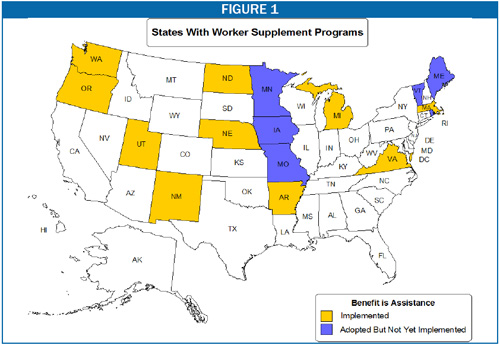
Since the passage of the DRA, at least one-third of states have authorized or implemented a new supplemental "assistance" benefit for TANF leavers, and in some states, for a broader group of low-income working families. At least ten states have already implemented these new worker supplement payments and a number of additional states have authorized but not yet implemented them. (See Map and Appendix.). These programs take a range of approaches to the amount of and duration of monthly benefits.
-
Some states provide modest monthly benefits; for example, Virginia and Washington State provide a monthly benefit of $50 per month. Others provide a richer monthly benefit; for example, North Dakota and New Mexico provide a benefit of $200 a month.
-
Some states provide benefits for a short period after a family leaves TANF for work; for example, Washington State. Michigan and North Dakota provide a six-month post-TANF transitional benefit. Others provide a longer post-TANF transitional benefit; for example, Arkansas provides benefits for up to 24 months and the not-yet-implemented Minnesota and Maine programs will provide benefits for up to 24 and 36 months respectively.
-
Several states provide a benefit to a broader group of low-income working families, specifically food stamp recipients with sufficient hours of employment. These worker supplement programs are not of limited duration and a family can qualify as long as they receive food stamps and are working. Massachusetts takes this approach; Vermont's not-yet-implemented program will as well.
Providing benefits to low-income working families helps those families make ends meet and increases work incentives. In addition, such programs can help states meet the TANF work requirements that they face under the DRA. Under the DRA — enacted in early 2006 — states must meet higher work participation rates than they were required to meet in the past and, because of changes in the law and the choices made by HHS in implementing regulations, achieving a high work participation rate will be more difficult than in the past. By providing a TANF or MOE-funded benefit that meets the definition of “assistance” under the TANF rules, a state can count these working families towards its work participation rate and boost the rate it achieves. Thus, the approach can help states meet federal requirements and assist in avoiding federal fiscal penalties, while also supporting low-income families as they transition into employment.
This paper provides guidance for states and policymakers considering a “worker supplement” program and reviews the choices made and lessons learned by states that have already implemented such a program for TANF leavers or a broader group of low-income working families. It also analyzes and considers the design decisions that a state faces in establishing and implementing such a program. Specifically, the paper discusses:
-
The benefits and services states can provide through such a program, including design issues such as how much will the benefit be, will it be a flat amount or vary based on other income or family characteristics, for how long will the benefit be provided, and the form in which the supplement payment will be provided;
-
The implications of financing such a program with either TANF versus MOE funds on TANF time limit and child support-related rules. (A number of states have used TANF funds in their worker supplement programs and thus trigger federal TANF time limit provisions and child support rules, including the state owing a share of child support collections to the federal government; other states have avoided these problems by using MOE funds in a separate state program.);
-
Issues relating to how the program is administered, including the enrollment process, ongoing eligibility maintenance, and verification of employment hours; and
 Click here for the PDF of full report (26pp.) Click here for the PDF of full report (26pp.)
End Notes:
[1] See, “Final Synthesis Report of Findings from ASPE ‘Leavers’ Grants,” by Greg Acs and Pamela Loprest, The Urban Institute, November 2001, http://aspe.hhs.gov/HSP/leavers99/synthesis02/index.htm.
[2] See, “Does Making Work Pay Still Pay? An Update on the Effects of Four Earnings Supplement Programs on Employment, Earnings, and Income” by Charles Michalopoulos, MDRC, August 2005. Executive summary at: http://www.mdrc.org/publications/414/execsum.html, full report at: http://www.mdrc.org/publications/414/full.pdf. |


